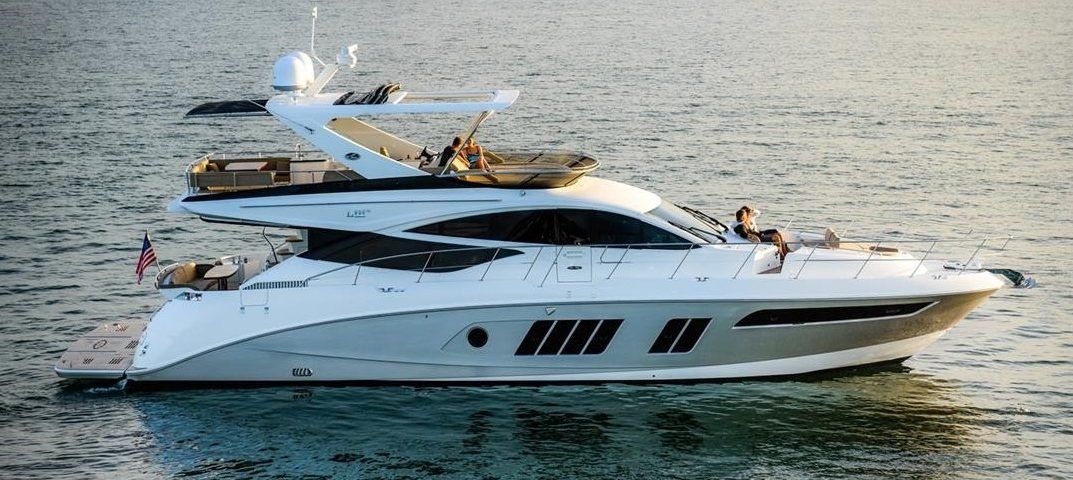
A smart used boat purchase doesn't start at the dock; it begins with solid research, a clear idea of what you need, and a budget that goes beyond the asking price. Much like buying a used RV, this initial homework is what separates a great buy from a costly mistake. It’s your best defense against buyer's remorse, arming you with the confidence and data to make the right call.
Starting Your Search from Shore
It’s easy to get swept up in the excitement of getting out on the water. But before you even schedule a viewing, the most important work happens right from your desk. This research phase makes sure you’re looking at the right kind of boat, in the right price range, right from the start.
The process is easier than ever, with over 80% of buyers now starting their search online. A 2025 Google Trends analysis even showed that searches for terms like 'used boat checklist' and 'boat market analysis' jumped by 42% in August 2025. This tells us that more buyers are doing their homework digitally before ever stepping foot on a boat.
Define Your Boating Lifestyle
First things first: forget about specific boats for a minute and think about what you'll actually do with one. An offshore fishing machine is a world away from a family-friendly pontoon or a nimble ski boat. An honest gut check here will prevent you from buying a beautiful boat that just doesn't fit your life.
Ask yourself a few key questions:
-
What’s the main mission? Fishing, cruising with the family, watersports, or long-distance adventures?
-
Who’s coming along? Think about how many people you'll typically have on board to figure out seating and space needs.
-
Where will I be boating? Calm lakes, big rivers, or coastal waters? The answer dictates everything from hull design to size and power.
Answering these questions helps you build a profile of your ideal boat, turning a vague idea into a specific shopping list.
Set a Realistic All-In Budget
The number on the listing is just the beginning. So many first-time buyers get blindsided by the ongoing costs of ownership. Whether it's a boat or an RV, a realistic budget accounts for the total cost, not just the purchase price.
A good rule of thumb is to budget about 10% of the boat's value for annual operating costs. This covers the essentials like insurance, maintenance, storage, fuel, and registration, giving you a much clearer picture of your real investment.
To make sure you're getting a fair deal from the get-go, it’s crucial to start with an understanding how boats are priced in today's market. Once you’ve got a handle on the potential costs, use online resources like NADAguides to check the real-world values for the models you're interested in. This simple step ensures you're looking at fairly priced listings from the very start.
Your Hands-On Inspection Guide
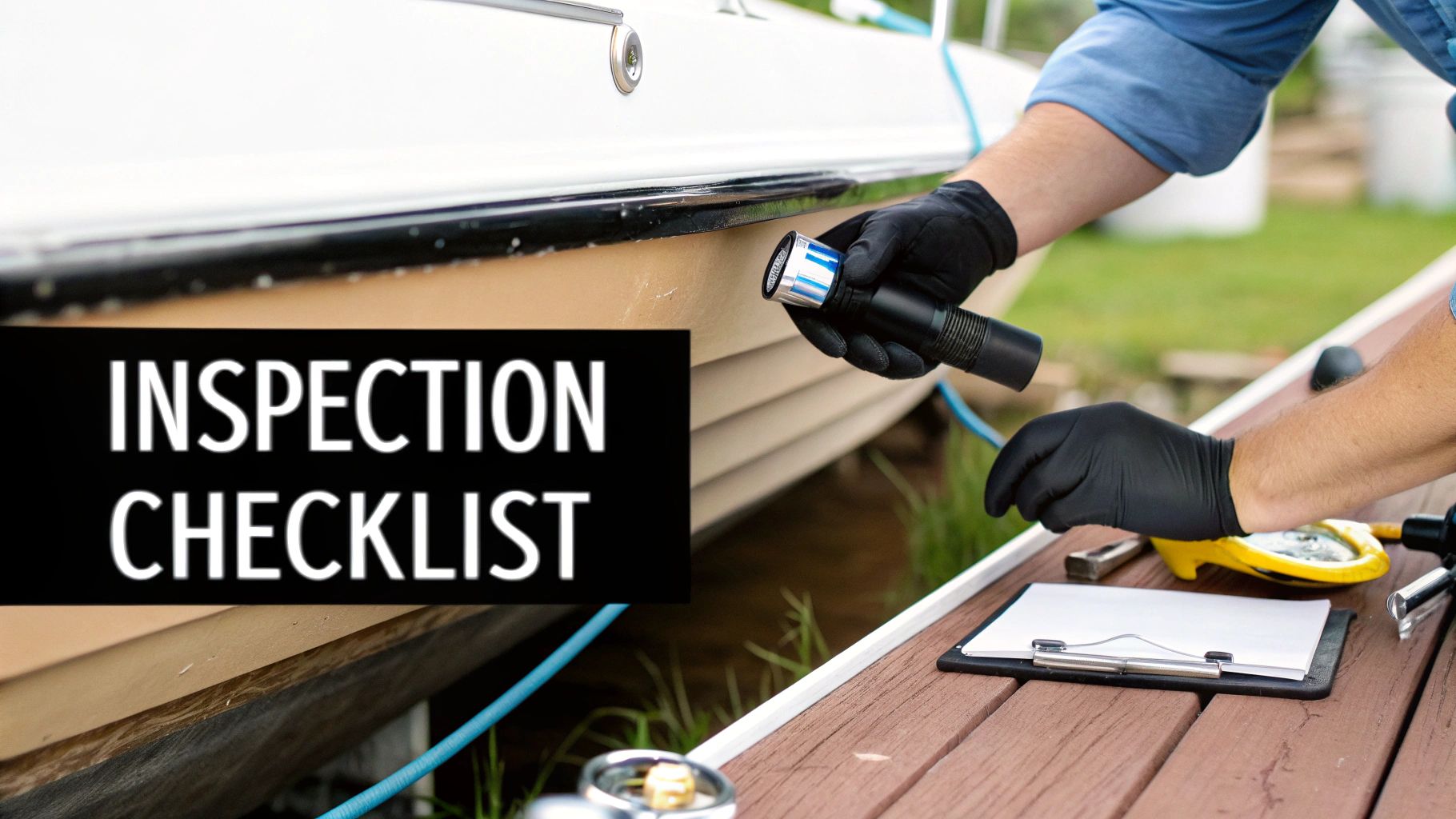
This is where the rubber meets the road—or in this case, where your research meets the fiberglass. An in-person inspection is your opportunity to look past the shiny online photos and uncover the boat's real story. You need to be methodical and thorough. Don't let a fresh coat of wax distract you from what's really going on underneath.
Think of yourself as a detective. Every issue you uncover, big or small, is a clue. Minor problems can become powerful bargaining chips during negotiation, while major structural issues are your signal to politely walk away and save yourself a world of headache.
Examining The Hull and Structure
Ideally, you'll start your inspection with the boat out of the water, sitting on a trailer or blocks. This gives you a clear, unobstructed view of the hull, keel, and all the running gear—things you simply can't see once it's afloat.
Get up close and personal. Run your hand along the hull; you're feeling for a smooth, fair surface. Your eyes and hands are looking for specific tell-tale signs:
-
Blisters: These bubble-like imperfections in the gelcoat can range from a minor cosmetic fix to a symptom of deeper moisture getting into the fiberglass laminate.
-
Stress Cracks: You'll often see these fine, spidery cracks radiating from high-stress points like cleats, winches, or window corners. A few are normal, but a web of them can point to serious structural fatigue.
-
Shoddy Repairs: Look for mismatched gelcoat colors, uneven surfaces, or sloppy fiberglass patches. These are dead giveaways of past damage that wasn't repaired by a professional.
Don't just look—listen. Tap along the hull with your knuckles or the plastic handle of a screwdriver. You want to hear a solid "thwack." If you get a dull, hollow thud, it could mean delamination, a serious condition where the fiberglass layers have separated.
Assessing The Deck and Cockpit
Time to hop aboard. The condition of the deck speaks volumes about the boat's overall upkeep. Walk every square inch of it, paying close attention to the feeling under your feet.
Any soft, spongy, or bouncy spots are a massive red flag. This almost always means water has found its way into the deck's core and rotted it from the inside out. Fixing a rotted deck is a huge, expensive job, so tread carefully.
Next, give all the hardware a good shake. Grab the railings, cleats, and stanchions and give them a firm tug. If anything wiggles or feels loose, it could mean the seal has failed and the backing plates are compromised.
Pro Tip: The smell test is your friend. Pop open every hatch, locker, and compartment. A musty, mildewy smell is the unmistakable signature of a persistent leak or poor ventilation. Don't ignore it.
Inspecting The Heart of The Boat The Engine
Now for the engine room. Even if you don't know a wrench from a ratchet, you can spot the most obvious signs of trouble. A clean bilge is a happy bilge, so start by looking for any signs of fluid leaks. Puddles or stains of oil, coolant, or hydraulic fluid are your first clues.
Take a good look at the belts and hoses. Belts should be tight and free of cracks or glazing. Squeeze the hoses—they should feel firm and pliable, not rock-hard, mushy, or brittle. Heavily corroded hose clamps are another sign of a damp, neglected environment.
The final and most critical check is the engine oil. Pull the dipstick. Clean oil is amber, used oil is black. What you don't want to see is oil that looks milky or frothy, like a coffee milkshake. This is a classic sign of water in the oil, which could mean a cracked block or a blown head gasket—a catastrophic, and costly, engine failure. This one simple check is a non-negotiable part of any buying a used boat checklist.
Quick-Reference Used Boat Inspection Checklist
When you're standing in front of a potential boat, it's easy to get overwhelmed and forget what to look for. Use this quick checklist during your initial walkthrough to keep yourself focused on the most critical areas and potential deal-breakers.
| Inspection Area |
Key Items to Check |
Common Red Flags |
| Hull (Out of Water) |
Gelcoat condition, fairness of the hull, keel, rudder, prop |
Blisters, extensive stress cracks, hollow sounds, bent prop/shaft |
| Deck & Cockpit |
Deck firmness, hardware security, hatches, canvas, upholstery |
Soft/spongy spots, loose stanchions, mildew smell in lockers, torn canvas |
| Engine & Bilge |
Oil condition, belt/hose integrity, fluid leaks, exhaust manifold |
Milky oil, cracked belts, rust streaks on manifold, standing water in bilge |
| Electrical System |
Battery condition, wiring neatness, all lights/pumps working |
Corroded terminals, "spaghetti" wiring, non-functional bilge pump |
| Cabin & Interior |
Signs of leaks, odors, appliance function, head operation |
Water stains on headliner, musty smells, non-working fridge/stove |
This isn't a substitute for a professional survey, but it will help you quickly identify boats that are worth a closer look and those that you should walk away from without a second thought.
The Indispensable Role of a Marine Surveyor
Even after you've done your own thorough walkthrough, it's time to call in the professionals. This is not a step to skip. Hiring a certified marine surveyor is arguably the single most important investment you can make during this entire process. Think of them as a home inspector for your potential boat—they have the training, specialized tools, and an unbiased eye to spot expensive problems you'd almost certainly miss.
https://www.youtube.com/embed/u0sZoxa9VbY
A good surveyor looks right past the fresh wax and clean cushions. They're trained to find the hidden issues. Using tools like moisture meters, they can detect water intrusion deep within the hull or deck core. Thermal imaging cameras can help them spot potential hot spots in the electrical system before they become a fire hazard. Their inspection is a deep dive into the boat's structural and mechanical soul, far beyond what you can see on the surface.
Understanding The Different Survey Types
Not all surveys are the same, and you need to order the right one for a purchase. The gold standard here is the Condition and Value (C&V) survey, which most people just call a pre-purchase survey. This is the one you want. It's the most comprehensive evaluation and it’s what any insurance company or lender will demand before they'll work with you.
A proper C&V survey is exhaustive and should cover:
-
Structural Integrity: A tap-test and visual inspection of the entire hull, deck, and superstructure. They’re looking for tell-tale signs of delamination, osmotic blisters, or shoddy previous repairs.
-
Systems Check: A hands-on test of every single system on board. This means flipping every switch, opening every valve, and checking the electrical, plumbing, fuel, and navigation electronics.
-
Engine Analysis: This includes a thorough visual inspection of the engine and its components. While they’ll run the engine during the sea trial, many buyers (myself included) recommend hiring a separate, certified engine surveyor for a more detailed analysis, including oil samples.
-
Sea Trial: The surveyor will join you on the water to see how the boat actually performs. They’re observing everything from handling characteristics and strange vibrations to how the systems function under a real-world load.
The final survey report isn’t just a laundry list of what’s wrong. It’s a powerful document that provides a current market valuation for the boat and a list of findings, usually split into essential repairs and long-term recommendations. This report becomes your single best negotiation tool.
Using The Survey For Negotiation
This is where the surveyor really earns their fee. The professional report takes all the emotion and guesswork out of the negotiation. Instead of saying, "I think there might be a problem," you have a documented, expert opinion.
If the surveyor finds that all the seacocks are corroded and need immediate replacement, or that there are soft spots on the foredeck, you now have leverage. You can go back to the seller with a detailed estimate for the repairs and negotiate a price reduction, or you can make the sale contingent on the seller fixing the issues before you close.
A survey is a non-negotiable part of any serious buying a used boat checklist. In fact, some industry data suggests that nearly 70% of buyers who forgo a survey end up with significant, unexpected repair bills in their first year of ownership.
Here in North America, expect to pay around $15 to $25 per foot of boat length for a quality survey. When you consider the thousands of dollars in repairs it could save you, it’s a tiny price to pay for peace of mind. For more on market trends, you can check out Boats Group's latest report on boat sales.
Ultimately, a survey gives you the hard facts you need to either make a fair deal with confidence or walk away from a floating money pit.
Conducting a Meaningful Sea Trial
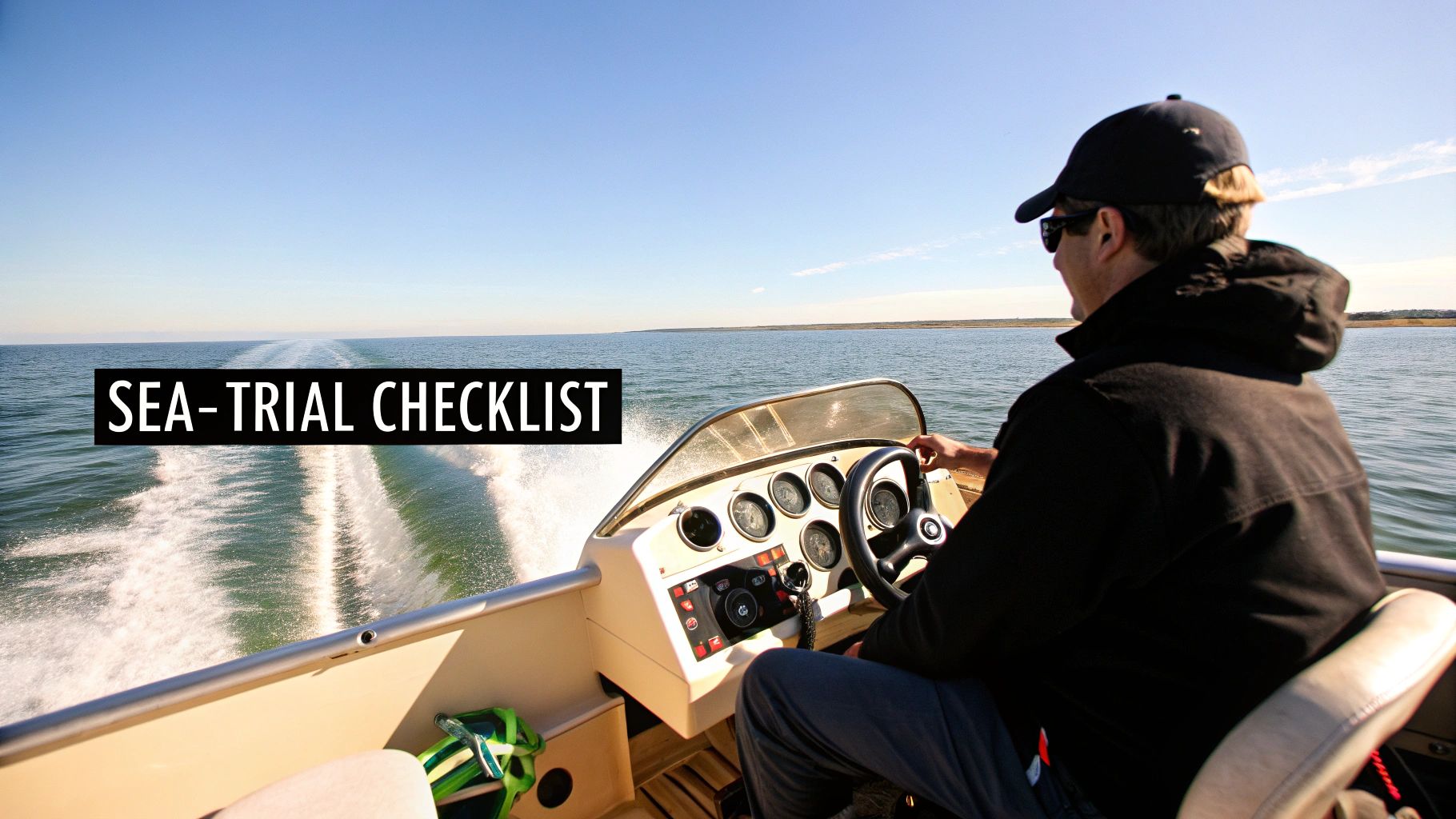
A boat can look absolutely flawless sitting on a trailer, but its true personality—and its problems—only emerge on the water. The sea trial is where you get to see past the shiny gelcoat and feel how the vessel actually behaves in its element.
Don't treat this like a casual joyride. This is a critical diagnostic test and a non-negotiable step in any buying a used boat checklist.
Your mission is to mimic how you’ll actually use the boat. If you’re an angler, see how it drifts with the engine off. If wakeboarding is in your future, you need to feel how it handles aggressive turns and pops out of the hole. A quick spin around the calm waters of the marina just won't cut it. You need enough time to really put the boat through its paces.
From Idle To Full Throttle
The engine is the heart of any boat, and the sea trial is its ultimate stress test. You're not just checking if it runs; you're evaluating its performance across the entire RPM range.
Ideally, you want to start the engine cold. A cold start can reveal issues like hard starting or rough idling that might disappear once everything is warmed up. When you turn the key, listen for any sputtering or strange noises. Once it’s running, let it idle for a bit and watch the gauges like a hawk. Is the temperature climbing steadily? Is the oil pressure right where the manufacturer says it should be?
As you ease out of the no-wake zone, pay close attention to how the boat gets on plane. It should be a smooth transition, without a cloud of excessive smoke or any feeling of the engine bogging down. Once you hit open water, it's time to open it up. Push the throttle all the way forward to Wide Open Throttle (WOT). The engine needs to reach its recommended maximum RPM range without shaking violently or overheating.
Listen Carefully: Your ears are one of the most valuable tools you have on a sea trial. Any unusual knocking, grinding, or high-pitched whining from the engine bay is a major red flag. Those are the kinds of sounds that often point to serious mechanical issues that demand immediate professional attention.
Testing Systems Under Load
Many of a boat’s systems can only be properly tested while underway. The vibration and motion of the boat cutting through the water can expose issues you'd never find at the dock. This is your chance to flip every switch and push every button.
Here’s a quick hit-list of systems to check while you’re moving:
-
Steering: Crank the wheel hard over, both to port and starboard, at various speeds. The steering should feel tight and responsive, not loose, sloppy, or excessively stiff.
-
Trim Tabs: If the boat has them, run the tabs all the way up and down. They should operate smoothly and have a noticeable effect on leveling the boat's ride.
-
Electronics: Make sure the GPS acquires a satellite lock quickly and the depth sounder gives you a believable reading. Turn on the VHF radio and check for a clear signal.
-
Bilge Pumps: This is a crucial one. Bring a bucket of water, pour it into the bilge, and make sure the automatic float switch actually kicks the pump on. Don't forget to test the manual switch at the helm, too.
Discovering a busted trim tab or a dead bilge pump during the sea trial is a fantastic bargaining chip. Finding out about it a week after you've handed over the cash is a frustrating, and often expensive, headache. A proper test run gives you the clarity to either buy with confidence or walk away.
From Paperwork to Keys in Hand: Closing the Deal
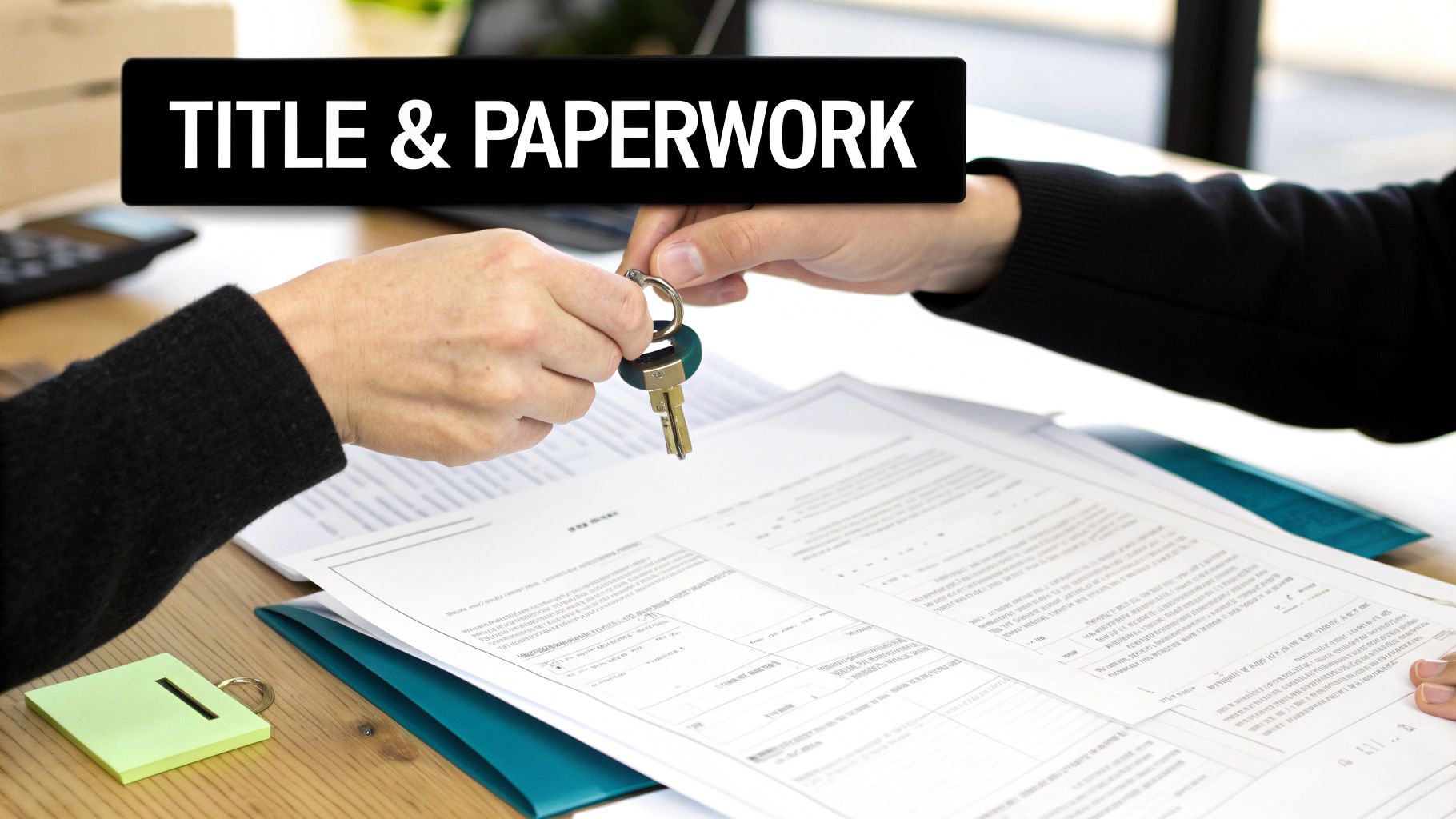
Alright, you've crawled through the bilges, run the engine, and the sea trial went off without a hitch. Now it's time for the home stretch. This is where you trade your inspection tools for a pen, shifting focus from the boat's physical condition to its paper trail.
Getting this part right is just as important as spotting a soft spot on the deck. The goal here is simple: make sure the boat's history is clean and land on a price that truly reflects its condition.
First thing’s first: check the Hull Identification Number (HIN). This is the boat's unique fingerprint, a 12-character ID usually stamped on the upper right side of the transom. Pull out the boat's title and registration and make sure the HIN on the paper matches the HIN on the boat. Perfectly. If they don't line up, pump the brakes immediately. A mismatch is a massive red flag.
The Paper Chase: Ownership and Service Records
With the HIN confirmed, you need to be certain the person selling the boat actually has the right to do so. Ask to see the title, and make sure their name is on it, free and clear. A critical part of any good buying a used boat checklist is running a lien search. You can do this through the relevant state agency (or the Coast Guard for federally documented vessels) to ensure no bank has a claim on your future boat.
Now, let's talk history. A meticulous owner will have a fat folder of maintenance records, and that’s pure gold for a buyer. These documents tell the real story of the boat’s life. A 2025 industry report highlighted that boats with thorough service logs can be worth up to 20% more than those with a spotty past. You can dive into the full marine market report to see just how much good paperwork adds to a boat's value.
Talking Turkey: How to Negotiate a Fair Price
Remember that professional survey you paid for? It’s about to become your best friend. This report isn't just an opinion; it's a factual, third-party assessment of the boat’s condition, and it's your most powerful negotiation tool.
Here's how to put it to work:
-
Tackle the big stuff first. If the survey uncovered critical safety issues or major mechanical problems—think a leaky seacock or evidence of core rot—get quotes for the repairs. Present these estimates to the seller and ask for a price reduction that covers the cost.
-
Don't sweat the small stuff (too much). For minor cosmetic flaws like faded upholstery or a cracked gauge, you can bundle them together. These points give you leverage to ask for a smaller price adjustment, especially if the seller is firm on the bigger ticket items.
A good negotiation isn't about winning an argument; it's about reaching a fair agreement. Approach the conversation with respect, laying out the facts from the survey calmly and clearly. When both you and the seller walk away feeling like the deal was fair, you’ve done it right.
Making It Official with a Purchase Agreement
Once you’ve shaken hands on a price, get it all down in writing. A formal Purchase and Sale Agreement is non-negotiable—it’s a legally binding contract that protects everyone involved.
Your agreement should spell everything out, leaving no room for confusion. Make sure it includes:
-
The full names and contact details for both you and the seller.
-
A complete description of the boat: year, make, model, HIN, and any registration numbers.
-
The final, agreed-upon sale price.
-
An itemized list of what's included in the sale (think electronics, safety gear, trailer, etc.).
-
A clause stating the boat is sold "as-is, where-is," which is standard practice in private boat sales.
With a signed agreement in hand, you’re ready to transfer the funds, get that title signed over, and finally, grab the keys. Congratulations, you're officially a boat owner.
Got Questions? Let's Talk About What Really Matters
Even with the perfect checklist, you're bound to have some nagging questions. It’s completely normal. Getting solid answers to these common sticking points is often the last step before you feel truly confident pulling the trigger. Let's dig into a few of the big ones I hear all the time.
How Many Hours Are "Too Many" on an Engine?
This is easily the most-asked question, and the honest answer is... it's not about the number. Maintenance history is far more important than the hour meter. I'd take a high-hour engine with a thick stack of service records over a low-hour mystery motor any day of the week.
Still, you need a ballpark, right? Here’s a rough guide to give you some context:
-
Gasoline Inboard/Outboard: Anything under 500 hours is great. Between 500-1000 is pretty standard, and once you start creeping over 1500 hours, you need to be paying very close attention.
-
Diesel Engines: These are a different beast entirely. Diesels are built to work. A well-maintained diesel can hum along happily for 5,000 hours or more before needing serious attention.
The real takeaway? A fat folder of receipts from a reputable mechanic is your best friend. An engine with suspiciously low hours and zero paperwork is a major red flag.
When Is the Best Time of Year to Buy a Boat?
If you want the best possible deal, you need to think like a seller. When are they most motivated?
The answer is simple: shop during the off-season, in the fall and winter. Owners are looking at a long, cold season ahead and are often desperate to avoid paying for winter storage, shrink-wrapping, and maintenance on a boat they aren't using. That's your moment.
Come spring and summer, everyone's got boat fever. It's a seller's market, with more buyers competing for the same boats, which means prices are firm. Shopping in the fall not only gives you serious negotiating leverage but also plenty of time to get any necessary work done before next season's launch.
Don’t forget the hidden costs. The purchase price is just the beginning. A good rule of thumb is to budget around 10% of the boat's value for annual expenses like insurance, moorage or storage, fuel, and upkeep. Then there are taxes, registration, and crucial safety gear. For a thorough rundown on equipping your vessel properly, check out the ultimate boat safety checklist for NZ waters.
Should You Buy from a Private Seller or a Dealer?
While private sellers can sometimes offer lower prices, buying through a certified dealer delivers unmatched peace of mind. Our pre-owned inventory is professionally inspected, serviced, and safety-checked before it ever reaches the lot.
Dealers also make ownership simple: financing options, trade-ins, warranties, and title work are all handled in one place. You drive away knowing your investment is protected and backed by a trusted service team.
Private sellers may tell a good story but with a dealership, you gain a partner who stands behind every sale and every mile ahead.
At SearchShop.com, our goal is to bring clarity and confidence to your search for recreational vehicles. Dive into our tools to track pricing history, compare thousands of listings for boats and RVs, and zero in on the perfect vehicle for your next adventure. https://www.searchshop.com