Getting a fantastic deal on a big purchase like an RV or a boat really comes down to two things: when you buy it and what it's actually worth. For these kinds of specialty vehicles, you have to look past the flashy sticker price to see the whole financial picture. The smartest buyers I know are the ones who walk in with a solid game plan for research, comparison, and negotiation.
Your Guide to Finding the Best RV and Boat Deals
Landing a great deal on a motorhome or a boat isn't quite like buying a daily driver. You need specific tactics for the recreational world. We're not just talking about shaving off a few hundred bucks here; this is about making a major investment that needs to fit your lifestyle for years.
This guide will walk you through proven buying strategies tailored specifically for the RV and boat markets. I'll show you how things like market timing, understanding different models, and lining up your financing beforehand can save you thousands. It’s time to move past the high-pressure sales pitches and confusing math.
The Foundation of a Great Deal
Think of this as your pre-game prep. The path to an incredible deal starts way before you ever set foot on a dealership lot or message a private seller. It all begins with a little homework and understanding what gives you the upper hand.
These are the non-negotiables:
Buy in the off-season. This is huge. RV and boat prices are all about supply and demand. Snagging a boat deal in late fall or shopping for an RV in the dead of winter is one of the easiest ways to find motivated sellers and lower prices.
Know the model landscape. A killer price on a massive 40-foot Class A motorhome doesn't mean a thing if a nimble travel trailer is what you actually need. Get familiar with the pros and cons of each type before you start shopping.
Get pre-approved for financing. This is my favorite tip. Walking into a negotiation with a loan already secured from your bank or credit union effectively makes you a cash buyer. It gives you incredible leverage.
A truly great deal is never just about the lowest price. It’s the right vehicle for you, at the right price, with financing that doesn't break the bank. It's about long-term value and enjoyment, not just a short-term win.
Before you start your search, it helps to have a quick reference for the most important factors.
Key Deal-Finding Factors for RVs and Boats
Here’s a quick summary of what you need to focus on from the very beginning. Getting these right will set you up for success.
Factor
Why It Matters for RVs & Boats
Potential Savings
Seasonality
Demand plummets in the off-season (fall/winter), forcing sellers to offer deep discounts to move inventory.
10-25% or more off peak-season prices.
Vehicle Condition
Water damage in RVs or hull issues on boats can be deal-breakers. A thorough inspection is non-negotiable.
Avoids thousands in unexpected repair costs.
True Market Value
Knowing what similar models actually sell for in your area gives you a powerful negotiation baseline.
Prevents overpaying by $5,000-$15,000+.
Pre-Approved Loan
It separates the financing discussion from the price negotiation, giving you more control.
Secures a lower interest rate, saving $1,000s over the loan term.
Keeping these elements in mind will help you stay focused on what really moves the needle when it comes to getting a fair price.
Shifting Your Mindset
The single biggest trap shoppers fall into is obsessing over the monthly payment. Dealerships love this because they can stretch out a loan term to make a wildly expensive vehicle seem affordable.
Don't fall for it. Instead, your entire focus should be on one number: the total "out-the-door" price. This is the final figure that includes the vehicle price, all taxes, title fees, and any other "doc fees" they try to tack on.
When you negotiate based on that single number, you stay in control. This guide will give you the tools and confidence you need—from timing your purchase just right to locking in the best possible loan—so you can drive (or sail) away knowing you got a genuinely great deal. Let's get into how you can turn these ideas into real savings.
How to Time Your Purchase for the Best Possible Deal
When you're hunting for a big-ticket item like an RV or a boat, timing is everything. The recreational vehicle market plays by its own set of rules—a highly seasonal calendar. If you can learn to read that calendar, you'll have a massive advantage.
Think of it like buying produce. You know strawberries will cost a fortune in December, right? The same logic applies here. The sunnier, warmer months are peak season for RVs and boats, and you can bet the prices reflect that sky-high demand.
The trick is to zig when everyone else zags. By deliberately planning your purchase for the off-season, you can unlock serious savings that just aren't on the table when the weather is perfect for camping or getting out on the water. This isn’t about luck; it's about being patient and smart.
The Power of Off-Season Shopping
The biggest price hikes for RVs and boats hit in the spring and early summer. It makes sense—families are gearing up for vacations, the weather is turning beautiful, and dealerships are swamped with eager buyers. With that kind of demand, sellers have very little reason to negotiate.
But once late fall and winter roll around, the entire dynamic flips on its head. Suddenly, dealerships are staring at a yard full of expensive inventory that isn't moving. They have to clear out last year's models to make room for the new ones, and that pressure creates a golden opportunity for you.
This is your moment to find the most motivated sellers. A dealer who’s facing the cost of insuring and storing a boat all winter is going to be far more open to a good deal in October than they were back in May.
Your goal is simple: shop when demand is at its absolute lowest and inventory is at its highest. This one shift in timing can slash the price by 10-25% compared to buying in peak season.
This idea of following seasonal trends isn't unique to RVs. Many large purchases follow similar cycles. The really great deals surface in the fall as dealers scramble to clear their lots for next year's models. In fact, data shows that buyers who wait for these end-of-year incentives can save an average of 10-15% on new vehicles. Timing is a critical piece of the puzzle, and you can explore more about these global market trends to see just how much they impact pricing.
Pinpointing Your Prime Buying Window
Even within the broader "off-season," you can get even more tactical by targeting specific moments when your negotiating power is at its absolute peak. These are the times when dealerships and their salespeople are under the most pressure to hit their numbers.
Here are the key moments to circle on your calendar:
End of the Month: Salespeople almost always have monthly quotas to hit. If you show up in the last few days of the month and they're behind on their goals, they might push for a deal they wouldn't have even considered a week earlier.
End of the Quarter: This is the end-of-month pressure on steroids. Dealerships have quarterly sales targets set by the manufacturers, and hitting them often unlocks huge bonuses. The final weeks of March, June, September, and December can be a goldmine.
Model Year-End: This usually happens in the fall, and it’s when dealers get desperate to move the current year's models. Finding a brand-new, leftover model from the previous year is one of the best deals in the business—you get all the new-vehicle perks at a used-vehicle discount.
Imagine it's October 2024, and a dealer still has two 2024 model year Class C motorhomes sitting on their lot. The 2025 models are already arriving. They are paying interest on that old inventory every single day. This is your chance to come in with a reasonable, but aggressive, offer.
Leveraging RV and Boat Shows
While off-season shopping is my go-to strategy, there's another event that can serve up incredible deals: the major RV and boat shows. These events cram manufacturers and multiple dealers under one roof, which naturally creates a super-competitive atmosphere.
Dealers go to these shows to sell, and they often bring special "show pricing" you won't see advertised on their regular lots. There are a few good reasons for this.
Direct Manufacturer Incentives: Manufacturers will often kick in extra rebates or special financing offers that are only valid during the show.
A High-Volume Mindset: At a show, the goal is to write as many orders as possible. They might make a smaller margin on each sale, but they make up for it in sheer volume.
Clearing Out Old Stock: A boat show is the perfect place for a dealer to finally unload any lingering previous-year models they still have taking up space.
Shop RVs For Sale
Browse current rvs from dealers near you — updated daily.
The key to making a show work for you is to do your homework before you go. Know exactly which models you're interested in and what they're currently selling for at local dealerships. That way, you’ll know instantly if a "show special" is a genuine deal or just marketing hype.
By mastering these timing strategies, you completely shift the power dynamic in your favor. It's the surest way to get the best possible deal on the RV or boat you've been dreaming of.
Choosing the Right Model for the Best Value
Let's be honest: securing a fantastic price on the wrong vehicle isn't a win. It's a mistake you'll regret later. The real secret to finding the best deals, especially when you're shopping for something as specialized as an RV or a boat, is making sure the model actually fits your lifestyle and budget. A great price is useless if you end up with a vehicle that's too big, too small, or a money pit to maintain.
This is where you find true value. It's not just about the sticker price; it's about the total cost of ownership and how well that RV or boat serves you for years to come. So, let’s dig into the different models to help you find that perfect match.
Comparing RV Models for Your Lifestyle
The world of RVs is huge, with each class designed for a completely different kind of adventure. Getting a handle on the pros, cons, and typical price points is your first step toward making a smart investment. A big part of getting a great deal is knowing when something is priced below its actual worth, a skill similar to learning how to identify undervalued assets in other markets.
Class A Motorhomes: Think of these as the luxury buses of the RV world. They offer incredible space and all the comforts of home, but they also have the highest price tag, guzzle fuel, and can be a real bear to drive and park.
Class C Motorhomes: A popular middle-of-the-road choice, these are built on a truck chassis and have that classic over-cab sleeping area. They strike a great balance between space and drivability, which makes them a fantastic, versatile option for families.
Class B Motorhomes (Camper Vans): These are the smallest and most nimble motorhomes out there. While they are compact, they're a breeze to drive, can park almost anywhere, and get the best gas mileage. The tradeoff? Limited living space.
Travel Trailers & Fifth Wheels: As towable options, these offer the most variety in both size and price. You'll need a capable tow vehicle, but you gain the flexibility of unhitching your truck for local trips once you've set up camp.
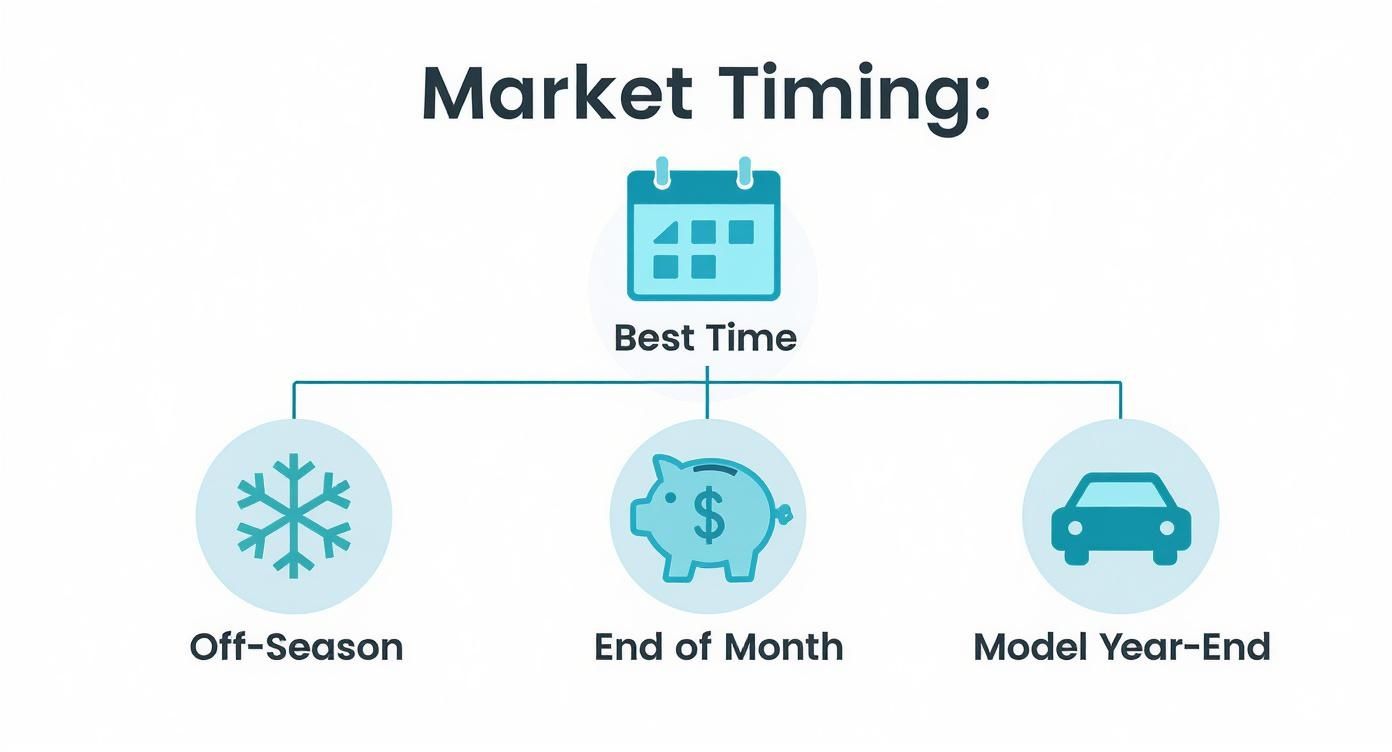
This infographic gives you a great visual breakdown of the best times to buy—a critical piece of the puzzle once you've zeroed in on the right model.
As you can see, timing your purchase for the off-season, the end of the month, or when new model years are rolling in can seriously boost your savings.
Navigating Boat Types for Water Adventures
Just like with RVs, the "best" boat is the one that fits what you actually plan to do on the water. It’s easy to get lured in by a low price on a sleek, high-speed cruiser, but that’s a poor choice if you just want to fish on a quiet lake.
Pontoon Boats: Often called the "party barges" of the water, pontoons are built for leisurely cruises with big groups. They're incredibly stable, comfortable, and perfect for relaxing, swimming, or some light fishing.
Fishing Boats: This is a wide-ranging category, but these boats are all designed with features like livewells, rod holders, and casting platforms. Their hulls are often built for specific water conditions, from glassy lakes to choppy coastal seas.
Cruisers (Cabin Cruisers): Built for longer trips and overnight stays, these boats have a cabin with sleeping quarters and a small kitchen. They offer a ton more comfort and protection from the weather, but that comes with higher purchase and maintenance costs.
Powertrain Choices and Long-Term Value
The engine is the heart of your new toy, and this choice has financial ripples that last for years. For example, a diesel pusher RV costs more upfront than a gas model, but it usually offers better fuel economy, more torque for climbing hills, and a longer engine lifespan—all of which boost its resale value down the road.
It's a similar story in the boating world. An outboard motor is generally easier and cheaper to maintain and replace than an inboard motor. However, inboards often provide better weight distribution and leave the back of the boat clear for a swim platform.
While the recreational vehicle market is unique, it's influenced by broader trends. The global shift toward electrification in the automotive sector has increased competition, often leading to more aggressive pricing on traditional gasoline and diesel models. This can create excellent buying opportunities for savvy shoppers.
Ultimately, your decision should balance that initial price tag with the long-term costs of fuel, maintenance, and what you can expect to get back when you eventually sell it.
Tapping into Regional Markets to Uncover Hidden Deals
When it comes to buying an RV or a boat, where you buy can be just as crucial as when you buy. It’s easy to fall into the trap of only looking at local dealerships, but frankly, that’s a rookie mistake that could cost you a small fortune. The real secret pros use is expanding their search beyond their zip code to hunt for incredible deals in different parts of a country.
This one strategy blows your options wide open and immediately puts you in a position of power. It all comes down to a simple truth: pricing isn’t the same everywhere. Local supply and demand, climate, and even the number of competing dealerships in an area create massive price variations.
Why Do Prices Vary So Much From Place to Place?
Let's get practical for a second. Imagine a boat dealership in Minnesota, where the boating season is short and sweet. As soon as the leaves start to turn, that dealer gets antsy. They're facing the real cost of storing massive inventory all winter. This makes them incredibly motivated to cut a deal with a buyer who’s willing to travel. Compare that to a dealer in sunny Florida, and you see the opportunity.
The same logic applies to RVs. Head over to an area like Elkhart, Indiana—the undisputed "RV Capital of the World"—and you'll find dealerships practically on top of each other. That fierce competition often translates into much lower prices as they all fight for your business. The trick is to spot these market imbalances and make them work for you.
The most powerful tool you have when hunting for a deal is information. By expanding your search radius, you're not just finding more vehicles; you're collecting more pricing data. That's how you learn what a genuinely great deal actually looks like.
These aren't just local quirks, either. They're tied to bigger economic trends. For instance, global light-vehicle sales are expected to inch up by only 1% in 2025, with some markets like the US and Europe actually seeing declines. In the first half of 2025, China saw registrations jump 12% thanks to some aggressive incentives, which created a buyer's paradise with deep discounts. At the same time, the EU market dropped by 1.9%, forcing dealers to get creative with their pricing to move inventory. You can see how these dynamics play out in the 2025 global automotive outlook and understand how it impacts your purchase.
Your Game Plan for Researching Out-of-State Deals
Finding these regional bargains isn't as hard as it sounds. The hunt begins online, where you can use nationwide marketplaces to compare prices across state lines without leaving your couch.
Here’s how to get started:
Go Broad with Big Marketplaces: Jump on sites like RV Trader, Boat Trader, or even Facebook Marketplace. Set your search radius to "nationwide" or target specific states. This gives you a quick, high-level view of the pricing landscape.
Target Hot Spots (or Cold Spots): Start thinking strategically. For RVs, that might mean looking near manufacturing hubs. For boats, check out states with short seasons or coastal areas packed with sellers.
Go Straight to the Source: Once you've zeroed in on a promising region, start digging into the websites of individual dealerships there. They often have special promotions or inventory that hasn't been posted on the major listing sites yet.
Don't Forget to Calculate the True Cost
Now, hold on. A lower sticker price in another state doesn't automatically mean you've hit the jackpot. You have to run the numbers on logistics and extra costs to see if the savings are real.
Before you get too excited, make sure you account for these expenses:
Transportation: Are you going to fly out and drive it back yourself? Or will you need to hire a professional delivery service? Get firm quotes for both.
Travel: If you're inspecting it in person (which you should), factor in flights, a hotel for a night or two, and meals.
Taxes and Registration: This is the big one people forget. You’ll almost always pay sales tax in the state where you register the vehicle, not where you buy it. Do your homework on your home state's regulations to avoid a painful surprise.
Inspection:Never, ever buy a vehicle sight-unseen. Budget for a professional, third-party inspection in the seller's city. It’s the best money you’ll ever spend to make sure you aren't buying someone else's headache.
Once you have these figures, the math is simple: Sticker Price Savings - Total Extra Costs = Your Real Savings. If that number is still big enough to make you smile, you’ve probably found a hidden gem worth chasing.
Negotiating Your Price and Securing Smart Financing
You’ve done the legwork—you timed the market, pinpointed the perfect model, and even widened your search radius to find it. Now for the part that trips most people up: the negotiation.
It doesn't have to be a stressful showdown. Think of it less like a battle and more like a simple business transaction. The research you've already done is your best tool. Armed with real market data, you can confidently steer the conversation toward a price that’s fair for everyone. This is where all your efforts pay off in real savings.
Making the Offer and Staying in Control
Walking into a negotiation unprepared is a surefire way to leave money on the table. The goal is to be polite, prepared, and firm. Your confidence comes from knowing what the vehicle is actually worth and having a walk-away price set in your mind before you even start talking.
So many buyers get trapped by focusing only on the monthly payment. Dealerships know this and will often stretch out the loan term to make an expensive RV or boat seem more affordable, which only costs you thousands more in the long run.
Don't fall for it. Focus on one number and one number only: the total "out-the-door" price. This is the all-in cost, including the vehicle price, taxes, title, and any other administrative or doc fees. When you negotiate this single number, there's nowhere for hidden costs to hide.
By zeroing in on the total price, you take away the dealer's ability to play shell games with the numbers. You’re not just agreeing to a monthly payment; you’re buying the vehicle for a specific, transparent price.
Treat Your Trade-In as a Separate Deal
If you’re trading in your current vehicle, you have to treat it as a completely separate deal. This is critical. Lumping the two negotiations together is a classic dealer tactic that can cost you dearly. They might give you an amazing price on the new RV, only to lowball your trade-in, effectively erasing any savings.
Here’s how to handle it like a pro:
Know Your Value First: Before you set foot in a dealership, get a clear idea of your trade-in's worth. Use resources like Kelley Blue Book or even get cash offers from places like CarMax to establish a solid baseline.
Negotiate the New Vehicle: Finalize the out-the-door price on the new RV or boat first, as if you have no trade-in at all. Get that number locked in.
Bring Up the Trade-In: Only after you’ve agreed on the purchase price should you mention your trade. A simple, "Great, we have a deal. Now, what can you offer me for my trade-in?" puts you in a much stronger position.
This approach forces them to give you a fair, transparent offer on your trade, protecting the deal you just worked so hard to get.
Get Your Financing Lined Up Before You Shop
This might be the single most powerful move you can make. Walking into the dealership with a pre-approved loan from your own bank or credit union changes the entire dynamic. For all intents and purposes, you're now a cash buyer.
You’re no longer dependent on the dealer's financing department, which is a major profit center for them—often through marked-up interest rates. With your own financing ready to go, the leverage shifts entirely to your side of the table.
This is a true game-changer:
You Set the Budget: Pre-approval gives you a hard ceiling on what you can spend, which is the best defense against making an emotional decision.
You Have a Rate to Beat: You can tell the finance manager, "Here's the rate my credit union gave me. Can you beat it?" If they can, you save even more. If not, you've still got a great rate waiting for you.
It Makes Negotiating Simpler: With financing off the table, you can concentrate all your energy on getting the best possible price for the vehicle itself.
Getting pre-approved is usually a quick online application. Taking this one simple step splits the purchase into two manageable parts—price and financing—and gives you a massive advantage when it's time to find the best deal.
Common Questions About Finding RV and Boat Deals
Even with a solid game plan, you're bound to have questions when buying something as significant as a recreational vehicle. Let's tackle some of the most common questions that pop up, so you can navigate the final steps with total confidence.
Is It Cheaper to Buy a New or Used RV or Boat?
On paper, a used RV or boat almost always has a much lower sticker price. This is almost entirely due to depreciation—a new vehicle can lose a massive chunk of its value in the first one to three years. For a lot of buyers, letting that first owner absorb the biggest financial hit is the smartest way to go.
But the lower price isn't the whole story. A brand-new vehicle comes with a full manufacturer's warranty and all the latest tech, which can save you from surprise repair bills right out of the gate. The "best deal" really depends on what you value more: the lowest possible upfront cost (used) or the peace of mind that comes with a new model.
Whichever route you take, a professional, third-party inspection is an absolute must for any used model. Think of it as your best defense against inheriting someone else's expensive problems and turning a great find into a financial nightmare.
What Are the Biggest Hidden Costs When Buying an RV or Boat?
The price you see on the windshield is just the starting point. If you want to understand what an RV or boat really costs, you have to look at the total cost of ownership. Forgetting about these associated expenses is the fastest way to blow your budget.
Here’s a quick rundown of the usual suspects you need to plan for:
For RVs: Don't forget about sales tax, registration, insurance, and potential storage fees if you don't have space at home. You'll also have initial "outfitting" costs for essentials like sewer hoses, leveling blocks, and basic kitchen supplies.
For Boats: Common costs include trailer and boat registration, insurance, mooring or slip fees at a marina, and seasonal maintenance like winterization and bottom painting.
Only by adding these items to your budget can you get a realistic picture of the true cost.
How Does a Trade-In Affect My Ability to Get a Good Deal?
Bringing a trade-in to the table can really complicate negotiations. A classic dealer tactic is to offer a fantastic price on the new vehicle while lowballing your trade-in. They might also do the reverse—offer an inflated trade-in value but refuse to budge on an overpriced new model. Either way, the numbers work in their favor.
Your best strategy is to treat these as two separate transactions. First, focus all your energy on negotiating a firm "out-the-door" price for the new RV or boat, just as if you were paying cash.
Once you have that price locked in (preferably in writing), then introduce your trade-in. To make sure you get a fair offer, you need to know what it's worth. Use online valuation tools and maybe even get competing offers from other dealers or platforms like RV Trader or Boat Trader to use as leverage. This approach keeps the process transparent and ensures you get a fair shake on both sides of the deal.
Ready to put this advice to work? SearchShop.com gives you the tools to dig into pricing history, analyze market values, and browse thousands of listings for your next RV or boat. Start your search and find your perfect deal today.