Picking the right RV feels like a huge decision, but it really boils down to two main options: drivable motorhomes and towable trailers. Getting this one choice right is the most important step, as everything else—your travel style, where you can camp, and your budget—flows from it.
Let's break it down and find your perfect home on wheels.
Decoding the World of RVs
Stepping into the world of RVs for the first time can feel a little intimidating. You’ve got everything from giant bus-like motorhomes to tiny teardrop trailers and sleek campervans. It's easy to get lost in the jargon and the sheer number of options.
But here’s the secret: it's simpler than it looks. We're going to cut through the noise and focus on what really matters. At its core, the choice is between a motorhome you drive and a trailer you pull. Motorhomes are your all-in-one package, while towables give you the freedom to unhitch your trailer and use your truck or SUV for day trips.
Once you grasp these two basic categories, you start to see how an RV’s design shapes your entire travel experience—from the backroads you can explore to the campsites you can reserve.
To get started, it's helpful to see a side-by-side comparison of these two fundamental types.
Quick Guide to RV Categories
This table lays out the core differences between motorhomes and towables to help you decide which path is right for you.
Category
Description
Typical Price Range
Key Advantage
Motorhomes
A self-contained, motorized vehicle with living quarters. Includes Class A, B, and C models.
$80,000 - $500,000+
All-in-one convenience; no towing required.
Towables
A non-motorized unit towed by a separate vehicle. Includes travel trailers, fifth wheels, etc.
$20,000 - $150,000+
Flexibility to use your tow vehicle for local travel.
Each category has its own unique feel and opens up different kinds of travel possibilities. Now, let's look at why the specific numbers matter so much.
Why RV Dimensions Matter
Beyond just drivable vs. towable, the actual size of an RV—its length, width, height, and weight—is a huge deal. These aren't just numbers on a spec sheet; they have a real-world impact on your entire journey.
A longer rig gives you more elbow room, but good luck fitting it into that beautiful, rustic national park campground built in the 1950s. A taller RV feels incredibly spacious inside, but it also means you'll be meticulously planning your routes to dodge low-clearance bridges. It’s a constant trade-off between comfort and access.
The RV lifestyle has exploded in popularity, and for good reason. The global market was valued at a staggering USD 73.14 billion in 2024 and is only expected to climb. If you're curious about the numbers, you can dive into the full RV market research from Precedence Research. This boom means there are more options than ever, making it easier to find an RV that truly fits your adventure.
So, You Want a Drivable RV? Here’s How the Motorhome Classes Shake Out
When you can walk from the driver’s seat to the refrigerator without stepping outside, you're in a motorhome. This all-in-one style of RV is a game-changer for many travelers, but they aren't all created equal. They're broken down into three main categories—Class A, B, and C—and each one offers a totally different experience on the road.
Figuring out which class fits your travel style is the very first step. Let's start with the big one, the undisputed king of the road: the Class A. These are basically luxury condos on wheels, built on the same kind of heavy-duty chassis you'd find under a commercial bus or truck. They're the pinnacle of space and comfort.
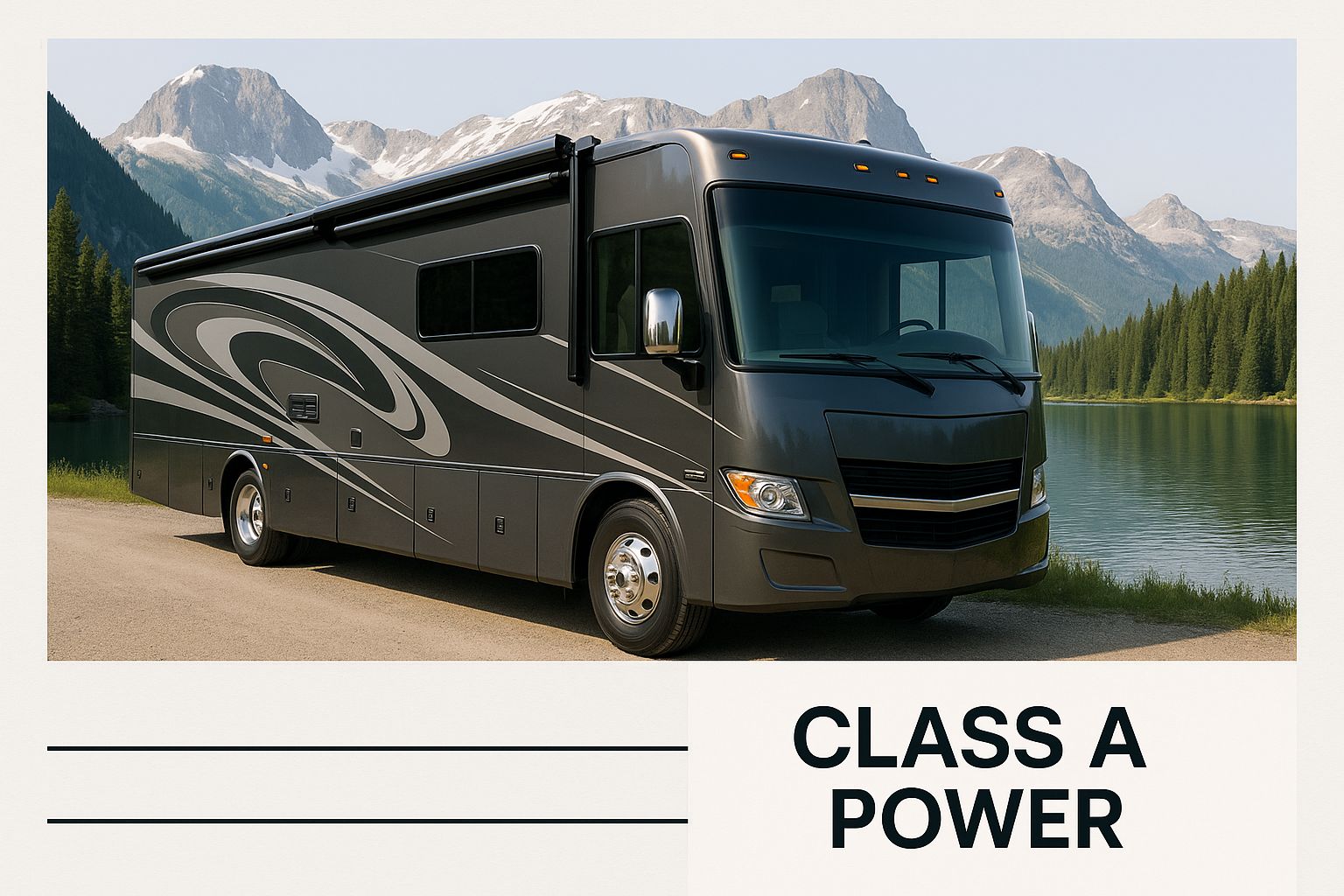
The image below gives you a great sense of the sheer presence of a Class A. It's not just a vehicle; it's a statement.
As you can see, a Class A isn't just about getting from A to B. It’s about bringing a serious level of comfort along for the ride. Now, let’s get into the nitty-gritty of what makes each class unique.
Class A: The Rolling Palace
Class A motorhomes are the largest and most luxurious rigs you can drive. You'll know one when you see it—they have that massive, flat front windshield and a distinct bus-like profile.
Typical Length:26 to 45 feet
Key Feature: Unbelievable interior space. We're talking residential-sized appliances, multiple slide-outs to expand the living area, and high-end finishes you'd expect in a nice home.
Best For: Full-time RVers, big families, and anyone who simply refuses to compromise on comfort and amenities while traveling.
Getting behind the wheel of a Class A feels like captaining a land yacht. It demands confidence and a bit of pre-planning, especially when navigating tight turns or older campgrounds not built for rigs this big. Their size is both their greatest asset and their biggest challenge.
Be aware: because these motorhomes often weigh more than 26,000 pounds, some states require a special non-commercial driver's license to operate one. It's crucial to check with your local DMV to know the rules.
Class C: The Versatile Family Favorite
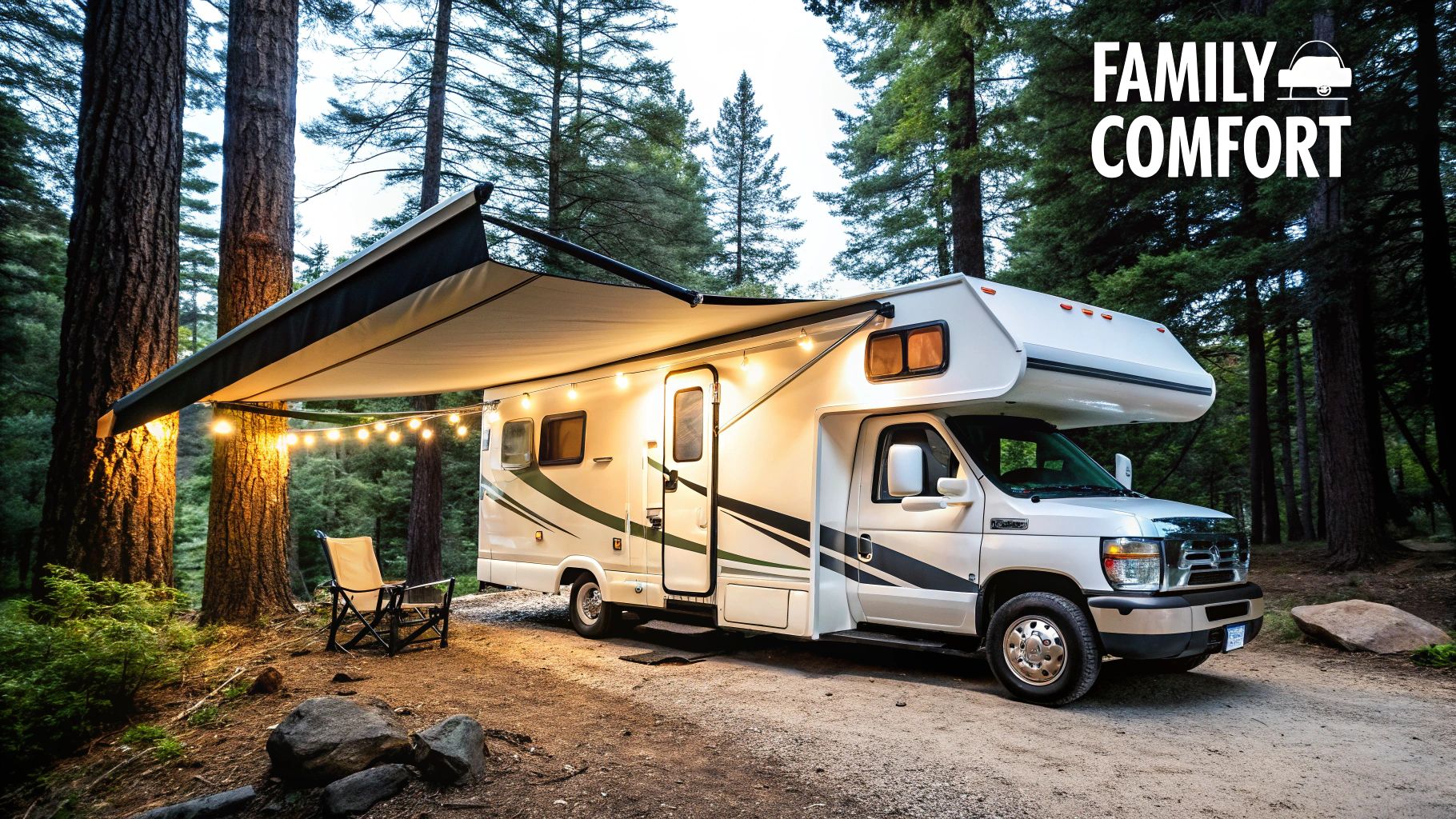
Next up is the Class C, which has what is probably the most recognizable RV shape out there. You can spot one from a mile away thanks to that signature bunk or storage area that extends over the driver's cab. They're built on a truck or van chassis, so driving one feels much more familiar to most people.
Class Cs hit that sweet spot, blending the spaciousness of a Class A with the easier handling of a smaller vehicle. This balance makes them a go-to choice for families and weekend warriors alike.
Typical Length:21 to 35 feet
Key Feature: The "cab-over" bunk is a game-changer, giving you extra sleeping quarters without eating into your main living space.
Best For: Families with kids, first-timers who are a little intimidated by a massive rig, and anyone wanting a solid mix of comfort and drivability.
Inside, you'll find plenty of amenities—often a separate bedroom, a full kitchen, and a decent-sized bathroom—all wrapped up in a much more manageable package than their Class A cousins.
Class B: The Agile Adventurer
Finally, we arrive at the nimble Class B motorhome, which most people just call a camper van. These are the smallest of the drivable classes, cleverly built out inside the shell of a standard full-sized van.
What a Class B gives up in elbow room, it more than makes up for in pure freedom and mobility. It drives like a normal van, fits into a regular parking spot, and lets you go almost anywhere your curiosity leads.
Typical Length:17 to 22 feet
Key Feature: Its compact footprint means it can navigate city streets and remote trailheads with ease—places larger RVs could only dream of reaching.
Best For: Solo travelers, couples, and adventurers who value the journey and the destination more than the size of their living room.
Shop RVs For Sale
Browse current rvs from dealers near you — updated daily.
Ingenious design is everything in a Class B. You'll see a lot of multi-functional furniture and wet baths (where the toilet and shower share the same waterproof space) to make the most of every square inch. If you see your RV as a basecamp for getting out there, the Class B is your perfect match.
When you dive into the world of RVs, it’s impossible to ignore the towables. They are, by far, the most popular choice for a reason. They offer an incredible amount of flexibility and are often more budget-friendly than their motorized cousins.
Most people start their RV journey right here, and it makes perfect sense. You have your living quarters in one unit and your driving vehicle in another. This means you can drop the trailer at your campsite and have your truck or SUV free to explore the local town, hit a remote trail, or just make a quick grocery run. It's a major perk.
The two heavyweights in this category are the travel trailer and the fifth wheel. While they both get pulled down the road, the way they connect to your truck creates two completely different camping experiences. Getting to know their unique personalities is the first step in picking the right one for you.
This setup is more than just popular; it’s a movement. As of 2021, a staggering 11.2 million American households owned an RV, which is a 62% increase from just two decades ago. Towables are a huge part of that growth because they're a much more approachable entry point than a pricey motorhome. You can dig into more of these fascinating RV industry statistics from ConsumerAffairs to see the full picture.
Now, let's look at the most versatile option on the road.
Travel Trailers: The Go-To Choice For Versatility
Close your eyes and picture a classic "camper." Chances are, a travel trailer comes to mind. These RVs are the quintessential towable, connecting to a standard ball hitch on the bumper or frame of your tow vehicle. This simple connection makes them compatible with a huge variety of vehicles, from pickup trucks to larger SUVs.
Their real superpower, though, is variety. You can find everything from a tiny 12-foot teardrop camper perfect for weekend getaways to a sprawling 35-foot bunkhouse model with room for the whole family. This incredible range in size and price makes them one of the most accessible RV types for just about any budget or travel style.
A key advantage of the travel trailer's conventional hitch is that it leaves your truck bed completely free. You don't lose that precious cargo space, meaning there's plenty of room for bikes, kayaks, a portable grill, and all your other gear.
While they're relatively straightforward to tow, their length can sometimes lead to a bit of sway on the highway, especially when it gets windy. A good weight-distribution hitch is a must-have for a safe and comfortable ride.
Fifth Wheels: The Pinnacle Of Towable Luxury
Fifth wheels are the undisputed kings of the towable world, offering a level of space and luxury that's hard to beat. You'll recognize them instantly by their distinctive, raised front section that extends over the bed of a pickup truck. This design isn't just for looks—it requires a heavy-duty jaw hitch mounted directly in the truck bed, similar to what semi-trucks use.
That unique connection point is a game-changer for the towing experience. By placing the pivot point over the truck’s rear axle instead of behind the bumper, a fifth wheel becomes incredibly stable and easy to maneuver. They are far less susceptible to trailer sway and can make surprisingly tight turns, which is a massive confidence booster when you're trying to back into a tricky campsite.
To make the differences crystal clear, let's put these two popular RV types side-by-side.
Travel Trailer vs Fifth Wheel At a Glance
The choice between a travel trailer and a fifth wheel often comes down to your tow vehicle, budget, and desired level of comfort. This table breaks down the core differences.
Feature
Travel Trailer
Fifth Wheel
Hitch Type
Standard ball hitch on bumper or frame
Jaw hitch mounted in the truck bed
Tow Vehicle
SUV, van, or pickup truck
Heavy-duty pickup truck required
Towing Stability
Good (with proper setup)
Excellent (inherently less sway)
Interior Space
Single-level floor plan
Bi-level, residential-style layouts
Storage
Good exterior "pass-through" storage
Massive "basement" storage bays
As you can see, the fifth wheel’s design really sets it apart.
The raised front section creates a fantastic bi-level interior, often with a dedicated master bedroom and bathroom upstairs. This gives it a much more residential, home-like feel. Down below, this design opens up enormous "basement" storage bays that are perfect for full-timers or anyone who likes to bring along all the comforts of home.
Exploring Specialty and Niche RVs
Once you look past the big, familiar motorhomes and trailers, you'll find a whole world of specialty RVs built for specific kinds of travel. These aren't your typical one-size-fits-all rigs; they're designed for people who build their trips around a particular hobby or a serious taste for adventure.
These unique RVs solve very specific problems, like how to haul your ATV without a second trailer or how to get deep into the backcountry where other campers can't go. They prove there’s a perfect rig for just about any passion. Let's dive into some of the most popular niche options, starting with one that’s incredibly easy to tow and store.
Pop-Up Campers: The Lightweight Towing Champ
A pop-up camper, sometimes called a folding camper, is a clever hybrid of a tent and a traditional travel trailer. When you're on the road, it’s a compact, low-profile box that’s a breeze to pull. In fact, most family SUVs or even minivans can handle them, which makes getting into RVing much more approachable.
When you get to your campsite, the magic happens. You simply crank up the roof, and the canvas-sided sleeping bunks slide out from the ends, creating a surprisingly roomy interior.
Collapsed Height:4 to 5 feet, so it fits neatly into a standard garage.
Set-Up Length:15 to 23 feet, providing plenty of sleeping space for a family.
Key Advantage: Its light weight and aerodynamic shape mean you’ll barely notice a difference in your gas mileage.
Toy Haulers: The Mobile Adventure Garage
What if your adventures involve dirt bikes, four-wheelers, or kayaks? That's where the toy hauler comes in. Think of it as a travel trailer or fifth wheel with its own garage built right into the back, complete with a heavy-duty ramp door that makes loading and unloading your gear a cinch.
The real genius of a toy hauler is how that garage space transforms. Once the toys are out, the area often converts into a living space with fold-down sofas or a spare bedroom. It’s no wonder they’re a favorite for outdoor enthusiasts who want to bring their entire adventure arsenal with them.
A toy hauler masterfully combines living quarters and gear storage in one seamless unit. It’s not just a place to sleep; it's a basecamp for your biggest adventures, ensuring your hobbies travel with you.
Truck Campers: The Ultimate Off-Grid Explorers
If your main goal is to get as far from civilization as possible, the truck camper is your rig. This is a self-contained camper unit designed to slide right into the bed of a pickup truck, offering what is arguably the most rugged and nimble RV experience you can get.
Because the camper becomes part of the truck, you can go anywhere a capable 4x4 can take you. We're talking remote forest service roads, secluded desert landscapes, and places other RVs wouldn't dare to go.
Length:8 to 12 feet (for the camper unit itself).
Width: Around 7 to 8 feet.
Best For: Solo adventurers or couples who value off-road freedom and true boondocking capability way more than palatial interior space.
Truck campers are the definition of "go-anywhere" RVing, proving that some of the grandest adventures come in the most compact and capable packages.
How RV Dimensions Shape Your Travel Experience
When you're shopping for an RV, it's easy to get swept away by shiny interiors and clever floor plans. But the real make-or-break details are on the spec sheet. The length, height, and weight aren't just numbers; they're the invisible rules that will dictate where you can go and how you'll get there. Honestly, overlooking these dimensions is one of the most common pitfalls for new RVers.
Think of it this way: your RV's size is its personality. A long, luxurious Class A is the kind of rig that loves sprawling out at a well-equipped, modern RV resort. On the flip side, a compact Class B camper van is the scrappy explorer, ready to dart down a narrow forest road or snag that last tiny campsite by the lake. The size you pick is a direct trade-off for freedom and access.
The right RV size doesn't just add comfort; it removes limitations. The goal is to find a rig that fits the adventures you dream of, not one that forces you to dream of adventures it can fit into.
Taking a moment to really understand how each dimension impacts your journey is the secret to choosing an RV you'll love for years, not just for the first few trips.
Decoding Length and Height Restrictions
Of all the stats, an RV's length is the one that will most directly impact where you can stay. That 45-foot motorhome might feel like a palace on wheels, but it's going to get you turned away from countless stunning state and national parks. Many of these campgrounds were built decades ago for much smaller vehicles.
You'll find that a 35-foot limit is pretty common in older parks, and some of the more rustic, beautiful spots can't handle anything over 25 feet.
Height is the next big hurdle. Most RVs hover somewhere between 10 to 12 feet tall. But some of the big fifth wheels and Class A motorhomes can push 13.5 feet or even more. That extra headroom inside can turn a relaxing drive into a nail-biting gauntlet of low-hanging tree branches, old gas station awnings, and low-clearance bridges.
The Critical Role of RV Weight
Finally, let's talk about weight. It's the factor that hits your wallet and your peace of mind on the road. The sheer range of RV types and sizes means a huge difference in operating costs. Heavier rigs need bigger, thirstier engines or tow vehicles, which translates directly to more pain at the pump.
The difference between towing a 3,000-pound travel trailer and piloting a 40,000-pound Class A is massive. It influences everything from fuel economy and tire wear to your insurance premiums. You can get a better sense of how all these RV market factors influence cost from industry data.
At the end of the day, these three numbers—length, height, and weight—are a team. They work together to define your entire travel experience, setting the boundaries for your route, your destinations, and your budget. It turns out that when it comes to RVs, size really does matter.
Common Questions About RV Types and Sizes
Alright, let's tackle some of the questions that are probably bouncing around in your head. Choosing an RV is a big deal, and getting these last few details ironed out will help you feel a lot more confident. Think of this as the final once-over before you grab the keys.
We’ll dig into the common concerns we hear all the time—from the best starter rigs to the nitty-gritty of driver's licenses and fitting into campsites. Getting these answers right can save you a world of headaches later on.
What Is the Best RV Type for a Beginner?
When you're just starting out, the last thing you want is an RV that feels intimidating. The goal is to find something manageable that lets you learn the ropes without a ton of stress. That usually leads new RVers to two fantastic options.
Smaller Travel Trailers: A trailer under 25 feet is a perfect starting point. They're lighter on the wallet, can often be towed by an SUV or truck you might already have, and are so much easier to back into a campsite.
Class C Motorhomes: If you'd rather drive your RV than tow it, a Class C is tough to beat. They're built on a truck chassis, so the experience behind the wheel feels more like driving a U-Haul than a city bus. That familiarity helps build confidence fast.
Both of these give you all the essential comforts without a massive learning curve, making them the ideal training wheels for the RV lifestyle.
Do I Need a Special License to Drive a Large RV?
This is a huge one, and for most people, the answer is surprisingly simple: no. In the vast majority of U.S. states, your standard driver's license is all you need to legally drive any RV, no matter how big or heavy it is.
However—and this is an important "however"—a few states do have special requirements. These rules usually kick in for RVs with a Gross Vehicle Weight Rating (GVWR) over 26,000 pounds. In those specific states, you might need to get a non-commercial special license.
You absolutely must check the DMV regulations for your home state. Don't take anyone's word for it. A quick search on your state's DMV website is the only way to get a definitive answer and avoid a major legal hassle.
How Does RV Length Affect Campground Access?
Of all the specs, RV length is probably the biggest factor in determining where you can camp. This is especially true when you're dreaming of visiting older national and state parks, many of which were built long before modern, massive rigs even existed.
Here's a good rule of thumb: if your RV is under 30 feet, you'll fit into the vast majority of campgrounds nationwide. Once you push past the 35-foot mark, your options start to narrow. For the really big rigs—we're talking 40 feet and up—you'll need to plan your trips carefully, as many popular spots simply won't be able to accommodate you.
Before you fall in love with that giant fifth wheel, do a little research. Look up the campgrounds in places you want to go and check their size limits. It’s the best way to make sure your new RV opens up your world, instead of limiting it.
Ready to find the RV that fits your adventure? At Searchshop, we simplify the process. Use our tools to compare different RV types and sizes, read expert reviews, and connect with trusted dealers. Find your perfect RV with Searchshop today