What to Look for When Buying a Boat A Buyer's Guide
Buying a Used Boat
What to Look for When Buying a Boat A Buyer's Guide
By Searchshop Editorial Team25 min readSeptember 23, 2025Updated January 2, 2026
Some links in this article are affiliate links. If you buy through them, Searchshop may earn a commission at no extra cost to you. Learn how this works.
Before you even step foot on a dock, the boat-buying journey really begins with some honest self-reflection. Much like shopping for an RV, it all boils down to three core things: your budget, how you plan to use the vehicle, and the true cost of ownership. First, get crystal clear on what you'll be doing out on the water—fishing, watersports, or just cruising around? That answer points you to the right type of boat. Then, you need to build a real-world budget that goes way beyond the price tag to include things like insurance, storage, maintenance, and fuel.
Setting Your Course: Budget and Lifestyle
It’s easy to get swept away by the romance of open water, but it's crucial to anchor your search in reality first. This initial planning is your compass, guiding you through the big questions that help you avoid a classic case of buyer's remorse. Get this right, and your new boat will be a source of joy, not a headache.
Think of this as creating the blueprint for your recreational life. It’s a simple but vital process that will shape every other decision you make down the line, whether you're buying a boat for the lake or an RV for the open road.
Defining Your Boating DNA
Every boat out there is built for a specific purpose. A sleek wake boat is engineered to throw the perfect wave. A center console is a rugged workhorse designed for offshore fishing. A pontoon, on the other hand, is basically a floating living room, perfect for lazy days with the family. To find your perfect match, you have to know your mission.
Start by asking yourself a few key questions:
What’s my main activity? Are you chasing tuna offshore, pulling the kids on a tube, or hosting sunset cocktail cruises? The answer will instantly narrow your search.
Who's coming with me? A boat for solo fishing trips looks very different from one meant for a family of five. You have to consider seating, space, and the right safety gear for your typical crew.
Where will I be boating? A boat designed for a calm inland lake is going to have a rough time in choppy coastal waters. Your home base—be it a lake, river, or the ocean—is a non-negotiable factor in your decision.
Answering these questions helps you sidestep the common trap of buying a boat that looks cool but doesn't actually fit how you want to spend your time. That high-performance speedboat is completely useless if your dream is to spend quiet afternoons fishing in a peaceful cove.
Your ideal boat is a direct reflection of your lifestyle. Matching the vessel's purpose to your own is the single most important decision you'll make in the buying process.
Calculating the True Cost of Ownership
That price tag you see on the boat? That's just the down payment on your adventure. A savvy buyer looks at the total cost of ownership, which goes far beyond the initial purchase. A good rule of thumb is to budget roughly 10% of the boat’s price for annual operating costs.
This "hidden" budget covers several recurring expenses you absolutely must plan for:
Insurance: This is non-negotiable for any major recreational vehicle. It protects your investment, and costs will vary based on the boat's value, size, and where you live.
Storage and Docking: Where will the boat live when you're not using it? On a trailer in your driveway? Or in a slip at a marina? Those marina fees can be a major annual expense.
Routine Maintenance: Just like a car or an RV, boats need regular love. This means engine tune-ups, oil changes, winterization, and keeping the hull clean.
Fuel: This cost can swing wildly depending on your engine and how you use the boat. A full day of watersports can burn through a surprising amount of fuel.
Repairs and Upgrades: Things break. It's just a fact of life. Setting aside a little slush fund for unexpected repairs is a smart move, especially if you're looking at a pre-owned boat.
Forgetting to account for these ongoing costs is the fastest way to turn your dream into a financial nightmare. By creating a realistic budget from the start, you’re making sure you can afford to not just buy the boat, but to actually get out there and enjoy it for years to come.
Finding the Right Boat for Your Adventures
The word "boat" is a bit like "car"—it covers everything from a tiny dinghy to a massive yacht. So, where do you even start? The first step is to forget the specs and think about the experience. What do you see yourself doing out on the water? Answering that question is the key to finding the right vessel for your adventures.
Choosing the right type of boat is make-or-break. The perfect match will feel like a natural extension of your lifestyle, while the wrong one will just lead to frustration and a vehicle that sits unused. The sheer size of the recreational boating industry—which recently hit $57.7 billion in annual U.S. sales—shows just how many different ways there are to enjoy the water. As you'll see in these boat marketing statistics and trends, there's a perfect fit for everyone.
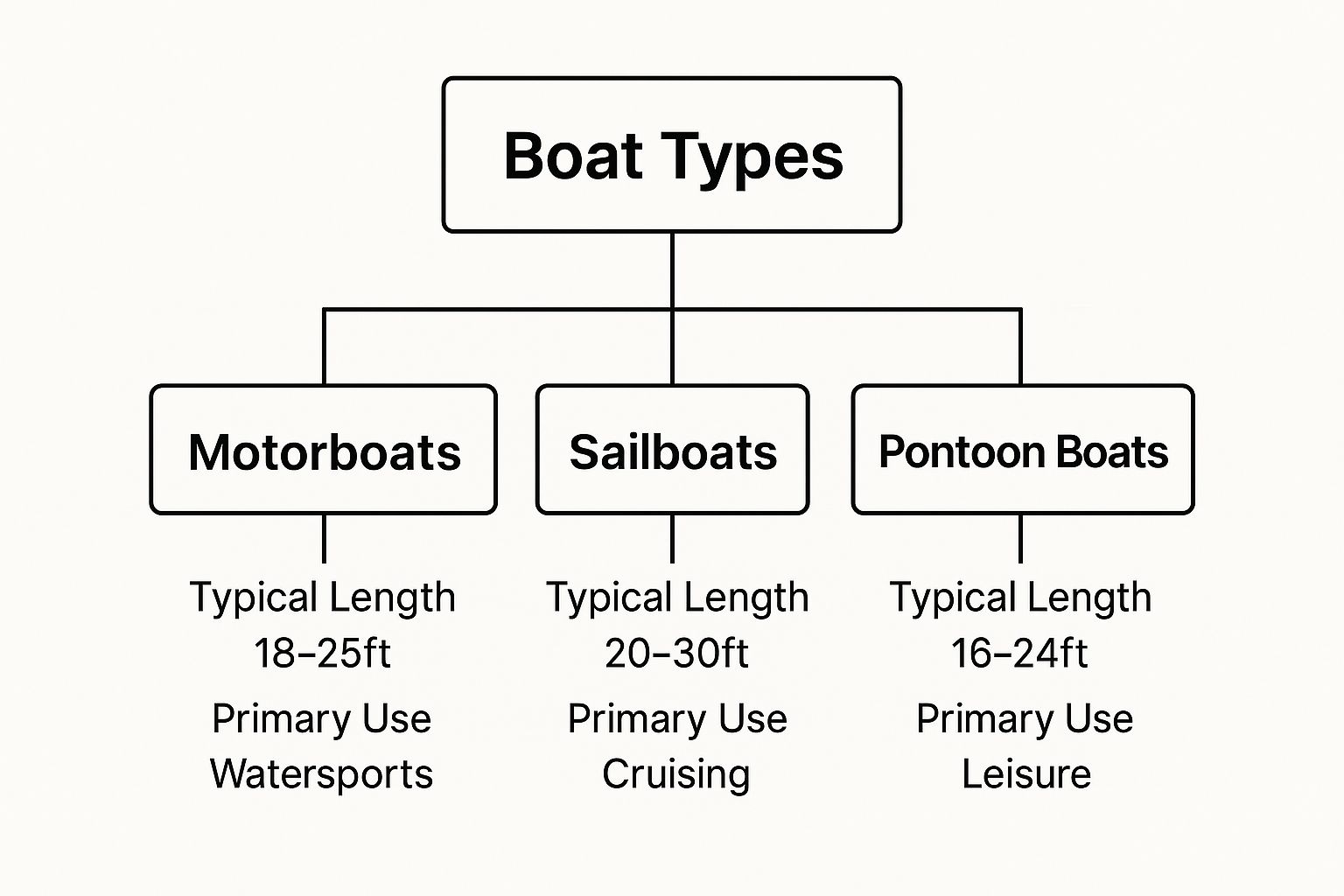
This overview breaks down the main categories to help you connect your dream day on the water with the right design.
As you can see, boats are specialized tools. Some are built for speed and action, while others are all about kicking back and relaxing.
Matching Your Activities to the Perfect Boat Type
To make this even clearer, let's connect the dots between what you want to do and the boat that will get you there. This table gives you a quick snapshot of the most common boat types and what they do best.
Boat Type
Best For
Typical Size Range
Key Feature
Pontoon Boat
Social gatherings, family cruising, calm-water lounging
Below-deck cabin with sleeping and cooking facilities
Jon Boat
Fishing in shallow water, hunting, simple utility
10 - 20 feet
Flat bottom for incredible stability in calm water
Each of these designs was born from a specific need. Once you know your "why," choosing the "what" becomes much easier.
Pontoon Boats: The Floating Patio
Think of a pontoon boat as your family's floating living room. Built on two or three big aluminum tubes (the "pontoons"), these boats are all about stability and massive, open deck space. They are the undisputed champions of leisurely days on lakes and calm rivers.
Their strength is pure comfort and capacity. With couch-like seating, tons of room to move around, and big shady tops, they are perfect for:
Family Outings: Pontoons are incredibly family-friendly. The high railings and stable platform create a safe space for kids and pets.
Social Gatherings: They are the ultimate party barge, perfect for hosting friends for a sunset cruise or anchoring up for a swim.
Relaxed Fishing: While not a hardcore fishing machine, they provide a steady, comfortable platform for drowning a few worms in calm water.
The trade-off for all that space is performance. Pontoons aren't built for speed or for handling rough, choppy seas. They're all about comfort, not high-octane thrills.
Center Consoles: The Rugged 4x4 of the Sea
If a pontoon is a comfy minivan, the center console is a rugged, go-anywhere 4x4. The name says it all: the steering and controls are on a console in the middle of the boat, which opens up a 360-degree deck. This layout has made it the weapon of choice for serious anglers.
This design means you can follow a fish from bow to stern without anything getting in your way. Center consoles are built tough with easy-to-clean surfaces and all the features a fisherman could want, like rod holders, livewells, and fish boxes.
A center console’s purpose-built design prioritizes function over luxury. It's less about lounging and more about providing a practical, open platform for activities like fishing, diving, or utility work.
Bowriders: The Versatile Family Sport Boat
Shop Boats For Sale
Browse current boats from dealers near you — updated daily.
The bowrider is the quintessential all-rounder—the boating world's crossover SUV. It gets its name from the open seating area in the bow, right in front of the windshield. This versatile layout makes it a fantastic choice for families who want to do a little bit of everything.
Bowriders are built for fun. Their V-shaped hulls allow them to cut through moderate chop for a smooth, dry ride, and they handle with sporty agility.
They are an excellent fit for:
Watersports: Most bowriders have the power to easily pull skiers, wakeboarders, and tubers across the lake.
Day Cruising: The comfortable seating in both the bow and the main cockpit makes them perfect for exploring the local scenery.
Socializing: The open layout provides plenty of room for family and friends to hang out and enjoy a day on the water together.
They might not have the hardcore fishing features of a center console or the massive deck of a pontoon, but their incredible flexibility is what makes them so popular.
Hull Design: The Secret to the Ride
What you can't see below the waterline is arguably the most important part of any boat: the hull. Think of it as the boat's suspension. The shape of the hull dictates how the boat handles, how it rides in rough water, and how stable it is.
A deep-V hull, common on center consoles and bowriders, features a sharp, pointed bottom. This design acts like a knife, slicing cleanly through waves to deliver a much smoother ride in choppy conditions. On the other end of the spectrum is the flat-bottom hull, found on small jon boats. It offers incredible stability in calm, shallow water but will pound you with a harsh, bumpy ride the second the waves kick up.
Pontoons are a different animal altogether, relying on their big tubes for buoyancy and stability instead of a traditional hull. Understanding this fundamental difference is the key to picking a boat that will actually perform well where you plan to use it.
Inspecting the Heart of the Vessel: The Engine
When you're figuring out what to look for when buying a boat, always remember that the engine is its beating heart. It's the most complex, expensive, and absolutely critical component on board. A beautiful, shiny hull doesn't mean a thing if the powerplant is on its last legs. A thorough engine inspection isn't just a good idea—it's a non-negotiable step.
Even if you’re not a trained marine mechanic, you can learn to spot the big red flags. Think of this as a first-pass health check. It helps you decide if a boat is even worth the time and money for a professional survey. You're trying to weed out the obvious lemons before you get too invested.
Understanding the Three Main Engine Types
Before you can inspect an engine, you need to know what you’re looking at. Recreational boats typically use one of three main setups, and each one has its own quirks, benefits, and things to watch out for.
Outboard Engines: These are the all-in-one units you see clamped to the back wall (the transom) of a boat. They’re super common on smaller vessels, are a breeze to access for maintenance, and can be tilted completely out of the water—a huge plus for preventing corrosion if you're boating in saltwater.
Inboard Engines: Think of these like a car engine, tucked away inside the boat's hull. They connect to a propeller through a straight shaft. You’ll find them on bigger cruisers and dedicated watersports boats where they deliver serious power and torque while leaving the swim platform wide open.
Sterndrive (Inboard/Outboard or I/O): This is the hybrid of the boat world. It pairs an inboard engine with a drive unit that looks and acts like the bottom half of an outboard. It gives you more power than most outboards and a clear transom, making it a popular choice for everything from bowriders to small cruisers.
Each of these designs requires a slightly different inspection approach, but the core principles—checking for wear, neglect, and damage—are the same across the board.
The Visual Inspection Checklist
Alright, time to open up the engine compartment and play detective. You're looking for clues that tell the story of how this engine has lived its life. Was it cared for, or was it run hard and put away wet? Here's what to look for.
First, find the engine hour meter. It’s the odometer for the boat. While there isn't a single "bad" number, a well-maintained engine with 500 hours is a much better bet than a neglected one with only 100 hours. You have to look at the hours in the context of the boat's overall condition.
A boat's engine hours are a critical piece of its history. They provide context for its condition, but they only tell part of the story. Always pair the hour reading with a thorough review of the maintenance logs.
Next, get your hands dirty with a quick visual check:
Check the Oil: Pull the dipstick. The oil should look clean—a translucent amber or a uniform black. If it looks like a milky coffee, that's a massive red flag. It means water is mixing with the oil, which could signal a cracked block or a blown head gasket. Walk away.
Look for Corrosion: Scan the engine block, mounts, and all the electrical connections. A little surface rust can be normal, but if you see chunky, flaky corrosion everywhere, it’s a sign of neglect, especially on a boat used in saltwater. This is where electrical gremlins are born.
Inspect Belts and Hoses: Give the hoses a good squeeze. They should feel firm, not spongy or rock-hard and brittle. Look over the belts for any signs of cracking, fraying, or a shiny, glazed appearance. These are cheap parts, but if the owner ignored them, what else did they ignore?
Examine the Bilge: Peek into the area right under the engine. A clean, dry bilge is a beautiful thing. If you see standing water or that tell-tale rainbow sheen of oil, you're looking at active leaks that need to be hunted down.
The Importance of Service Records
Just like you’d ask for the service history on a used car or RV, you should always ask for the boat’s maintenance records. This paperwork is your proof that the engine received the regular care it needs, from oil changes and new filters to proper winterization.
A seller who hands you a thick, organized folder of receipts is showing you they were a responsible owner. It’s tangible proof of what was done and when. If there are no records, it’s not an automatic deal-breaker, but it means you need to be ten times more cautious.
Ultimately, your initial inspection is a qualifier. It helps you quickly pass on the poorly maintained boats and gives you the confidence to take the next step. But it is never a substitute for a professional opinion. If a boat passes your visual check, the final, crucial step is hiring a certified marine mechanic for a full engine survey, including a compression test. That expert analysis is the best insurance you can buy against a future mechanical nightmare.
Looking Beyond the Shine: A Hull and Systems Checklist
A brilliant, freshly waxed gelcoat can catch anyone's eye, but what lies beneath that shine is what really counts. When you’re figuring out what to look for in a used boat, a thorough top-to-bottom inspection of the hull and onboard systems is non-negotiable. This is where the expensive, hidden problems love to hide, and finding them ahead of time gives you the power to negotiate a better deal—or walk away before it's too late.
Think of yourself as a home inspector, but for a boat. You’re not just looking for a few cosmetic scuffs; you're hunting for the kind of structural deal-breakers that can sink your boating dream before it even leaves the dock.
Reading the Story of the Hull
The hull is the boat's foundation, and its condition tells a vivid story about its life on the water and how well it was cared for.
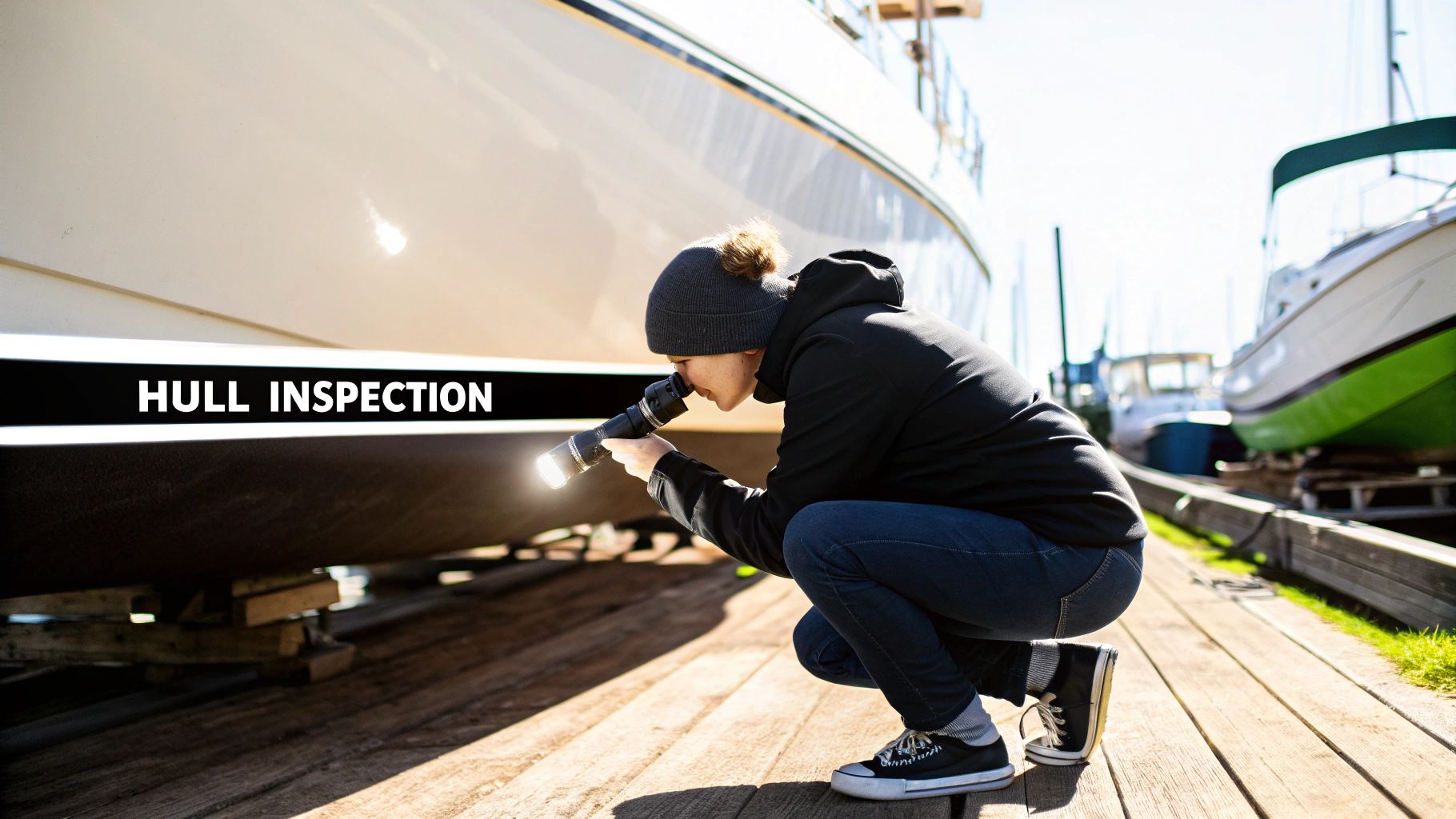
Start with the big picture. Stand back from the bow and then the stern, and sight down the length of the boat. You’re looking for any weird hooks, warps, or uneven lines. These could be red flags signaling a shoddy repair job or serious structural stress from a hard life.
Once you’ve done that, get right up close and personal with the hull:
Gelcoat Blisters: These are the little bubbles or bumps you might see in the finish. A few scattered blisters are usually no big deal, but a hull covered in them can point to much deeper moisture issues soaking into the fiberglass itself.
Stress Cracks: Pay close attention to high-stress areas like the corners of the cabin and around cleats and railings. You’ll probably see fine, spiderweb-like cracks—that’s pretty normal. It’s the long, deep cracks that feel rough to the touch that you need to worry about; they can indicate the hull is flexing way more than it should.
Previous Repairs: Mismatched paint, surfaces that aren’t quite smooth, or patches of gelcoat that don't match the rest of the hull are dead giveaways of past damage. It’s critical to find out what happened and, more importantly, how it was fixed.
A boat's hull is its skeleton. Minor scrapes are part of the deal, but deep cracks, widespread blistering, or evidence of major repairs demand a much closer look from a professional marine surveyor.
The Deck and Topside Inspection
After giving the hull a good look-over, it's time to hop aboard and inspect the deck and topsides. Your number one mission here is to hunt for soft spots—a massive red flag.
Walk slowly around the entire deck, especially around fittings like cleats and hatches. Use the heel of your foot to press down firmly. The deck should feel solid everywhere you step. A spongy, flexible, or soft spot is a clear sign that water has seeped into the core material between the fiberglass layers, causing it to rot from the inside out. This isn't just a cosmetic issue; it's a major structural problem that's often incredibly expensive to fix right.
While you're up there, grab every railing, stanchion, and cleat and give it a firm shake. They should be rock solid. Any wobble means the fittings are loose, the sealant has failed, or the structure underneath is compromised. Don’t forget to check all the underwater fittings you can see, like thru-hulls and transducers, for any signs of corrosion or cracking. A failed thru-hull is one of the quickest ways to sink a boat, even when it's tied to the dock.
Checking the Boat's Nervous System
If the engine is the heart and the hull is the skeleton, then the electrical and plumbing systems are the boat’s nervous and circulatory systems. Faulty wiring is a leading cause of boat fires, and a plumbing failure can lead to anything from a minor annoyance to a catastrophic flood.
Start with a simple, methodical test of every single switch at the helm:
Flip Every Switch: Turn on the navigation lights, anchor light, courtesy lights, and any spotlights. Do a full walk-around to make sure each one actually lights up.
Test the Bilge Pumps: Most boats have at least one bilge pump, usually with both an automatic float switch and a manual override. Hit the manual switch first to hear and see that the pump runs.
Check Electronics: Fire up the chartplotter, VHF radio, and any other electronics to ensure they power on and seem to be working correctly.
For the plumbing, find the seacocks (the valves for underwater fittings) and try to open and close them. They should move smoothly, not feel seized up. If the boat has a freshwater system, turn on the faucets and flush the toilet to check for good pressure and any obvious leaks.
This hands-on inspection gives you a powerful, real-world snapshot of the boat’s true condition. Understanding these key inspection points builds confidence and gives you serious leverage, which is especially useful right now. Recent industry data shows a 9% decline in new boat sales in the U.S., with 64,883 new boats sold through April compared to 71,321 the year before. This softening market means that a well-inspected used boat can offer fantastic value, putting buyers who've done their homework in a great negotiating position. You can dive deeper into these figures by checking out the latest market trend reports.
Getting Your Hands Dirty: The Sea Trial and Marine Survey
So, you’ve done your homework and found a boat that checks all the boxes. It looks great, feels solid, and you can already picture yourself at the helm. But now comes the most important part: proving it performs where it counts—on the water.
This is where the rubber meets the road, or rather, where the hull meets the waves. The sea trial and the marine survey are your final, non-negotiable hurdles. They’re the last pieces of the puzzle that will either give you the green light to sign with total confidence or the hard evidence you need to walk away from a potential nightmare.
The Sea Trial: Your On-the-Water Test Drive
A sea trial is exactly what it sounds like. You’re taking the boat for a proper spin to see how it really handles. It’s one thing to admire a boat tied to the dock, but it’s a completely different story when you feel it slicing through the water.
This isn't a joyride; it's an investigation. You need to be fully engaged, listening, feeling, and watching for clues about the boat's true condition.
Here's what you need to focus on:
Performance at All Speeds: Push the throttle. How does it accelerate? Does it get up on plane without pointing its nose to the sky? Run it at every speed, from a dead-slow crawl to wide-open, and feel for any odd vibrations or hesitations.
Handling and Maneuverability: Put it through its paces. Make sharp turns, lazy S-curves, and tight figure eights. You want it to feel responsive and predictable, not like you're wrestling a pig.
Engine Vitals: Glue your eyes to the gauges, especially temperature and oil pressure. They should climb to their normal operating range and stay there, solid as a rock.
Strange Noises or Smells: Tune in your ears. Are there any weird clunks, whines, or grinding sounds coming from the engine room? A whiff of burning oil or an electrical smell is an immediate red flag.
The Marine Survey: Your Expert Second Opinion
Once the boat passes your test drive, it's time for the final verdict from a professional marine surveyor. Don't even think about skipping this step. A surveyor is like a home inspector for a boat—a completely unbiased expert whose only job is to find every single flaw, from minor to catastrophic.
This is, without a doubt, the best money you will spend in the entire boat-buying process.
A marine surveyor offers an impartial, expert deep-dive that you simply can't do on your own. Their final report is your single most powerful negotiation tool and the key to avoiding a very expensive mistake.
The surveyor will perform a thorough "out-of-water" inspection, tapping the entire hull for any signs of delamination and using moisture meters to detect hidden water intrusion. They'll go through every system—electrical, plumbing, propulsion—with a fine-toothed comb.
What you get back is a detailed report that outlines the boat's condition, its fair market value, and a list of necessary repairs. This document is pure gold. You can use it to negotiate a lower price, insist the seller fixes major issues, or simply walk away.
Making a sound investment is crucial, especially now. The global leisure boat market was valued at $41.6 billion and is expected to climb to $65.9 billion in the next decade, with a 5.3% CAGR. As this market grows with new tech and more boaters, as detailed in this leisure boat market outlook report, ensuring your purchase is a good one has never been more important.
Common Questions About Buying a Boat
As you get closer to sealing the deal on a boat, a few key questions always seem to pop up. It doesn't matter if you're buying your first boat or you've been on the water for decades; getting clear answers can be the difference between a good purchase and a great one. Let's walk through some of the most common questions we hear from buyers.
Think of this as your final pre-launch check. Answering these last few queries helps clear up any lingering doubts and sets you on a course for a smooth, enjoyable ownership experience.
How Much Should I Budget for Annual Boat Maintenance?
A solid rule of thumb is to plan on spending about 10% of the boat's purchase price each year on maintenance and operating costs. This isn't just for fixing things that break; it's a realistic budget for all the predictable expenses that come with owning a boat.
So, for a $50,000 boat, you should expect to set aside around $5,000 a year. This fund typically covers:
Routine Engine Service: Think oil changes, new filters, and regular tune-ups to keep the engine reliable.
Hull Care: This includes bottom painting to fend off marine growth and regular washing and waxing.
Insurance and Storage: These are fixed costs, whether you're paying for a slip at a marina or keeping it on a trailer.
A "Just-in-Case" Fund: For those inevitable surprise repairs that are just part of boating.
Just remember, this figure can creep up, especially for older boats or those used exclusively in saltwater. Salt is incredibly corrosive and much tougher on engines and electrical components.
What Are the Biggest Red Flags on a Used Boat?
When you're inspecting a used boat, the most serious red flags are almost always tied to the boat's structural integrity or its engine. You can fix cosmetic flaws, but major structural and mechanical problems can turn into financial nightmares.
Be on high alert for any soft, spongy spots on the floor (the deck) or the transom (the back wall where the engine is mounted).
A soft deck is a dead giveaway for water intrusion and internal rot. This isn't a simple patch job; it often means the boat's core structure is compromised and needs an expensive, ground-up rebuild.
When you check the engine, pull the dipstick. If the oil looks milky, walk away. That means water is mixing with the oil, which could be from a cracked engine block or a blown head gasket—both are catastrophic failures. Also, keep an eye out for excessive corrosion in the engine bay and be wary of any s
SE
Written by
Searchshop Editorial Team
Vehicle research & buying-guide team
The Searchshop editorial team researches and writes buying guides, model reviews, and category roundups across RVs, boats, motorcycles, ATVs, autos, and snowmobiles. We combine hands-on product research, live dealer inventory data, and manufacturer specifications to help buyers make confident decisions.
Reviewed by Searchshop Review Board — credentialed industry professionals.