So, you’re ready to buy your first motorcycle. Awesome. That first step into the world of two wheels is a feeling you’ll never forget. But with a sea of options out there, it’s easy to feel a little lost.
The secret isn’t finding some mythical "perfect" bike. Instead, it’s about finding the right vehicle for you—one with manageable power, a fit that inspires confidence, and a price that doesn’t drain your bank account. Your first motorcycle should feel like an extension of yourself, not a beast you’re constantly trying to tame.
Think of it this way: you wouldn't learn to drive a boat with a high-performance racing model. You'd start with something simple to get the fundamentals down. The same logic applies here. Your first bike is your training partner, designed to help you master the core skills—throttle control, smooth braking, and balance—without the intimidation of too much power or weight.
Getting this right is crucial. A good first experience builds a solid foundation and fuels a lifelong passion for riding. A bad one can be discouraging and, frankly, dangerous.
So, what should you look for? Let's cut through the noise and focus on three key traits. A bike that nails these three things will be forgiving when you make mistakes, easy to handle in everyday traffic, and affordable enough to leave you with cash for quality gear and training.
The goal is to find a motorcycle that you can control, not one that controls you. Confidence is the most important skill for a new rider, and the right bike is your greatest tool for building it.
To help you get started, we've put together a quick reference table. Think of this as your cheat sheet when you're looking at listings for new or used motorcycles, ATVs, or other powersports vehicles. It lays out exactly what to look for in a first bike.
This table breaks down the most important factors for a new rider. Keep these numbers in mind, and you'll be able to quickly spot the bikes that are genuinely beginner-friendly.
| Characteristic |
Ideal Range for Beginners |
Why It Matters for New Riders |
| Engine Size |
125cc – 400cc |
Gives you enough power for city streets and even some highway riding, but it's smooth and predictable enough that you won't feel overwhelmed. |
| Bike Weight |
Under 400 lbs (181 kg) |
A lighter bike is way easier to handle at slow speeds, maneuver in a parking lot, and—let's be honest—pick up if you happen to drop it. |
| Seat Height |
Under 32 inches |
This is a huge confidence booster. Being able to plant both feet flat on the ground at a stop makes you feel stable and in complete control. |
Ultimately, a bike that fits these criteria is designed to help you learn and grow. It's the perfect starting point for your journey on two wheels.
Stepping into the world of motorcycles means getting familiar with a whole new language, especially when looking at spec sheets. But out of all the numbers and jargon, there's one you need to focus on above all else: engine size, measured in cubic centimeters (cc). This isn't just a number; it defines the bike's personality—its power, its weight, and how it will feel underneath you.
There's a golden rule every seasoned rider will tell you: start small. Think back to learning how to drive a car. Would you have hopped into a powerful truck for your first lesson? Of course not. You’d go for a sensible sedan because it's predictable, easy to handle, and lets you focus on the fundamentals. The exact same logic applies here.
A smaller engine delivers its power smoothly and predictably. This is huge. It means you can get the hang of throttle control, braking, and leaning into turns without feeling like you're trying to tame a wild animal. The goal is to find a vehicle that's thrilling but forgiving, giving you the space to build real skills safely.
Choosing a smaller engine—generally in the 125cc to 400cc ballpark—has a wonderful domino effect. A less powerful engine doesn't need a heavy, bulky frame to support it. This means the whole bike is lighter and more compact, which is a massive win for anyone new to riding.
You'll really feel the benefit of a lighter bike when you're navigating a tight parking lot or trying to hold it steady at a stoplight. It’s far less intimidating and much easier to manage at low speeds. This nimbleness is what builds confidence, freeing you up to actually enjoy the ride instead of fighting the machine.
A classic rookie mistake is buying a powerful bike with the idea of "growing into it." This almost always backfires. It's far better to master a smaller bike and ride with confidence than to be constantly on edge, intimidated by a machine that's too much, too soon.
It’s no surprise that bikes up to 200cc are the most popular choice for new riders across the globe. They hit the sweet spot of being affordable, fuel-efficient, and incredibly easy to handle. This category makes up the biggest slice of the market, offering just enough power for city streets without overwhelming someone who's still learning. For a deeper dive, you can explore more data on motorcycle market trends and see just how dominant these smaller bikes are.
Okay, so "cc" is important, but it doesn't tell the whole story. The engine's design—specifically, how many cylinders it has—radically changes how that power feels. For a beginner, single-cylinder and twin-cylinder engines are your best friends.
-
Single-Cylinder Engines: These are the workhorses. Simple, light, and they produce power in a very straightforward, predictable way. You’ll find them in dirt bikes, small dual-sports, and a ton of entry-level street bikes. They give you a nice punch of power right off the line, which is great for getting going from a stop.
-
Parallel-Twin Engines: This is the sweet spot for many new riders. Bikes like the Kawasaki Ninja 400 or Yamaha MT-03 use them, and for good reason. They're smoother than a single but still deliver power in a friendly, manageable way. They also have a bit more oomph at higher speeds, making them more capable for the occasional highway trip.
On the other end of the spectrum are four-cylinder engines, like the ones in 600cc supersport bikes. These are bred for the racetrack and designed to scream at high RPMs. Their power can come on suddenly and explosively—the last thing you want when you're still mastering the delicate dance of the throttle and clutch. Stick with a single or a twin, and you'll be setting yourself up for success.
Engine size always gets the spotlight, but if you ask any experienced rider, they’ll tell you that how a bike fits you is just as important, if not more so. A motorcycle’s weight and ergonomics—how it’s shaped for the rider—are what make you feel in control and confident.
Think of it like this: a motorcycle should feel like an extension of your own body. You wouldn't wear shoes that are three sizes too big, right? The same logic applies here. The right bike gives you the stability and control you need to learn properly and safely.
One of the biggest mental hurdles for new riders is feeling wobbly at a stop. That's where seat height makes all the difference. Being able to plant both feet flat on the ground when you stop is a huge relief.
This solid footing isn't just about comfort; it's a massive confidence booster. It gives you a stable base to manage the bike’s weight, making you feel completely in command before you even twist the throttle. When you're shopping around, this is something you absolutely have to test in person.
A quick tip: Don't just trust the numbers on a spec sheet. The best way to know if a bike fits is to actually sit on it. A bike's width and the shape of the seat can make a huge difference in how easily your feet reach the pavement, so what looks good on paper might feel totally different in the showroom.
Beyond the seat, the bike's overall weight is a massive factor in how steep your learning curve will be. Lighter bikes, especially those weighing under 400 pounds, are just plain easier to handle at low speeds. Maneuvering through a parking lot, making a tight U-turn, or just wheeling it out of the garage feels effortless, not like a wrestling match.
Let’s be honest, too—every rider drops their bike at some point. It’s practically a rite of passage. Trying to muscle a 500-plus-pound machine back upright is not only physically difficult, it's incredibly discouraging. A lighter bike is far easier to pick up, turning a potentially frustrating moment into a minor hiccup. That forgiveness is key to keeping your spirits up while you're still learning.
Ergonomics also covers your riding position, which is all about the relationship between the seat, handlebars, and footpegs. This "rider triangle" determines how you sit on the bike, which directly impacts your comfort and control.
- Upright/Standard: Think of a comfortable, neutral posture. The handlebars are high and close, and your feet are right below you. This position is fantastic for seeing over traffic and staying comfortable on longer rides. A lot of the best beginner bikes fit this description.
- Sport: This is the "leaned forward" position. The handlebars are low and the footpegs are set back, putting you in an aggressive posture built for speed and tight cornering. It’s great on a track, but it can be tough on your back and wrists for everyday riding.
- Cruiser: Picture a relaxed, laid-back stance. You sit low in the bike, with your feet forward and handlebars that sweep back to meet you. It’s perfect for lazy Sunday rides, but you sacrifice a bit of the nimble control you get from a standard position.
When you're "trying on" different bikes, make sure you can reach all the controls without stretching or feeling cramped. Your arms should have a comfortable bend, and your body should feel relaxed. Remember, a bike that fits you well isn't just safer—it also helps you avoid the kind of handling mistakes that can lead to maintenance issues. To learn more, check out our guide on common motorcycle problems and how to prevent them.
Alright, now that we've covered the practical stuff like engine size and weight, it’s time to get to the fun part: picking a style that speaks to you. A motorcycle is so much more than just a way to get from A to B; it's a statement. The style you choose really shapes your entire riding experience, from how you sit on the bike to how it feels leaning into a turn.
This isn't just about what looks the coolest in a parking lot. It’s about being honest with yourself. Are you looking for a nimble machine to slice through city traffic on your daily commute? Or are you dreaming of lazy Sunday afternoons cruising down scenic country roads? Your answer will point you directly to the right kind of bike.
Let’s break down the three most common and beginner-friendly styles out there: the standard, the cruiser, and the sport bike. Each has its own personality, and understanding them will help you find a machine that feels like it was built just for you.
Think of the standard motorcycle as the Swiss Army knife of the riding world. They're often called "naked bikes" simply because they skip the extra plastic bodywork—the fairings—you see on sport bikes. This gives them a raw, mechanical look that’s all about function over flash.
What really defines them is the riding position. It’s neutral and upright. Your hands are on the bars at a natural height, and your feet are right underneath you. For a new rider, this is gold. You get a great view of the road and traffic, and it puts almost no strain on your back or wrists. This makes them fantastic for pretty much anything you throw at them, from a quick trip to the store to a weekend adventure.
Standard bikes are loved for their balanced performance. The engines are tuned for predictable, smooth power, so you won't get any nasty surprises. They feel light and handle directly, which is a massive confidence booster when you're just starting out.
- Pros: Supremely versatile for all kinds of rides, comfortable posture, easy to handle, and perfect for learning the fundamentals.
- Cons: With no windscreen, you’ll definitely feel the wind on the highway. Being a jack-of-all-trades means they don't have the specialized focus of a cruiser or sport bike.
When most people close their eyes and picture a "motorcycle," they're probably picturing a cruiser. These bikes are defined by their low-slung seats, feet-forward controls, and swept-back handlebars. Cruisers are pure Americana, built for soaking up the scenery and enjoying the journey itself.
For a new rider, the biggest perk is that super-low seat height. Being able to plant both of your feet flat on the ground at a stoplight is a huge deal. It gives you a real sense of stability and control while you're still getting the hang of balancing a heavy machine. It’s a major reason cruisers are often recommended as the best motorcycle for beginners.
That kicked-back riding position can be a double-edged sword, though. While it’s incredibly comfortable for long, straight stretches of road, having your feet out in front can make the bike feel a little less agile in tight corners compared to a standard. They also tend to carry a bit more weight, which is something to keep in mind.
Cruisers are for the rider who values a relaxed vibe and timeless style above all else. They truly shine on open roads and leisurely trips, turning every ride into a small escape from the daily grind.
The Thrill-Seeker: The Entry-Level Sport Bike
Sport bikes are purpose-built for one thing: performance. They look fast even when they're standing still, with aggressive lines and full fairings that seem pulled straight from a racetrack. Now, let me be clear: a fire-breathing 600cc or 1000cc supersport is an absolutely terrible choice for a beginner. But lucky for us, manufacturers have created an incredible class of entry-level sport bikes.
These bikes, usually in the 250cc to 400cc range, give you that sharp, race-inspired look without the terrifying power of their bigger siblings. They are incredibly lightweight, nimble as can be, and have engines that are exciting but won't get away from you. The riding position is leaned forward, which helps you tuck in from the wind and gives you a really connected feel to the front end of the bike in the corners.
This makes them an absolute blast on a twisty road. If your dream is to carve up canyons and maybe even hit a track day in the future, an entry-level sport bike is the perfect starting point. Just know that the aggressive posture can be tough on your wrists and back during a long commute. Before you pull the trigger, it’s a good idea to think more about how to assess your needs when buying a motorcycle to make sure your dream bike matches your real-world plans.
Alright, we've talked theory—engine size, weight, riding position. Now, let's get down to brass tacks and look at some real bikes. Seeing specific models in action helps all those concepts click into place, making it much easier to figure out what makes a great first ride.
We’re going to zero in on what I consider the sweet spot for most new riders: the 200cc to 400cc class. These motorcycles offer the perfect blend of exciting, usable power and easy, confidence-inspiring handling. They have enough get-up-and-go to keep you from getting bored as your skills improve, but they’re still forgiving enough while you're learning the ropes.
When you're starting out, the best bike is one that's reliable, approachable, and helps you build confidence every time you swing a leg over it. These models have earned their reputations for doing just that.
- Honda Rebel 300/500: A modern cruiser that has become the gold standard for beginners. Its ridiculously low seat height is a massive confidence booster, and its smooth power delivery makes it a dream to handle around town.
- Kawasaki Ninja 400: This bike proves that "beginner sport bike" isn't an oxymoron. It has the sharp, aggressive looks of its bigger siblings but pairs it with a friendly engine, nimble handling, and a surprisingly comfortable riding position you can live with every day.
- KTM 390 Duke: Nicknamed "The Corner Rocket," this naked bike is all about fun. It's incredibly light and agile, with a punchy single-cylinder engine that just begs for twisty roads. Plus, its upright posture makes it a fantastic city machine.
- Yamaha MT-03: Often called a "hyper naked," the MT-03 is built on the same fantastic platform as the YZF-R3 sport bike but gives you more comfortable, upright handlebars. It's a do-it-all standard bike that looks mean and rides easy.
Especially if you're shopping for a pre-owned bike, a careful once-over is non-negotiable. Our guide on how to properly inspect a used motorcycle before purchase is a great resource to help you spot red flags and make a smart buy.
The price you pay at the dealership is just the beginning of the story. You also have to factor in the ongoing costs of insurance, gear, and maintenance.
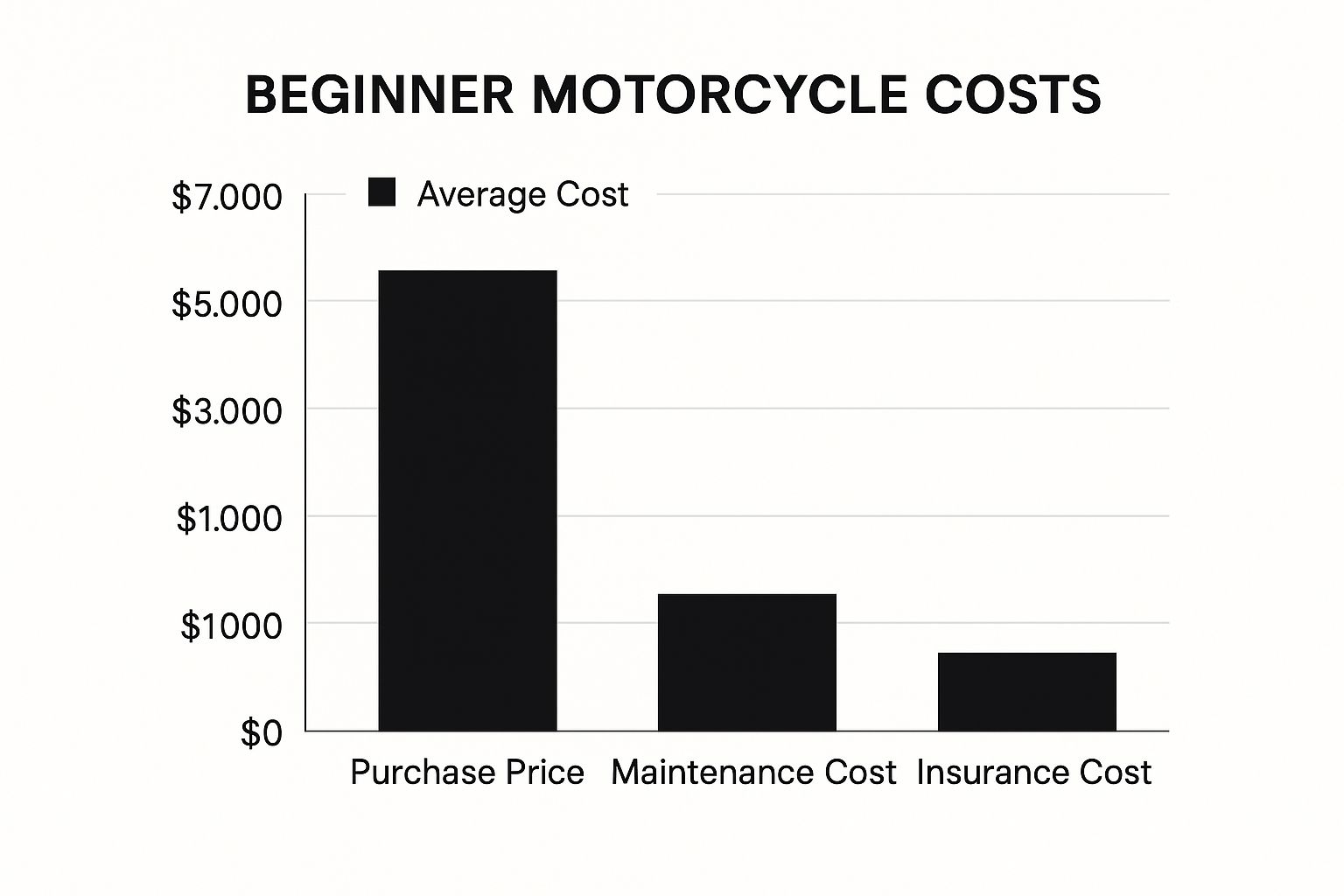
As you can see, things like insurance can add up quickly, so it's crucial to get quotes and build these expenses into your overall budget from day one.
To help you visualize the differences, here's a side-by-side look at some of the best motorcycles for beginners, highlighting their key specifications.
A quick reminder: spec sheets only tell part of the story. The absolute best way to know if a bike is right for you is to sit on it. A motorcycle that looks perfect on paper might feel all wrong once you're in the saddle.
| Model |
Style |
Engine (CC) |
Seat Height (inches) |
Weight (lbs) |
| Honda Rebel 300 |
Cruiser |
286 |
27.2 |
364 |
| Kawasaki Z400 |
Standard/Naked |
399 |
30.9 |
364 |
| KTM 390 Duke |
Standard/Naked |
373 |
32.7 |
340 |
| Yamaha YZF-R3 |
Sport |
321 |
30.7 |
375 |
| Suzuki DR-Z400S |
Dual-Sport |
398 |
36.8 |
317 |
This table makes the trade-offs crystal clear. The Honda Rebel 300 has that incredibly low seat, while the KTM 390 Duke is a featherweight, making it feel super nimble. Your perfect bike depends on what you value most.
So, you’ve waded through the different styles and maybe even have a few models bookmarked that feel just right. Now for the million-dollar question every new rider faces: should you buy a brand-new bike or a pre-owned one?
There's no magic answer here. It really boils down to your budget, how comfortable you are with potential maintenance, and what you’re looking for in your first vehicle experience. Let's break it down.
For some folks, buying new is the only way to go. You get a flawless machine straight from the factory, a full warranty, and the peace of mind that comes with knowing you're its one and only owner. Plus, newer bikes almost always include the latest safety tech, like anti-lock braking systems (ABS), which is an incredible safety net when you're just starting out.
Of course, that showroom shine comes with a hefty price tag. And just like a new car or RV, a motorcycle loses a big chunk of its value the second you ride it off the lot. A used bike, however, lets the first owner absorb that depreciation hit. This makes the used market a treasure trove for finding the best motorcycle for beginners without breaking the bank.
Opting for a used bike can easily save you thousands. That’s serious cash you can pour into top-notch gear, an advanced rider course, or just tuck away for gas and future maintenance. A used bike is also a much more forgiving learning tool.
Let’s be honest for a second. As a new rider, you're probably going to drop your bike. It happens to almost everyone, usually at a standstill in a parking lot. Scratching up a $4,000 used bike stings a lot less than putting the first dent in a pristine $8,000 machine.
The real advantage of buying used is financial and emotional freedom. You get a capable machine to build your skills on without the constant fear of that first cosmetic mistake, allowing you to focus purely on becoming a better rider.
Naturally, buying used means you have to do your homework. You’re the one responsible for checking the vehicle’s mechanical health, so you need to know exactly what to look for.
When you go to check out a used motorcycle, put on your detective hat. Don’t be timid—get down on your knees and really inspect the machine. A few minutes of thorough investigation can save you from a world of mechanical headaches and financial regret.
Key Inspection Points:
- Tires and Chain: How's the tire tread? Look for cracks in the sidewalls, which indicate old, brittle rubber. The chain should be clean and have just the right amount of slack—not sagging, but not banjo-string tight. A dry, rusty chain is a huge red flag that the bike has been neglected.
- Leaks and Fluids: Scan the engine and front forks for any signs of oil or coolant drips. Use the sight glass or dipstick to check the oil. It should look like honey, not dark, sludgy coffee.
- Crash Damage: Scrapes on the ends of the handlebars, footpegs, and exhaust pipe are the classic calling cards of a bike that's been dropped. Run your hand along the gas tank to feel for dents or deep scratches that might have been painted over.
- Cold Start: This is crucial. Always insist on hearing the bike start from cold. An engine that’s already been warmed up can easily hide starting problems. It should fire up smoothly without a ton of sputtering, and you shouldn’t see any blue or white smoke coming from the exhaust.
Remember to think about the total cost of ownership. Your budget isn't just the price on the tag; it’s the bike plus gear, insurance, and training. You should plan on spending $800-$1500 for a quality helmet, jacket, gloves, and boots. Consider it a non-negotiable part of the investment. Armed with this knowledge, you can walk into any negotiation with confidence.
Getting into motorcycling is an incredible feeling, but it's totally normal to have a few questions buzzing around in your head. Let's tackle some of the most common ones we hear from new riders. Clearing these up now will give you the confidence you need to hit the road.
Think of this as a final once-over before you swing a leg over your first bike. Getting these answers straight will save you a lot of guesswork and help you start your journey the right way.
Yes. Full stop. It's hands-down the smartest first step you can take. Signing up for a Motorcycle Safety Foundation (MSF) course or a similar local program is a game-changer.
You'll learn the absolute essentials in a controlled, safe space, riding a bike that isn't even yours. Not only will you become a much more competent rider, but passing the course often gets you a nice discount on your insurance. It's the perfect way to build a solid foundation.
The MSF course is also a fantastic "try before you buy" experience. You get to feel what it's like to handle a motorcycle before you've spent thousands of dollars. Many new riders figure out exactly what kind of bike feels right for them during the course, which is a huge help when it's time to shop.
I know, the temptation is real. You see those sleek, aggressive bikes and picture yourself on one. But for a new rider, the answer has to be a firm, responsible "no." Starting on a 600cc supersport is a bad idea.
Those bikes are high-strung, precision-tuned machines built for the racetrack. Their power is immediate and explosive, and their handling is razor-sharp—all things that are incredibly unforgiving for a beginner. Learning the ropes on a bike that wants to go 100 mph in first gear is a recipe for disaster. It's far better to master the fundamentals on a smaller, more manageable motorcycle first.
Your gear is just as critical as the bike itself, so this isn't the place to cut corners. A good rule of thumb is to budget between $800 and $1,500 for a full, quality setup.
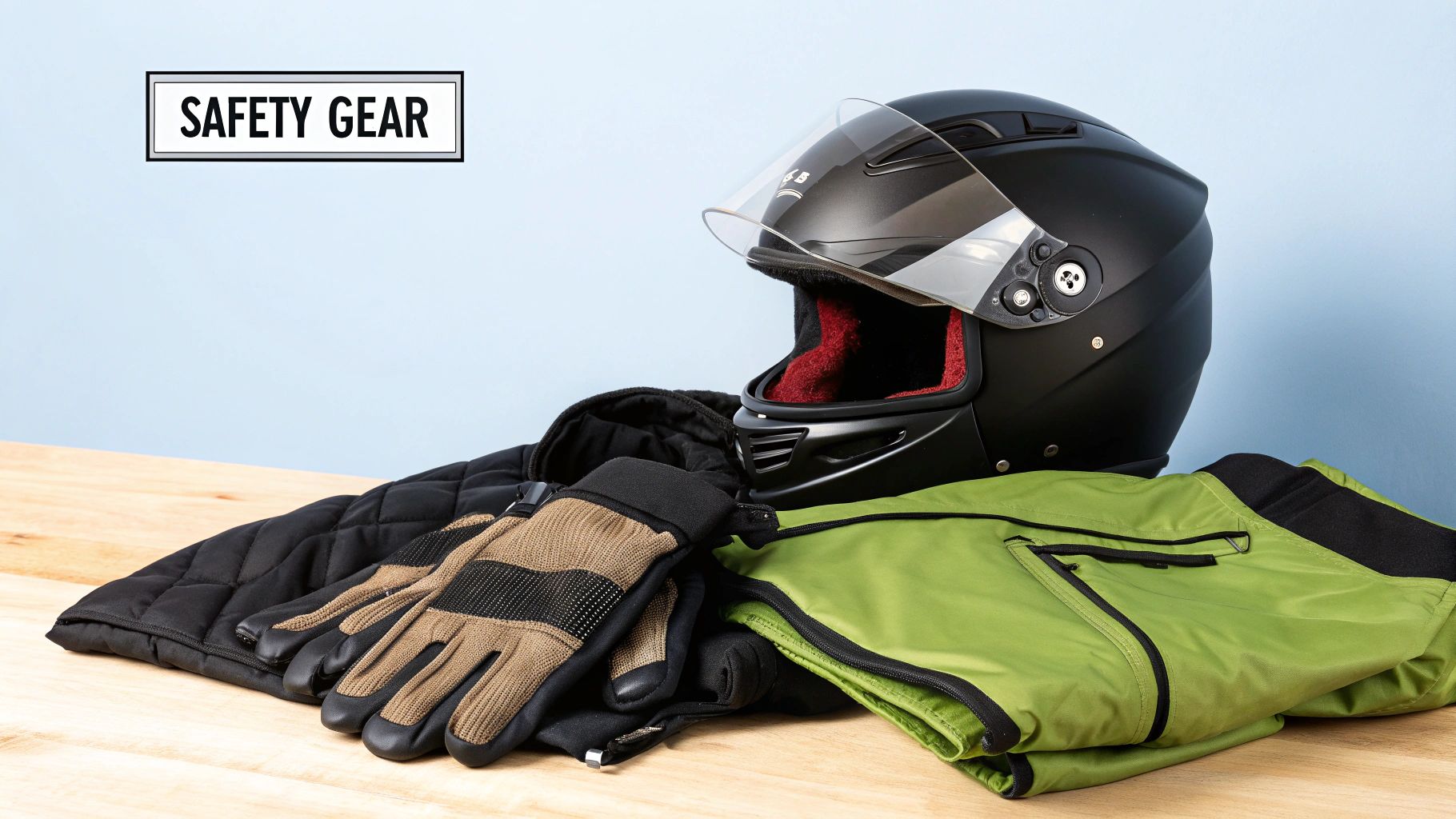
That budget should get you all the non-negotiable pieces:
- A DOT or ECE-certified helmet
- An armored riding jacket
- Proper motorcycle gloves
- Sturdy boots that cover your ankles
- Abrasion-resistant riding pants
Always remember the old saying: dress for the slide, not for the ride. Your gear is the only thing between you and the pavement.
At SearchShop.com, our mission is to make buying any vehicle a clear and simple process. Whether you're hunting for your first motorcycle, a family RV, a trail-ready ATV, or a new truck, our huge inventory and smart research tools will help you find exactly what you need. Explore thousands of new and used vehicles and buy with total confidence at SearchShop.com.
Article created using Outrank