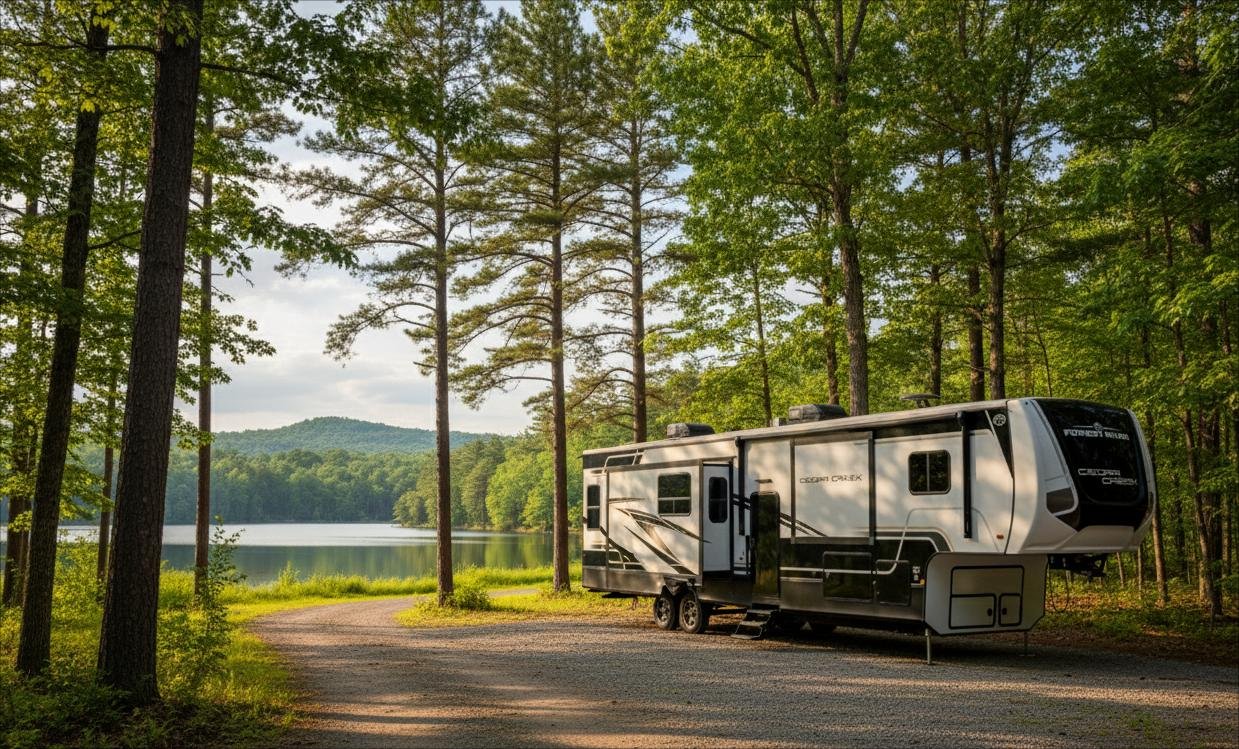
When you start thinking, "I need to find a toy hauler fifth wheel for sale near me," you're in luck. These days, a mix of online marketplaces, dedicated RV classifieds, and dealer locators makes the hunt easier than ever.
The trick is to cast a wide net at first, using your zip code on the big search platforms. From there, you can start filtering by the brands you like, the size you need, and the budget you’ve set. This guide is here to help you turn that initial curiosity into a successful purchase.
A toy hauler fifth wheel is so much more than just an RV. It's your mobile basecamp, perfectly engineered for adventurers who don't want to leave their favorite toys behind.
Picture a comfortable, modern home seamlessly fused with a spacious, versatile garage. That’s a toy hauler. It gives you the freedom to pack up your motorcycles, ATVs, kayaks, or mountain bikes and hit the road. This unique blend of luxury living and serious hauling capacity is what makes it the top choice for anyone with an active, outdoor-focused lifestyle.
Consider this your complete roadmap. We'll walk you through everything, starting with how to master your local search and covering every crucial step along the way to becoming a confident buyer.
You’re not the only one looking! The popularity of these rigs is booming, and the numbers back it up. The toy hauler RV market is on track to hit a value of around $2 billion by 2025, growing at a steady clip of nearly 6% each year.
This surge is driven by people just like you—folks who want a multi-purpose RV that serves as both a cozy home on wheels and a capable cargo hauler. Even when the general RV market has its ups and downs, the toy hauler segment often holds strong because of its specialized appeal.
Finding the right rig goes way beyond a quick online search. To make a smart investment you'll be happy with for years, you need a solid game plan.
-
Master the Local Search: First, you have to know where to look. We'll show you the best platforms and search terms to uncover those hidden gems right in your backyard. A great starting point is exploring a comprehensive directory of RV dealerships near you to see what's available.
-
Decode the Key Specs: Next, you need to speak the language. Understanding what terms like GVWR (Gross Vehicle Weight Rating) and garage capacity really mean is essential for your safety and enjoyment.
-
Inspect with Confidence: Finally, you need to know a good rig from a bad one. We'll give you a detailed checklist so you can spot potential red flags before you ever sign on the dotted line.
This whole process is about finding the perfect machine to fuel your adventures. Let's get started.
Finding the right rig is all about knowing where to look. Sure, you can type "toy hauler fifth wheels for sale near me" into Google and see what pops up, but the truly great deals—the hidden gems—require a bit more digging. Think of it less like a simple search and more like a treasure hunt.
By combining big online platforms with some old-school legwork, you'll uncover options that most buyers completely miss. Let's get into the nitty-gritty of how to find the perfect toy hauler right in your own backyard.
The huge online marketplaces are your best friends in this process, but only if you know how to use them properly. Websites like RV Trader and even Facebook Marketplace are where most of the action is, and mastering their search filters is the name of the game.
Don't just plug in your zip code and start scrolling. Dive deep into the advanced search functions. This is how you cut through the static and zero in on the exact models that fit your life.
-
Model and Year: Got your eye on a Grand Design Momentum or an Alliance Valor? Search for it by name.
-
Price Range: Figure out your budget before you start looking. It's way too easy to get tempted by a rig that's just outside your price range.
-
Garage Size: This one is non-negotiable. Measure your side-by-side, bikes, or whatever you're hauling, and filter for a garage that gives you some wiggle room.
-
Sleeping Capacity: If you're bringing the whole crew, filtering by how many people a rig can sleep will save you a ton of time.
Here's what you'll see on the RV Trader homepage. This is your starting point for getting super specific.
From here, you can drill down and turn a nationwide inventory into a manageable list of real contenders near you.
How you search can completely change what you find. A private seller might not list their rig with the same polished, keyword-rich title a dealership would. To find these "hidden" listings, you have to get creative and think like the person selling it.
Mix it up with a few of these variations:
-
"5th wheel with garage for sale"
-
"Fifth wheel toy hauler [your town/county]"
-
"Toy hauler camper for sale near [nearby large city]"
-
Get specific: "Used Fuzion 429 for sale"
By switching up your search phrases, you catch all the different ways people list their RVs. It’s a simple trick, but it can easily uncover dozens of local toy haulers you would have otherwise never seen.
While the major marketplaces are your bread and butter, they aren't the only game in town. Some of the best deals, especially from motivated private sellers, are found in places the average buyer doesn't think to look.
Tapping into these communities can lead you to a well-cared-for rig, often at a great price, that was never even listed on the big sites.
How to Uncover Off-Market Deals
-
Go Straight to the Source: Call or, even better, visit your local RV dealerships. Salespeople often know about trade-ins that have just arrived but haven't been listed online yet. Striking up a conversation can get you a first look.
-
Hit the Shows: RV shows and expos are a goldmine. You can walk through dozens of models in a single afternoon and often find show-only discounts from dealers and private sellers trying to make a deal.
-
Join the Club (Forums): Every major brand has an owner's forum (like Grand Design Owners or Keystone Forums). Members often post their rigs for sale there first, complete with meticulous maintenance records, to an audience they know will appreciate it.
-
Check Social Media Groups: Search on Facebook for groups like "[Your State] RV Buy/Sell/Trade" or "Toy Hauler Owners Group." These are fantastic places to find private-party deals and get honest feedback from people who already own the models you're considering.
When you first lay eyes on a toy hauler's spec sheet, it can feel like you're trying to crack a secret code. You're hit with a wall of acronyms, weights, and measurements that can make your head spin. But trust me, those numbers aren't just technical jargon—they're the blueprint for your future adventures.
Getting these details right is what separates a rig that feels like a perfect extension of your lifestyle from one that’s a constant source of headaches. Understanding this blueprint is your secret weapon when you're searching for toy hauler fifth wheels for sale near me. It lets you instantly weed out the models that won’t work and laser-focus on the ones that will. It’s all about matching the machine to your mission.
This visual map lays out the different avenues you can explore to find the right rig locally, from starting your search online to kicking the tires at a dealership.

Each of these methods has its perks. By blending all three, you’ll get the most comprehensive picture of what’s available in your area.
To make sense of it all, let's break down the most critical specs and what they really mean for you. The table below cuts through the clutter, explaining the key numbers on that spec sheet.
| Specification |
What It Means |
Why It Matters to You |
| GVWR (Gross Vehicle Weight Rating) |
The absolute maximum weight the toy hauler can be, including the trailer, all your gear, water, propane, and toys. |
This is the most important safety number. Your truck's tow capacity must exceed this figure. No exceptions. |
| Garage Dimensions |
The usable length, width, and height of the cargo area where you'll park your toys. |
Your side-by-side or dirt bikes have to fit. Measure your toys before you shop and add a few inches for clearance. |
| Cargo Carrying Capacity (CCC) |
The total weight of all the "stuff" you can load into the RV. This includes toys, water, food, clothes, and gear. |
This tells you how much adventure equipment you can actually bring along without overloading the trailer. |
| Holding Tank Sizes |
The capacity of the fresh, gray (sinks/shower), and black (toilet) water tanks, measured in gallons. |
These numbers dictate your off-grid freedom. Bigger tanks mean longer stays in remote spots before needing to resupply or dump. |
| Ramp Door Capacity |
The maximum weight the rear ramp door can support when used as a ramp or a patio. |
You need to be sure the ramp can handle the weight of your heaviest machine rolling up and down it. |
Getting a handle on these numbers isn't just about ticking boxes; it's about picturing how you’ll use the RV and ensuring the specs align with that vision.
Let's be crystal clear about this: the single most important spec on that entire sheet is the Gross Vehicle Weight Rating (GVWR). This isn't a friendly suggestion; it’s a non-negotiable safety limit baked into the trailer's design by the engineers who built it. It’s the maximum your toy hauler can weigh when it's packed with your gear, your toys, and full tanks.
Think of it like packing a backpack for a serious mountain trek. You can’t just cram in everything you own. You have a physical limit to what you can carry before you risk injury or failure. The GVWR is that limit for your RV, and pushing past it puts dangerous stress on the frame, axles, and tires.
Your truck’s towing capacity must be higher than the toy hauler’s GVWR. There is zero wiggle room on this. Mismatching your truck and trailer is a recipe for disaster, plain and simple. It leads to terrible handling, braking problems, and puts you in a seriously dangerous spot on the road. Always start with what your truck can safely tow, and only then look at toy haulers that fall well within that number.
The garage is the whole reason you're buying a toy hauler, so its dimensions are non-negotiable. You need to know the exact length, width, and height of your biggest toy, whether it's a massive side-by-side or a couple of dirt bikes. Get out the tape measure, write down the numbers, and then add a few inches all around for clearance.
But it's not just about raw space. Look closer at these critical garage features:
-
Ramp Door Capacity: That ramp isn't just a door—it’s a piece of structural equipment. Make sure its weight rating can easily handle your heaviest toy.
-
Tie-Down Points: You want to see heavy-duty, frame-mounted D-rings. The placement and number of these points are what will keep your very expensive gear locked down and secure while you're rolling down the highway.
-
Floor Material: Is the flooring tough, fuel-resistant, and easy to clean up? The garage floor is going to take a beating, so it better be built for it.
Think of the garage as a custom-fit suit for your adventure equipment. If it doesn't fit perfectly, the entire outfit is useless, no matter how nice the living room is.
Your ability to escape the crowded campgrounds and truly go off-grid boils down to your tank sizes and power system. These specs are your lifeline, determining how long you can comfortably camp before you have to hunt down a dump station or a power outlet.
For instance, a family of four can easily use 20-30 gallons of fresh water a day, even when being careful. If a rig only has a 50-gallon fresh tank, your boondocking trips are going to be cut very short. If you dream of exploring remote places, you need to be looking for models with generous holding tanks.
-
Fresh Water Tank: For any serious off-grid use, bigger is always better. I'd aim for 100+ gallons.
-
Gray Water Tank (Sinks/Showers): This tank often fills up the fastest. A large gray tank is just as vital as a large fresh one.
-
Black Water Tank (Toilet): This determines how many days you have before the inevitable trip to a dump station.
-
Generator: An onboard generator is an absolute game-changer, giving you AC power wherever you park. Check its fuel source (gas or propane) and its wattage output.
This demand for blending rugged utility with real comfort is what's pushing the market forward. We're seeing a steady rise in consumer trends in toy hauler searches as more people want this kind of flexibility. Big platforms like RV Trader, which draws about 6.5 million visitors a month, reported a significant jump in toy hauler searches in early 2025. This interest is driving manufacturers to innovate with models like the Jayco Seismic 413, which pairs a massive 13-foot garage and a cargo capacity of over 5,000 pounds with high-end living quarters.
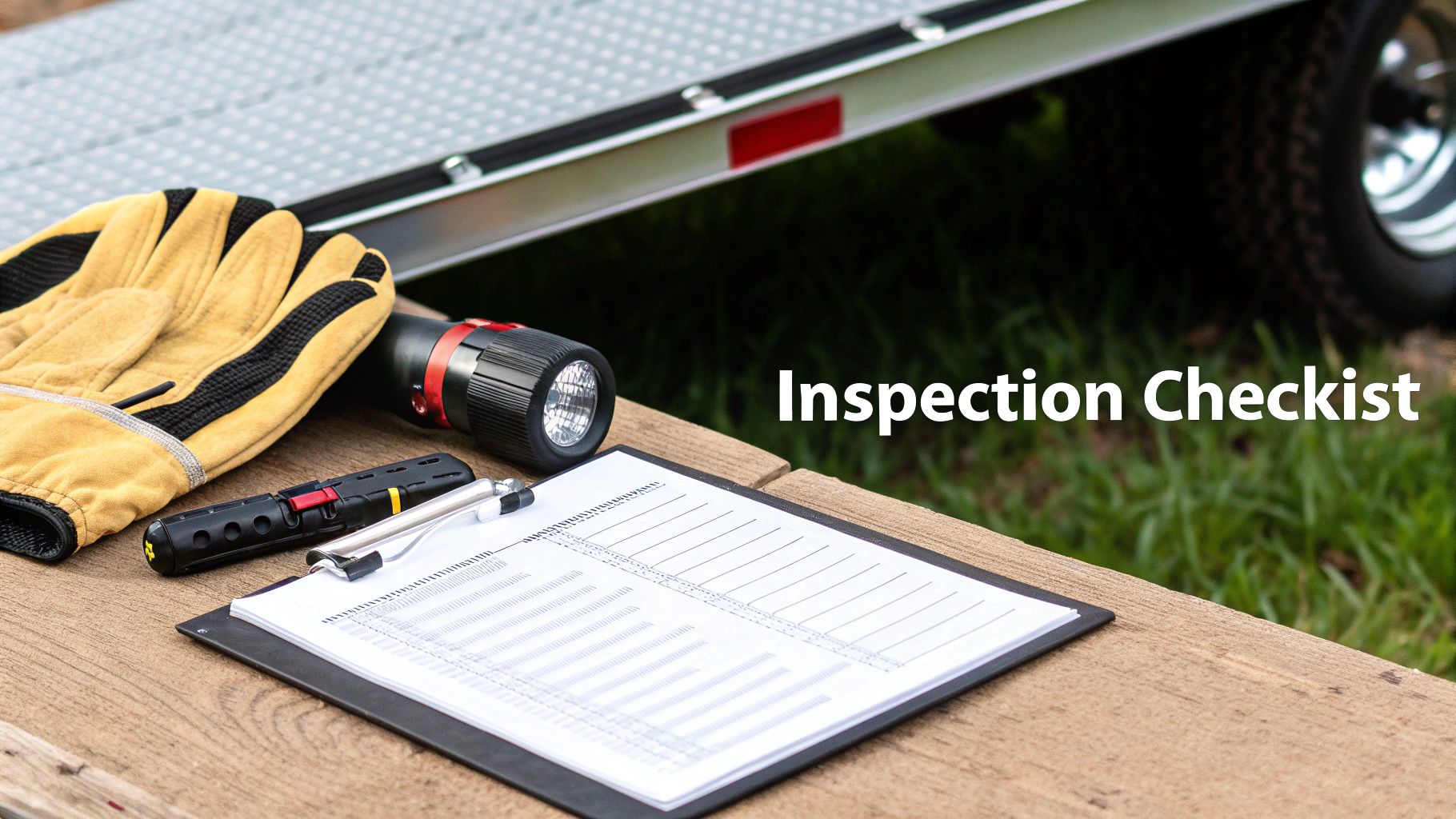
Alright, you've done the online legwork and found a toy hauler that looks promising. Now comes the most critical part of your "toy hauler fifth wheels for sale near me" search: the on-site inspection. This isn't just a quick once-over; it's a deep-dive investigation that can save you from a world of headaches and wallet-draining repairs.
Think of yourself as a home inspector, but for a house on wheels. A systematic, zone-by-zone approach is the only way to ensure you don't miss a critical flaw. Let’s walk through the three key areas you need to put under the microscope: the garage, the living quarters, and the exterior.
The garage is the heart and soul of a toy hauler, so this is where I always start. It's the workhorse of the rig, and if there are problems, they'll usually show up here first. The floor and ramp door take the most punishment, so they deserve your full attention.
First thing, lower that ramp door. Listen for any groaning or catching, and watch how it moves. Check the cables and hinges for fraying or rust. Once it’s down, walk every square inch of it. Bounce on it. Do you feel any soft spots or see any signs of delamination? That’s a huge red flag for water damage or a failing structure.
Now, step into the garage. Stomp around the entire floor, paying extra attention to the corners and edges where water tends to collect. Any sponginess underfoot means water has gotten in, and that’s a deal-breaker for me. Finally, grab every single tie-down D-ring and give it a hard pull. You need to know they’re anchored securely to the frame, not just the floor.
Next up, let's head into the living area. Your number one mission in here is to be a water detective. Water is the silent killer of RVs, causing thousands in hidden rot and mold damage.
Use your senses. Your eyes and nose are your best tools for this job.
-
Stains or Discoloration: Scan the entire ceiling. Pay close attention to the areas around every vent, skylight, and the air conditioning unit.
-
Wrinkled Walls: Look for any bubbling or warping in the wall panels. It’s a classic sign that moisture is trapped behind them.
-
Musty Smells: If you get even a whiff of a damp, musty odor, be on high alert. That smell almost always means hidden mold or mildew.
Once you’ve cleared the area for water damage, it's time to test every single thing that turns on, slides out, or cools down. Don't just take the seller's word for it. You have to see it work with your own eyes.
Pro Tip: Before you even drive out, ask the seller to have the rig plugged into shore power and city water. If they hesitate or say they can’t, I'd be suspicious. You can’t properly test a thing without power and water.
Go down the list methodically:
-
Run all the slide-outs in and out a couple of times. Listen for any grinding or hesitation.
-
Fire up the furnace and the air conditioner (test both the AC and the heat pump if it has one).
-
Turn on the water heater using both the electric and propane settings.
-
Check the refrigerator on both power sources, too. Give it time to get cold.
-
Flick every light switch, test every outlet, and run the microwave for a minute.
This might seem tedious, but it’s absolutely essential. For an even more detailed checklist, our guide on RV inspection steps for spotting hidden issues goes into greater depth.
Last but not least, we inspect the rig’s armor and bones—the exterior, from the roof all the way down to the tires. This is where you’ll spot signs of neglect and potential structural issues.
If you can do it safely, get up on the roof. It’s the RV’s first line of defense. Look for cracked, peeling, or missing sealant around every single vent, seam, and the front and rear caps. The condition of the roof sealant tells you almost everything you need to know about how well the previous owner maintained it.
Back on the ground, get down on your hands and knees with a flashlight. Check the frame, leaf springs, and axles for rust. Some light surface rust is fine, but if you see deep, flaky rust that’s eating away at the metal, you could be looking at a serious structural problem.
Finally, check the tires. Look for the four-digit date code on the sidewall. RV tires often age out before they wear out and should be replaced every five to seven years, no matter how much tread is left. Old tires are a blowout waiting to happen. Also, look for any small cracks in the sidewalls, a sign of dangerous dry rot. A thorough three-zone inspection like this is what separates a smart buy from a costly mistake.
So, you've started searching for "toy hauler fifth wheels for sale near me." Your search results are probably splitting into two main channels: local RV dealerships and private sellers. It’s a lot like buying a car—you can go to the shiny showroom with a full service department out back, or you can buy one directly from your neighbor down the street.
Each path has its own unique landscape, complete with big advantages and potential pitfalls. The best choice for you really boils down to your budget, how comfortable you are with risk, and how much legwork you’re willing to put in. One route offers a safety net for a higher price, while the other dangles a lower price tag but puts all the responsibility squarely on your shoulders. Let's break down what each experience is really like.
Walking onto a local RV dealership lot is often the most straightforward way to get into a toy hauler. Dealers aim to be a one-stop shop, bundling the RV, financing, and all the paperwork into a neat little package. This path is fantastic for first-time buyers or anyone who just wants the peace of mind that comes with a structured process.
Here’s what you get when you go through a dealer:
-
Warranties and Service: New fifth wheels come with a manufacturer's warranty, and most good dealers offer at least a limited warranty on their used models. If a major appliance quits a week after you buy it, you have a clear place to go for help.
-
Financing Assistance: Dealers work with a network of lenders day in and day out. This relationship makes it much easier to secure an RV loan, even if your credit isn't perfect.
-
Trade-In Options: Already have an RV? A dealer can take it as a trade-in, which dramatically simplifies the process of upgrading your rig.
-
Inspected Inventory: Reputable dealers don't just take a used RV and slap a price tag on it. They inspect and often recondition their inventory, which weeds out a lot of the immediate, costly surprises.
Of course, all this convenience and security isn't free. Prices at a dealership are almost always going to be higher than what you’d find in a private sale. You’re paying for their overhead, the cost of reconditioning, and their profit margin. Plus, you have to navigate a sales environment, which isn't everyone's cup of tea.
The private market is where the real bargains are hiding. When you buy directly from an owner, you skip the dealer markup and have a lot more room to negotiate. This route can easily save you thousands of dollars, but it demands that you become a much more thorough, almost skeptical, buyer.
A private sale is, at its core, an "as-is" deal. The moment money changes hands and that title is signed, the RV—along with every single one of its hidden quirks and potential problems—is yours. There's no warranty, no service department to call, and no one to hold accountable if the generator dies on your first trip.
The big prize in a private sale is value, but the risk is inheriting someone else's problems. Your most powerful tool is a thorough inspection and asking the right questions to uncover the RV's complete history.
The toy hauler market is pretty resilient, so you’ll find plenty of options from both dealers and private sellers. Even though overall RV shipments dropped by a hefty 36.5% from 2022 to 2023, the fifth wheel segment—which includes a ton of toy haulers—held its ground and even saw some production growth. This consistent supply keeps the private market active. You can get a better sense of these dynamics by looking at recent RV industry shipment figures.
Whether you’re standing on a paved dealer lot or in a stranger’s driveway, having the right questions in your back pocket is crucial. Your mission is to peel back the layers and understand the RV’s real story.
For a Dealership:
-
What specific reconditioning or repairs did you perform on this unit?
-
Can I see the full service write-up from your pre-sale inspection?
-
What are the exact terms of the warranty you offer on this used RV? Is anything excluded?
-
Besides the sticker price, what other fees should I expect? Doc fees, prep fees?
For a Private Seller:
-
So, why are you selling it? (Listen carefully to the answer.)
-
Do you have maintenance records and service receipts I can look through?
-
Has this rig ever had any water damage or leaks, even small ones around a window or slide?
-
How old are the tires and batteries?
In the end, choosing between a dealer and a private seller is a judgment call. A dealer offers a structured, secure process. A private seller offers the chance to score a fantastic deal—but only if you do your homework and know exactly what you’re looking at.
Alright, you've done the hard work of finding the perfect rig and giving it a thorough inspection. Now comes the final stretch: handling the money and paperwork that officially makes it yours. This part can feel a little intimidating, but breaking it down makes it a straightforward process to get those keys in your hand.
Getting a loan for a big toy hauler isn't quite like financing a car. Lenders often classify RVs as luxury items, which means the approval process can be a bit different. Your best bet is to explore financing directly through the dealership, your own bank, or a local credit union. Dealerships are convenient, for sure, but your bank or credit union might just offer you a better interest rate. It pays to shop around.
Here's a pro tip: get pre-approved for your loan before you start seriously negotiating. Walking onto the lot with your financing already lined up is a massive advantage. It instantly proves you're a serious buyer and lets you focus the conversation on the final price, not on whether you can afford it.
Getting pre-approved is like having the cash in your pocket. It transforms you from a browser into a buyer, giving you the leverage to negotiate the best possible deal on the toy hauler fifth wheel you found for sale near you.
This step also forces you to get comfortable with the key financial terms before you're sitting across from a finance manager:
-
Interest Rate: This is the cost of borrowing the money, expressed as a percentage.
-
Loan Term: How long you have to pay it back. For RVs, this can be surprisingly long, often from 10 to 20 years.
-
Down Payment: The cash you put down upfront. Plan on 10-20% of the purchase price being the standard.
If you really want to get into the nitty-gritty, this guide on how to finance an RV the smart way is a fantastic resource for building a smart, sustainable budget.
Once your financing is locked in, it's time for the final paperwork. This is what makes the purchase official and legally transfers the toy hauler into your name. Make sure you have these critical documents in order.
-
Bill of Sale: Think of this as the official receipt for your purchase. It needs to clearly list the sale date, price, Vehicle Identification Number (VIN), and have signatures from both you and the seller.
-
Title Transfer: The seller signs the vehicle's title over to you. This is the single most important document for proving you are the new legal owner.
-
Registration and Plates: With the signed title and bill of sale in hand, you'll head to your local DMV. They'll help you register the rig in your name and issue your new license plates.
With the deal officially closed, the last puzzle piece is getting your new toy hauler home. If you aren't equipped to tow it right away, don't worry. There are specialized fifth wheel transportation companies that can safely and professionally move it for you.
It's completely normal to ha