Before you fall in love with a gleaming motorhome on the lot or a sleek boat bobbing in the marina, let's talk about the most important step: the money. Getting your finances sorted out first is the most critical part of buying an adventure vehicle. It’s the difference between years of happy memories and a purchase that ends in buyer's remorse.
It’s incredibly easy to get swept up in the excitement of a showroom, but your budget is the anchor that keeps you grounded. Forget the listed price for a moment. What you really need to figure out is the total cost of ownership, because the day you drive it home is just the beginning of your expenses.
Think of it this way: the sticker price is the ticket to the amusement park. You still have to pay for everything once you're inside.
For specialty vehicles like RVs and boats, those "inside" costs can be significant. First-time buyers often get blindsided by these expenses, so let's map them out now to avoid any nasty surprises down the road.
You'll want to budget for ongoing costs like:
- Insurance: RV and boat policies are specialized and usually cost more than your daily driver's insurance, thanks to their higher value and unique risks.
- Storage/Mooring Fees: Got a place to park that 40-foot Class A? If not, you'll need to rent a storage spot. For boats, that means paying for a slip at a marina. These fees can run into hundreds or even thousands per year.
- Maintenance & Repairs: Things will break. From regular engine service and oil changes to resealing an RV roof or maintaining a boat's hull, consistent upkeep is just part of the deal.
- Winterization: If you live where it freezes, you can't just park your RV or boat for the winter. It needs to be properly winterized to prevent pipes from bursting and causing thousands in damage.
- Fuel Costs: Let's be honest, these vehicles are thirsty. The fuel bill for a cross-country RV trip or a summer of boating will have a major impact on your budget.
To give you a clearer idea, here's a quick look at how these ownership costs might break down for both an RV and a boat.
| Expense Category |
Typical RV Costs (Annual Estimate) |
Typical Boat Costs (Annual Estimate) |
| Insurance |
$800 - $2,500+ |
$300 - $1,000+ |
| Storage/Mooring |
$500 - $3,000 |
$1,500 - $5,000+ |
| Maintenance/Repairs |
$1,000 - $4,000 |
$1,200 - $3,500 |
| Winterization/De-winterization |
$200 - $500 |
$300 - $600 |
| Fuel (Based on Usage) |
$1,500 - $5,000+ |
$1,000 - $4,000+ |
This table isn't exhaustive, but it paints a realistic picture of the financial commitment you're making beyond that initial purchase price.
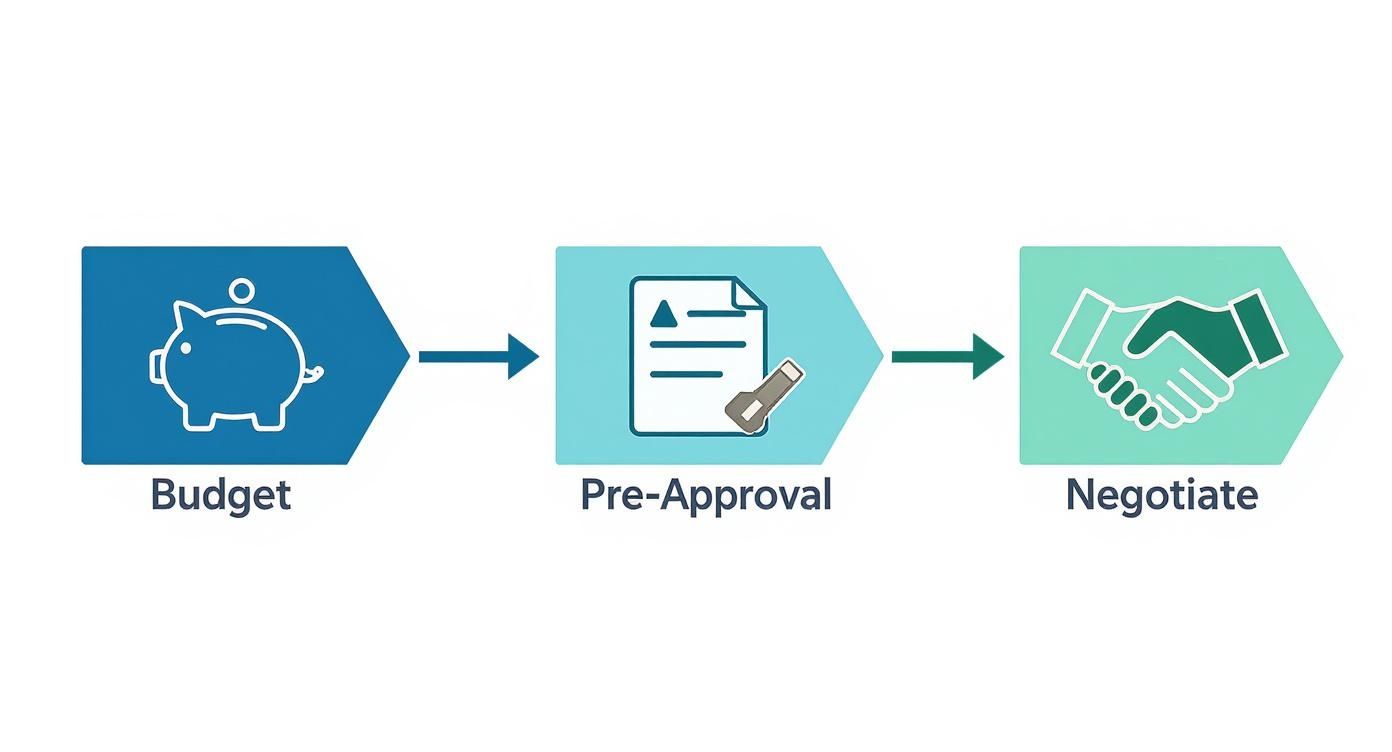
This simple flow—budget, pre-approval, negotiation—is your roadmap. Following it puts you in the driver's seat, turning you from a reactive shopper into a proactive, confident buyer.
Once you have a firm grip on your total budget, your next move is to get pre-approved for a loan. Don't skip this. Getting financing sorted out with your own bank or credit union before you talk to a seller is one of the smartest things you can do.
Why? Because it essentially turns you into a cash buyer.
You are no longer negotiating based on a monthly payment the dealer wants you to hit. Instead, you're negotiating the "out-the-door" price of the vehicle itself, which gives you a significant advantage.
This tactic keeps the deal clean. The dealer can't muddy the waters by mixing the vehicle price, your trade-in value, and financing terms into one confusing monthly figure. You stay focused on one thing: getting the best possible price on the vehicle.
Knowing a bit about the wider market helps, too. In 2025, global vehicle sales hit around 57.38 million units, with the USA making up 19.4% of that. That level of volume creates a competitive environment, which can mean better deals and more financing options for you. Keeping an eye on global auto market trends on Focus2move.com can give you a feel for whether it’s a buyer’s or seller’s market, giving you just a little more leverage at the negotiating table.
With your budget dialed in, it's time for the fun part: matching your dreams to your reality. It's incredibly easy to get swept up by the allure of a massive Class A motorhome or a slick, high-powered ski boat. But I've seen it happen time and again: the perfect vehicle on paper isn't always the one that fits your actual life. Getting this step right is the key to avoiding a beautiful, expensive mistake that ends up gathering dust.
Before you even start browsing, you need to get brutally honest about how you'll be using it. This goes way beyond planning one perfect vacation.
Think about your typical adventure and who’s coming along for the ride:
- Who's in your crew? Is this for quiet getaways with your partner, or are you packing in kids, grandkids, and the family dog? The space a couple needs is a world away from what a family of five requires to stay sane on a week-long trip.
- What's your travel style? Are you plotting epic, months-long cross-country treks, or are you more of a "weekend warrior" hitting local spots? Long-haul journeys demand a lot more in terms of storage, comfort, and sheer durability.
- What's the main mission? Is the goal full-time RV living, casual weekend fishing, or hosting the best parties on the lake with a pontoon? Each of these activities points to a completely different class of vehicle.
Answering these questions first moves you from a fuzzy dream to a concrete shortlist. It’s the foundation for a purchase that will bring you joy, not a headache.
When it comes to RVs, the big fork in the road is usually motorhome vs. travel trailer. They both put a roof over your head, but they deliver two totally different travel experiences.
A motorhome is your all-in-one rig. It’s fantastic being able to access the kitchen or bathroom while on the move, a huge plus for families. The downside? Once you’re parked and set up at a campsite, running a quick errand means packing everything up unless you tow a separate car.
A travel trailer, on the other hand, offers a ton of flexibility. You can drop the trailer at your campsite and have your tow vehicle free for exploring or grabbing groceries. That freedom, however, comes with a big string attached: you need a capable truck or SUV to pull it safely.
So many first-time trailer buyers get this wrong. They completely underestimate their tow vehicle's limits. Before you even think about shopping, find your truck's Gross Combined Weight Rating (GCWR). That’s the absolute maximum allowed weight for your vehicle, trailer, passengers, and all your gear combined.
For boat buyers, the logic is the same—it’s all about where and how you’ll use it. A boat built for glassy inland lakes will get you into serious trouble on choppy coastal waters.
Think about what a perfect day on the water looks like for you:
- Fishing: You'll want something with open decks and features built for anglers, like a center console or a dedicated bass boat.
- Watersports: A ski or wake boat is what you're after. They have specially designed hulls and powerful engines engineered to kick up the perfect wake.
- Relaxing & Entertaining: Nothing beats a pontoon boat. They offer a huge, stable platform for cruising comfortably with a big group.
- Overnight Trips: A cruiser or a cabin boat with sleeping quarters and basic amenities is essential for longer journeys on the water.
Your choice here directly impacts everything from your enjoyment to the nitty-gritty of ownership, like what kind of trailer you need and the skills required to handle it.
Beyond just picking a type of vehicle, a few practical details often get lost in the excitement. Thinking about these now will save you a world of hurt later.
Storage Solutions
Let’s be real: where are you going to park this thing? A 40-foot RV isn't going to fit in your driveway, and many HOAs have rules against it. You might need to budget for a monthly fee at a dedicated storage facility. The same goes for a boat—you’ll need a slip at a marina, a spot in dry stack storage, or a big enough piece of property to keep it at home.
Maneuverability and Skill
Handling a big motorhome or backing up a long trailer is a completely different ballgame than driving your car. Docking a boat in a crowded marina, especially with wind and current, takes real practice. Be honest with yourself about your comfort level and if you're willing to learn. Looking into a local RV driving course or a boating safety class isn't just a good idea; it's a smart investment in your safety and confidence.
By thinking through these real-world logistics, you can zero in on a vehicle that doesn't just look good in pictures but actually fits into your life.
You’ve done the research, crunched the numbers, and finally found an RV or boat that looks like "the one." Now comes the most important part of your entire boat and RV buying checklist: the hands-on inspection. Don't be fooled by a quick walk-around or a short test drive. This is your chance to play detective and uncover the vehicle's true story.
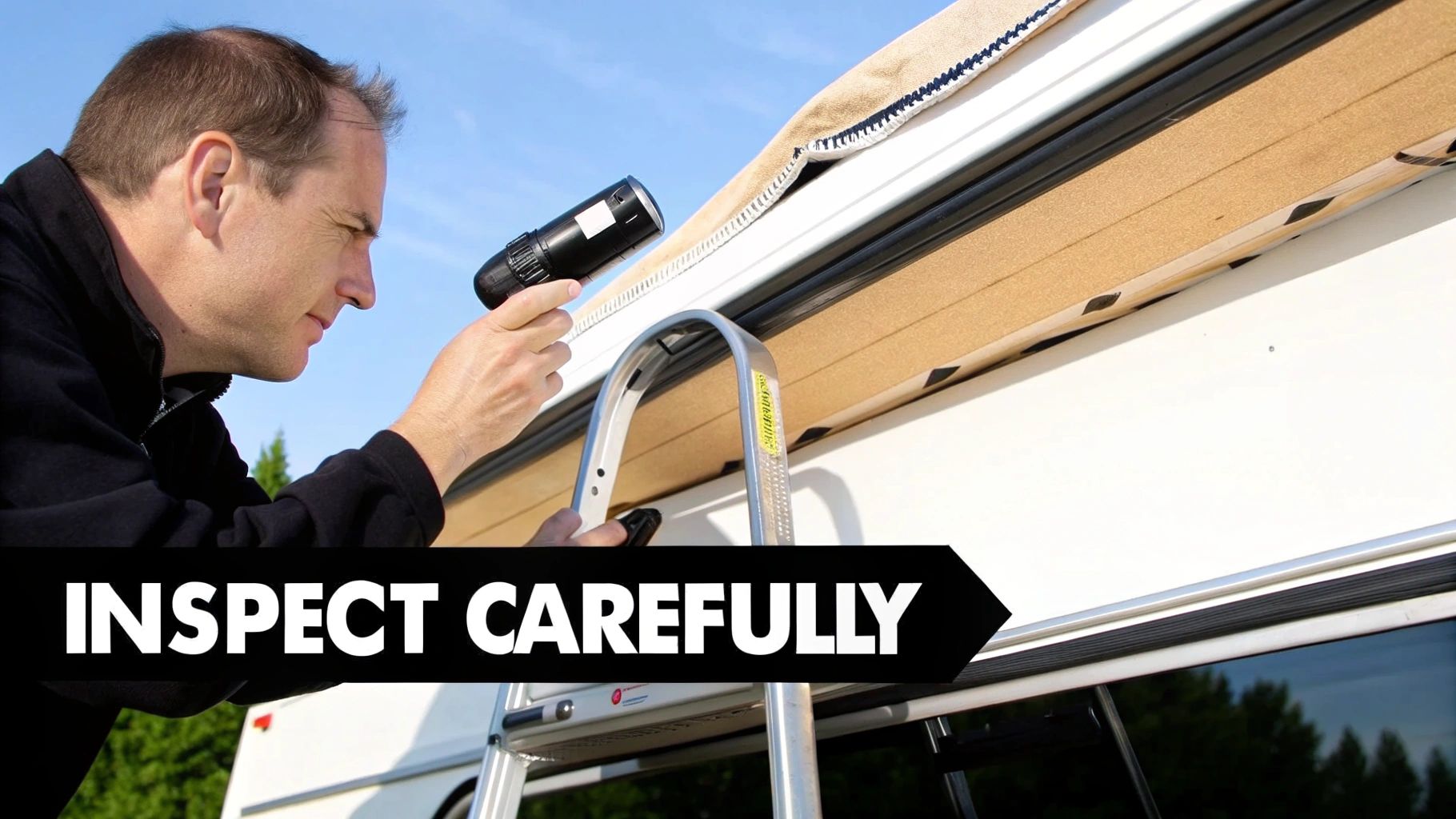
Honestly, this single step can be the difference between a dream purchase and a total financial nightmare. Your job is to look right past that shiny exterior and find the hidden problems that could drain your bank account later.
When it comes to recreational vehicles, one issue trumps all others: water damage. It's the silent killer of RVs, capable of rotting one from the inside out. I always tell people to make their entire inspection a hunt for moisture.
Start on the roof. Get up there and closely examine every single seam and seal. Look around the vents, the AC unit, the antennas—anywhere something is cut into the roof. You're looking for cracked, peeling, or separated sealant. Even a pinhole-sized gap can let in enough water over time to cause catastrophic damage to the walls and floor.
Once you’re inside, trust your senses:
- Look: Scan the ceiling and walls for any stains, discoloration, or bubbling paint. Pay extra attention to corners and the inside of cabinets.
- Feel: Walk the entire floor and press down firmly, feeling for any soft or spongy spots. The areas around the kitchen, bathroom, and slide-outs are common culprits.
- Smell: Take a deep breath. A musty, mildewy odor is a dead giveaway that there's hidden moisture somewhere.
Beyond water, you need to methodically test every system. Don't be shy about it. Any problem you find now is the seller's problem, not yours.
- Appliances: Fire up the fridge (on both gas and electric if it's a dual-source model), run the microwave, and test both the furnace and the air conditioner.
- Slide-Outs: Run every slide-out in and out a few times. Listen for weird grinding noises and make sure they move smoothly and evenly.
- Chassis and Tires: Crawl underneath and look for serious frame rust. Check the date codes on the tires. RV tires often die of old age before their tread wears out, and a blowout on a big rig is incredibly dangerous.
With boats, the inspection is just as intense, but your focus shifts to the hull and the engine. The marine environment is brutal, and a small problem can quickly become a major safety hazard out on the water.
Start with the hull. For fiberglass boats, hunt for spider cracks or blisters in the gelcoat, as these can point to moisture getting into the laminate. On aluminum boats, you need to check every weld and rivet for any sign of stress or cracking. A compromised hull is a deal-breaker, full stop.
Next, pop the engine cover. You don't have to be a master mechanic to spot big red flags. Look for excessive rust or corrosion on the engine itself. Squeeze the hoses—are they brittle or cracked? And take a good look at the bilge. A little clean water might be okay, but an oily film or a lot of standing water could mean you have a leak.
A clean, tidy engine bay is usually the sign of a careful owner. On the other hand, if you see a chaotic mess of wires and corrosion, it should make you wonder what else has been neglected.
Finally, just like with an RV, test everything. Flip every switch on the console. Test the bilge pumps and navigation lights. Check all the upholstery and canvas for mildew and rot. If you happen to be looking at an electric boat, the inspection needs to be even more thorough; you can find a great checklist covering the top things to look for when inspecting a used EV that has some good crossover points.
As important as your own inspection is, it shouldn't be the final verdict, especially on a used boat or RV. Hiring a certified RV inspector or a professional marine surveyor isn't an expense; it's an investment in your peace of mind.
These pros have specialized tools and a trained eye to spot things you'd never see. An RV inspector might use a moisture meter to find hidden water damage, while a marine surveyor will "sound" the entire hull by tapping it to listen for delamination.
Their fee, usually a few hundred dollars, is a tiny price to pay to avoid a $10,000+ repair bill. Plus, their detailed report is a powerful negotiation tool you can use to request repairs or a lower price based on their official findings.
You’ve found it. After all the searching, you’ve pinpointed the perfect RV for those long-awaited road trips or the boat that’s calling you to the water. Now comes the part that makes most people’s palms sweat: making the deal. But don’t worry. All that homework you’ve done is about to pay off in a big way, turning you from a hopeful browser into a confident buyer.
Good negotiation isn't about being confrontational. It's simply about reaching a fair agreement based on facts. You know the market, you have your financing lined up, and you understand the vehicle's true condition. With that knowledge, you can walk to the table ready to get a great price.
Your first offer really sets the stage for the rest of the conversation. A common mistake is to base your offer on the seller's asking price. Don't do that. Instead, anchor your offer in the real-world market data you’ve already gathered. This is where a tool like SearchShop.com becomes your secret weapon, showing you what similar models are actually selling for, which can be very different from the sticker price.
Let's say you're eyeing a five-year-old Class C motorhome with an asking price of $75,000. If your research on SearchShop shows that comparable units have been selling for closer to $68,000, that’s your starting point. Now, factor in what you learned during the inspection. Did the marine surveyor point out a boat's bilge pump is on its last legs? If that’s a $500 fix, it's perfectly reasonable to deduct that from your offer. Start with a realistic number that has a little wiggle room, but is firmly grounded in data.
A key piece of advice: The goal here is to arrive at a fair market price, not to "win" by lowballing the seller. When you present your offer, calmly explain the data and the inspection findings that led you to that number. It immediately establishes you as a serious, well-informed buyer.
If I can give you one piece of advice, it’s this: treat your trade-in as a completely separate transaction. Dealerships love to lump everything together—the price of the new vehicle, the value of your trade, and the financing details—into one confusing monthly payment. It's an old tactic called the "four-square," and it's designed to muddy the waters so you can't see the real numbers.
Politely but firmly insist on locking in the purchase price of the RV or boat before you even mention a trade-in. Once you have a final, agreed-upon price in writing, then you can say, "Great, now let's talk about my trade." This keeps the math clean and prevents the dealer from giving you an inflated trade-in value while secretly bumping up the price of the vehicle you're buying.
Once the numbers are settled, you'll be presented with a stack of documents. It’s so tempting to just sign and get on your way, but this is where you need to hit the brakes and read every single line. Slowing down now can save you major headaches later.
Pay close attention to these three documents:
- Purchase Agreement: This is the legally binding contract. Check that the vehicle identification number (VIN) or hull identification number (HIN) is correct. Make sure the final price, your trade-in value, and any promised repairs are all listed exactly as you discussed. No handshake deals here—if it's not in writing, it doesn't exist.
- Title: This is your proof of ownership. On a used vehicle, confirm the seller's name is on the title and, most importantly, check for any liens. A lien means a bank or lender still has a financial claim on the vehicle. That lien must be cleared before the title can be legally transferred to you.
- Financing Contract: If you're getting a loan, review the interest rate (APR), the loan term (in months), and the total amount financed. Keep an eye out for any surprise fees or add-ons that you didn't agree to.
Your last stop is usually the Finance and Insurance (F&I) office. This is where you’ll be pitched a whole menu of extras: extended warranties, tire and wheel protection, paint sealants, and more. While some of these can offer genuine value, they are also major profit centers for the dealership.
Before you agree to any of them, take a breath and ask if the cost truly justifies the benefit for your specific situation. An extended warranty on a high-tech motorhome with lots of complex systems might actually be a smart move. But even then, the price for that warranty is almost always negotiable. Don't be afraid to push back or decline altogether.
By staying focused, questioning every line item, and sticking to your plan, you'll ensure the deal you sign is the great deal you worked so hard for. Then, the real adventure can begin.
Buying an RV or a boat is a huge financial commitment. You're not just buying a vehicle; you're investing in years of future adventures. That's why it's smart to think about where the market is headed before you sign on the dotted line.
Right now, we're seeing a slow but steady shift toward electric and hybrid technologies in the recreational world. While good old gas and diesel engines are still king, things like solar-assisted RVs, hybrid motorhomes, and fully electric boats are popping up more frequently. Getting a handle on what these new options can—and can't—do will help you make a much smarter long-term choice.
Electric and hybrid options sound great on paper. They promise quieter operation and a break from high fuel prices. But they also come with a whole new set of practical questions you need to ask.
Thinking about an electric boat? Great, but where are you going to charge it? Many marinas are still playing catch-up and haven't installed the charging infrastructure needed to support a fleet of electric vessels.
It's the same story with an electric RV. Road trips require a different kind of planning. You’ll be mapping your route from one compatible charging station to the next, not just looking for the next gas station. You also have to be brutally honest about battery range, especially if you're towing a car or driving through mountains.
Thinking about the future isn't about jumping on the latest bandwagon. It's about honestly assessing whether these new technologies actually fit your lifestyle and how you plan to travel, both today and five years from now.
What About Maintenance and Resale Value?
The ownership experience for these newer vehicles is just different. On one hand, electric motors have way fewer moving parts than a traditional engine, which can translate to less routine maintenance. On the other hand, you're swapping oil changes for concerns about long-term battery health and potential replacement costs.
To keep everything straight, a good car maintenance checklist template is incredibly helpful. It gives you a structured way to track what needs to be done and when, protecting your investment no matter what's under the hood.
The move toward electrification is happening everywhere. In Europe, for example, new battery electric vehicle registrations jumped 27% in August 2025 compared to the year before, grabbing a record 20.2% of the market. This trend shows just how important things like charging access and battery longevity are becoming for buyers. You can dig into more data about the rise of European BEV sales on best-selling-cars.com.
Ultimately, you're the one who has to make the call. A traditional gas motorhome gives you proven, coast-to-coast reliability and a massive service network. An electric boat, however, might be the perfect, silent companion for your favorite lake. By weighing these future-focused details, you can pick a vehicle that you'll not only love today but that will also hold its value and relevance for many years to come.
You're in the home stretch. You've done the research, crunched the numbers, and probably kicked a few tires. But as you get closer to signing on the dotted line, a few big questions always seem to pop up. Let's tackle the most common ones we hear from buyers, so you can close the deal with total confidence.
Think of this as the final once-over on your RV and boat buying checklist. We'll get these last few details sorted out.
This is the big one, isn't it? There's no single right answer, because it really boils down to what matters most to you.
Buying new is fantastic. You get the latest tech, a full factory warranty backing you up, and, let's be honest, that amazing feeling of being the very first owner. It also means you’ll likely spend less time and money on immediate repairs and have a wider selection of current models to browse.
But going with a used model is often the smarter financial play. The biggest win is the lower price tag and much slower depreciation. New vehicles take a significant value hit the second they're driven off the lot. A well-cared-for model that's just a couple of years old can give you a great mix of modern features without that initial drop in value.
It's a classic trade-off between peace of mind and your budget. If a full warranty and zero prior wear-and-tear are non-negotiable for you, go new. If you want your money to go further and you're diligent about getting a pre-purchase inspection, a used vehicle is an excellent choice.
Your regular car insurance policy won't cover an RV or boat properly—they're specialized vehicles with unique risks. You need a dedicated policy to be truly protected.
- For your RV: A good policy should cover more than just the vehicle itself. Look for coverage that protects your personal belongings inside, offers vacation liability (in case a guest is injured at your campsite), and even full-timer liability if it’s going to be your primary residence.
- For your boat: The essentials are coverage for physical damage to the hull and liability protection for any on-water accidents. You'll also want to make sure your trailer is covered. Smart add-ons to consider include on-water towing and specific coverage for expensive fishing gear.
Don't just take the first quote you get. Prices can be all over the map, so shop around. An independent insurance agent who specializes in recreational vehicles can be a huge help here.
A "certified pre-owned" or CPO vehicle can be a great sweet spot between new and used. These are usually recent, low-mileage models that have passed a rigorous multi-point inspection by the dealer and come with a limited warranty.
The real benefit is dialing down the risk. You’re getting a vehicle that’s been professionally checked over and has a warranty to protect you from some surprise repair bills. That alone can be a massive stress reliever. The catch? You will pay a bit more for that security compared to a similar non-certified used model.
If you’re considering a CPO, always ask for a copy of the full inspection report. And read the warranty details carefully—you need to know exactly what’s covered and for how long.
Ready to turn all this knowledge into action? At SearchShop.com, we’ve built the tools to help you research pricing, compare different listings, and zero in on the perfect RV or boat for your next adventure. Start your search with confidence at https://www.searchshop.com.