When you're trying to figure out an RV's value, you need to look way beyond the sticker price. An RV's true worth isn't one set number; it's a flexible range based on its age, condition, and what the market is demanding right now. The best way to pin this down is by using NADAguides for a baseline, digging into comparable online listings for real-world pricing, and doing a detailed condition assessment of the rig itself. This three-pronged approach gives you the solid data you need to negotiate with confidence, whether you're buying an RV or a boat.
Before you even think about shopping or listing your own rig for sale, it's critical to get one thing straight: an RV’s value isn't a single, fixed number. It’s a dynamic figure that’s always shifting based on several key factors. Unlike a simple product off a shelf, a recreational vehicle—much like a boat—is a complex asset, and its value depreciates and fluctuates over time.
Thinking of an RV's price as just one number is a rookie mistake. A much better way to look at it is as a range influenced by a few different perspectives.
Understanding these core value types is the first step to determining a fair price for any RV or boat.
| Value Type |
What It Means |
How You'll Use It |
| Retail Value |
The highest price, what you'd see on a dealer's lot. It includes profit, reconditioning, and maybe a warranty. |
Use this as the top-end benchmark when you're buying from a dealership. |
| Wholesale Value |
The lowest price, what a dealer might pay for a trade-in or at auction before marking it up. |
A good reference point when you're trading in your rig or selling it quickly. |
| Private-Party Value |
The sweet spot between retail and wholesale. This is what a private seller can realistically ask from a private buyer. |
This is the most relevant number for most private sales, whether you're buying or selling. |
Getting a feel for these different values gives you a solid foundation for what to expect in the market.
Knowing the value types gives you a starting point, but it's the specific details of the RV that truly shape its final price. I've seen a decade-old RV that was meticulously maintained sell for more than a newer model that was clearly neglected.
For instance, a five-year-old Class A motorhome with low mileage and a stack of service records is going to fetch a much higher price than the exact same model with visible roof damage or a broken fridge. These details make all the difference.
An RV's true market value is a story told by its history, condition, and desirability—not just the number on its title. Mastering how to read that story is the key to a smart investment.
Understanding the true worth of any major asset, including RVs and boats, is the only way to make an informed decision. These same principles apply across the board, and you can learn more about how to determine the true value of a vehicle in general to broaden your knowledge.
Now, let's walk through the three key methods you'll use to get an accurate RV valuation.

Before you do anything else, your first stop for finding an RV’s value should be NADAguides, which is now part of J.D. Power. This isn't just a helpful website; it's the gold standard. Dealers, banks, and insurance companies all rely on these numbers for both RVs and boats, so you should too. It’s the closest thing to an "official" price you're going to find.
Getting started is simple enough. You’ll plug in the RV's year, make, and model. Accuracy is key here. A "Jayco Jay Flight 28BHBE" and a "Jayco Jay Flight 28BHS" might sound similar, but their values can be thousands of dollars apart. This first step gives you the "bare bones" value of the RV.
Now for the part that really fine-tunes the price: the options. This is where you account for all the extras that can significantly bump up an RV's worth. We're talking about things like a beefier generator, a full solar package, automatic leveling jacks, or a high-end awning. These aren't just creature comforts; they represent real money.
Take your time with this step. Go through the checklist and select every single feature that applies to the rig you're researching. It's easy to miss a valuable upgrade, but it's just as common to accidentally add value for something that was actually standard on that model. A little due diligence here pays off.
Let's walk through a quick example with a 2019 Winnebago Vista 29VE:
-
Manufacturer: Winnebago
-
Model / Series: Vista
-
Trim: 29VE
-
Options: This is where you'd check the boxes for any add-ons, like an exterior TV, an upgraded A/C unit, or specific interior finishes.
Getting this right ensures your starting number is as close to reality as possible before you move on to comparing it with what's actually for sale on the market.
After you've entered all the details, NADA will spit out a couple of key figures: Low Retail and Average Retail. Knowing how to read these is essential.
Low Retail: Think of this as the price for an RV that needs a little love. It might have high miles, show some obvious wear and tear, or require a few repairs. This is often the ballpark for a private-party, "as-is" sale.
On the flip side, Average Retail is what you should expect to pay for a well-maintained, clean unit from a reputable dealer. It’s been inspected, everything works, and it’s ready to hit the campground. Your job, which we'll get into next, is to use real-world comparisons and a thorough condition assessment to figure out where a specific RV truly lands between these two goalposts.

While NADAguides gives you a solid, industry-standard baseline, it’s just that—a starting point. The true market value of any RV or boat is what a real buyer is willing to pay for it right now. To get to that number, you have to put on your appraiser hat and start digging for "comps," which are just comparable vehicles currently on the market.
Think of it like pricing a house. You wouldn't compare a two-bedroom bungalow to a five-bedroom mansion, even if they're on the same street. It’s the same deal with RVs. This process is absolutely essential if you want to understand how to find RV values that reflect today's reality, not just a number in a book.
Your mission is to collect a handful of solid data points from a few different places. Casting a wide net gives you a much better feel for the market, showing you everything from what a private seller is asking to what a big dealership is charging.
Here are the best spots to start your search:
-
RV Trader: This is one of the biggest online marketplaces dedicated to RVs. Its search filters are fantastic, letting you dial in the exact make, model, year, and location to find direct comparisons. It's an invaluable first stop.
-
Facebook Marketplace: A goldmine for private-party sales of both RVs and boats. The variety here is huge, and you’ll often find that prices are more negotiable than what you'd see on a dealer lot.
-
Dealership Websites: Always review the inventory listings of local and regional RV and marine dealers. While retail pricing typically runs higher than wholesale values, these listings establish an essential benchmark for market positioning and pricing strategy.
By pulling listings from all three, you start to see the full spectrum of asking prices. This helps you build a realistic price range that accounts for both private sales and dealer profits.
Okay, finding another RV with the same make and model is easy. The real trick is making sure it's a true apples-to-apples comparison, because the devil is always in the details.
Drill down and focus on these three critical factors:
-
Mileage and Engine Hours: For motorhomes, mileage is a massive value driver. For any RV with a generator, or a boat with an engine, the hours can also swing the price significantly.
-
Floor Plan/Layout: A bunkhouse model is going to have a completely different value than a rear-kitchen layout, even if they're the same brand and year. For boats, a center console differs greatly from a cabin cruiser. Make sure the layouts match up.
-
Overall Condition: This one is more subjective but just as important. Scour the photos for signs of wear and tear, dated decor, or obvious damage. A listing described as "like new" is going to fetch a much higher price than one that’s been "well-loved."
In the world of statistics, there's a measure called the RV coefficient used to evaluate how similar two data sets are. A score above 0.7 suggests a strong match. You don't need to do any complex math, but the principle is key: the more similar your comps, the more accurate your valuation will be. If you're curious, you can explore the technical details behind this concept to get a better grasp of statistical similarity.
Pro Tip: Don't just look at the asking price. Pay close attention to how long an RV or boat has been listed. If you see the same unit pop up for months on end, it’s a giant red flag that it's overpriced. On the flip side, a vehicle that sells in a week was likely priced right on the money.
Ultimately, this hands-on research takes you from a theoretical number to what that rig is actually worth in your area. It’s the difference between guessing and knowing, and it'll help you spot an overpriced unit from a mile away—or recognize a great deal when one finally comes along.
How Condition and History Affect RV Value
Once you have a baseline value from your research and a good sense of the market from comps, it's time to get your hands dirty. This is where the rubber really meets the road. Two RVs can look identical on paper but be thousands of dollars apart in real-world value, all thanks to their condition and history.
Don't let a shiny exterior fool you. That gleaming fiberglass might be hiding a history of water damage, just as a dated-looking interior could belong to a rig with a perfectly maintained engine. Moving your valuation from a spreadsheet to an in-person assessment is what separates a smart buy from a costly mistake.
Some problems are just inconvenient. Others are absolute deal-breakers—or at least, massive negotiating points. When you're inspecting a used RV, these are the big-ticket items that can turn a dream rig into a nightmare. The same logic applies to boats, where a leaky hull or engine trouble can sink a deal.
-
Water Damage: This is, without a doubt, the #1 enemy of any RV. Look for discoloration on the ceiling, feel for soft spots on the floor (especially around walls and corners), and trust your nose—a musty smell is a huge red flag. Water intrusion leads to delamination and rot, which are often catastrophic to repair.
-
Roof Integrity: You have to get on a ladder for this one. Carefully inspect the sealant around every vent, skylight, and seam. A neglected roof is the main entry point for water, and a full roof replacement can easily cost upwards of $10,000.
-
Tire Age: RV tires almost always die of old age, not from a lack of tread. Find the DOT date code on the sidewall. If the tires are more than six or seven years old, they need to be replaced, period. A new set can run $2,500 or more.
-
Appliance Functionality: Test every single thing. The fridge on gas and electric. The furnace. The water heater. The AC. The microwave. A new RV refrigerator alone can set you back $2,000, so you want to know what works before you buy.
Finding a few problems doesn’t automatically mean you should walk away. In fact, it can be your biggest advantage. Every issue you uncover is a potential point of negotiation, but only if you handle it correctly.
A well-documented list of necessary repairs transforms your negotiation from a subjective argument over price into an objective discussion based on facts and figures. It’s the most effective way to justify a lower offer.
Let's say you discover the tires are eight years old. Before making an offer, get a quick quote from a local tire shop. Armed with that $2,500 estimate, you can approach the seller with a concrete, fact-based offer: "The market comps put your RV around $45,000, but it needs a new set of tires right away. I can offer $42,500 to account for that immediate expense."
The Importance of Maintenance Records
Finally, always ask to see the service history. A meticulous owner with a thick folder of receipts is a dream find. It's a clear sign they were proactive with upkeep rather than just fixing things as they broke.
This paper trail gives you incredible peace of mind and supports a higher valuation. A well-maintained and organized interior also speaks volumes about the owner's care; you can explore top RV organization hacks to see how a tidy space can make an RV feel more valuable and appealing.
Alright, you've put in the legwork. You've dug through NADAguides, scoured market comps, and given the RV a thorough once-over. Now comes the moment of truth: turning all that research into a solid offer that saves you money.
This isn't about pulling a number out of thin air. It's about piecing everything together—the good, the bad, and the ugly—to build a smart, defensible offer. Having a clear strategy before you even start talking to the seller changes the entire dynamic. It stops being a guessing game and becomes a conversation grounded in facts.
To walk into a negotiation with real confidence, one price point just isn't enough. You need to know your financial boundaries inside and out. I always recommend establishing three key numbers; this simple framework keeps you in the driver's seat.
-
Your Ideal Price: This is your best-case scenario. It’s an aggressive-but-fair number based on what the market data says, minus the cost of any repairs or immediate upgrades you’ve identified.
-
Your Opening Offer: Always start below your ideal price. This gives you some wiggle room to move up during the negotiation without immediately hitting your ceiling.
-
Your Walk-Away Price: This is your absolute, non-negotiable maximum. Figure this out beforehand and stick to it. It’s your safety net to prevent emotion from taking over and causing you to overpay.
This infographic breaks down some of the most critical inspection points that will directly influence your offer.
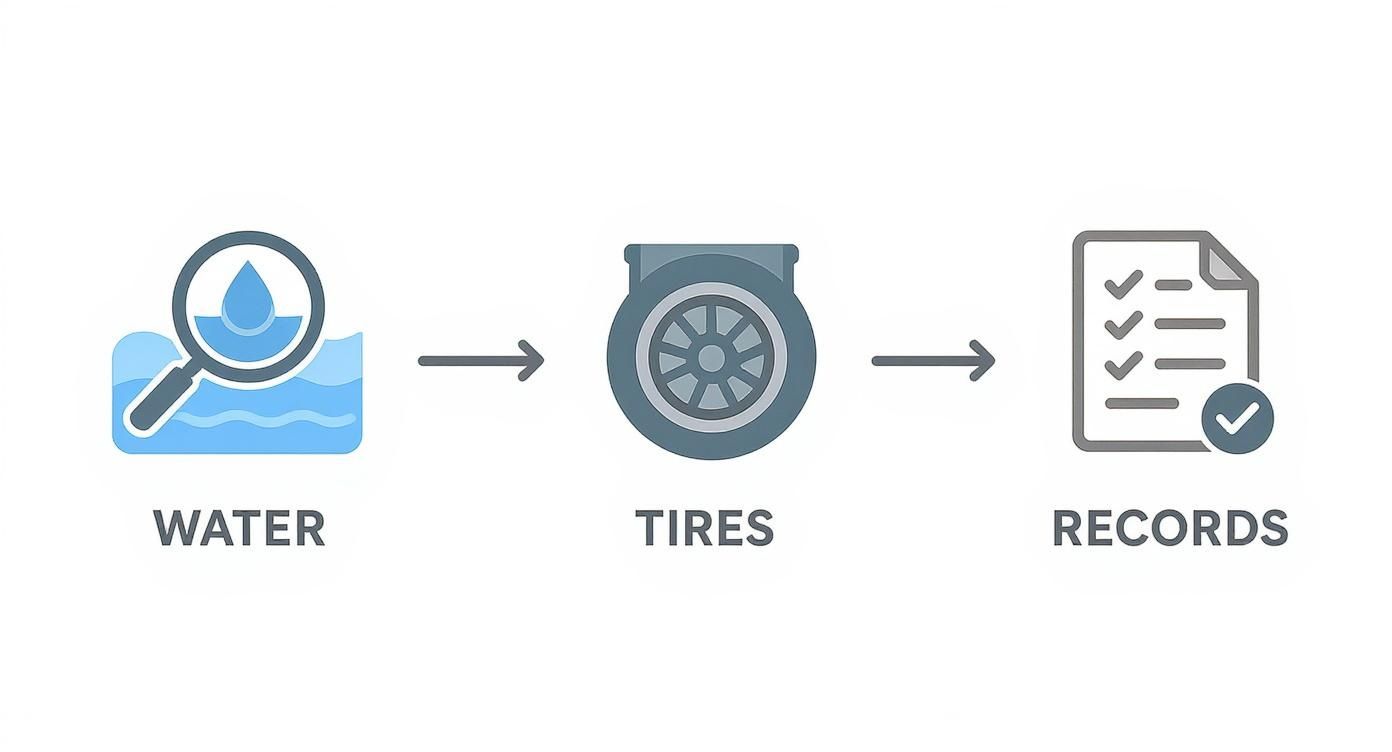
Think of each of these areas—water damage, old tires, spotty maintenance records—as a potential cost. These are the very factors that create the gap between a seller's asking price and the RV's actual market value.
The most potent tool in your negotiation arsenal is the folder full of data you've gathered. Instead of just saying, "Your price is too high," you can lay out a logical case for your offer. This data-first approach takes the emotion out of the discussion and anchors it in reality.
When you can back up your offer with specific market comps and repair estimates, you shift the dynamic. You're no longer just a buyer haggling over price; you're an informed consumer presenting a value proposition based on current market conditions.
For instance, you could frame your offer like this:
"The NADA average retail is right around $55,000, and I've found a few similar models on RV Trader listed between $52,000 and $56,000. Given that this one will need a new set of tires—which I've been quoted about $2,500 for—an offer of $51,500 feels much more aligned with its true current value."
This method is surprisingly similar to how statisticians work with uncertainty. They calculate the expected value of a variable to find its likely average outcome, while the variance tells them how spread out the possibilities are. In our world, the average price from your comps is the expected value, and the cost of needed repairs creates variance. If you're curious, you can learn more about these statistical fundamentals and see how the pros quantify value.
By presenting your offer this way, you're showing it’s reasonable and backed by solid research, which dramatically boosts your chances of the seller saying "yes."
As you start digging into RV and boat values, you'll find a few questions that always seem to surface. It’s totally normal. Getting these last few things cleared up will give you the confidence you need, whether you're about to buy your first travel trailer or finally sell that beloved Class A motorhome.
The biggest hit an RV's value ever takes is the moment it rolls off the lot. A brand-new rig can lose a staggering 20-30% of its value in the very first year. It's a tough pill to swallow, but that's just how it works.
After that initial drop, things calm down quite a bit. You can generally expect a more predictable depreciation rate of about 3-6% each year that follows. Of course, this isn't set in stone. A well-cared-for Airstream or a meticulously maintained Tiffin is going to hold its value much, much better than a budget-friendly model that's seen better days. Your best weapon against depreciation is simple: relentless maintenance.
Tools like NADAguides are absolutely essential for getting a starting point. In fact, they’re the very same guides that dealers and banks use for both RVs and boats, so you know the data is solid. But they can only tell you part of the story.
An online calculator has no idea about the custom solar setup you installed, the condition of the tires, or what the RV market looks like in your specific town.
Think of an online calculator as your first step, not your final answer. A truly accurate valuation comes from mixing that NADA number with real-world research on similar RVs for sale and, most importantly, a detailed, hands-on inspection of the rig.
It sure does. Where an RV or boat is located can have a huge impact on its price tag. A motorhome sitting in sunny Arizona, where people can camp year-round, is almost always going to fetch a higher price than the exact same model for sale in a state with a short camping season. Likewise, a boat in Florida will have a different market value than one in a landlocked state.
That's precisely why looking at local comps is non-negotiable. Before you even think about making an offer, you have to ground your research in what's happening in the seller's immediate area. It's the only way to really understand what's fair.
For the vast majority of used RVs, probably not. If you do your homework—check NADA, find good market comps, and give the unit a thorough inspection—you'll get a valuation that's more than accurate enough for a private sale or purchase.
But there are exceptions. If you're dealing with a really high-value coach, a rare vintage model, or a completely custom-built rig, then a professional appraisal is a smart move. An appraiser gives you an unbiased, certified report that's gold for getting the right loan, securing proper insurance, or giving you leverage in a tough negotiation.
Ready to see how the numbers stack up in the real world? At SearchShop.com, we give you the tools to analyze prices, dig into pricing history, and browse thousands of listings. You can find the perfect RV or boat for your next adventure with total confidence. Start your search today on SearchShop.com and get a real feel for the market.