Adventure Calls: Looking Beyond Cars for Sale in Austin TX
Shopping for an RV
Adventure Calls: Looking Beyond Cars for Sale in Austin TX
By Searchshop Editorial Team21 min readSeptember 12, 2025Updated January 2, 2026
Some links in this article are affiliate links. If you buy through them, Searchshop may earn a commission at no extra cost to you. Learn how this works.
When you start looking for cars for sale in Austin, TX, it's easy to think in terms of sedans and SUVs for the daily Mopac commute. But living in Austin is about more than the daily grind—it’s about the lifestyle. It’s about spontaneous trips to the Hill Country and sun-soaked days on Lake Travis. That's why the smartest vehicle search in Austin often leads not to a car, but to an RV or a boat.
Finding a Vehicle That Fits Your Austin Lifestyle
It’s easy to get stuck in the mindset of only considering sedans, SUVs, and trucks. They’re practical, no doubt, and perfect for navigating Austin's busy streets. But Austin’s heart and soul are tied to its incredible outdoor scene—from the cool, clear waters of Lake Travis to the rolling landscapes of the Texas Hill Country.
Thinking about that connection opens up a whole new world of possibilities. Instead of just another car, imagine a vehicle that genuinely enhances your life here. The real value isn't just in transportation; it's in the experiences you can unlock with a boat or an RV.
Think Beyond the Daily Grind
Getting outdoors is just part of the deal when you live in Austin. This is where widening your search to include recreational vehicles can be a total game-changer. Picture yourself pulling a travel trailer out to Garner State Park for a long weekend, or dropping a boat in Lake Austin for a spontaneous sunset cruise. These aren't just daydreams; they're very real possibilities.
Just imagine what you could do:
Weekend Escapes: A small Class B RV or even a pop-up camper can turn any weekend into a mini-vacation, minus the headache of booking hotels.
Family Road Trips: A larger motorhome gives you all the comforts of home, making those family trips to Texas state parks easier and way more fun.
Lake Days: Owning a ski boat or a pontoon means a hot summer day can instantly become an unforgettable memory on Lake Travis or Lake Buchanan.
An Investment in How You Live
When you start to see an RV or a boat as an investment in your quality of life, not just another expense, the whole buying process changes. The hunt for cars for sale in Austin, TX becomes a chance to find something that creates priceless experiences and memories that will last a lifetime. You're shifting your focus from pure utility to long-term enjoyment.
A vehicle should do more than just get you from point A to point B. In a city like Austin, it should be your ticket to adventure, connection, and the very lifestyle that makes this place so special.
At the end of the day, finding the right vehicle is about matching what you buy with what you're passionate about. Before you start filtering your search by make and model, take a minute to think about the life you truly want to live here. The perfect vehicle might not be the one that gets you to work, but the one that helps you get away from it all.
Thinking About an RV or Boat? Here’s the Austin-Specific Scoop
If you’re dreaming of hitting the Hill Country in an RV or dropping a boat into Lake Travis, you should know that shopping for these in Central Texas is a whole different ballgame than buying a regular car. It's not just about finding a good price; it's about finding a quality rig from someone you can trust. The key is knowing where to look and, more importantly, what to ask.
First, you've got to get a feel for the local scene. Austin's growth is no secret, and that boom extends to the demand for lifestyle vehicles. As more people flock here for the tech jobs and outdoor culture, the competition for a good Class A or a weekend-ready ski boat gets fierce. This high demand, as noted in analyses of Austin's dealership landscape, means you need to be a savvy shopper.
Where to Actually Find Good Deals
When you start your hunt for cars for sale in Austin TX, you’ll quickly realize that your best options for RVs and boats are rarely on a standard car lot. You'll want to focus on specialized dealerships. These are the places that live and breathe recreational vehicles, so their staff can actually answer your technical questions and guide you through the unique features.
Of course, there's also the online world. Marketplaces like RV Trader and Boat Trader are fantastic for seeing what’s out there, but you’ll have to do all the legwork yourself. Private sellers can offer tempting prices, but the risk goes way up.
My two cents: If you're going the private seller route, a full vehicle history report and a professional pre-purchase inspection are non-negotiable. If a seller gives you any pushback on either, just walk away. It’s a massive red flag.
How to Tell a Good Seller from a Bad One
A reputable seller, whether it's a big dealership or just a guy down the street, will be an open book. They should have maintenance records on hand and be happy to answer your questions without getting defensive. A good dealer will actually want you to take your time and crawl all over the vehicle.
Once you find a boat or RV that looks promising, it’s time to play detective. The questions you ask now can save you from a world of hurt later. If you get vague, shifty answers, that's your cue to leave.
Here are the hard-hitting questions you absolutely need to ask:
For any RV: "Can I see the complete service history? I’m especially interested in the engine, generator, and any slide-outs." Then, follow up with, "Has this rig ever had water damage? If it has, show me the repair records."
For any Boat: "What are the hours on the engine, and can I see the maintenance logs?" Also, ask, "Has the hull ever been patched or repaired? I'm looking for any history of blisters or cracks." And a big one: "When was the impeller last replaced?"
For Both: A simple, "So, why are you selling it?" can be very revealing. And always ask, "Are there any known issues—mechanical or otherwise—that I need to be aware of?"
Asking direct questions like these does two things: it gets you critical information about the vehicle and gives you a good read on the seller’s honesty. Their willingness to be transparent is often just as important as the vehicle itself. This is how you avoid buying someone else’s problem and find a machine that’s truly ready for your next adventure.
Choosing the Best RV or Boat for Your Texas Adventures
When you start searching for cars for sale in Austin, TX, it’s easy to focus on daily drivers. But let's be honest, living in Central Texas is all about getting out and exploring. The real question isn't just "What car do I need?" but "What RV or boat will unlock the adventures I want to have?"
The answer depends entirely on you. You could be dreaming of a massive Class A motorhome for a cross-country odyssey or a zippy ski boat to carve up the waters of Lake Austin. The key is to cut through the noise and figure out what you’ll actually use.
Think about it this way. A young family with kids might want to make regular weekend trips to places like Garner State Park. They need something comfortable to sleep in, easy to tow with their SUV, and simple enough to set up and tear down without a huge hassle. A massive RV would be overkill.
Then you have a couple whose perfect weekend involves casting a line on Lake Buchanan. They don’t need a kitchen or a bedroom on the water; they need a stable platform with plenty of room to fish. Two very different goals, two very different vehicles.
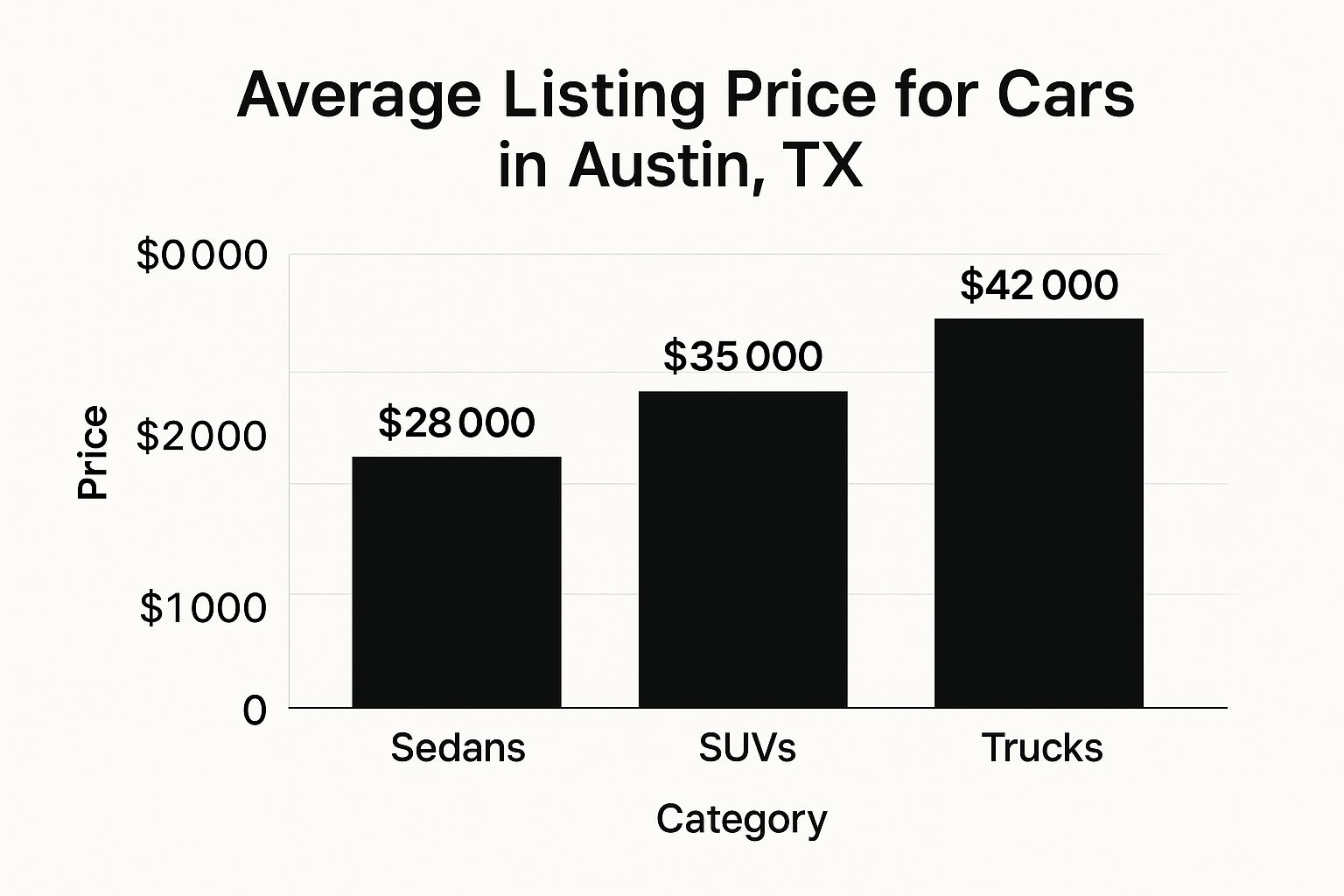
Before we dive into the fun stuff, it helps to see where the general auto market stands. This gives you a baseline for what most people are paying for everyday vehicles in the area.
Shop RVs For Sale
Browse current rvs from dealers near you — updated daily.
As you can see, trucks fetch a premium—no surprise given their do-it-all nature. But this chart doesn't tell the whole story, especially when it comes to the specialized world of RVs and boats.
Matching an RV or Boat to Your Austin Lifestyle
Choosing the right recreational vehicle can feel overwhelming, but it gets a lot easier when you connect specific models to your lifestyle. The table below breaks down some popular options and how they fit into the classic Austin-area experience.
Vehicle Type
Best For
Austin-Area Use Case
Average Cost (Used)
Pros
Cons
Pop-Up Camper
Weekend campers, small families, beginners
Spontaneous trips to Inks Lake State Park or Pedernales Falls State Park.
$5,000 - $15,000
Lightweight, easy to tow and store, affordable.
Limited amenities, setup/teardown required.
Class C Motorhome
Families wanting more comfort, longer trips
A week-long tour of the Hill Country, stopping at different parks and towns.
$40,000 - $80,000
All-in-one convenience, more space, no towing.
Lower fuel economy, harder to park in cities.
Bass Boat
Serious anglers
Early mornings on Lake Travis or Lake Buchanan chasing largemouth bass.
$15,000 - $40,000
Fast, stable casting platform, designed for fishing.
Limited seating, specialized for one activity.
Pontoon Boat
Social gatherings, families with kids
Anchoring in a cove on Lake Austin for a day of swimming and relaxing with friends.
$20,000 - $50,000
Huge amount of space, comfortable, versatile.
Slower speeds, not ideal for watersports.
Ski/Wake Boat
Watersports enthusiasts
Action-packed days on Lake Travis, wakeboarding, surfing, and tubing.
$35,000 - $75,000
Powerful engine, creates a perfect wake.
Expensive, high fuel consumption, less deck space.
Ultimately, the best choice is the one that gets you out there doing what you love. An easy-to-use pop-up camper that you take out twice a month is a much better investment than a luxury motorhome that sits in storage because it’s too intimidating to drive.
Finding the Perfect Fit for Land and Water
Let’s go back to our examples.
For that family planning state park adventures, a pop-up camper or a small travel trailer is the perfect starting point. They’re light enough for a mid-size SUV to pull, they won’t break the bank, and you can often park them right in your driveway. That means less friction and more impromptu getaways.
But if your vision involves seeing the whole country, a drivable motorhome is the only way to go.
Class C Motorhome: These are built on a truck chassis and hit the sweet spot between space and maneuverability. You get dedicated sleeping areas and more robust amenities without feeling like you're piloting a city bus.
Class A Motorhome: This is the king of the road. These bus-style RVs are literally homes on wheels, built for long-term travel or even full-time living. Just be prepared for the higher cost and steeper learning curve.
The best RV isn't always the biggest one. It's the one that removes barriers to adventure. An easy-to-hitch trailer that gets used twice a month is a far better investment than a massive motorhome that sits in storage due to its complexity.
Now for our fishing couple on Lake Buchanan. Their needs are just as specific. A bass boat or a center console fishing boat is built for the job, offering stability, wide-open casting decks, and livewells to keep their catch fresh. They’re designed for quick launches, making it easy to hit the water whenever the mood strikes.
If your ideal lake day involves a cooler, a playlist, and a dozen of your closest friends, the pontoon boat is your answer. Think of it as a floating party deck—perfect for socializing and swimming on Lake Travis. But if you’re chasing an adrenaline rush, a ski boat or wakeboard boat has the specialized hull and raw power to create the perfect wake for watersports.
At the end of the day, picking the right vehicle comes down to being honest about how you’ll actually spend your time. Focus on the adventures you want to have, and you’ll find the perfect boat or RV that truly adds to your life, instead of just complicating it.
The Pre-Purchase Inspection That Saves You Money
You’ve found it. After weeks of searching beyond the typical cars for sale in Austin TX, you’ve stumbled upon an RV or boat that looks perfect. It’s a great feeling, but hold on. That initial rush can quickly sour if you skip one non-negotiable step: the pre-purchase inspection.
A thorough, hands-on check is your single best defense against buying a money pit. Don't let a seller rush you through this part.
This goes way beyond just kicking the tires. It’s a deep dive to uncover the red flags that could cost you thousands down the road. With both RVs and boats, you're really inspecting two different things at once—the vehicle and the living space attached to it.
What to Check on an RV Before You Buy
When you're looking at a used RV, water is your biggest enemy. A tiny leak you can't even see can lead to the kind of structural rot that costs a fortune to fix. Your inspection should start and end with a hunt for any sign of water intrusion.
Here's where to focus your attention:
Seals and Seams: Get up close and personal with every single exterior seal. Check around the windows, doors, roof vents, and any other fixture. You’re looking for any cracking, peeling, or gaps where water could sneak in.
Interior Surfaces: Go inside and literally push on the walls and ceiling. Pay special attention to the corners and the areas around any slide-outs. If you feel any soft, spongy, or "bouncy" spots, that’s a massive red flag for water damage and delamination.
Underneath the Rig: Don't be afraid to get a little dirty. Slide underneath and look at the frame for significant rust, which can tell you a lot about its history. Also, check the condition of the subfloor from below.
Once you’ve hunted for water damage, it’s time to test every single system. Fire up the generator. Run the A/C and the furnace. Test every appliance—the fridge, stove, and microwave. You need to fully extend and retract all slide-outs and awnings, listening carefully for any weird grinding noises or hesitation.
If a seller says you can't test something, walk away. Any hesitation or excuse like "it's just a little finicky" or "it just needs a quick fix" should be treated as "it's broken and will be expensive to repair."
Your Essential Boat Inspection Checklist
For boats, the inspection is just as crucial, but your focus shifts to the hull and the engine. The hull's integrity isn't just about value; it's about safety.
Start by visually inspecting the entire hull surface for damage. Then, run your hand along the bottom to feel for any blisters—these are little bubbles in the fiberglass that can signal moisture has gotten into the layers. Also, keep an eye out for stress cracks, especially around fittings and joints where pressure is highest.
The engine is the heart of any boat, and a marine engine compression test is an absolute must for any inboard or outboard motor. This single test gives you a clear picture of the engine's internal health and can spot serious problems you'd never see otherwise.
Finally, power up all the electronics. Make sure the GPS, depth finder, and other navigation systems are fully functional. Test the bilge pumps, all the lights, and every other switch on the console to make sure it works as it should.
The Non-Negotiable Test Drive
Whether it’s an RV or a boat, a quick spin around the block or a short loop in the marina just won't cut it.
For an RV, you need a real test drive. Get it on the highway, navigate some city streets, and find some hills. You need to feel how it handles, brakes, and accelerates in different situations.
For a boat, a proper "sea trial" is essential. This is your chance to get it on the water and open it up. You'll feel how it performs at different speeds, hear how the engine sounds under a real load, and check for any steering issues. It's during these real-world tests that hidden problems almost always decide to show themselves, saving you from a purchase you’ll definitely regret.
Understanding the True Cost of Owning an RV or Boat
When you’re looking at cars for sale in Austin TX, the sticker price is usually the biggest number on your mind. But if you’re dreaming of an RV or a boat, that initial price is just the tip of the iceberg. I’ve seen it time and again: understanding the real, ongoing costs from the very beginning is what separates a dream purchase from a financial nightmare.
The market for these toys is a different beast altogether. While the Austin used car scene is always moving—we’ve seen sedan prices drop 15.6% year-over-year and some EVs plummet nearly 38%—RV and boat demand is all about lifestyle, not just getting from A to B. You can see how local price trends are changing for regular cars, but for recreational vehicles, the financial story really begins after you’ve signed the papers.
Beyond the Monthly Payment
The expenses that really sneak up on new RV and boat owners are the ones they didn't see coming. These recurring costs can pile up fast, so it's critical to bake them into your budget right from the start.
Here’s what you absolutely have to plan for:
Specialized Insurance: This isn't your everyday auto policy. Insurance for an RV or boat has to cover unique situations, like liability at a crowded campsite or an incident out on the water. It’s almost always more expensive.
Storage Fees: Let's be real, most Austin neighborhoods have HOAs that won't let you park a 30-foot motorhome in the driveway. That means you'll need to rent space at a dedicated storage facility, and that can easily run you several hundred dollars a month.
Marina or Slip Fees: If a boat is your goal, keeping it on Lake Travis or Lake Austin is incredibly convenient, but that convenience has a hefty price tag. Annual slip fees can easily cost you thousands.
Think of it this way: the purchase price gets you the vehicle, but the recurring costs are what actually unlock the lifestyle. Budgeting for storage and insurance is just as crucial as figuring out your down payment.
Factoring in Maintenance and Upkeep
Maintaining an RV or a boat is a whole different level of complexity compared to a car. You're not just dealing with an engine. You’re taking care of a miniature house on wheels or a complex marine vessel, complete with plumbing, electrical systems, generators, and specialized appliances.
You need a realistic annual maintenance budget, period. A good rule of thumb is to set aside 1-2% of the vehicle's value each year for routine upkeep and those inevitable surprise repairs.
So, for a $60,000 used motorhome, that means putting away $600 to $1,200 a year before anything major breaks. This proactive fund means you won't be scrambling for cash when a roof seal on your RV starts leaking or you need to replace the impeller on your boat's engine. It’s what keeps your investment ready for the next adventure.
Got Questions About Buying an RV or Boat in Austin?
So, you're ready to pull the trigger. Once you start looking past the usual cars for sale in Austin TX and dive into the world of recreational vehicles, a few specific questions always seem to come up. Getting these sorted out now will save you a ton of headaches down the road.
A big one I hear all the time is about financing. Can you just use a regular car loan? Almost never. Lenders see boats and RVs as specialty items, so they require specific recreational vehicle loans built just for them.
The good news is these loans often come with much longer terms—we're talking 10 to 20 years in some cases—which helps keep the monthly payments from getting out of hand. Your best bet for a good rate is to check with local Austin credit unions or banks that have experience with these loans. They get the unique value of these assets in a way a standard auto lender just won't.
Sorting Out the Local Rules and Requirements
Insurance is another area where people get tripped up. What does Texas actually require for an RV or boat? The answer is pretty different for each.
When it comes to boats, Texas law is a bit quirky—it doesn't technically mandate liability insurance. But don't let that fool you. If you plan on keeping your boat at a marina on Lake Travis or Lake Austin, they will absolutely require you to have it before you can rent a slip. Frankly, it's a must-have to protect yourself anyway.
For RVs, it all comes down to what kind you have:
Drivable Motorhomes: These are treated just like any other vehicle. You'll need to carry at least the state's minimum auto liability coverage to be legal on the road.
Towable Trailers: The liability coverage from your truck or SUV usually extends to the trailer while it's hitched. But—and this is a big but—you’ll need a separate comprehensive policy to cover the RV itself from damage, theft, or a nasty hailstorm.
A word of advice: Always get a specialized RV or boat policy. A standard auto policy won't cover things like your personal belongings inside the RV or on-water towing if your boat breaks down.
Finally, you need to figure out where your new toy is going to live. Storage is a huge deal, especially since many Austin neighborhoods have strict HOA rules that forbid parking large vehicles on your property. You’ll want to scope out dedicated RV and boat storage facilities in nearby areas like Leander, Pflugerville, or Dripping Springs. If you have a boat, the marinas on Lake Travis and Lake Austin offer wet slips so it's always ready for the water.
Ready to find your next adventure vehicle? At SearchShop.com, we offer a massive selection of new and used RVs, boats, and more. Our transparent listings and powerful research tools help you analyze prices and make the right choice with confidence. Start your search today at https://www.searchshop.com.
SE
Written by
Searchshop Editorial Team
Vehicle research & buying-guide team
The Searchshop editorial team researches and writes buying guides, model reviews, and category roundups across RVs, boats, motorcycles, ATVs, autos, and snowmobiles. We combine hands-on product research, live dealer inventory data, and manufacturer specifications to help buyers make confident decisions.
Reviewed by Searchshop Review Board — credentialed industry professionals.