Explore the Best RVS for Families: Top Picks & Features
Shopping for an RV
Explore the Best RVS for Families: Top Picks & Features
By Searchshop Editorial Team24 min readOctober 11, 2025Updated January 2, 2026
Some links in this article are affiliate links. If you buy through them, Searchshop may earn a commission at no extra cost to you. Learn how this works.
When you start looking for the best RV for your family, you'll quickly notice a few features that keep popping up: dedicated bunkhouses, multiple slide-outs for extra space, and layouts designed with kids in mind. The most popular choices usually fall into three camps: Travel Trailers for their sheer variety, Fifth Wheels for that "home away from home" feeling, and Class C Motorhomes for their grab-and-go convenience.
Finding the Right RV for Your Family Adventure
Choosing an RV can feel like the single biggest decision standing between you and your family's first big road trip. It’s easy to get overwhelmed, but it doesn't have to be that way. We're going to cut through all the jargon and focus on what really matters for making amazing memories with your kids on the open road.
This is about more than just picking a vehicle; it's about finding the perfect mobile basecamp for all your future explorations. We’ll dig into why things like dedicated bunkhouses, smart layouts, and clever storage aren't just nice-to-haves—they are absolute game-changers for keeping the peace and having a great time.
Understanding the Main RV Types
Let's start by breaking down the three most popular options for families: Travel Trailers, Fifth Wheels, and Class C Motorhomes. It helps to think of them like choosing a family car. A minivan is perfect for daily school runs, an SUV is great for weekend sports tournaments, and a big passenger van is built for hauling the whole crew and their friends. Each RV type shines in different situations.
Class C Motorhomes: This is your all-in-one rig. It’s perfect for families who want to get to the campground, park, and start having fun with the least amount of setup.
Travel Trailers: The classic, versatile option. You can unhitch it at the campsite, leaving your truck free to explore town or hit a remote trailhead.
Fifth Wheels: The king of space. These often feel like a small apartment, with residential-style amenities that make them ideal for longer trips or full-time living.
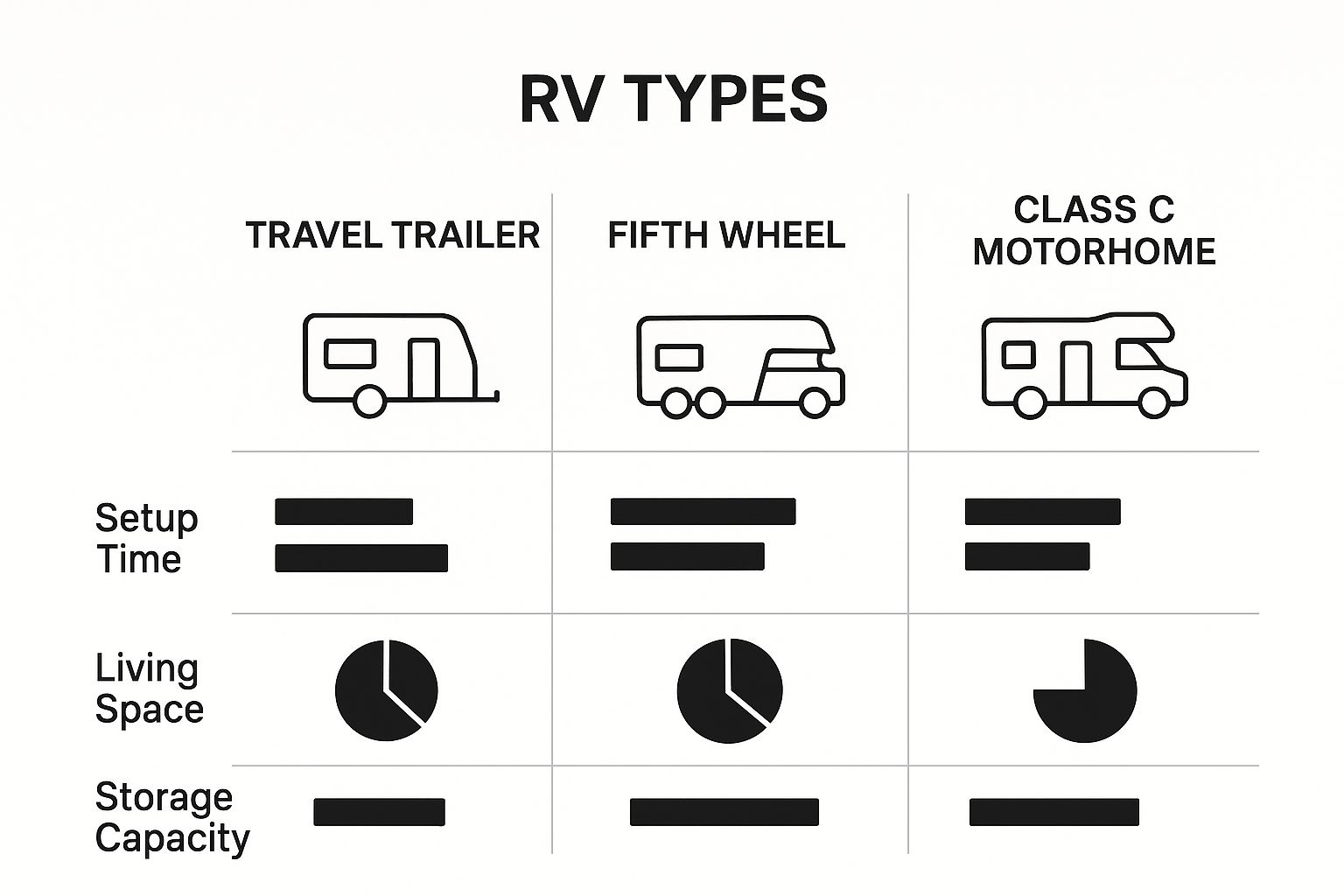
The infographic below gives you a quick visual on how these three stack up when it comes to setup time, living space, and storage.
As you can see, there’s always a trade-off. Fifth Wheels give you incredible space and storage, but that often comes with a bit more setup. Class C motorhomes, on the other hand, are all about speed and convenience.
The Rise of Family RVing
It’s no secret that RVing with kids is more popular than ever. The face of the typical RVer has changed a lot recently, with families jumping into the lifestyle in huge numbers. The median age of RV owners is now just 49, and a whopping 46% of all owners are between 35 and 54—prime time for raising a family. You can dig deeper into these numbers in the full RV owner profile.
This trend points to a simple fact: more and more parents are realizing that RV travel offers a unique way to unplug from the daily grind and reconnect with each other in nature.
Our goal here is to give you the confidence and the know-how to find the perfect RV for your crew, your budget, and your travel dreams.
How to Choose an RV Type for Family Travel
When you're RV shopping for a family, it's easy to get lost in a sea of floorplans and features. But here’s the secret: the "best" RV isn't about having the most slide-outs or the biggest TV. It’s about finding a rig that matches your family’s unique travel rhythm.
Think about how you want to travel. Does your family prefer to park for a week and explore the area in a separate vehicle? Or is the convenience of having your transportation and living space all in one a top priority? Each RV type serves a different purpose, and understanding those core differences is the first step to making a great choice.
Let's break down the top three options for families to see which one feels like the right fit for you.
The Class C Motorhome: The All-In-One Adventure Hub
Picture this: you’ve just finished a long day on the road. The kids are getting antsy, and everyone's ready for dinner. With a Class C motorhome, you just pull into your spot, put it in park, and you're home. No hitching, no leveling—you can go from driver's seat to dinner table in minutes.
Class Cs are instantly recognizable by the sleeping area or "bunk" that sits over the cab of the truck chassis it's built on. This design is a game-changer for families on the move. The kids can use the bathroom, grab a drink from the fridge, or play a game at the dinette (while buckled in, of course) without you ever having to pull over. That convenience can make a world of difference on a cross-country trip.
The flip side of this all-in-one convenience is that your motorhome is your only vehicle. A quick run to the grocery store means packing up your whole camp. But for families who love the simplicity of a single vehicle and plan to settle in at their site, a Class C is hard to beat.
The Travel Trailer: The Versatile Basecamp
Now, let's imagine a different kind of trip. Your family wants to set up a comfortable home base for the week but spend your days exploring nearby hiking trails, beaches, or small towns. This is where the travel trailer truly shines.
Towed behind your truck or SUV, a travel trailer gives you the freedom to unhitch and go. Once you're set up at the campsite, your tow vehicle is free for day trips and errands. This "basecamp" style of camping offers a level of flexibility that motorhomes just can't match, which is why it's the most popular RV type out there.
Travel trailers come in an endless variety of floorplans, with tons of bunkhouse models designed specifically with kids in mind. The biggest learning curve is the towing itself. You'll need to make sure your vehicle can safely handle the weight, and backing into a tight campsite definitely takes some practice. To get a better handle on all the options, our guide on RV classes for beginners explained is a fantastic resource.
The ability to unhitch and explore is the travel trailer's superpower. It allows you to separate your camping life from your daily driving needs, giving you the best of both worlds.
The Fifth Wheel: The Spacious Home-Away-From-Home
What if you're planning longer trips, or even thinking about full-time RVing? When space, storage, and residential comforts are at the top of your list, nothing compares to a fifth wheel. These rigs often feel more like a small apartment on wheels than a camper.
A fifth wheel connects to a special hitch in the bed of a heavy-duty truck, which creates a much more stable and secure towing experience than a traditional travel trailer. Their signature bi-level design, with the raised front section over the truck bed, creates high ceilings and a wonderful separation of space. You’ll often find a master suite upstairs with a large living area and kitchen downstairs.
This layout makes room for incredible features like kitchen islands, residential-sized appliances, and even a second bathroom. For families who plan to spend weeks or months on the road, that extra room is invaluable. The main trade-off is that you need a powerful—and often expensive—truck to pull it, and their tall profile can make some low-clearance bridges or tree-lined campgrounds a no-go.
RV Type Comparison for Families
To make the decision a little easier, here’s a quick side-by-side look at how these three popular family RVs stack up against each other.
Feature
Class C Motorhome
Travel Trailer
Fifth Wheel
Ease of Setup
Easiest. Park and you're done.
Moderate. Requires hitching and leveling.
Moderate. Requires hitching but is often easier to back up.
On-the-Road Access
Excellent. Full access to living area.
None. Cannot access while moving.
None. Cannot access while moving.
Day Trip Flexibility
Limited. Must pack up the whole RV.
Excellent. Unhitch and use your tow vehicle.
Excellent. Unhitch and use your tow vehicle.
Space & Storage
Good. Clever use of space.
Varies. Wide range of sizes and layouts.
Best-in-Class. High ceilings and residential feel.
Vehicle Needed
None. It's a self-contained vehicle.
SUV or half-ton truck.
Heavy-duty truck.
Best For
Families who value convenience and simple travel days.
Active families who want a basecamp for exploration.
Long-term travelers or families needing maximum space.
Ultimately, the best choice comes down to envisioning your ideal vacation. By matching the RV's strengths to your family's travel style, you'll find the perfect home on wheels for your next adventure.
Shop RVs For Sale
Browse current rvs from dealers near you — updated daily.
What takes a family RV from just "good" to "great"? It boils down to a handful of really smart features. Yes, the overall length and type of RV matter, but it's the specific amenities inside that will make or break your day-to-day life on the road. These are the little details that keep sibling squabbles to a minimum, make mealtimes a breeze, and give everyone just enough personal space.
Think of it like house hunting. You could have two homes with the exact same square footage, but the one with the mudroom, the walk-in pantry, and an extra half-bath is going to feel a lot more livable for a family. It's the same deal with RVs. The layout and features are what make the biggest difference.
Bunkhouses: The Undisputed MVP
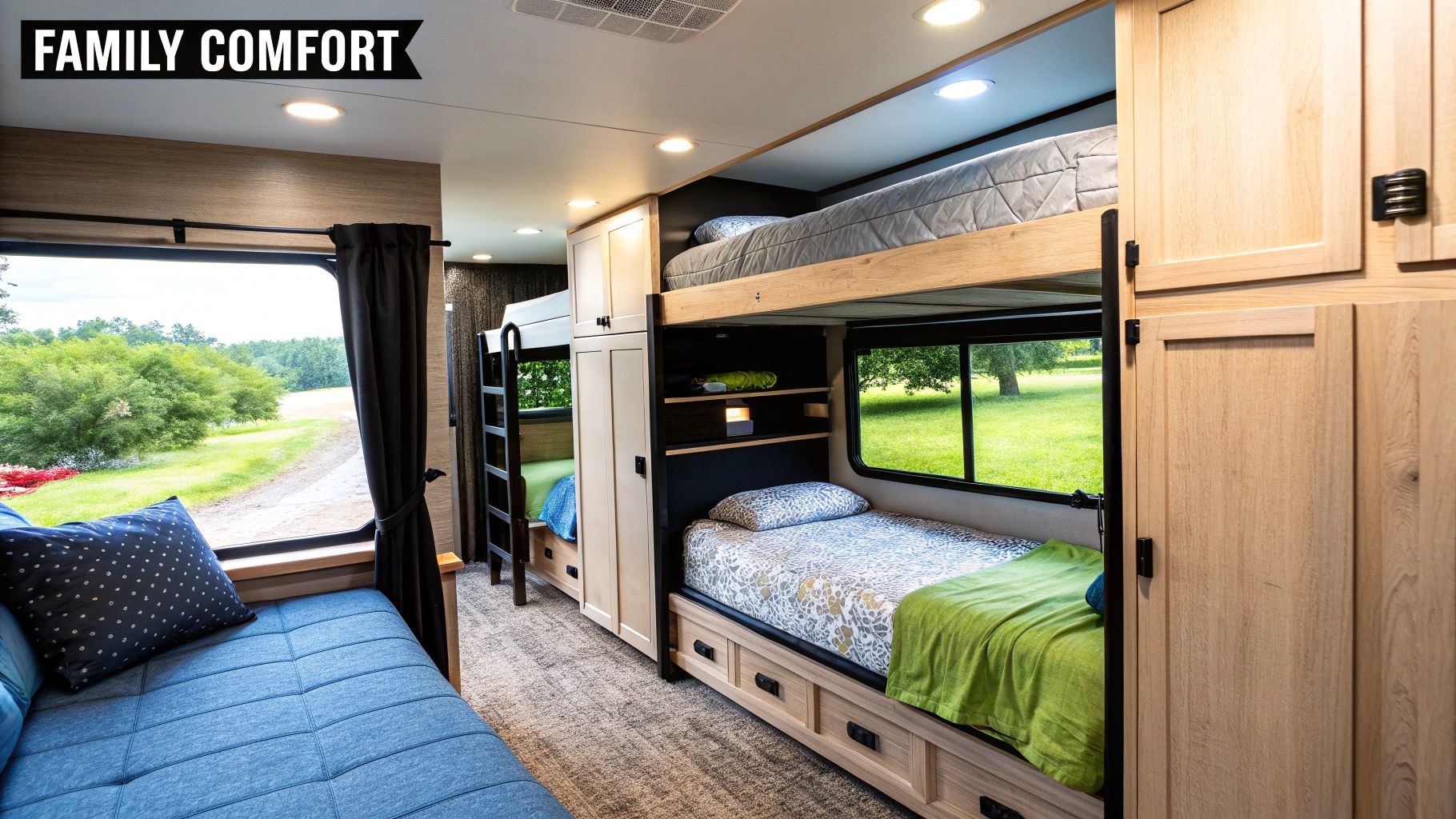
If I had to pick one non-negotiable feature for families, it's the bunkhouse floorplan. This is a separate, dedicated sleeping area—usually in the back of the RV—with at least two bunk beds. This isn't just about cramming in more beds; it’s about creating a "kids' zone."
Giving them their own space is a game-changer. It’s a place for their toys, books, and a bit of quiet time away from the main living area. On a rainy day, it becomes a playroom, which keeps the clutter from taking over your kitchen. For parents, this separation is a lifesaver, especially on those longer trips.
Modern bunkhouses have come a long way. Many now include:
Small Wardrobes: A spot for each kid to keep their clothes organized.
Gaming Hookups: Outlets and TV connections ready for their devices.
Convertible Sofas: Some bunk rooms even have small sofas that fold into beds, turning the space into a mini-lounge.
The Power of a Second Bathroom
A second bathroom in an RV might sound like a wild luxury, but for a family, it's pure practicality. Morning routines can be a madhouse at home; imagine that in a tiny space with a single bathroom. It’s a recipe for daily meltdowns.
An RV with a "bath-and-a-half" floorplan (one full bath, one half-bath) just makes everything run smoother. No more waiting in line for the toilet while someone’s in the shower. You'll most often find this feature in larger travel trailers and fifth wheels, and it's one of the top things families with four or more people look for.
A second bathroom isn’t about luxury; it’s about efficiency. It dramatically reduces morning and evening bottlenecks, making for a smoother, happier start and end to every adventure-filled day.
The Outdoor Kitchen: A Parent’s Best Friend
You go camping to be outside, right? An outdoor kitchen helps you do exactly that. This feature is usually a slide-out compartment on the side of the rig that brings the cooking essentials right to your campsite. Most will have a small fridge, a sink, and a two-burner stove or griddle.
For families, the benefits are immediate. Cooking messes, lingering smells, and heat stay outside your main living area. That mini-fridge is perfect for drinks and snacks, so kids aren't running in and out, tracking dirt through the RV every time they want a juice box. From frying bacon in the morning to grilling burgers at night, an outdoor kitchen makes meal prep part of the fun.
The Unseen Heroes: Safety Features
While fun features are easy to get excited about, nothing trumps safety. When you’re walking through potential RVs, you have to look past the fancy decor and check out the safety gear. A truly family-friendly RV is one that’s built to protect its precious cargo. To get a full rundown, make sure you explore all the top RV features to consider when buying a new RV.
Here’s a quick checklist of what I always look for:
Seatbelt Locations: In a motorhome, make sure there are properly installed, frame-mounted seatbelts for every single person. Double-check that they’re easy to access at the dinette or sofa.
Detectors: Look for a smoke detector, a carbon monoxide (CO) detector, and a propane gas leak detector. Don't be shy—ask to test them.
Emergency Exits: Every sleeping area needs its own emergency exit window, including the bunkhouse. Show everyone in the family how to open them.
Fire Extinguisher: Find the fire extinguisher (it should be near the door or kitchen) and check its expiration date.
When you prioritize these key features—from the sanity-saving bunkhouse to the must-have safety equipment—you can pick an RV that isn't just big enough, but is truly designed for your family's next adventure.
Top-Rated RV Models for Families
Alright, now that we’ve covered the must-have features for family RVs, let's get down to the fun part—looking at specific models that get it right. It's time to move from theory to reality. Think of this as your personal shopping list, filled with road-tested options that families consistently love.
The RV industry is booming, with the North American market expected to hit around $21.8 billion by 2025. This isn't surprising when you see how many families are hitting the road. Class C motorhomes and travel trailers are especially popular because they offer that perfect blend of space, function, and affordability for traveling with kids. You can dive deeper into the numbers with these RV industry statistics.
Let's spotlight some of the top contenders in the main RV categories and break down exactly what makes them a great fit for families.
Jayco Redhawk 26M: The Do-It-All Class C
If you're looking for an RV that’s easy to drive and packed with conveniences, the Jayco Redhawk series is a perennial favorite. The 26M floorplan, in particular, is a brilliant choice for families who want big features without a massive footprint—it keeps everything under 30 feet.
Its secret weapon is a rear slide-out that holds a walk-around queen bed. This creates a legitimate primary bedroom that feels worlds away from the main living area, a true luxury in a Class C this size. Up front, the classic "cab-over bunk" is a kid's dream fort, and it’s built tough with an impressive 750-pound weight capacity. The U-shaped dinette also converts into another bed, giving you flexible sleeping options for a family of four or five.
Family-Friendly Highlight: The layout gives parents a private rear bedroom while the kids get their own dedicated, high-capacity bunk up front. That separation is a game-changer.
Practical Spec: It’s built on a sturdy chassis with a Gross Vehicle Weight Rating (GVWR) of around 14,500 pounds, giving you real peace of mind on the highway.
Grand Design Imagine 2800BH: The Super-Smart Travel Trailer
Grand Design has earned its reputation for exceptional quality and clever design, and the Imagine 2800BH is a perfect showcase of why families rave about their RVs. This bunkhouse travel trailer was clearly designed by people who’ve actually camped with kids.
The back of the trailer is dedicated to double-over-double bunks, and each one gets its own window and reading light. It’s a cozy, personal space that kids can call their own. But the real magic happens outside. This model includes a fantastic outdoor kitchen with a griddle and mini-fridge, which means greasy cooking smells stay out of your living space. Better yet, a second exterior door leads directly into the bathroom—a genius move that stops kids from tracking mud and dirt through the entire camper every time nature calls.
That direct-to-bathroom door is a small detail with a massive impact. It’s one of those features you don’t realize you need until you have it, and then you can’t imagine life without it.
Keystone Cougar 368MBI: The Spacious Fifth Wheel
When your top priority is maximum living space for a larger crew, fifth wheels are in a league of their own. The Keystone Cougar 368MBI is an absolute standout thanks to its innovative "mid-bunk" floorplan, which delivers a level of privacy and function that’s tough to beat.
Instead of sticking the bunks in the back, this layout places a separate room right in the middle of the RV. This room is a master of multitasking: it can be a second bedroom with a sleeper sofa and a bunk, a dedicated playroom, or even a quiet mobile office. This design creates three distinct zones—the master suite upstairs, the central kitchen and living area, and the kids' room. It's an ideal setup for longer trips or for families with teens who need their own space to retreat to.
Best Use Case: An amazing choice for families of five or more, or for anyone planning to spend extended time on the road and wanting a more residential feel.
Key Feature: The dedicated mid-bunk room is a private, multi-use space that can be a bedroom one day and a playroom the next.
These models are just a few examples, but they really highlight the best of what’s out there for families. By seeing how these layouts work, you can walk onto a dealership lot with a clear, confident idea of what you’re looking for.
Understanding the True Cost of Your Family RV
It’s easy to get swept up in the excitement of finding the perfect family RV. But experienced RVers know that the sticker price is just the tip of the iceberg—think of it as the cover charge for a lifetime of adventure. The real financial picture is painted by a collection of ongoing expenses that every prospective owner needs to anticipate.
Ignoring these "hidden" costs is one of the biggest pitfalls for new owners and can quickly turn a dream purchase into a source of stress. The key is to create a realistic budget from day one, ensuring your RV brings your family nothing but joy and great memories.
Beyond The Sticker Price: The Ongoing Costs
The moment you drive that RV off the lot, a new set of expenses kicks in. These recurring costs are just part of the ownership experience, and they'll vary quite a bit depending on your rig, how often you hit the road, and even where you live. Planning for them is the secret to a sustainable and stress-free RV lifestyle.
Here are the main categories you'll want to factor into your budget:
Insurance: This is non-negotiable. RV insurance is a specialized product that covers you on the road and at the campsite. Premiums can range from a few hundred dollars to well over a thousand each year.
Storage: Unless you have a dedicated spot at home, you’ll probably need to pay for storage. A secure facility can easily add a significant amount to your annual expenses.
Fuel: This is a huge variable. A big Class C motorhome is going to be a lot thirstier at the pump than the truck you use to pull a lightweight travel trailer.
Campground Fees: This will be a major line item in your travel budget. Nightly rates can swing from $30 for a simple state park site to $100+ for a full-hookup resort.
Just like a house, an RV needs regular TLC to stay in top condition. Think of this as preventative care that protects your investment and, more importantly, keeps your family safe. Putting off routine maintenance is a surefire way to face much bigger, more expensive emergency repairs down the road.
Proactive maintenance isn't just about protecting your RV; it's about protecting your vacation time. A well-maintained rig is far less likely to sideline your family with an unexpected problem.
Here are a few key maintenance jobs you should budget for every year:
Roof Resealing: Routinely inspecting and touching up the seals on your roof is the number one way to prevent leaks and water damage—one of the most destructive and expensive issues an RV can have.
Tire Replacement: RV tires usually age out before they wear out. Plan to replace them every five to seven years, regardless of mileage, because sun exposure and time break them down.
Winterization/Dewinterization: If you live where it freezes, properly preparing your RV’s plumbing system for the cold is absolutely essential to prevent burst pipes.
Appliance Servicing: Your furnace, water heater, and air conditioner all need periodic check-ups to keep them running safely and efficiently.
Building Your Annual RV Budget
To help you visualize how this all comes together, we've created a sample budget. Remember, these numbers are just estimates—your actual costs will depend on your specific situation. But this should give you a solid starting point for your own financial planning.
Sample Annual RV Ownership Budget
Here is a ballpark breakdown of what a family might expect to spend on their RV each year after the initial purchase.
Expense Category
Low-End Estimate
High-End Estimate
Insurance
$600
$2,000
Storage
$720
$2,400
Fuel
$1,000
$4,000+
Campground Fees (40 nights/year)
$1,400
$4,000
Routine Maintenance
$500
$1,500
Accessories & Supplies
$500
$1,000
Total Estimated Annual Cost
$4,720
$14,900+
As you can see, the true cost of enjoying one of the best RVs for families goes well beyond that initial price tag. By budgeting for these ongoing expenses, you can hit the road with complete peace of mind and focus on what really matters: making memories.
Answering Your Final Questions About Buying a Family RV
Diving into the RV world can feel a bit like learning a new language, with all its own lingo and critical details. It's totally normal to have a head full of questions as you get closer to picking the one.
Think of this section as your final pre-flight check. We've pulled together the most common questions we hear from families, with straightforward answers to help you cross the finish line with confidence.
What’s the Best RV for a Family of Four or Five?
For a family of this size, the conversation almost always lands on two heavy hitters: bunkhouse travel trailers and Class C motorhomes. They just nail the combination of space, function, and value that most families are looking for.
Travel trailers are amazing for their sheer variety of floorplans. You can find models with totally separate bunk rooms, giving the kids their own little den—a feature that feels like a miracle on a rainy day. On the flip side, Class C motorhomes are the undisputed champs of convenience. Being able to grab a snack from the fridge while your partner is driving or setting up camp in five minutes flat is a massive win for family harmony.
Ultimately, your choice will probably boil down to your personal travel style, your budget, and whether you already have a truck you love.
Should We Buy a New or Used RV?
Ah, the classic dilemma. There’s no single right answer here, as both paths have some serious pros and cons.
Buying brand new gives you that incredible peace of mind. You get a full manufacturer's warranty, the latest tech, and that "new RV smell." But, you'll also pay a premium and face immediate depreciation the second you drive it off the lot.
A used RV, on the other hand, can be an incredible deal. Your money goes a lot further, potentially getting you into a bigger or better-equipped model. The trade-off? No warranty and the risk of inheriting someone else's problems. Many first-time buyers find a sweet spot with a gently-used, well-cared-for model from a reputable source—it often strikes the perfect balance between value and reliability.
The new vs. used debate really comes down to what you value more: the security and modern features of a new rig, or the financial savings and extra space you can get with a used one.
What are the Most Important RV Safety Features for Kids?
When you’ve got the whole crew with you, nothing else matters more than safety. A truly family-friendly RV is one designed to protect everyone on board.
Here are the non-negotiables to look for:
Proper Seatbelts: For motorhomes, make sure every seating position at the dinette or sofa has a frame-mounted seatbelt. No exceptions.
Essential Detectors: Your RV must have a working smoke detector, a carbon monoxide (CO) detector, and a propane (LP) leak detector. Test them regularly.
Emergency Exits: Every single sleeping area, especially a bunk room, needs its own easy-to-use emergency exit window. Practice opening it with your kids so they know what to do.
Towing Safety: If you're getting a trailer, be absolutely sure your tow vehicle can handle the RV's fully loaded weight (GVWR). A good weight distribution and sway control hitch isn't optional; it's a necessity.
SE
Written by
Searchshop Editorial Team
Vehicle research & buying-guide team
The Searchshop editorial team researches and writes buying guides, model reviews, and category roundups across RVs, boats, motorcycles, ATVs, autos, and snowmobiles. We combine hands-on product research, live dealer inventory data, and manufacturer specifications to help buyers make confident decisions.
Reviewed by Searchshop Review Board — credentialed industry professionals.