If you're hunting for motor homes for sale in Florida, you’ve landed in one of the best spots in the country to do it. The Sunshine State is an absolute hotbed for RVs and other recreational vehicles, offering a massive selection of both new and used rigs, seriously competitive pricing, and perfect year-round weather for getting out on the road or on the water. Let's walk through everything you need to know to find your perfect home on wheels here.
Florida isn't just a great place to travel in an RV—it's arguably the best place to buy one. The state is a magnet for adventurers, attracting a constant stream of new inventory and trade-ins from snowbirds, boaters, and full-timers alike. All that activity creates a bustling, competitive marketplace that works in your favor as a buyer.
It’s kind of like shopping for produce at a giant farmer's market instead of a small corner store. The sheer volume and variety of vehicles give you a better selection and much more aggressive pricing. That dynamic puts you in the driver's seat, with plenty of options to find the exact motor home that fits your plans and your budget.
Florida’s appeal runs deeper than just the number of RVs for sale. The state’s whole culture and geography are built for the motor home lifestyle, and that directly shapes the quality and diversity of the market.
Here’s what really makes Florida stand out:
- A True Year-Round RV Season: There's no "off-season" here. Unlike northern states where things shut down for winter, dealers in Florida are selling and buyers are trading all year long. This keeps the market for motor homes, campers, and even boats fresh and constantly moving.
- Unbeatable Inventory: You'll find it all. From sprawling luxury Class A diesel pushers to nimble Class B camper vans, the selection is just massive. You’re almost guaranteed to find a model with the exact floor plan and features you've been dreaming of.
- A Competitive Dealer Network: The high concentration of dealerships—from huge national chains to small, family-owned lots—creates some serious competition. That pressure means you’ll find better deals and more incentives than in almost any other state.
The RV industry isn't just a niche market in Florida; it's an economic powerhouse. The state's recreational vehicle dealer industry is estimated to be worth a staggering $5.1 billion. That number covers everything from the sale of all classes of motor homes, travel trailers, and fifth-wheels to the thriving repair services and parts suppliers that support them. This healthy ecosystem means you're buying into a stable, well-supported environment for owning and maintaining your rig. You can dig into more details on Florida's RV market over at Ibisworld.com.
The sheer scale of Florida’s RV market puts the buyer in control. With thousands of motor homes available at any given time, you have the power to compare, negotiate, and find the perfect fit without feeling rushed or pressured. Your ideal home on wheels is almost certainly waiting for you right here.
Trying to find the right motor homes for sale in Florida can feel a bit overwhelming, especially when you see just how much prices and availability can swing. Think of the market like a big, moving puzzle—different types of RVs (Class A, B, and C) are the pieces, and their popularity is always shifting. Knowing how those pieces are moving is the first step to making a great buy instead of just a buy.
You wouldn't jump into an investment without checking its performance, and the same logic applies here. Some motor home classes are hot right now, meaning higher demand and firmer prices. Others might be a little cooler, opening the door for a fantastic deal. Understanding this ebb and flow gives you a real edge when it's time to negotiate.
If you look at the recent numbers, you’ll see some interesting trends popping up. The overall RV market has cooled off a bit, but certain types of motor homes are actually bucking that trend, which directly affects what you’ll find on dealer lots from the Panhandle to the Keys.
The data paints a fascinating picture. While the RV industry as a whole saw an 11.98% dip in sales year-over-year, it wasn't a universal drop. Class C motor homes, for instance, grew by a healthy +7.75%, and park models shot up by a massive 38.10%. At the same time, big Class A coaches and smaller Class B camper vans saw sales fall by 19.74% and 30.26%, respectively. You can discover more about these RV industry shifts and what they mean for buyers.
This graphic gives you a quick snapshot of the Florida motor home market, covering sales figures, average costs, and even typical insurance savings.
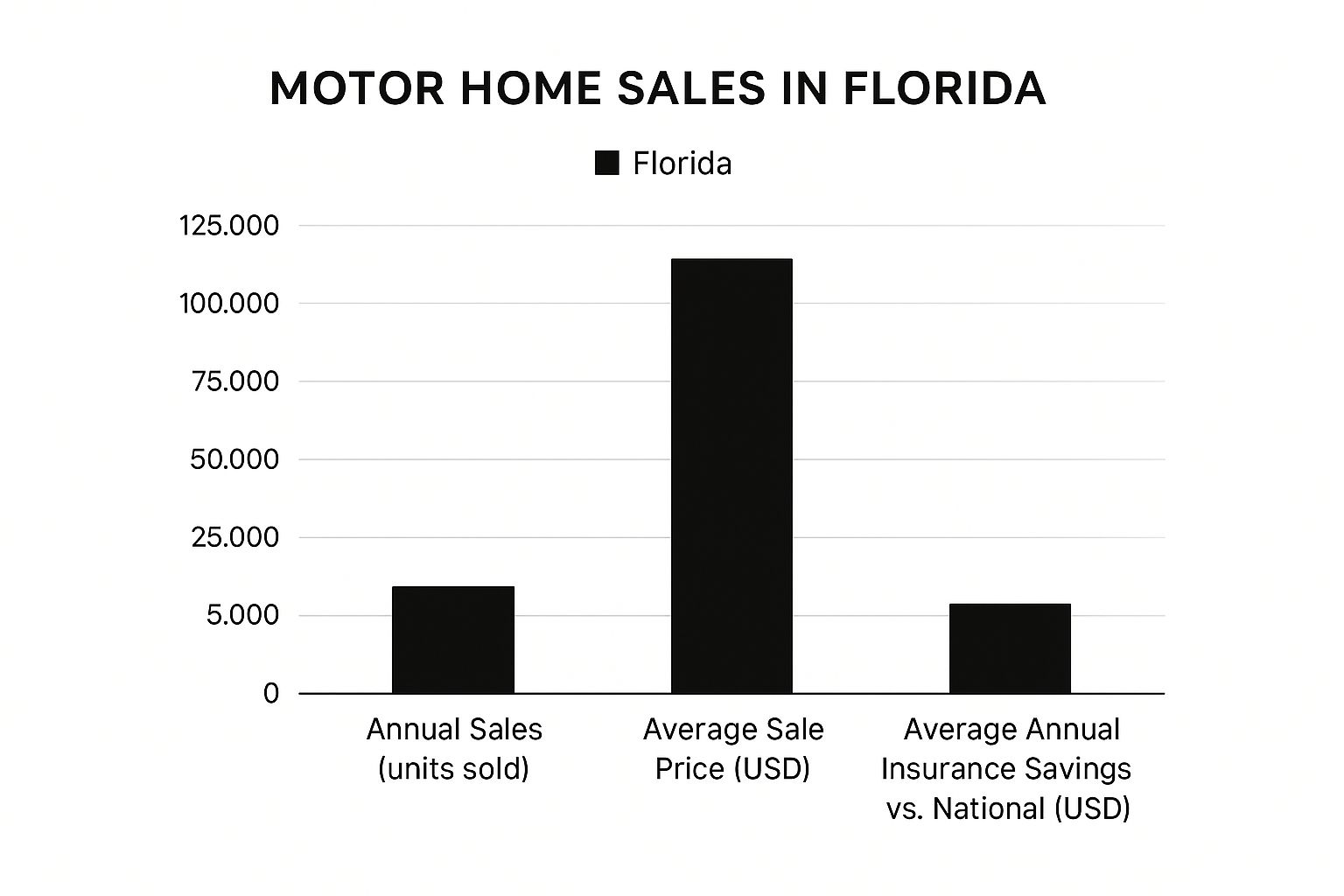
As you can see, sales numbers don't always move in lockstep with pricing, which creates some real opportunities if you know where to look.
To help you sort through it all, this table breaks down the different motor home classes and how they're performing right now.
| Motor Home Class |
Best For |
Typical Price Range (New) |
Recent Market Trend |
| Class A |
Full-time living, luxury travel, large families |
$150,000 - $500,000+ |
Sales decline (-19.74%); potential buyer's market. |
| Class B |
Solo travelers, couples, weekend trips, easy driving |
$80,000 - $180,000 |
Significant sales decline (-30.26%); good deals may be found. |
| Class C |
Families, first-time owners, versatile travel |
$90,000 - $200,000 |
Strong growth (+7.75%); high demand and wide selection. |
| Park Model |
Seasonal living, stationary "tiny home" lifestyle |
$40,000 - $100,000 |
Explosive growth (+38.10%); very popular for snowbirds. |
This snapshot shows the clear differences in what's hot and what's not, which can guide your search for the best value.
One of the first big forks in the road is deciding between a brand-new rig and a pre-owned one. This applies whether you're shopping for a motor home, a travel trailer, or even a boat. There's no single right answer here—it really comes down to your budget, how you plan to use it, and what gives you peace of mind.
A new motor home is a clean slate. You get the latest gadgets, modern styling, and, of course, that new-RV smell. Most importantly, it comes with a full factory warranty, which is a huge comfort for first-time owners who don't want to worry about surprise repair bills.
On the other hand, a used motor home has already taken its biggest financial hit. The initial depreciation, which can be steep, was absorbed by the first owner. This means you can often get a higher-end model with more bells and whistles for the same money you'd spend on a new, more basic unit.
The single biggest financial perk of buying used is sidestepping that initial depreciation. A new motor home can lose 20-30% of its value in the first three years alone—a cost the second owner completely avoids.
For anyone trying to maximize their budget, that kind of value is tough to pass up.
So, what does all this market chatter mean for you? It means you have strategic choices to make. The surge in Class C popularity tells us there will be plenty of new and gently used models to look at, but you might have less wiggle room on the price. They’re the hot item right now.
Conversely, the slowdown for Class A and Class B models could mean it's a buyer's market for those rigs. Dealers might be more eager to move that inventory, possibly leading to better prices or other incentives. If a roomy Class A or a nimble Class B is what you've been dreaming of, this could be the perfect time to find a great deal on one of the many motor homes for sale in Florida.
Finding the perfect motor home is only half the adventure. The other half—and arguably the more critical part for your long-term happiness—is finding the right dealer. Think of them less as a salesperson and more as your partner on the road ahead. They're your go-to for service, advice, and maybe even your next trade-in down the line.
In Florida's bustling RV and boat market, the dealership you choose can make or break your entire ownership experience. From massive national chains with acres of inventory to small, family-run lots, each offers a completely different vibe. Knowing what sets them apart is the first step to finding a team you can truly trust.
So, should you go with a big-box-style dealership or a local independent? It's a bit like choosing between a national supermarket and the neighborhood butcher. One gives you a massive selection and streamlined efficiency, while the other offers specialized expertise and a personal touch. Neither is better than the other, but one will definitely be a better fit for you.
The big players, like Camping World or La Mesa RV, come with some serious perks:
- Vast Inventory: They often have hundreds of new and used motor homes for sale in Florida, as well as other RV types and sometimes even boats. This means you can walk through countless brands, models, and floor plans all in one visit.
- Standardized Financing: Their finance departments are built for volume. They work with a wide network of lenders, which can make the approval process smoother and faster.
- Nationwide Service Networks: This is a huge plus for travelers. Buying from a national chain often means you can get warranty work or service done at any of their locations across the country.
On the other hand, independent dealers have their own unique advantages:
- Personalized Service: You’re far more likely to be talking directly with an owner or a senior manager who lives and breathes RVs and has a genuine stake in your satisfaction.
- Pricing Flexibility: Without the heavy corporate overhead, smaller dealers can often be more flexible on price and get more creative with your trade-in value.
- Local Reputation: Their business is built on word-of-mouth in the local community. That’s a powerful motivator to make sure you have a great experience, from the sale to your first service appointment.
Florida's market is massive enough to support both. As one of the top states for RV sales, the industry brought in over $306 million in a single quarter. This incredible demand means you'll find plenty of options no matter which type of dealer you prefer. You can dive deeper into these RV statistics and market dynamics to see just how big the industry is.
As you start visiting dealerships, you need to be on the lookout for signs that you’re in good hands. These "green flags" are the tell-tale indicators of a business that operates with integrity and truly values its customers.
Here are the positive signs to watch for:
- Transparent Pricing: The price is clearly marked on every unit. Any extra fees—like dealer prep, doc fees, or freight—are explained upfront, not sprung on you when you’re about to sign.
- A Well-Maintained Service Center: Ask to see their service bays. A clean, organized, and busy shop is a great sign that they are committed to supporting their customers after the sale.
- Knowledgeable, Low-Pressure Sales Staff: A great salesperson is a consultant, not a closer. They should listen to what you need, answer your questions honestly, and know their inventory without relentlessly pushing you toward a sale.
- Positive Online Reviews: Before you visit, check Google, Yelp, and RV forums. Every business has a few grumpy customers, but you're looking for a consistent pattern of positive feedback about their honesty and service.
A trustworthy dealer wants to build a relationship, not just make a one-time sale. They see you as a future service customer, a potential repeat buyer, and a source of referrals. Their entire approach should reflect this long-term perspective.
At the end of the day, you're looking for a dealership that feels like a reliable resource. Trust your gut. If a deal seems too good to be true or you feel pressured and rushed, it's always okay to walk away. The right partner will make you feel confident and supported as you find the perfect motor homes for sale in Florida.
Figuring out how to pay for your dream motor home can feel like a huge hurdle, but it's more straightforward than you might think. Just like there are countless RV styles, there are several ways to finance one. Getting a handle on your options early on puts you in a much stronger position when you start seriously looking at motor homes for sale in florida.
Don't think of it like a standard car loan. RV loans are a different animal, often with longer terms that can stretch from 10 to 20 years. Lenders treat them more like a second home mortgage, which is great for keeping monthly payments manageable. The flip side is that you really need to watch the interest rate to keep your total cost in check over the life of the loan.
When you're ready to get a loan, you've basically got three main doors to knock on. Each has its pros and cons, and the best one for you really boils down to your own finances and how much of the legwork you want to do yourself.
-
Dealership Financing: This is the path most people take. The dealer’s finance office sends your application out to their network of lenders and presents you with the options. It's incredibly convenient, but you might not always get the rock-bottom best rate.
-
Bank Loans: Your own bank is a fantastic place to start. They already know you, which can make the process smoother, and they sometimes offer better rates to loyal customers.
-
Credit Union Loans: Since credit unions are non-profits, they are famous for offering some of the best interest rates and friendliest terms out there. If you're a member, definitely check with them first.
Getting pre-approved for a loan before you ever set foot on a dealership lot is one of the smartest moves you can make. It’s like walking into a negotiation with cash in your pocket—it separates the financing conversation from the price of the RV, giving you serious leverage.
Walking onto a lot with a pre-approval letter from your bank or credit union completely changes the game. You're no longer just browsing; you're a qualified buyer ready to make a deal. This signals to the dealer that you're serious and, more importantly, gives you a benchmark interest rate.
If the dealership's financing can beat your pre-approved rate, fantastic! If not, you've already got your funding locked in. This simple step lets you focus completely on negotiating the best possible price for the motor home itself, without getting the numbers muddled with confusing financing terms.
To get the ball rolling on any loan, you'll need to pull together a few standard financial documents. Having everything ready ahead of time makes the application process quick and painless.
- Proof of Income: Grab your most recent pay stubs. If you're self-employed, you'll need your W-2s or recent tax returns.
- Proof of Identity: A valid driver's license or another government-issued ID will do the trick.
- Credit Score Information: Lenders will pull your credit report, but it’s always a good idea to know your own score beforehand so there are no surprises.
- Down Payment Information: You'll need to show you have the funds for your down payment, which is typically 10-20% of the RV's price.
With these items in hand, you can move fast when you find the perfect motor home. Once your financing is sorted, you're just one small step away from hitting the open road.
So, you’ve found a motor home that looks perfect, and the price feels right. Hold on. Before you even think about signing on the dotted line, we need to talk about the single most critical step in this entire journey: the inspection.
This isn’t just a quick once-over. This is your only real defense against buying a beautiful rig with ugly, wallet-draining secrets hidden just beneath the surface.
Think of an RV inspection like a home inspection, but for a house that has to survive hurricane-force winds on the highway and constant vibrations. A tiny, seemingly harmless roof leak or a soft spot in the floor can spiral into a multi-thousand-dollar repair bill faster than you can say "road trip." A proper evaluation, whether you tackle it yourself or bring in a pro, is about knowing exactly what you’re getting into.
Let’s be honest: unless you’re a seasoned RV technician, hiring a certified inspector is one of the smartest investments you can possibly make. These experts are trained to spot the subtle clues an average buyer would walk right past. They show up with specialized tools to detect moisture hiding in the walls, test the propane system for dangerous leaks, and properly evaluate the complex dance of the electrical systems.
The gold standard here is the National RV Inspectors Association (NRVIA). An NRVIA-certified inspector will give you an unbiased, incredibly detailed report on the motor home’s true condition. This report isn't just for your peace of mind; it's a powerful negotiation tool. If the inspection uncovers problems, you now have the leverage to ask the seller to fix them or lower the price to cover your future costs.
An inspection report from a certified professional transforms your negotiation from "I think there might be a problem" to "Here is a documented issue that will cost an estimated $1,500 to fix." This factual leverage is invaluable when finalizing the price of a motor home.
Deciding whether to go it alone or hire an expert really comes down to your own mechanical confidence and the complexity of the rig you're looking at. For many, a hybrid approach works best: do your own thorough walkthrough first, and if it passes your initial tests, then bring in the professional for the final verdict.
To help you decide, here’s a breakdown of what each approach looks like in the real world.
| Inspection Aspect |
DIY Inspection (What to Look For) |
Professional Inspector (Why It's Worth It) |
| Roof and Seals |
Look for obvious cracks, peeling sealant, or discoloration. Carefully walk the roof (if it's safe!) to feel for any spongy spots that scream "water damage." |
They use specialized moisture meters to find water intrusion inside the walls and ceiling that your eyes can't see. They spot failing sealant before it becomes a major leak. |
| Tires and Chassis |
Find the DOT date code on every tire. Anything over 5-7 years old is a blowout risk and needs replacing, no matter how good the tread looks. Check for rust on the frame. |
A pro conducts a deep dive into the suspension, brakes, and axles. They can spot subtle signs of frame damage or excessive wear that could compromise your safety on the road. |
| Systems (Plumbing, Electrical, Propane) |
Test every single faucet, flush the toilet, and run the shower. Turn on all the lights and appliances, testing them on both battery power and when plugged into shore power. |
They perform pressure tests on the propane system to find leaks, check the electrical converter's health, and test the water heater and furnace under a full load. |
| Slide-Outs and Appliances |
Run every slide-out in and out multiple times. Listen for grinding, stuttering, or other strange noises. Fire up the fridge, microwave, and A/C to ensure they work properly. |
They evaluate the slide-out mechanisms for proper alignment and check the integrity of the seals. They also verify that all appliances are functioning to the manufacturer's specs. |
If you decide to do the initial walkthrough yourself, focus on the big-ticket items that cause the most headaches. This checklist covers the absolute essentials when you're looking at motor homes for sale in Florida.
- Exterior Examination: Start with a slow walk around the entire RV. Look for any delamination—those bubbles or ripples in the fiberglass siding—which is a classic sign of water getting in where it shouldn't. Check the condition of every seal around windows, doors, and storage bays.
- Roof Integrity: Get a ladder and get a good look at the roof. The sealant around every vent, skylight, and antenna is a known failure point. Any signs of cracking or peeling are major red flags that demand immediate attention.
- Interior Systems Check: Once inside, turn on everything. Run the water pump, test the hot water, and cycle both the furnace and the air conditioner. Open every cabinet and press firmly on the floors, especially in corners, around the shower, and under sinks. You're feeling for any soft spots.
- Test Drive Dynamics: A test drive is absolutely non-negotiable. Pay close attention to how the engine performs, how the brakes feel, and listen for any unusual rattles, whines, or clunks. This is your only chance to feel how the motor home you plan to buy actually behaves on the road.
You’ve done the inspections, you’ve shaken hands on the deal, and now it's time for the final hurdles: the paperwork. Getting your motor home registered and insured is the last step that officially makes it yours and protects your new investment for all the miles ahead. It might feel like a bit of a chore, but getting this part right from the start saves a world of headaches later on.
Registering a motor home in Florida isn't all that different from registering a car, but there are a few extra wrinkles to be aware of. The whole process is managed by the Florida Department of Highway Safety and Motor Vehicles (FLHSMV), and their job is to get you set up with a title, registration, and license plate so you can legally start your adventures.
The best advice I can give you is to get all your ducks in a row before you walk into your local tax collector’s office. A little prep work here makes the entire process faster and far less frustrating.
Here’s a quick checklist of the essentials you need to have in hand:
- Proof of Ownership: For a used RV, this is the Certificate of Title, signed over to you by the previous owner. For a brand-new rig, it's the Manufacturer's Certificate of Origin.
- Proof of Identity: A valid Florida driver’s license will do the trick.
- Proof of Florida Insurance: You can't get a license plate without showing you have an active insurance policy that meets Florida's minimum requirements.
- Completed Application Forms: You'll need to have the Application for Certificate of Title With/Without Registration (Form HSMV 82040) filled out.
- Payment for Fees: Be prepared to cover the title fees, registration fees (which vary based on your RV's weight), and any applicable sales tax.
Think of motor home insurance as a unique blend of car and home insurance. It’s designed to cover risks that neither policy handles well on its own—like liability when you’re parked at a campsite or protecting all the personal belongings you've packed inside your home-on-wheels.
Getting the right insurance for your motor home is a much bigger deal than just checking a box to satisfy the state. Your standard car insurance policy is completely out of its depth here. It wasn't built to cover your personal possessions, protect you from liability at a campground, or replace expensive, specialized gear like slide-outs and awnings.
As you shop for motor homes for sale in Florida, it’s a smart move to start gathering insurance quotes at the same time. This gives you a realistic idea of the total cost of ownership and helps you understand the different types of coverage that fit the RV lifestyle.
Look for a policy that includes these specialized protections:
- Full-Timer Liability: Absolutely essential if the motor home is your main home. This works like homeowner's liability, covering you if someone gets injured in or around your RV while it's parked.
- Personal Effects Replacement: This covers everything you keep inside your motor home—laptops, clothes, kitchen gear, you name it. The value of these items adds up fast, often reaching thousands of dollars.
- Vacation Liability: This offers liability coverage when you're parked and using your RV as a temporary home, like at a state park or private campground.
- Total Loss Replacement: If the unthinkable happens and your new RV is totaled in its first few years, this coverage can get you a brand-new, comparable model, not just a check for its depreciated value.
Nailing down the right insurance policy is the final, crucial step in protecting your dream. Once the paperwork is filed and you're properly covered, you are officially ready to turn the key and hit the open road.
It's completely normal to have a few last-minute questions pop up as you get closer to buying your motor home. In fact, it’s a good sign—it means you're thinking through all the details. Let's walk through some of the most common questions we hear from people searching for motor homes for sale in Florida so you can close the deal with total confidence.
So, when is the best time to buy in the Sunshine State? The market here is active all year, but a couple of seasons really stand out. The fall, especially from September to November, is a fantastic time to look. That's when many families are wrapping up their summer trips and decide to sell, which means a fresh wave of well-maintained used motor homes often hits the market.
Another prime window is right around the major RV shows, like the huge Florida RV SuperShow in January. These events bring tons of dealers and inventory together in one spot. The competition can be fierce, which often translates int