Ready to finally hit the open road? The thought of financing a camper can feel a little daunting, but it’s a lot more manageable when you break it down into a clear, step-by-step process. Forget the mountains of paperwork and confusing financial jargon for a second. At the end of the day, getting an RV loan is really just about showing a lender you’re a reliable borrower who has truly thought this purchase through.
This guide is your practical roadmap. We’ll walk you through everything, from that initial dream of owning a camper to confidently signing on the dotted line. My goal is to help you take the right steps to not only get approved but to land the best possible loan terms for your situation.
The world of RVing isn't just for retirees anymore. It has exploded into a mainstream lifestyle choice for a much younger, more diverse crowd, and that has completely changed how lenders approach camper financing.
The average RV owner is getting younger, with the median age dropping from 53 to 49. In fact, 46% of owners are now between 35 and 54 years old, and a whopping 16.9 million households are thinking about buying an RV in the next five years. You can discover more about these RV ownership trends to get a feel for how much the market has shifted.
So, what does this mean for you? It means lenders are more familiar than ever with financing RVs for young families, full-time digital nomads, and weekend adventurers. The financing options available today are far more flexible and varied than they were even a decade ago.
The key takeaway is simple: Lenders aren't just financing a vehicle; they're investing in a popular and growing lifestyle. Your goal is to show them you’re a prepared and responsible part of that trend.
To make this whole process crystal clear, I find it helps to think of it in four distinct stages. Each one builds on the last, putting you in a progressively stronger position to secure a great loan. We'll dive deep into each of these throughout this guide, but let's start with a high-level view of the journey ahead.
Here’s a table that breaks down the entire process into a simple, at-a-glance reference.
| Financing Stage |
Key Action |
Why It's Important |
| Budget & Planning |
Calculate the total cost of ownership, not just the sticker price. |
Prevents financial surprises and ensures you can comfortably afford the monthly payment and ongoing upkeep. |
| Financial Prep |
Check your credit score and save for a solid down payment (aim for 10-20%). |
A strong profile makes you a low-risk borrower, unlocking lower interest rates and better loan terms. |
| Lender Shopping |
Compare offers from banks, credit unions, and specialized RV lenders. |
Rates and terms can vary significantly between lenders; shopping around ensures you get the best deal. |
| Application & Closing |
Gather your documents and carefully review the final loan agreement. |
Being prepared makes the application process smooth, and understanding the fine print helps you avoid hidden fees. |
Think of these stages as your checklist. By tackling them one by one, you’ll be in the driver's seat, ready to make a smart, confident financial decision on your new camper.

It’s so easy to get fixated on the price tag you see on the windshield. But trust me, that number is just the beginning of your financial journey. To actually pull off financing a camper without nasty surprises down the road, you’ve got to get real about the total cost of ownership.
Getting this big picture view is what separates a sustainable, happy RV life from a stressful one.
Many first-time buyers get caught off guard by the immediate, one-time costs that hit you right after the handshake. These are the fees you have to pay before you even think about your first trip.
Think of these as the gatekeepers to getting your camper on the road. They aren't optional, and they can add a significant chunk to your initial outlay. Factoring them into your financing plan from the get-go is critical.
- Sales Tax: This one varies wildly depending on where you live, but it can easily add thousands to your final bill. A 6% sales tax on a $50,000 camper, for example, is an extra $3,000 you need to plan for.
- Title and Registration: Just like your car, your new camper needs to be legally registered with the DMV. These fees can be pretty minor or run up to several hundred dollars.
- Dealership Fees: You'll often hear these called "doc fees" or "prep fees." They cover the dealership's cost for handling all the paperwork and getting the RV ready for you. Don't be shy—always ask for a full breakdown of these costs before you agree to a price.
These initial expenses are a huge reason why having a solid down payment is so important. It helps you cover these immediate costs without rolling them into your loan, which means you won't be paying interest on them for years to come. For a deeper look into these costs, our guide on how much an RV really costs has some great tips.
Once you’re past those one-time fees, you need to be prepared for the ongoing expenses. This is what truly shapes your monthly and annual budget.
This is where a realistic budget really shows its worth. The expenses of owning a camper don’t just stop once it’s parked in your driveway; they’re a part of the deal for as long as you own it. Ignoring them can quickly turn that dream adventure into a financial headache.
Insurance Premiums
Camper insurance is non-negotiable. The cost can swing dramatically based on the camper's value, your driving record, and how much coverage you want. It's smart to expect to pay anywhere from $250 to over $1,500 annually.
Maintenance and Repairs
Like any vehicle, a camper needs regular TLC. You have to budget for routine tasks like sealing the roof, checking tires, and winterizing. It's also incredibly wise to have an emergency repair fund. A new water heater or an unexpected mechanical issue can be expensive. A good rule of thumb is to set aside 1-2% of the camper’s value every year just for maintenance.
Storage Fees
Don't have space at home? You'll need to pay for storage. Depending on your location and whether you opt for a simple outdoor spot or a climate-controlled indoor unit, this can run from $50 to over $200 per month.
Remember, the loan payment is just one piece of the puzzle. Your true monthly cost is the loan payment plus insurance, storage, and a contribution to your maintenance fund.
Campsite and Fuel Costs
Finally, don't forget about the costs of actually using your camper! Campsite fees can range from $30 to over $100 per night, depending on the location and amenities. And with fuel efficiency often in the single digits for bigger rigs, your fuel budget can become a major line item on long trips.
Thinking about these real-world costs as you plan your adventures is the key to keeping your travels enjoyable and stress-free.
Before you even start daydreaming about floorplans or browsing online listings, the most important work happens right at your kitchen table. When you apply for a camper loan, lenders are really just trying to answer one big question: "How likely is this person to pay us back?" Your goal is to make their answer a confident "very likely."
You don't need to be a financial guru to put yourself in a strong borrowing position. It all boils down to two key areas: your credit history and how much cash you can bring to the table for a down payment. Nailing these two things will open the door to better interest rates, more favorable terms, and a far less stressful approval process.
In the world of camper financing, your credit score is the most important number on your application. It’s a quick, easy way for lenders to gauge your financial reliability, and they rely on it heavily. A higher score tells them you're a low-risk borrower, which translates directly into savings for you.
While a score in the high 600s might get you an approval, you’ll want to aim for 740 or higher to see the best possible interest rates. The difference between a "good" score and an "excellent" one can literally save you thousands of dollars in interest over a typical 10- to 20-year RV loan term.
Think of it this way: a few extra points on your credit score can mean a lower monthly payment. That's more money in your pocket for fuel, campground fees, and the actual adventures you're buying the camper for. It's time well spent.
First things first, you need to know where you stand. You’re entitled to free copies of your credit reports from the three main bureaus—Equifax, Experian, and TransUnion—every year. Get them and go through each one with a fine-tooth comb.
- Hunt for Errors: Look for anything that seems off. Are there accounts you don't recognize? Incorrect payment histories? Personal information that isn't yours? Even a small mistake can weigh down your score.
- Dispute Any Inaccuracies: If you spot an error, dispute it with the credit bureau right away. They are legally required to investigate your claim. This is often the quickest way to give your score a little boost.
This infographic breaks down the simple, step-by-step process of prepping your finances.
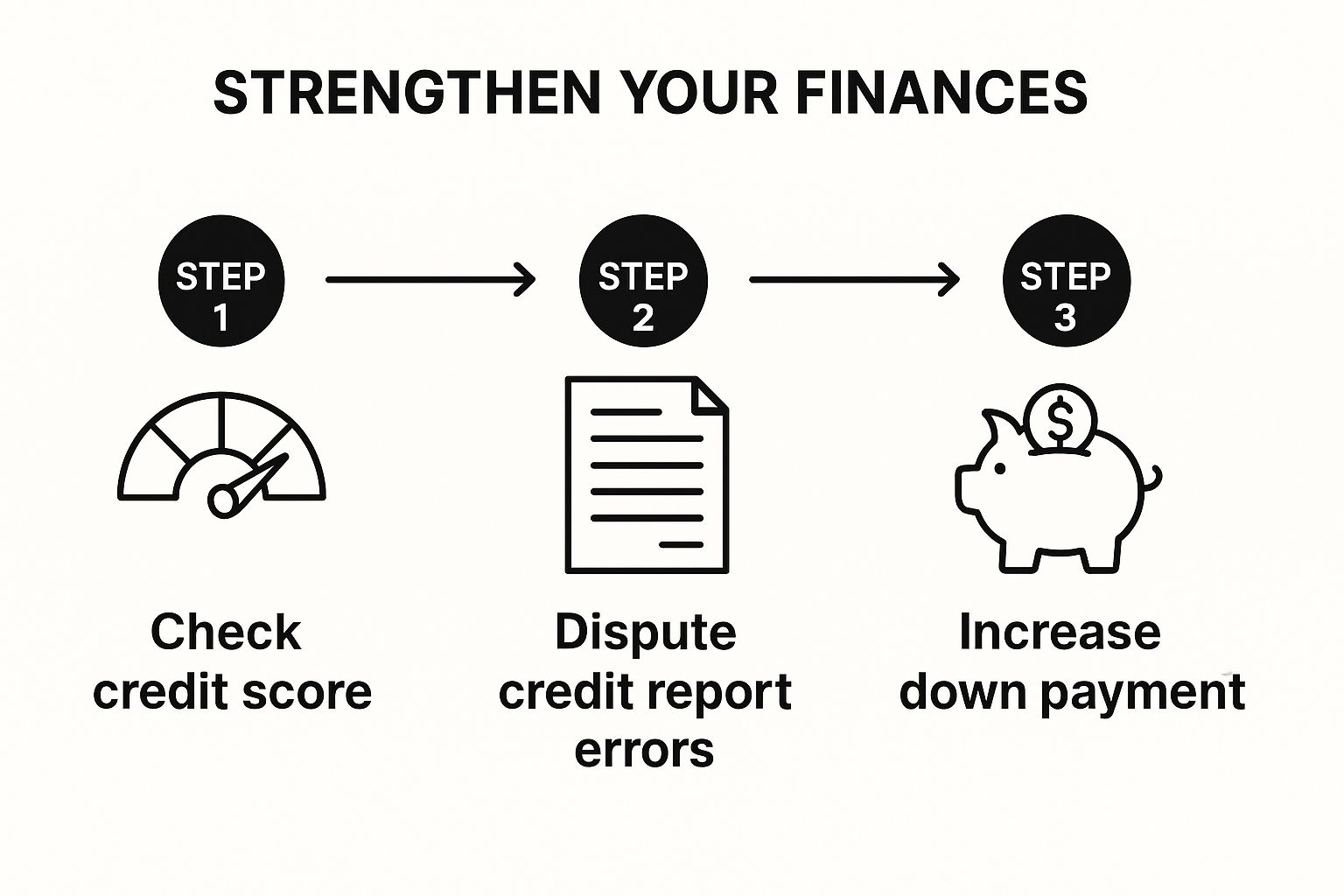
As you can see, getting your credit in shape and saving up a solid down payment are the foundational moves that give you negotiating power when it's time to talk numbers.
While you might see zero-down offers for cars, the RV world plays by a different set of rules. Lenders almost always require a down payment, and for good reason. A camper isn't just a vehicle; it's a significant depreciating asset, much more like a vacation home on wheels.
Putting down a good chunk of cash shows the lender you have skin in the game. It instantly lowers their risk by reducing the loan-to-value (LTV) ratio—the amount you're financing compared to the camper's actual worth.
The standard down payment for a camper is typically between 10% and 20% of the sale price. While 10% might be the bare minimum to get in the door, pushing for that 20% mark will pay off in a big way.
Let’s run the numbers on a real-world example. Say you're looking at a $60,000 travel trailer and get offered a 15-year loan at a 7.5% interest rate.
| Down Payment |
Loan Amount |
Monthly Payment |
Total Interest Paid |
| 10% ($6,000) |
$54,000 |
$522 |
$39,960 |
| 20% ($12,000) |
$48,000 |
$464 |
$35,520 |
Putting down that extra $6,000 upfront saves you $58 every month and a whopping $4,440 in interest over the life of the loan. That's enough cash to fund dozens of weekend getaways!
The benefits don't stop at just the direct savings. A larger down payment also:
- Protects You from Negative Equity: RVs lose value, especially in the first few years. A bigger down payment creates a buffer, helping you avoid owing more than the camper is worth (a situation known as being "upside-down").
- Boosts Your Approval Odds: If your credit is on the borderline, showing up with a 20% down payment can be the very thing that convinces a lender to approve your application.
- Lowers Your Monthly Bills: Simply put, borrowing less money means a smaller monthly payment. This leaves more breathing room in your budget for all the other fun—and not-so-fun—costs of RV ownership.
By taking the time to polish your credit and build your savings, you’re doing more than just preparing an application. You're taking control of the process to lock in the best financial deal for your future on the road.
https://www.youtube.com/embed/jz2UjnbdQus
Alright, you’ve wrestled with your budget and have a solid number in mind. Now for the exciting part: finding the money. It's a common misconception that all camper loans are basically the same. The truth is, where you get your financing can dramatically change your interest rate, the length of your loan, and your overall experience.
You'll generally run into three main options: financing directly through the RV dealership, going to your own bank or credit union, or working with a specialized online lender. Each one has its own vibe and set of pros and cons. Let's dig in so you can figure out which path makes the most sense for you.
There's no denying the appeal of handling everything in one go. You find the perfect rig, and the dealership's finance manager works their magic, presenting you with loan options right then and there. It's the ultimate one-stop-shop, and for many people, that convenience is a huge win.
But that ease can sometimes come with a hidden cost. The interest rate offered might be a point or two higher than what you could get on your own. Dealerships often partner with a network of lenders and may add a small margin to the rate for arranging the loan. It's a standard business practice, but it’s something to be aware of as you weigh your options.
Your local bank or credit union should be one of your first stops. You’ve already got a history with them, and that relationship can sometimes translate into better rates or a smoother process. Credit unions, in particular, are famous for their member-first approach and often have some of the best rates you'll find anywhere.
Here's a pro tip: Get pre-approved before you start shopping. Seriously. Walking onto an RV lot with a pre-approval letter from your bank is a massive power move. It essentially makes you a cash buyer in the dealer's eyes and gives you serious leverage to negotiate the best possible price on the camper itself.
Pre-approval is your superpower. Walking into a dealership with your financing already secured puts you in control of the conversation and forces them to compete for your business.
The world of RV financing is changing, and a growing number of buyers are now turning to online lenders who do nothing but RV loans. These folks live and breathe this stuff, so they often have more flexibility, especially for unique situations like financing a rig you plan to live in full-time.
The market has really opened up. While big banks like Bank of America and Wells Fargo are still in the game, a new wave of online-focused lenders is making things more competitive. In fact, this segment of the market is projected to grow at a compound annual rate of 15.46% through 2030. This boom is driven by the sheer convenience and flexibility these lenders offer. You can get a better sense of the evolving RV financing market and see how technology is shaking things up.
Many of the big, traditional lenders also have a strong online presence, showing how they're adapting.
As you can see, they often highlight long loan terms and the ease of applying online, trying to compete with the newer digital-first companies.
To help you sort through it all, it helps to see the options laid out side-by-side. Think about what's most important to you—is it the absolute lowest rate, a lightning-fast process, or more flexible terms for a unique situation?
This table should give you a good starting point.
Comparing Camper Financing Sources
| Lender Type |
Typical Interest Rates |
Pros |
Cons |
| Dealership |
Moderate to High |
Convenience: Handles everything in one place.
Fast Approval: Can often secure financing on the same day. |
Higher Rates: May not offer the most competitive interest rate.
Less Transparency: Can be harder to see the true cost of the loan. |
| Bank/Credit Union |
Low to Moderate |
Competitive Rates: Especially from credit unions.
Existing Relationship: May offer loyalty discounts or better terms. |
Stricter Criteria: Can have tougher approval standards.
Slower Process: May take longer to get pre-approved. |
| Online Lender |
Low to Moderate |
Specialized Knowledge: Understands the nuances of RVs.
Flexible Terms: Often offers longer terms and options for full-timers. |
Impersonal: The entire process is digital.
Variable Reputation: Requires research to ensure you choose a reputable company. |
So what's the bottom line? Don't put all your eggs in one basket. The smartest move is to get quotes from at least three different sources—try your credit union, an online lender, and see what the dealership can offer. For a closer look at some of the best companies out there, check out our guide on the top RV financing options for your dream RV.
A little bit of homework here can literally save you thousands of dollars over the life of your loan. It’s well worth the effort.

You've done the financial homework and have a lender in mind—now you're in the final stretch. The loan application is where all that prep work really shines. A smooth application process all comes down to being prepared.
Having all your ducks in a row doesn't just make things faster; it shows the lender you're an organized, serious borrower. You're essentially making their job easier, which ultimately makes your life easier.
Before you even think about filling out a form, get your paperwork in order. Lenders need to verify your identity, income, and overall financial standing, and scrambling for documents at the last minute is a recipe for stress.
You’re building a case for yourself as a reliable borrower. The clearer the picture you can provide, the better.
Most lenders will ask for a standard set of documents:
- Proof of Identity: A clear copy of your driver's license or another government-issued photo ID is a must.
- Proof of Income: This is the big one. Have your last two pay stubs, W-2s from the past two years, and maybe your most recent tax returns ready. If you're self-employed, tax returns are non-negotiable.
- Proof of Residence: A recent utility bill or bank statement showing your current address usually does the trick.
- Bank Statements: Lenders typically want to see your last two or three months of bank statements to confirm you have the down payment funds and to get a feel for your cash flow.
- Purchase Agreement: Once you’ve picked out your camper, you’ll get a signed purchase agreement from the dealer. This document has all the key details, including the price and the vehicle identification number (VIN).
I always recommend saving digital copies of these in a secure folder on your computer. It makes online applications incredibly fast.
Pro Tip: If you have income from side hustles, freelance work, or rental properties, be ready with extra documentation. The more thorough you are upfront, the fewer questions and delays you'll have to deal with later.
Everyone wants the best interest rate—it’s one of the most important parts of figuring out how to finance a camper. But there's a common fear that applying with multiple lenders will tank your credit score. Thankfully, there’s a smart way to do it.
Credit scoring models are built to understand that people shop around for the best rates on big purchases. That’s why multiple inquiries for the same type of loan within a short window (usually 14 to 45 days) are typically treated as a single event. This lets you compare real offers without taking a major hit to your credit.
This "rate-shopping" window is your golden opportunity. Try to submit all your applications within a one- to two-week period just to be safe. You can then compare the official loan estimates side-by-side and see which lender is truly offering the best deal.
Once you get an approval, you’ll receive the loan agreement. It's so tempting to just sign on the dotted line, but this document controls your financial commitment for the next 10 to 20 years. You have to read it.
The world of financing a camper can be complex, and small differences in rates and terms add up to a lot of money over time. With great credit, you might see rates for new RVs starting around 5.99%, but rates for used models can climb from 8.74% to over 20%, depending on the lender. If you're curious how these numbers stack up, you can explore more about RV industry financing trends.
Pay close attention to these key details in your agreement:
- Annual Percentage Rate (APR): This is the real cost of borrowing, as it includes the interest rate plus any lender fees. Double-check that the APR on the contract is the same one you were quoted.
- Loan Term: Confirm the total number of months you'll be making payments. Remember, a longer term gives you a lower monthly payment, but you'll pay significantly more in interest over the life of the loan.
- Prepayment Penalties: This is a huge one. Some lenders charge a fee if you pay off the loan ahead of schedule. Always look for a loan with no prepayment penalty—it gives you the freedom to pay it down faster if you can.
- Late Fees: Know the grace period for your payments and exactly what the penalty is if you happen to miss a due date.
Taking a few extra minutes to understand these points ensures you won’t have any unwelcome surprises down the road. You want to start your RV adventure with an agreement you're completely comfortable with.
As you start digging into how to finance a camper, you'll inevitably run into a few specific questions. These are the details that often trip people up, but getting them sorted out early will make the whole process feel much less intimidating.
Let's walk through the most common questions that pop up, so you can move forward with total confidence.
You absolutely can. Financing is readily available for both new and used campers, but you should expect the terms to be a bit different. Lenders see a used RV as a slightly bigger risk, so they adjust the loan accordingly.
This usually means you'll be looking at slightly higher interest rates and shorter repayment periods compared to what you'd get for a shiny new model. For instance, a new camper loan might run for 15 or even 20 years, while a used model might be capped at 10 or 12 years.
Keep in mind that most lenders have an age limit on used campers. It's common for them to pass on financing any model older than 10-15 years. They'll also likely require a professional inspection to confirm its condition and value before they'll approve the loan.
Forget everything you know about car loans. Camper loans are a different beast entirely, operating on a much longer timeline. Because RVs are such a big investment—often more like a second home than just a vehicle—lenders stretch out the repayment periods to keep the monthly payments from getting out of hand.
Most camper loans fall into the 10 to 15-year range. For those really big rigs, like a high-end Class A motorhome or a massive fifth wheel, some specialty lenders will even push the term out to 20 years.
A longer term definitely makes for a lower monthly bill, but it's a trade-off. You'll end up paying significantly more in total interest over the life of the loan. The goal is to find that sweet spot: a payment you can comfortably afford without throwing away too much extra money on interest.
It is, but you need to be prepared for a few extra hurdles. The idea of financing a primary residence can make some traditional banks a little jumpy, mainly because repossession laws are more complicated for a home than for a recreational vehicle.
The good news? With the boom in the full-time RV lifestyle, many lenders—especially online lenders who specialize in RVs—are completely comfortable with this. They've built processes specifically for full-timers.
The golden rule here is to be upfront with your lender from the very beginning. Don't try to hide your plans to live in it full-time; that can cause serious problems down the road. They might ask for some extra paperwork, but finding a loan for your home-on-wheels is very doable with the right partner. If you want to dive deeper, you can find more answers in these camper financing frequently asked questions.
While there's no single magic number for approval, lenders do have clear benchmarks. As a general rule, you’ll want your credit score to be 680 or higher to get access to competitive loan offers.
If you're aiming for the best possible interest rates and terms, a score of 740 or above is your target. This puts you in the top tier of borrowers and gives you much more leverage.
Here’s a quick breakdown:
- Excellent Credit (740+): Expect the lowest interest rates and most attractive terms.
- Good Credit (680-739): You should get approved without much trouble, though your rate might be a tick higher.
- Fair Credit (Below 680): A loan is still possible, but you should prepare for a higher interest rate and a larger down payment requirement.
If your score is sitting below 640, it's a smart financial decision to take a few months to improve it before applying. The long-term savings in interest will be well worth the wait.
Ready