Ready to explore the world of nimble travel? If you're searching for light weight travel trailers for sale, you're really looking for a ticket to freedom—one that doesn't require a giant, gas-guzzling truck. This guide is here to cut through the noise and help you find the perfect match for your adventures.
Jumping into the search for the right lightweight travel trailer is an exciting first step toward a more flexible and adventurous way of life. It’s no surprise these RVs have become so popular; they strike that perfect balance between comfort and mobility, making them a great fit for both seasoned road warriors and first-timers.
Think of it like choosing the perfect hiking backpack. It has to be light enough to carry comfortably on the trail, but it also needs enough space for all your essential gear. The same principle applies here.
We've designed this guide to be your trusted companion, walking you through every crucial detail. We’ll break down what "lightweight" actually means in the RV world, show you how to safely match a trailer to the vehicle you already own, and give you the confidence to navigate the buying process like a pro.
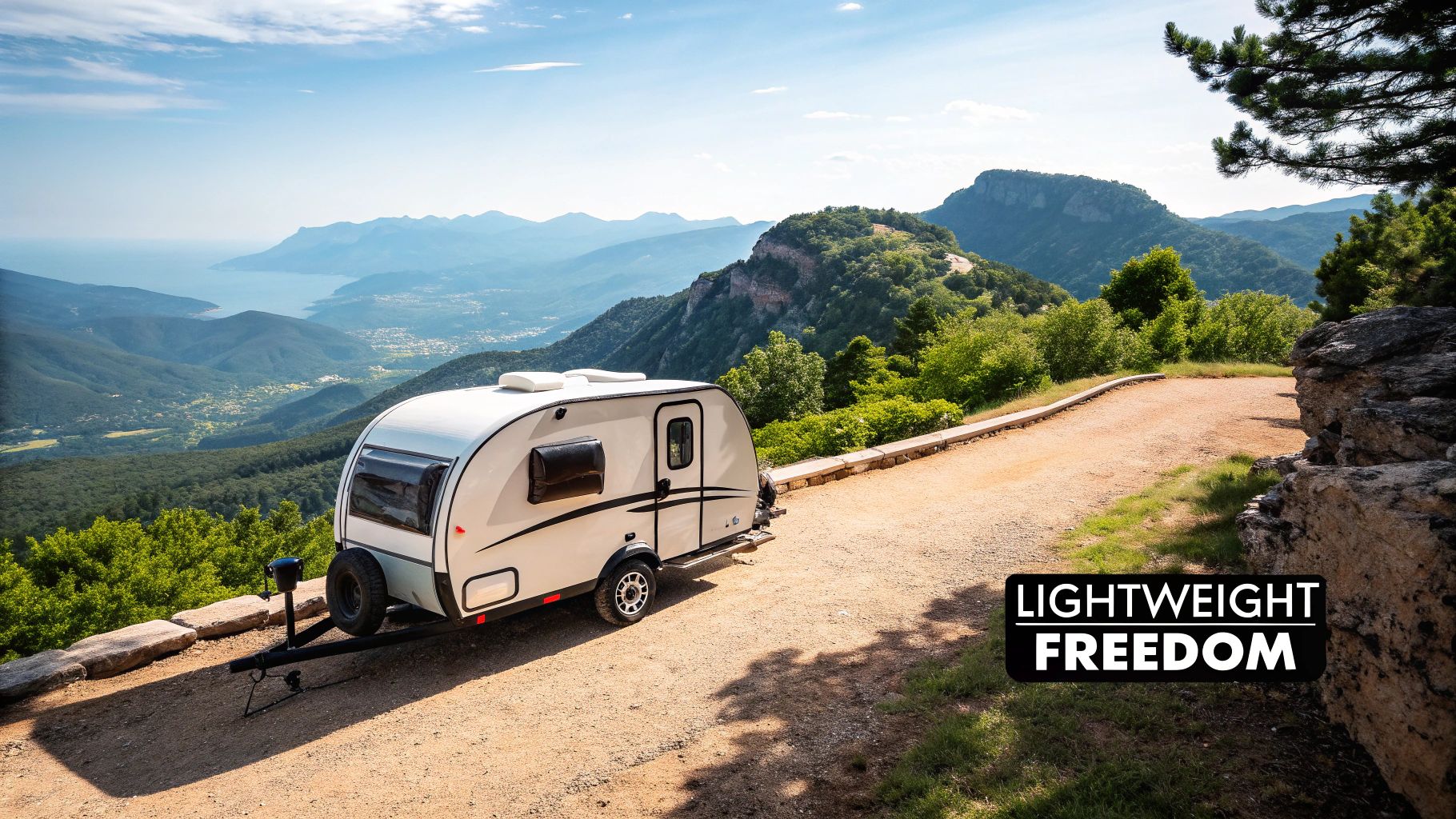
The appeal of a smaller, lighter trailer goes way beyond just being easier to tow. These nimble rigs open up a world of possibilities that their larger, heavier cousins simply can't match. From saving money to enabling more spontaneous trips, the advantages are hard to ignore.
Here's what makes them so great:
- Better Fuel Efficiency: A lighter load means your tow vehicle doesn't have to work as hard. That translates directly into less fuel consumption and more money in your pocket on every single trip.
- Easier Towing and Maneuverability: If you're new to towing, a small trailer is the perfect way to learn. They're far less intimidating to pull, a breeze to park, and much easier to navigate through tight campground spots or busy city streets.
- Greater Accessibility: Many of the most beautiful state and national park campgrounds have strict length and weight restrictions. A compact trailer is your ticket into these more remote, scenic spots that are off-limits to bigger rigs.
- Lower Overall Cost: The savings don't stop at the purchase price. Lightweight trailers generally come with lower insurance premiums, registration fees, and maintenance costs compared to larger models.
The real magic of a lightweight trailer is its simplicity. It's all about minimizing the hassle so you can maximize the adventure, letting you focus on the experience instead of the logistics of a heavy rig.
Before you dive into browsing listings for light weight travel trailers for sale, it's crucial to get a clear picture of your needs and, just as importantly, your limitations. A little bit of homework now will save you from major headaches down the road.
Answering a few key questions first will help you narrow the search and zero in on a model that truly fits your lifestyle.
This table gives you a quick snapshot of the most important things to think about as you get started.
| Factor |
What to Look For |
Why It Matters |
| Towing Capacity |
Your vehicle's max tow rating and GVWR. |
Exceeding your vehicle's limits is incredibly unsafe and can cause serious, expensive damage to your engine and transmission. |
| Sleeping Capacity |
How many people (and pets!) will be traveling with you. |
This ensures everyone has a comfortable place to sleep without feeling like you're all crammed into a sardine can. |
| Floor Plan |
The layout of the kitchen, bathroom, dinette, and beds. |
The right layout makes a small space feel huge and functional, matching how you actually live and move around. |
| Build Quality |
Construction materials like aluminum frames, Azdel composite panels, and axle types. |
Better materials mean better durability, a longer lifespan, and more resistance to common issues like water damage. |
Taking the time to think through these points will put you in a much better position to find a trailer you'll love for years to come.
When you start looking at light weight travel trailers for sale, you'll see the term "lightweight" everywhere. But what does it actually mean? It’s not just a random number on a spec sheet. It's a whole design philosophy focused on smart engineering to build a camper that’s both comfortable and towable by a much wider range of vehicles—think SUVs, crossovers, and even some minivans.
This is a game-changer. It opens up the world of RVing to anyone who doesn't own (or want to own) a massive, heavy-duty pickup truck. Suddenly, the family car you already have in the driveway might be all you need to hit the road. But to really get it, we need to peel back the marketing jargon and look at the numbers and materials that make these nimble campers possible.
The first step to understanding any travel trailer is learning to speak the language, and the most critical vocabulary is all about weight. You'll see two acronyms constantly: UVW and GVWR. Mixing these up is an incredibly common—and potentially dangerous—mistake.
Think of it like packing a suitcase for a flight. The empty bag has a weight, but the airline only cares about how heavy it is when it’s fully packed.
-
Unloaded Vehicle Weight (UVW): This is your "empty suitcase." It's the weight of the trailer right from the factory, with all the standard equipment but before you've added a single thing. No water in the tanks, no propane, no camping gear, no food. It's your starting point.
-
Gross Vehicle Weight Rating (GVWR): This is the airline's hard limit. It’s the absolute maximum weight your trailer can safely handle when fully loaded. This includes the trailer itself plus everything you've packed—water, clothes, chairs, bikes, you name it. You can never, ever exceed this number.
The difference between the GVWR and the UVW gives you your Cargo Carrying Capacity (CCC). That's the real-world number that tells you exactly how many pounds of gear you can safely bring along. Getting this right is the key to safe, worry-free towing.
A trailer's true weight isn't what it weighs empty, but what it weighs when you're packed and ready to hit the road. Always prioritize the GVWR to ensure you stay within your tow vehicle's safe limits.
So, how do manufacturers manage to build a trailer that’s both light and sturdy? It all comes down to the materials. Modern technology has given them fantastic new options to shave off pounds without compromising on durability, which is a massive win for all of us.
This infographic really helps visualize the process of choosing the right lightweight trailer, from understanding its weight ratings to picking the right construction.
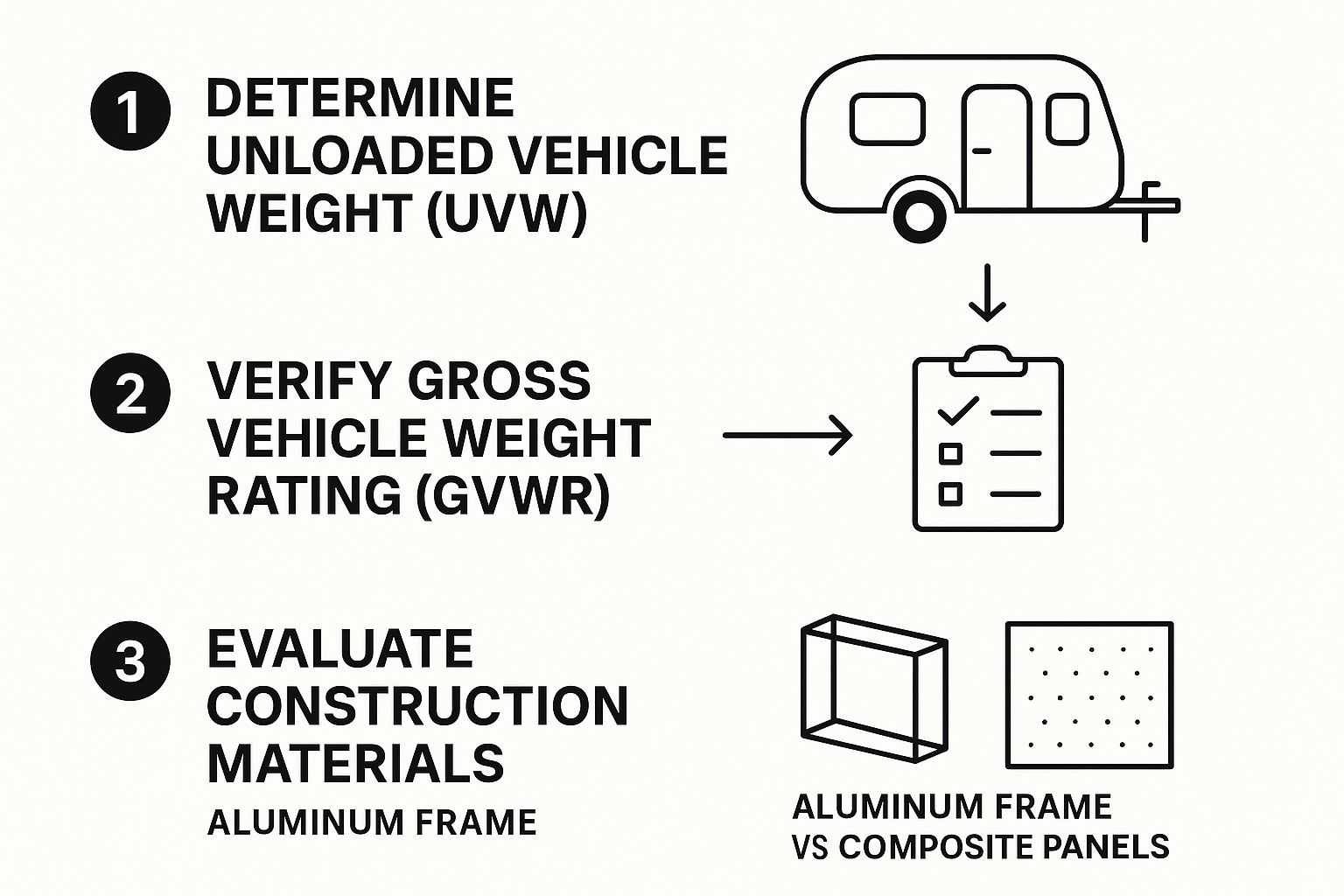
As you can see, it's a step-by-step decision. You start with the weight to ensure safety and then move on to the materials that will give you the longevity you want. Some of the key materials that help keep the weight down include:
- Aluminum Framing: Instead of heavy steel, most lightweight trailers use a welded aluminum cage as their "skeleton." It provides a fantastic strength-to-weight ratio.
- Composite Panels: Cutting-edge materials like Azdel composite panels are now often used for the walls instead of traditional luan plywood. Azdel is about 50% lighter than wood, and it's also waterproof and mold-resistant, which helps prevent the dreaded delamination you see on older RVs.
- Fiberglass Shells: Some of the most sought-after lightweight trailers, like Scamps or Casitas, are built with a molded fiberglass shell. This "egg" style of construction is incredibly durable, naturally leak-resistant, and very light.
These kinds of innovations are a big reason the RV market is booming. The global recreational vehicle market is actually projected to grow from $53.1 billion in 2025 to $81.4 billion by 2032, driven by people looking for more accessible ways to travel. You can read more about the trends shaping the future of RVs and see how these materials play a role.
The "lightweight" category isn't just one type of camper; it's a broad term that covers several distinct styles. When you see light weight travel trailers for sale, they will most likely fall into one of these groups:
- Teardrop Trailers: The smallest and lightest of the bunch, often weighing well under 2,000 pounds. They typically have a simple sleeping cabin and a galley kitchen in a "clamshell" hatch at the back. They’re perfect for solo travelers or couples who like to keep things simple.
- Pop-Up Campers: These clever trailers have a hard-sided base and canvas walls that expand or "pop up" at the campsite. This design keeps them incredibly light and low-profile for towing but gives you a ton of living space once you’re set up.
- Small Bunkhouse Models: A family favorite! These trailers brilliantly squeeze a set of bunk beds into a compact floor plan, usually weighing between 3,000 and 5,000 pounds. You get all the essential amenities of a big RV in a package your SUV can handle.
https://www.youtube.com/embed/wJFVMj-bVsY
It’s easy to get swept up in the excitement of finding the perfect lightweight travel trailer. But before you get too attached to a floor plan, the most critical step is making sure your vehicle can actually pull it safely.
Towing can seem intimidating, full of acronyms and numbers, but it really boils down to just a few key specs. Getting this part right isn't a suggestion—it's absolutely non-negotiable for the safety of you, your family, and everyone else on the highway.
Think of your vehicle's towing capacity as your guide. Before you even start browsing, you need to know exactly what your car, truck, or SUV can handle. This one piece of information will immediately filter your search and show you which light weight travel trailers for sale are realistic options.
First things first: you need to find your vehicle’s maximum tow rating. This is the number the manufacturer has certified as the absolute limit. You can usually find it in a couple of places:
- Your Owner’s Manual: This is your best friend. Flip to the section on "Towing" or "Specifications" for the most accurate information.
- The Driver’s Side Door Jamb: Look for a sticker inside the driver's door. It's packed with crucial weight info, including the Gross Combined Weight Rating (GCWR), which is the max weight of your fully loaded vehicle and your fully loaded trailer.
- The Manufacturer's Website: A quick search for your vehicle’s year and model plus "towing guide" will usually get you the official specs.
Once you find that number, treat it as a hard ceiling. But here's a pro tip: your real-world, safe towing capacity is almost always less than that maximum number.
The 80% Rule of Safe Towing
I always tell people to follow the 80% rule. It's a simple rule of thumb that can save you a world of trouble. Never plan to tow more than 80% of your vehicle's maximum rating. For example, if your SUV is rated to pull 5,000 pounds, you should only be looking at trailers with a fully loaded weight (GVWR) of 4,000 pounds or less. That 20% buffer gives you a margin of safety for handling steep hills, fighting a headwind, and reducing the daily wear and tear on your engine and transmission.
Matching your trailer isn’t just about the total weight you're pulling. It's also about how that weight is balanced on your hitch. This is where tongue weight comes into play.
Imagine your vehicle and trailer are a seesaw, with the hitch ball as the pivot point. Tongue weight is the downward force the trailer puts on that pivot. Getting it right is the secret to a stable, relaxing tow. The sweet spot is a tongue weight that's between 10% and 15% of the trailer's total loaded weight (its GVWR).
- Too Little Tongue Weight: The trailer gets light in the front, causing the back end to sag. This is a recipe for terrifying trailer sway—that "tail wagging the dog" feeling that can quickly lead to losing control.
- Too Much Tongue Weight: All that weight pushes down on your vehicle's rear bumper, causing it to squat. This lifts your front wheels, which kills your steering response and seriously reduces your braking power.
So, for that 4,000-pound trailer, you'll want a tongue weight between 400 and 600 pounds. This keeps the whole rig level, balanced, and driving smoothly.
Okay, so you’ve found a trailer that fits your vehicle’s numbers. You’re not quite done yet. To tow safely and legally, you need some essential gear. These aren't fancy add-ons; they are fundamental safety systems.
- A Proper Hitch Receiver: This is the square tube on the back of your vehicle that the hitch slides into. Make sure it's rated to handle the weight you plan to tow.
- A Weight Distribution Hitch: For anything bigger than a tiny teardrop trailer, I consider this a must-have. It uses a system of spring bars to spread the tongue weight across the axles of both your vehicle and the trailer. This prevents that dangerous rear-end squat and dramatically improves stability.
- A Brake Controller: This is a small device installed in your driver's cab that activates your trailer's brakes when you press your brake pedal. It's a game-changer for stopping power. Plus, most states legally require trailer brakes for any trailer weighing over 3,000 pounds.
Of course, having the right tow vehicle from the start makes all of this much easier. If you're looking for a new rig, our guide to the top picks for the best truck for towing a travel trailer in 2024 is a great place to start your research.
When you know your numbers and have the right equipment, you can tow with confidence. That peace of mind is the true first step to countless amazing adventures on the road.
Alright, let's get to the fun part—picturing yourself on the road. When you start looking at light weight travel trailers for sale, you'll see an incredible variety of models out there. Each one is built with a different kind of traveler in mind. We're going to dive deeper than just the spec sheets to see what the key features actually mean for your camping trips.
This is about more than just numbers. It’s about translating a feature list into a real-world experience. For instance, a slide-out isn't just a few extra square feet. It's the difference between feeling cramped on a rainy day and having enough room for the whole family to play a board game. Getting a feel for these details is what will help you pick a trailer you'll genuinely love.
The demand for this kind of travel is absolutely booming. The North American travel trailer market is expected to hit USD 28.6 billion by the end of 2025 and an incredible USD 57.3 billion by 2035. This growth is being fueled by a new wave of adventurers who want a more mobile, flexible lifestyle. You can learn more about this expanding market and its future trends to see just how popular these RVs are becoming.
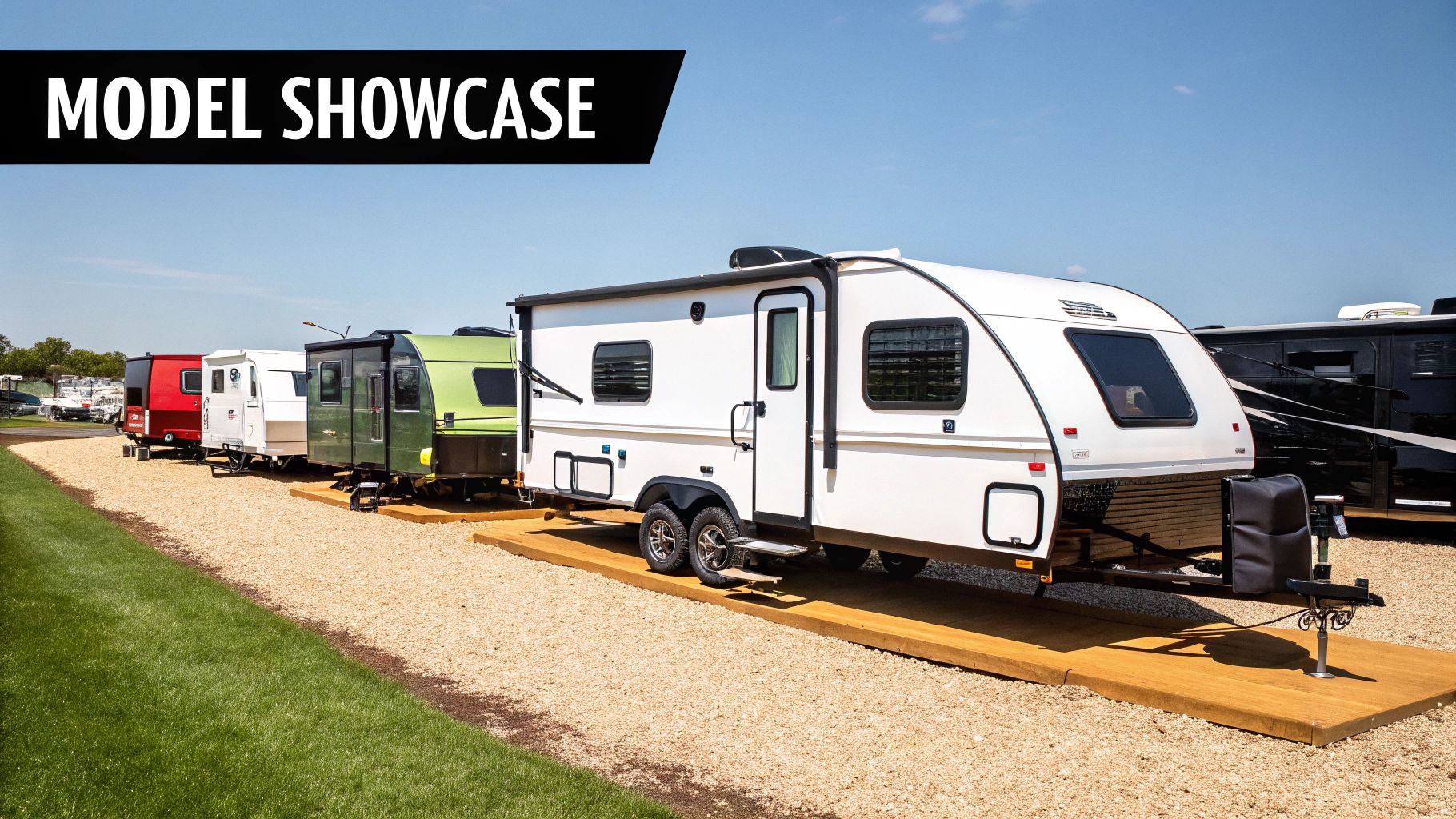
Teardrop trailers are the very picture of minimalist adventure. They're tiny but mighty.
Typically weighing less than 2,000 pounds, you can tow them with a huge range of vehicles, including many crossovers and small SUVs. That iconic curved shape isn't just for show—it's super aerodynamic and helps with fuel efficiency on the highway.
The whole design philosophy is brilliantly simple: a cozy spot to sleep inside and a great little kitchen outside.
- Rear Galley Kitchen: Most teardrops have a clamshell-style hatch at the back that lifts up to reveal a compact kitchen. This is perfect for people who love cooking outdoors and want to feel connected to their surroundings.
- Cozy Sleeping Cabin: The inside is pretty much all bed, usually a queen-sized mattress. It’s a massive step up from a tent, giving you a secure, warm, and dry place to crash for the night.
These little trailers are perfect for solo travelers or couples who spend their days out exploring and just need a comfortable home base to return to.
For young families, the small bunkhouse model is a total game-changer. These trailers manage to fit sleeping space for four or five people into a lightweight frame, usually coming in between 3,000 and 5,000 pounds. They're proof that you don't need a giant rig to bring the kids along for the ride.
A great example is the Forest River Wolf Pup 16BHS. It manages to pack in a queen bed for the parents and a set of bunks for the kids, all in a trailer that’s easy to tow and park.
The real genius of a small bunkhouse is its ability to create separate zones in a tiny space. Giving kids their own bunk area provides a sense of personal space that can make longer trips much more enjoyable for everyone.
To help you get a sense of what’s out there, here’s a quick comparison of some popular lightweight trailer types. This table breaks down what makes each style unique and who it might be best for.
| Trailer Type |
Typical Weight Range (lbs) |
Best For |
Common Features |
| Teardrop Trailer |
1,000 - 2,500 |
Solo travelers, couples, minimalists |
Outdoor kitchen, cozy sleeping cabin, basic amenities |
| Small Bunkhouse |
3,000 - 5,000 |
Young families, small groups |
Bunk beds, queen bed, small kitchen & bath |
| Couples Coach |
3,500 - 6,000 |
Couples seeking more comfort |
Rear living/dinette, larger bathroom, slide-out options |
| Hybrid Trailer |
2,500 - 4,500 |
Tent camping fans wanting an upgrade |
Canvas-sided pop-out beds, hard-sided body |
As you can see, the "best" trailer really comes down to how you plan to travel and who you're bringing with you.
As you start comparing models, you'll run into some specific lingo. Let's break down what these terms actually mean for your day-to-day life at the campsite.
Wet Bath vs. Dry Bath
This is one of the most important things to understand in small trailers.
- A Wet Bath puts the toilet and shower together in one single, waterproof room. It’s a brilliant way to save space, but it does mean you’ll need to wipe down the toilet and walls after you shower.
- A Dry Bath keeps the shower separate from the toilet and sink, just like at home. It definitely takes up more room, but the convenience is a huge step up.
Slide-Outs: The Space Multiplier
A slide-out is a section of the trailer that, with the push of a button, extends outward once you’re parked. Even a single, small slide-out can completely transform the interior, making a narrow trailer feel open and airy. They add a bit of weight and mechanical complexity, but for families or anyone planning longer trips, that extra living space is often a non-negotiable.
Solar Prep and Off-Grid Capability
You'll see a lot of new lightweight trailers advertised as coming with "solar prep." All this means is that the wiring for solar panels is already installed from the factory. This is a fantastic feature if you’re interested in boondocking or camping without hookups, as it makes adding panels later on much easier. It gives you the freedom to power your lights and charge your devices using just the sun.
A fantastic example of a trailer that balances all these features is the Winnebago Micro Minnie. It often packs in a spacious dry bath and a slide-out while keeping the weight in a range that many SUVs can handle. You can see how it all comes together in our in-depth review of the Winnebago Micro Minnie 1808FBS and its standout features. Once you start visualizing how these features fit your travel style, you’ll be able to confidently pick the perfect trailer.
Alright, you’ve figured out the size and features you’re after. Now comes the big fork in the road: should you buy a brand-new trailer or a pre-loved one? This decision is really about balancing your budget against your appetite for risk. There’s no right or wrong answer here—it all comes down to what matters most to you.
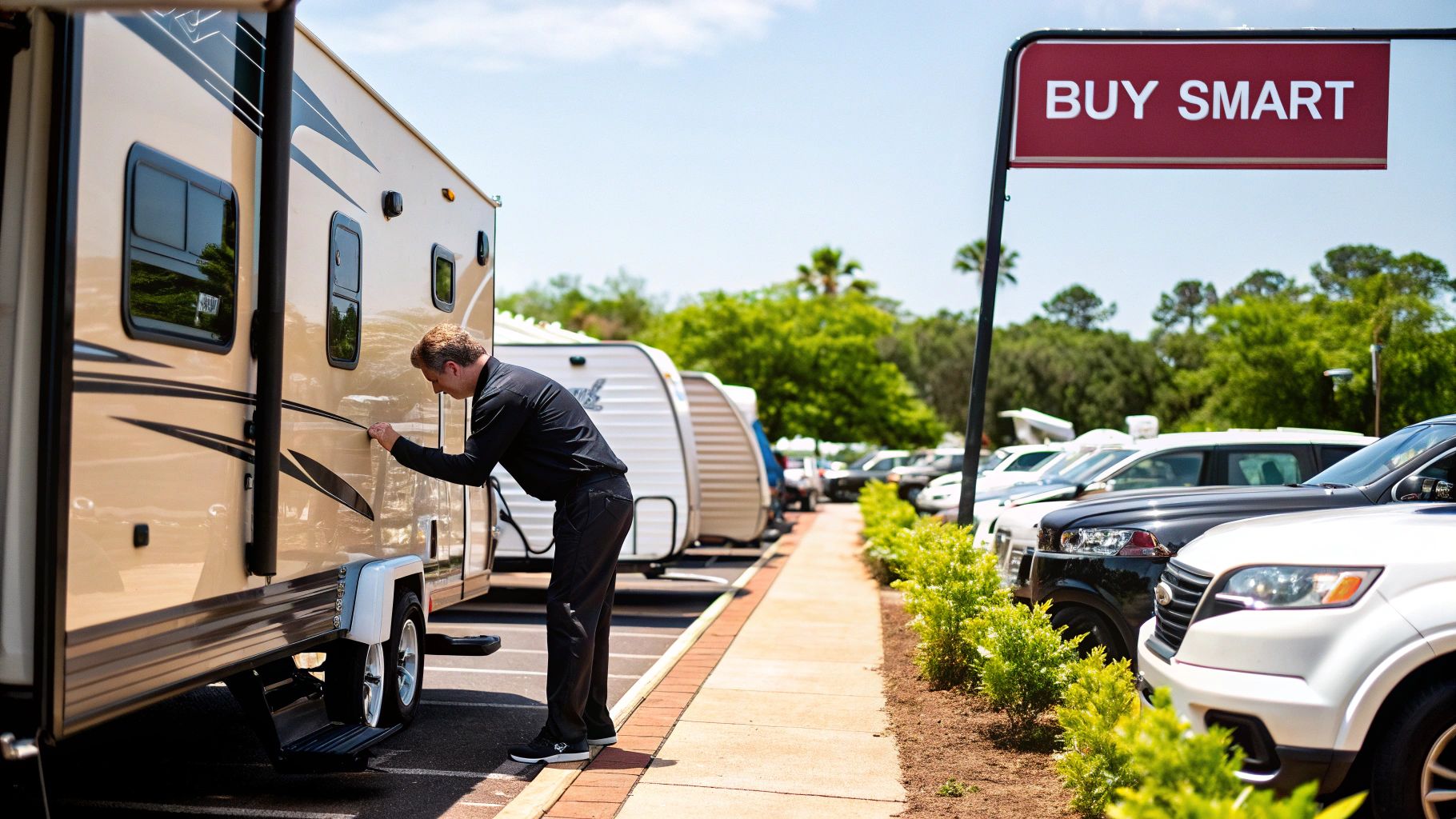
Buying new is an amazing feeling. You get that "off-the-lot" shine, all the latest gadgets, and a full manufacturer's warranty. That warranty alone provides incredible peace of mind for the first year or two of ownership. The flip side? You’re going to take the biggest hit on depreciation, which can easily be 20% or more in the first year.
Going the used route lets the first owner absorb that initial depreciation. You can often find a much nicer, more feature-packed trailer for the same money you'd spend on a basic new model. The trade-off, of course, is that you’re buying its history—the good and the bad. Any repairs that pop up will likely be coming out of your own pocket.
Walking onto a dealership lot can feel a little intimidating, but doing your homework beforehand transforms you into a confident buyer. When buying new, that factory warranty is your golden ticket. Get crystal clear on what it covers and for exactly how long.
Here are a few tips to help you get the best possible price:
- Shop at the End of the Month: Sales teams have quotas to hit. They often become much more flexible with pricing as the end of the month or quarter looms.
- Know the True Market Value: Do some digging online to see what similar models are actually selling for in your area. This gives you a solid, realistic number to start your negotiations with.
- Negotiate the "Out-the-Door" Price: Don't get hung up on the sticker price. Always ask for the final, all-in price that includes every fee, tax, and prep charge. This avoids any nasty surprises when you’re about to sign the papers.
Don't be afraid to walk away. If the numbers don't feel right, there will always be another trailer. Your willingness to leave the negotiating table is your most powerful tool.
The market for towable RVs is still hot. In the first quarter of 2025, shipments of these RVs (which are mostly travel trailers) jumped 17.1% year-over-year to 33,982 units. This strong demand means it pays to be a prepared and savvy buyer. You can dive into more details on recent RV market trends to get a feel for the current sales climate.
Buying a used trailer means you have to put on your detective hat. Your number one enemy is water damage—it can be a total deal-breaker. A meticulous pre-purchase inspection is your best line of defense against inheriting someone else’s expensive problems. If you're not confident in your skills, spending a few hundred bucks on a certified RV inspector is money well spent.
This can be a lot to remember, so having a good checklist is key. For a truly comprehensive look, our article offers a complete guide to buying a used travel trailer.
In the meantime, here are the absolute must-check items:
- Check for Water Damage: The second you step inside, take a good sniff. A musty smell is a major red flag. Look for stains, discoloration, or soft spots on the ceiling, in corners, and around every window and vent. Push on the walls—they should feel firm and solid.
- Inspect the Roof and Seals: Safely get on a ladder and take a close look at the roof. The sealant around every vent, seam, and the A/C unit should be flexible, not cracked and brittle. A poorly maintained roof is the leading cause of catastrophic water leaks.
- Examine the Tires: Look for the four-digit date code on the tire sidewall (e.g., "3522" means it was made in the 35th week of 2022). RV tires need to be replaced every 5-7 years, no matter how much tread is left. The rubber simply breaks down over time.
- Test Every Single System: This is non-negotiable. Don't just take the seller's word for it. Run the water pump, light the stove, fire up the furnace and A/C, and plug something into every outlet. Test the fridge on both electric and propane. If it works, you need to see it work.
By arming yourself with this knowledge, you can approach the buying process with confidence. Whether you go new or used, a smart, informed strategy is your best bet for making a purchase that leads to years of happy adventures.
Even after hours of research, a few last-minute questions always seem to surface. That's perfectly normal. Choosing the right lightweight travel trailer is a big decision, and it’s smart to chase down any lingering doubts so you can buy with total confidence.
Think of this section as your final checklist. We've compiled the most common questions we hear from buyers and laid out some clear, no-nonsense answers to help you lock in your choice.
This is usually the first question on everyone's mind, and the honest answer is: it varies—a lot. Just like with cars, the price of light weight travel trailers for sale really depends on the brand, size, build quality, and included features.
You can find some great, brand-new pop-up campers that will get you started for around $10,000 to $15,000. They're a fantastic gateway into the RV world. If you're looking for a sma

