Before you ever step foot on a dealership lot, the most critical part of your motorhome buying journey happens right at your kitchen table. It starts with a brutally honest conversation about how you really plan to travel. Getting this right is the single most important step to making a smart purchase you'll love for years, not one you regret after the first big trip.
It’s incredibly easy to get swept away by the glamour of a massive, 40-foot Class A with residential fridges and multiple slide-outs. But before you get lost in glossy brochures and fancy features, you need to ground your search in reality. That dream rig might feel like a palace, but it becomes a nightmare when you're trying to navigate the winding roads of a national park. On the flip side, that nimble Class B van looks like the perfect adventure mobile, but it can start to feel awfully tight for a family of four two weeks into a cross-country adventure.
The trick is to nail down the practical details of your travel dreams. This means asking some tough questions and being honest with yourself.
Are you the type who takes off every other weekend for a quick getaway? Or are you a snowbird chasing the sun for months at a time? Maybe you're a full-time digital nomad who needs a reliable mobile office. Each of these travel styles points to a very different kind of motorhome.
- The Weekend Warrior: You need something that's easy to pack up, drive, and park. Your priorities are maneuverability and low-fuss setup. A smaller Class C or a versatile Class B van is often a perfect fit.
- The Seasonal Traveler: You're out for weeks or months, so you need a good balance of comfort and mobility. More storage and larger water tanks become essential. Look at mid-size Class C models and smaller, more manageable Class A coaches.
- The Full-Time Nomad: This is your primary home, so it needs to function like one. Maximum storage, robust four-season insulation, and a layout built for daily living are non-negotiable. This is where the big Class A and Super C models truly shine.
A motorhome is more than just a vehicle—it's a home on wheels. The most beautiful floor plan in the world is completely wrong if it doesn't support the way you actually want to eat, sleep, work, and explore.
This infographic breaks down one of the first big hurdles: aligning what you want with what you can realistically afford.

Nailing down your budget from the get-go saves a ton of time and prevents you from falling in love with a rig that’s simply out of reach.
To help you get started, this table matches motorhome classes with common travel styles. Think of it as a cheat sheet to narrow your focus.
| Motorhome Class |
Best For |
Typical Size Range |
Key Advantages |
| Class A |
Full-timers, long-term travelers, families |
29-45 feet |
Massive storage, residential amenities, smooth ride |
| Class B |
Solo travelers, couples, weekend adventurers |
19-24 feet |
Easy to drive/park, fuel-efficient, stealthy |
| Class C |
Families, first-time owners, seasonal use |
21-35 feet |
Good balance of space & maneuverability, bunk options |
| Super C |
Full-timers needing high towing capacity |
33-45 feet |
Heavy-duty truck chassis, powerful engine, durable |
Once you have a general idea of the right class, you can start digging into the specifics that matter most to you.
Now, take that travel persona and turn it into a concrete checklist. For a family with kids, sturdy bunk beds are probably a "must-have," while a second TV might be a "nice-to-have." If you're working from the road, a dedicated desk space or a dinette that comfortably converts into one is essential. This list is your North Star—it keeps you focused and prevents you from getting distracted by shiny objects you'll never actually use.
The motorhome market is booming and expected to hit USD 59.7 billion by 2035, largely thanks to a new wave of younger buyers and families hitting the road. As you can discover more insights about motorhome market trends, you'll see that today's wish lists often include things like solar prep, better fuel economy, and smart home features. Your personal checklist should reflect what you need, but also keep an eye on these modern standards.
By putting in this work upfront, you can walk onto a dealer's lot with confidence, ready to zero in on the few models that are a genuine fit for your adventures.
This is probably the biggest decision you'll make, and honestly, there's no single right answer. It’s a classic head-versus-heart debate. The pull of a brand-new motorhome is undeniable—that new-rig smell, a full warranty, and all the latest gadgets are incredibly tempting.
But that new rig comes with a gut-punch of a price tag and the steepest depreciation you'll ever see. It's not an exaggeration to say a new motorhome can lose up to 20% of its value the second its wheels hit the public road.
On the flip side, a gently used motorhome can be a fantastic deal. The first owner took that huge depreciation hit for you, and they likely sorted out all those annoying little factory bugs that pop up in the first year. The catch? You're also buying its entire history, good and bad. That could mean hidden issues, older tech, and zero warranty to back you up.
Choosing a new motorhome is really about buying peace of mind. That manufacturer's warranty is your safety net, and trust me, it’s worth its weight in gold during those first couple of years when things inevitably need adjusting.
New models also come loaded with modern features that can be a real pain to add later. We’re talking about things like factory-installed solar packages, vastly improved insulation for four-season camping, and energy-efficient appliances that sip propane and power. For a lot of people, just knowing they’re the first and only ones to sleep in that bed is worth every extra penny.
A new motorhome isn't just a vehicle; it's a blank canvas. You get to write its story from page one, with a factory warranty watching your back.
Going the used route can save you a serious amount of cash, but it demands you put on your detective hat. A bargain price means absolutely nothing if you're immediately blindsided by a five-figure repair bill for a delaminated wall or a bad transmission.
When you're inspecting a used rig, you have to be meticulous. Get past the shiny countertops and clean upholstery to hunt for the real problems lurking underneath. Don't be timid about it—ask the tough questions and expect straight answers. A seller who has nothing to hide will be happy to show you everything.
Here’s a checklist of non-negotiable questions to ask any seller, whether it's a private party or a dealership:
- Maintenance Records: "Can you walk me through the service history?" A thick folder of receipts is a beautiful sight. It shows a history of care.
- Water Damage: "Has this rig ever had a leak? Even a small one?" Look for the tell-tale signs yourself: faint stains on the ceiling, a soft spot near the slide-out, or a musty smell. Water is the ultimate enemy of an RV.
- Tire Age: "What’s the date code on these tires?" RV tires almost never wear out; they age out. If the tires are more than five or six years old, they're a safety hazard and a $2,000+ replacement cost you need to factor in.
- Lifestyle and Storage: "How did you use it, and where was it kept?" A motorhome that sat in a covered storage unit will be in dramatically better shape than one that baked in the Arizona sun or endured snowy northern winters.
In the end, it boils down to a trade-off between cost and risk. A new rig costs more but minimizes your short-term risk. A used one can be an incredible value, but only if you’ve done the legwork to make sure you're not buying someone else's expensive problems.
Alright, this is it. After all the online searching and tire-kicking, you’re finally standing in front of what could be your new home on wheels. This is where the real work begins. A detailed, hands-on inspection is absolutely crucial, regardless of whether the motorhome is brand new or has seen a few thousand miles of adventure.
Don't be timid here. You need to get up close and personal. I always recommend bringing a good, bright flashlight and wearing clothes you don't mind getting a bit grubby. Before you even show up, ask the seller to have everything hooked up and running—shore power, city water, and propane. Any serious seller will be happy to oblige.
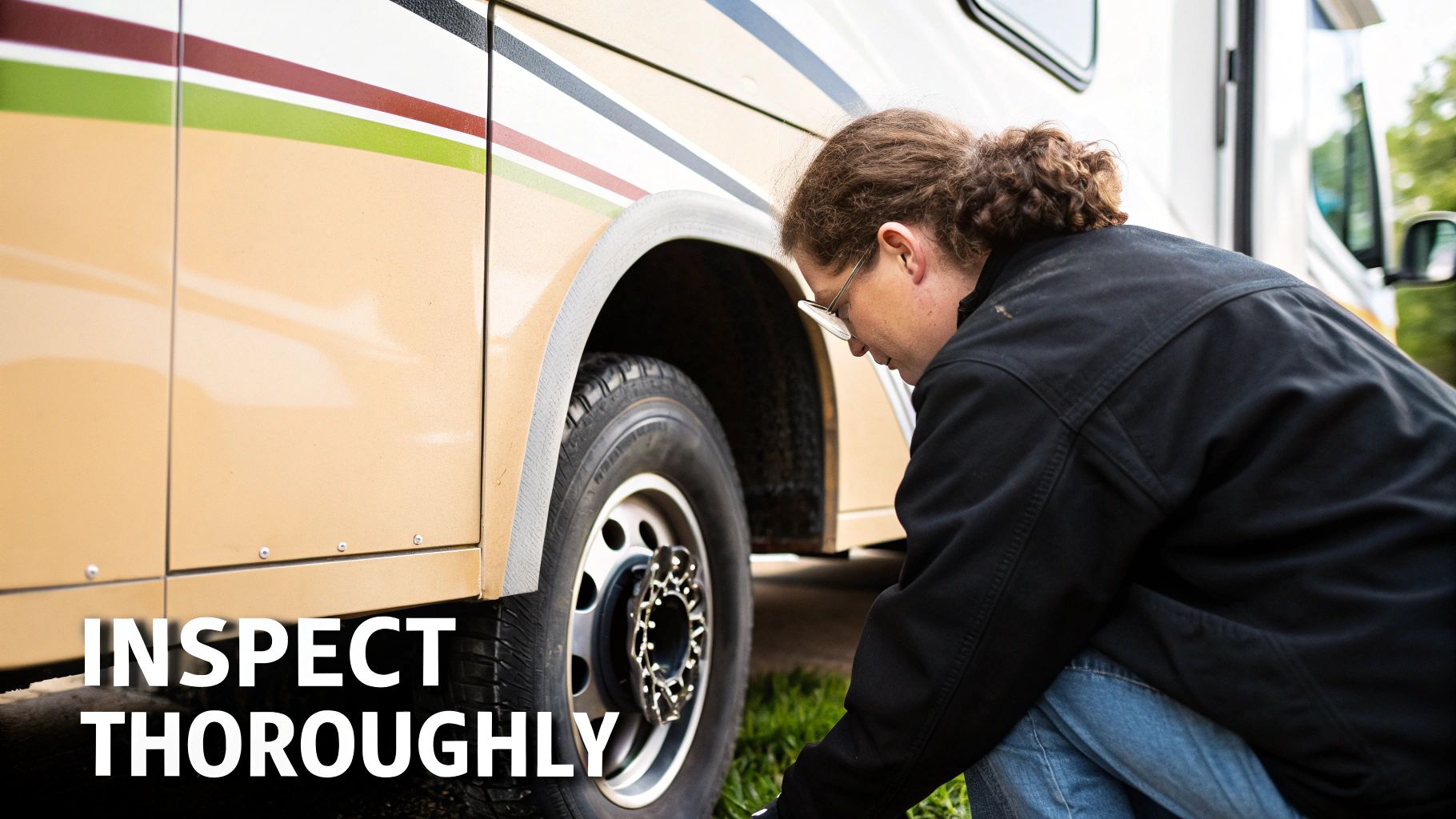
Your inspection starts on the outside. The exterior is the rig’s armor against the elements, and even a tiny flaw here can snowball into a massive, expensive headache later.
- Roof Seals and Caulking: Grab a ladder (be safe!) and examine every single seam on that roof. You're looking for sealant that's cracked, peeling, or completely missing around the vents, A/C unit, and edges. This is ground zero for water intrusion.
- Sidewall Condition: Gently press and run your hands all over the fiberglass or aluminum siding. Feel for any bubbles, ripples, or soft spots. This is called delamination, a tell-tale sign that water has gotten in and separated the layers of the wall.
- Tire Age and Condition: Don't just look at the tread; find the DOT date code stamped on each tire. RV tires almost always age out before they wear out. Any tire older than five to six years is on borrowed time and needs replacing, which can be a hefty expense right off the bat.
A beautiful interior can easily hide a rotted-out frame. I tell every new buyer to spend at least half their inspection time on the exterior, roof, and underbelly. Water damage is the #1 killer of motorhomes, and the first clues are almost always found outside.
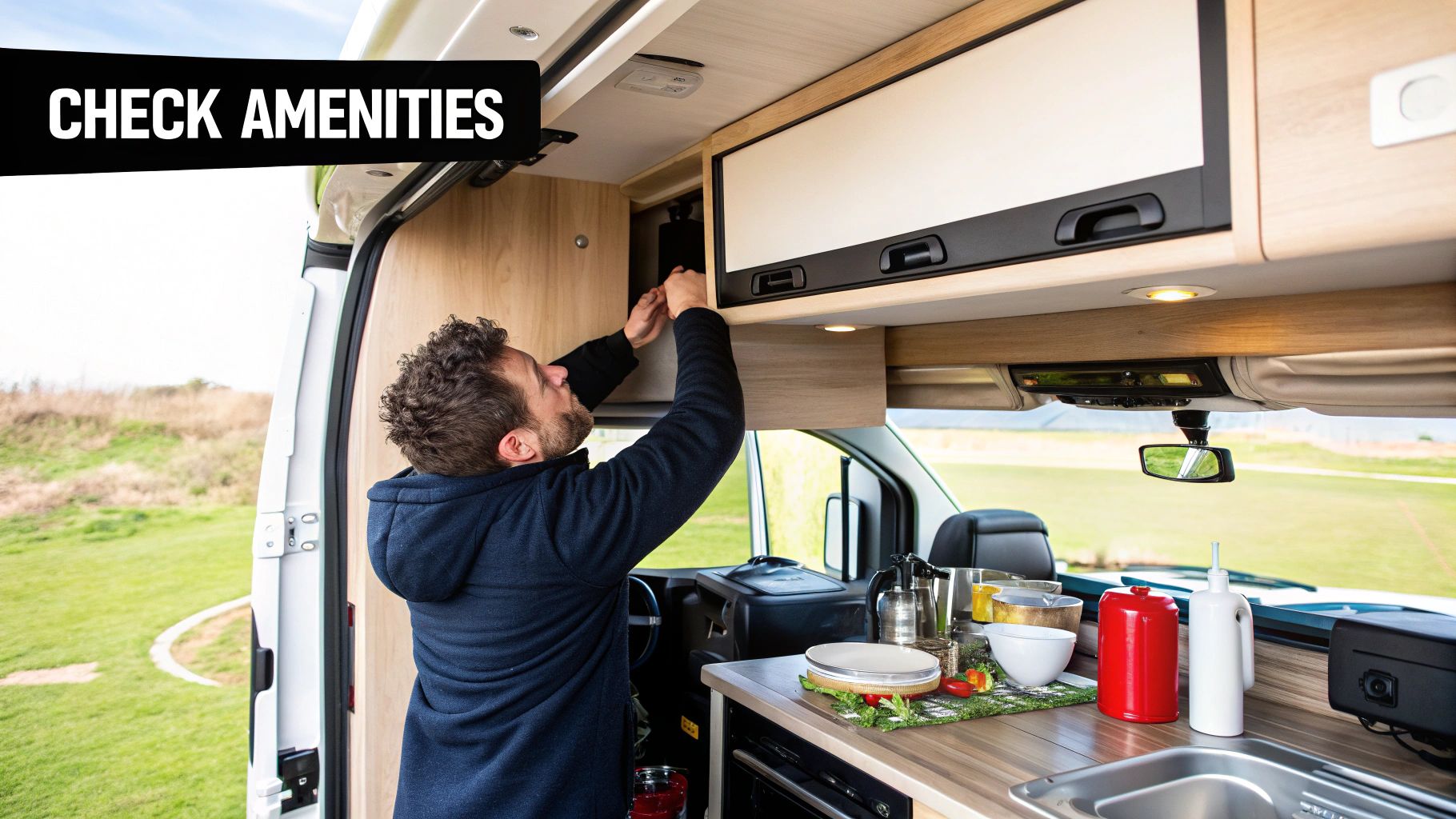
Now you can head inside, but keep that critical eye. Your goal is to test every single switch, button, and appliance. Pretend you're setting up camp for a week and operate everything you would normally use.
Start by doing the "soft spot shuffle." Walk slowly across the entire floor, paying extra attention around the slide-outs, the shower, and under the kitchen sink. Any sponginess is a huge red flag for a hidden leak. Next, open every single cabinet and closet. Use your flashlight to peer into the dark corners, looking for water stains or smelling for that unmistakable musty odor.
Then, hit the big-ticket items:
- Appliances: Fire up the refrigerator (on both gas and electric settings), light every stove burner, and test the microwave.
- HVAC: Crank the air conditioner to make sure it blows ice-cold, then switch over to the furnace to confirm it ignites properly and pushes out hot air.
- Plumbing: Turn on every faucet, including the shower, to check for good, steady water pressure. And yes, flush the toilet to ensure it holds water and the seal is good.
Remember, you're not just buying a small house—you're buying a vehicle. It’s time to pop the hood and get a look underneath.
Scan the engine bay for any obvious signs of leaks—oil, coolant, or transmission fluid. Slide underneath (this is where those old clothes come in handy) and inspect the frame for anything more than surface rust. Deep, flaky rust can seriously compromise the vehicle's structural integrity. If you can, take it for a real test drive. Listen for weird engine noises, feel for any pulling when you brake, and pay attention to how smoothly the transmission shifts through its gears.
The motorhome world is changing fast. In fact, motorhomes now make up over 60% of the entire caravan and motorhome market globally. This boom is fueled by demand for better tech and more convenience. Features like factory-installed solar, smart control panels, and advanced driver-assist systems are becoming common. As you can read more about caravan and motorhome market reports, your inspection needs to cover these modern systems, not just the old-school mechanicals. Make sure your checklist is up-to-date to ensure you're getting a rig built for today's adventures.
The floor plan is what makes a motorhome a home. Get this wrong, and even the most beautiful rig can become a daily frustration. It’s not just about what looks good in a brochure; it’s about how you’ll actually move and live in the space day in and day out.
A layout that seems perfect on the showroom floor can reveal its flaws quickly on the road. That's why a quick walk-through just isn't enough. My best advice? Spend some real time in any model you're seriously considering. Go through the motions. Pretend to make coffee, try to walk past someone in the kitchen, and imagine being stuck inside on a rainy day. Does it still feel comfortable?
Every single layout is a game of trade-offs. That huge rear living room with the panoramic window? It probably means you're sacrificing bathroom space. A king-sized master suite might come at the expense of a functional kitchen counter. You have to decide which compromises you’re willing to make.
Think about how different layouts cater to different lifestyles:
- Front Living Models: These are fantastic for socializing. They create a natural gathering spot right up front, but you might give up a bit of privacy.
- Rear Bedroom Layouts: A classic for a reason. Having your sleeping quarters tucked away in the back provides a quiet retreat, which is a huge bonus for couples.
- Bunkhouse Models: If you've got kids, this is often the go-to. It gives them their own zone, but remember, that square footage has to come from somewhere, usually the main living area.
- Toy Haulers: Nothing beats their versatility. That garage space is a game-changer for bringing along bikes, kayaks, or even a home office, but it can affect insulation and eat into dedicated living space.
Here’s a pro tip: always check the layout with the slide-outs in. Can you still get to the fridge for a drink or use the bathroom when pulled over at a rest stop? If you have to extend a slide just for a quick lunch break, that "minor" inconvenience will drive you crazy.
Where you plan to travel can, and should, influence your choice. I've seen many buyers overlook how regional trends shape motorhome design. In Europe, for example, the tight roads demand compact, hyper-efficient layouts.
But here in North America, the world's biggest RV manufacturing hub, the trend is all about space. Larger models with multiple slide-outs are common, built for those embracing full-time life on the road. This matters more than you’d think. A model’s origin can impact its usability, how easy it is to find parts, and even what it’s worth down the line. While market data shows the standard motorhome price segment holds a massive 61.4% share, a savvy buyer knows to learn more about motorhome market data and consider how a layout’s design philosophy will affect their ownership experience long-term.
The perfect floor plan doesn't just look good—it feels right. It supports your daily rhythm without you even having to think about it. If you have to constantly squeeze past someone or reconfigure a dinette just to sit down, it's the wrong layout for you.
Your goal is to find a layout that feels intuitive. Smart storage, an ergonomic kitchen, and genuinely comfortable sleeping spots should be non-negotiable items on your motorhome buying checklist. A floor plan that works with you makes life on the road a joy, not a chore.
You’ve done the inspections, imagined life on the road, and found the one. Now it’s time to tackle the final, and often most intimidating, part of the process—the paperwork and payment. Honestly, getting this step right is just as important as spotting a leaky roof seal.
Approaching financing with a clear strategy gives you a ton of leverage. One of the smartest moves you can make is to get pre-approved for an RV loan from your own bank or a credit union before you even make an offer. When you walk into a dealership with your own financing already lined up, you immediately transform from a casual browser into what they see as a cash buyer. This simple step can really shift the negotiation in your favor, since you aren’t reliant on their in-house financing, which often comes with less-than-ideal terms.
The sticker price you see? That’s just the starting line. A truly complete motorhome buying checklist has to account for all the extra expenses that can easily add thousands to your final cost. Budgeting for these from the get-go will save you from any nasty last-minute surprises.
Here’s what to watch for:
- Sales Tax and Registration: These are the big ones, and they vary dramatically by state. Do a little homework on your local requirements to get a solid estimate.
- Insurance: Don't just go with your standard auto insurer. RV insurance is a specialized product, so you’ll want to get quotes from providers who really understand motorhomes. This ensures you have proper coverage for the vehicle, your personal belongings inside, and liability on the road.
- Extended Warranties: A dealer will almost certainly offer you an extended warranty or service contract. They can provide genuine peace of mind, especially on a used model, but you absolutely have to read the fine print. Know exactly what is—and isn't—covered before you commit.
The excitement of a new purchase can disappear in a flash if you get blindsided by unexpected fees. Always, always ask for a complete, out-the-door price that includes every single tax, title, and dealer fee. That number is the only one that truly matters.
Before your pen ever touches that paper, it’s time for one last, careful review. The purchase agreement is a legally binding contract. Once it’s signed, there's no going back. So, take a deep breath, slow down, and verify every single detail.
First, double-check the Vehicle Identification Number (VIN) on the contract. Make sure it perfectly matches the VIN on the motorhome itself. A simple typo here can spiral into a massive headache when you go to register and insure your new rig.
Next, confirm that any promises made during negotiations are written down. If the dealer agreed to throw in a new set of tires, fix that wonky cabinet latch, or perform a final service, that commitment must be spelled out in the purchase agreement. Verbal promises have a funny way of being forgotten the moment you drive off the lot.
Finally, give the loan terms one last look—interest rate, loan duration, and monthly payment—to make sure they match exactly what you agreed to. This final check is your best insurance for a smooth and stress-free start to your new life on the road.
Diving into the world of motorhomes is exciting, but it's natural to have a few questions swirling around as you get closer to making a choice. Think of this as a chat with a seasoned RVer. We'll tackle the big questions I hear all the time to help you cross the finish line with confidence.
Hands down, it's falling for the wrong floor plan. It happens all the time. You walk into a brand-new rig at a dealership, and you're instantly wowed by the shiny finishes and a huge rear lounge with a massive TV. It looks incredible.
But then you get it home and realize you can’t open the refrigerator door all the way if the slide-out is in. Or that gorgeous living area came at the cost of a kitchen so cramped you can barely make coffee. That’s when the dream turns into a daily frustration.
Don’t just glance at a layout—try to live in it for a few minutes. Walk through the motions. Pretend to cook a meal, make the bed, and get something from the bathroom while your partner is in the hallway. If you're constantly doing the "RV shuffle" and squeezing past each other, that layout isn't the one, no matter how pretty it is.
Choosing a floor plan based on looks over pure, day-to-day livability is the fastest way to end up with a very expensive case of buyer’s remorse.
How Much Should I Realistically Set Aside for Maintenance?
This is a big one. A good, safe rule of thumb is to budget 1-2% of your motorhome's purchase price for annual maintenance and repairs. So if you buy a rig for $100,000, you should have a dedicated fund of $1,000 to $2,000 a year.
Now, if you're looking at an older, used motorhome, I'd strongly suggest bumping that up to around 3%. This isn't just a "what if" fund for a catastrophic breakdown; it's for the predictable costs that come with owning a house on wheels.
Think of what this covers:
- Routine engine service and oil changes, just like your car.
- Checking and touching up the roof sealant every year (a non-negotiable!).
- New tires, which you'll often replace due to age and sun exposure long before the tread wears out.
- The inevitable hiccup with an appliance, the water pump, or an electrical outlet.
Having a dedicated "RV repair fund" makes these things a manageable inconvenience instead of a trip-ruining crisis. It’s the key to keeping your investment safe and road-ready without the financial stress.
This is a tough one, and there's no single right answer—it really comes down to you. An extended warranty can be a lifesaver, especially if you're buying a used motorhome or a newer model packed with complex electronics and slide-outs. Knowing a major repair on your engine or leveling system is covered brings incredible peace of mind.
But—and this is a big but—the devil is always in the details. You absolutely have to read the fine print before you even think about signing.
Here's what you need to ask:
- What’s actually covered? Be specific. Does it cover the engine and chassis? The "house" components like the fridge and A/C? Both?
- What’s my deductible? Is it per visit or per item repaired?
- Where can I get it fixed? Are you tied to a specific dealer network, or can you use any certified RV tech? This is huge when you’re on the road.
- What’s the claims process like? Do you have to pay out of pocket and wait for reimbursement, or do they pay the shop directly?
For some people, the math just doesn't work out, and they'd rather self-insure by putting that money in their repair fund. For others, a single costly breakdown of a slide-out mechanism can make that warranty pay for itself three times over. Get a few quotes, compare them, and weigh the cost against your own tolerance for risk.
Ready to find the perfect motorhome without the hassle? At Searchshop, we simplify the process with powerful search tools, real dealer reviews, and our unique Vehiscore quiz to match you with your ideal RV. Start your journey with confidence and explore your options today.