So, you’re thinking about buying your first RV. Before you get swept up in shiny models and fancy floor plans, let’s talk about the single most important first step: figuring out how you’ll actually use it.
This one decision—whether you're a weekend warrior, a full-time nomad, or something in between—steers everything else. Get this right, and you're on the path to finding the perfect rig.
Welcome to the club! Deciding to buy your first RV is a huge, exciting moment. It’s easy to feel a little overwhelmed, but this guide is here to walk you through it, starting with the absolute basics to build a solid foundation for a smart purchase.
You’re in good company. RV ownership has exploded by over 62% in the last 20 years, with a staggering 11.2 million households in the U.S. now owning one. It’s not just for retirees, either. Younger buyers are jumping in, with the median age for first-timers dropping to 32. If you're curious, you can explore more RV ownership statistics and see just how much the community has grown.
Before you even think about stepping onto a dealer's lot, you need to get crystal clear on what your RV life is going to look like. This isn’t about brand names or fancy features just yet. It’s about your real-world needs.
Ask yourself a few honest questions:
- Who’s coming along? Is it just you? You and a partner? A whole family with kids and a dog? The number of people (and pets) dictates everything from sleeping arrangements to storage space.
- How often will you hit the road? Are we talking about weekend trips to nearby state parks, or are you planning epic, months-long journeys across the country? A rig built for occasional use is very different from one designed for the rigors of full-time living.
- Where are you going? Do you see yourself at full-service campgrounds with all the hookups, or are you dreaming of boondocking off-grid in the middle of nowhere? This will determine your need for things like solar panels, generator capacity, and the size of your water tanks.
Your RV has to fit your lifestyle, not the other way around. The biggest mistake first-time buyers make is falling for a beautiful RV that's completely impractical for how they actually want to travel.
Walking onto an RV lot for the first time can feel a little overwhelming. You're hit with a wave of industry jargon—Class A, fifth wheel, toy hauler—and it's easy to get lost in the terminology.
My advice? Forget the labels for a moment and think about how you want to travel. Are you dreaming of long, cross-country treks or weekend escapes to a nearby lake? Matching the RV to your adventure is the first and most important step.
Think of it like this: you wouldn't use a sledgehammer to hang a picture frame. A massive, bus-style Class A motorhome is a dream for full-timers who want all the comforts of a stationary home. But if you already have a capable truck and want to unhitch your camper to explore town, a towable travel trailer might be the perfect fit.
This infographic gives you a great visual starting point for understanding the different shapes and sizes you'll encounter.
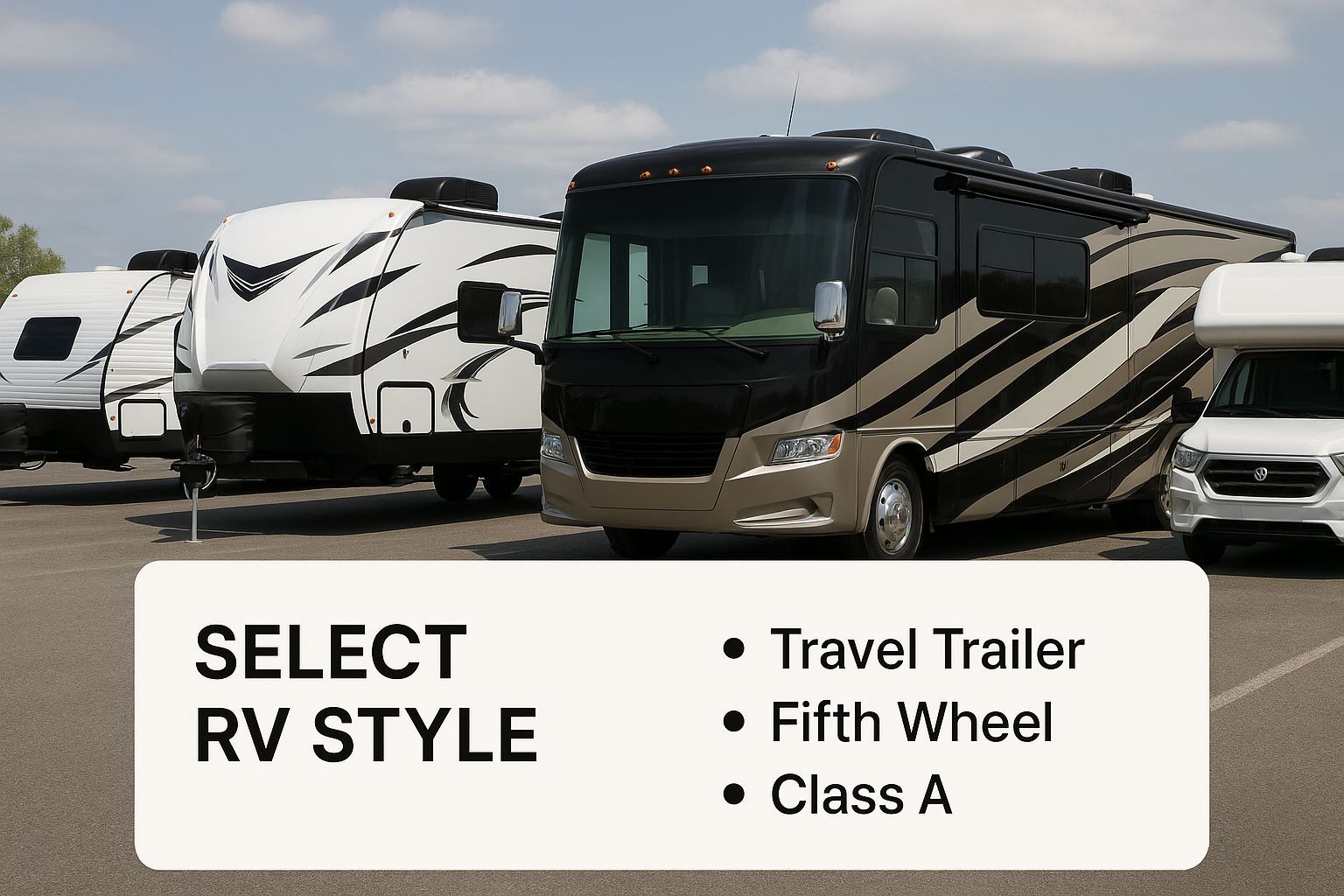
Seeing the models side-by-side really helps clarify the major differences in scale and design. It’s a quick way to narrow down which styles feel right for you.
Your first major fork in the road is choosing between a motorhome (where you drive the whole unit) and a trailer (which you pull behind a separate vehicle). This one decision has a huge impact on your travel days and your experience at the campsite.
-
Motorhomes (Classes A, B, and C): These are all about convenience on the road. Someone can grab a drink from the fridge, use the bathroom, or even take a nap on the couch while you're cruising down the highway. The tradeoff comes when you get to the campground—your RV is now your only vehicle unless you tow a smaller car behind it.
-
Towables (Travel Trailers and Fifth Wheels): Flexibility is the name of the game here. You can set up your camper as a home base and then use your truck or SUV to run errands, visit attractions, or navigate tight parking lots. Of course, this means you'll need to get comfortable with the process of hitching, towing, and backing up.
The RV world is bigger and more diverse than ever. Recent data shows the median age of new owners has dropped to 49, and first-time buyers now make up a whopping 36% of the market. The community is also beautifully diverse, with 30% of owners identifying as Hispanic-American, African-American, Asian-American, or LGBTQ+. You can see more fascinating trends on the RVIA.org website.
To help you sort through the most common options, here is a quick-glance table comparing the most popular RV types for newcomers.
| RV Type |
Typical Price Range (New) |
Best For |
Key Pro |
Key Con |
| Travel Trailer |
$25,000 - $70,000 |
Budget-conscious buyers, families, weekend campers. |
Huge variety of layouts and prices; can unhitch tow vehicle for exploring. |
Requires a capable tow vehicle; towing and backing up takes practice. |
| Class C Motorhome |
$80,000 - $150,000 |
Families, couples wanting a less intimidating motorhome. |
Easy-to-drive chassis; often includes extra sleeping space over the cab. |
Limited mobility at a campsite without a towed car. |
| Class B (Camper Van) |
$90,000 - $180,000 |
Solo travelers, adventurous couples, digital nomads. |
Drives and parks like a regular van; highly mobile and versatile. |
Very limited interior space and storage; often the most expensive per sq ft. |
| Fifth Wheel |
$40,000 - $100,000+ |
Full-timers, long-term travelers needing residential space. |
Spacious, multi-level layouts with high ceilings; very stable towing experience. |
Requires a heavy-duty truck with a special in-bed hitch. |
| Class A Motorhome |
$150,000 - $500,000+ |
Long-term travelers, luxury seekers, large families. |
Bus-like ride with panoramic views; tons of storage and residential features. |
Large size can be intimidating to drive and limits campsite access. |
This table should give you a solid foundation, but the best way to know what’s right is to see them in person.
While you'll see every type of rig out on the road, a few models are consistently popular choices for those just starting out. Here’s a breakdown with some real-world context.
-
Class C Motorhome: You’ll instantly recognize these by the sleeping bunk that hangs over the driver's cab. They're built on a familiar truck chassis, which makes them feel less intimidating to drive than their larger Class A cousins.
- Perfect for: A family of four heading out on a summer road trip to visit national parks. The kids get their own dedicated sleeping space, and travel days are a breeze since everyone is together.
-
Travel Trailer: This is the quintessential RV and the most common type you'll see. They come in every size, from tiny teardrops to massive bunkhouse models, and are towed from a hitch on your truck or SUV's bumper.
- Perfect for: A couple who loves escaping for long weekends. They can pull a lightweight trailer with the SUV they already own, unhitch it at the state park, and then use their vehicle to go find the best hiking trails.
-
Class B Camper Van: These are the smallest and nimblest of the motorhomes. At their core, they are full-size vans that have been expertly converted into tiny, efficient living spaces.
- Perfect for: A solo digital nomad who wants to blend work and travel seamlessly. It functions perfectly as a mobile office with a scenic view and is small enough to serve as a daily driver for exploring cities.
It’s so easy to get fixated on the sticker price when you’re shopping for your first RV. I've seen it happen a thousand times. But that big number? It's just the tip of the iceberg. A realistic budget has to account for the total cost of ownership, otherwise you risk turning your dream rig into a source of financial stress.
Thinking through these hidden costs before you even step on a dealer lot is probably the single most important thing you can do. It's what separates a happy RVer from someone who gets a nasty case of sticker shock after the papers are signed.
Once you and the dealer shake hands on a price, a few other immediate expenses pop up. These are the non-negotiable costs that you’ll have to pay before you can legally hit the road. They often get forgotten in the excitement of the moment.
- Sales Tax: This one can be a real gut punch. Depending on your state, sales tax can add thousands of dollars to your final bill right out of the gate.
- Registration and Titling: Just like your daily driver, the RV needs a title and plates. Expect to pay a visit to the DMV and hand over a few hundred dollars in fees.
- Insurance: This isn't your standard auto policy. RV insurance is a specialized product, and your premium could be anywhere from a few hundred to a couple of thousand dollars a year, based on the rig’s value, its type, and your driving record.
Here’s a pro tip: Get a few insurance quotes before you commit to buying a specific RV. It gives you a much clearer financial picture and helps you avoid any last-minute surprises.
Remember, the purchase price is just the down payment on your adventure. The real cost includes everything it takes to get on the road and stay there safely and comfortably.
Okay, you've driven it off the lot. Now your budget needs to shift from one-time purchase costs to the recurring expenses of actually using and owning the RV. This is where many first-timers get tripped up.
Just think about fuel. That massive, beautiful Class A motorhome might only get 8-10 MPG. A simple 1,000-mile road trip could easily run you over $400 in fuel alone. On the other hand, a lightweight travel trailer towed by an efficient pickup will have a much smaller impact on your wallet for that same trip.
These are the recurring costs you absolutely have to plan for:
- Fuel: This will almost certainly be your biggest variable expense. How much you travel directly impacts how much you spend.
- Campsite Fees: These are all over the map. You might find a basic state park spot for $20 a night, but a fancy resort-style RV park with a pool and full hookups can cost over $100 per night.
- Maintenance: An RV needs constant love. We’re talking oil changes, tire rotations, checking roof seals, and winterizing the plumbing every year.
- Repairs: Trust me on this one: things will break. It’s not a matter of if, but when. Having a separate fund for a busted water heater or a faulty slide-out motor is a lifesaver.
- Storage: Can't park it at your house? You'll need to budget for monthly storage. This can range from $50 to $250+, depending on whether you choose an open lot or a covered, secure facility.
I always recommend people create a simple spreadsheet to track these projected costs. Laying it all out helps you see the true monthly and annual commitment. If you plan for these real-world expenses from the start, you’re setting yourself up for years of incredible memories instead of financial headaches.
This is one of the biggest forks in the road you'll face. Do you go for that shiny, brand-new rig with the new-car smell, or do you hunt for a pre-loved gem that offers more bang for your buck?
Honestly, there’s no single right answer here. The best choice really boils down to your budget, how much risk you're comfortable with, and whether you enjoy a good DIY project.
https://www.youtube.com/embed/DO3u1Bk-rbE
Let's start with the allure of a brand-new RV. It comes with the latest gadgets, a pristine interior nobody else has ever used, and most importantly, a full manufacturer's warranty. For a lot of first-timers, that warranty is a huge security blanket.
The major downside, however, is the one-two punch of depreciation. It's a tough pill to swallow, but a new RV can lose as much as 20% of its value the second you pull out of the dealership. That’s a massive financial hit to take in your first year.
For many people, the peace of mind that comes with buying new is worth every penny of that initial depreciation. You're the first person to sleep in the bed, the first to cook a meal in the kitchen, and the first to start making memories. You don't have to worry about any hidden problems left behind by a previous owner.
Financing can also be a smoother process for new models. Banks and credit unions often see new RVs as a safer bet, so they might offer better interest rates or longer loan terms. This can sometimes lead to a lower monthly payment than you'd get on an older, used unit, even if the total price is higher.
And let’s not forget that factory warranty. If your slide-out motor decides to quit or the water heater goes on strike in that first year, it's covered. That safety net is incredibly valuable when you're still figuring out all the complex systems of an RV.
The number one reason to buy used? Cost savings. It's that simple.
You can often step into a much larger or more luxurious RV for the same money you'd spend on a smaller, entry-level new one. Why? Because the first owner has already absorbed that gut-wrenching initial depreciation hit for you.
Going this route is a fantastic way to dip your toes into the RV lifestyle without taking a massive financial plunge. If you decide after a year or two that it's not for you, you'll lose a lot less money when it's time to sell.
You'll also find that many used RVs have already been kitted out with valuable upgrades. Things like solar panel systems, lithium battery banks, or suspension enhancements can cost thousands to add yourself, but they often come included in the sale of a used rig.
The decision often comes down to this: A new RV offers peace of mind through a warranty, while a used RV offers financial peace of mind through a lower price and slower depreciation.
If you go the used route, you need to put on your detective hat. A thorough inspection is non-negotiable—it's the only way to avoid buying someone else's expensive problems. Water damage is the silent killer of RVs, so start your investigation there.
-
Hunt for Water Damage: Get on your hands and knees and press firmly on the floor, especially in corners and around slide-outs. Feel for any soft, spongy spots. Do the same on the walls and ceiling. Open every single cabinet and look for discoloration or wall paneling that looks bubbly or wavy (delamination).
-
Get Up on the Roof: You need to see the roof for yourself. Borrow a ladder and carefully check all the sealant around the vents, skylights, AC unit, and along the front and rear seams. You're looking for any cracks, gaps, or areas where the sealant is pulling away.
-
Test Every Single System: Don't be shy. Ask the owner to show you everything working. Turn on the fridge (on both electric and propane), fire up the furnace, and blast the air conditioner. Run the water pump, light the stove burners, and make sure the water heater provides hot water.
-
Check the Tire Dates: This is a big one. Look at the sidewall of each tire for a stamped four-digit code (e.g., "3221"). This is the date code—it means the tire was made in the 32nd week of 2021. RV tires almost always "age out" from sun exposure before the tread wears down. Any tire that's more than five or six years old is on borrowed time and needs to be replaced, no matter how good it looks.

You’ve finally found it. After what feels like a million hours of searching, you’ve picked out the perfect RV. But hold on—you're not quite at the finish line yet. The next steps are all about the money and the final inspection, and this is where being prepared can literally save you thousands of dollars and prevent a world of future headaches.
Think of the financing part of this journey as your first big opportunity to take control. Dealership financing is always presented as the easy button, but it's rarely the best deal you can get. The single smartest thing you can do is get pre-approved for a loan before you even think about talking numbers with a salesperson.
Walking onto that lot with a pre-approval letter from your bank or credit union completely changes the dynamic. Suddenly, you're not just a browser; you're a cash buyer in their eyes, and that gives you a ton of negotiating power.
This pre-approval also sets a benchmark. If the dealer’s finance manager can’t offer you a better rate, you can simply and confidently walk away with your own loan.
Here are a few places to shop for your loan:
- Credit Unions: In my experience, credit unions often have the most competitive rates and friendlier terms for recreational vehicle loans.
- Traditional Banks: Don't overlook your own bank. They might have loyalty discounts or an easier approval process for existing customers.
- Dealership Financing: It's the most convenient for sure, since they handle all the paperwork on-site. Just make sure you compare their offer directly against your pre-approval to see if it's truly a good deal.
Pro Tip: It's easy to get fixated on the monthly payment, but don't fall into that trap. Pay close attention to the loan term (the number of years) and the total interest you'll pay. A longer-term loan might look appealing with its lower monthly bill, but you could end up paying thousands more over the life of the loan.
Okay, the money is sorted. Now comes what I consider the most critical moment of the entire purchase: the final walkthrough, officially called the Pre-Delivery Inspection (PDI). This is your last, best chance to find anything wrong with the RV and have the dealer fix it on their dime.
Seriously, do not let them rush you through this. A proper PDI should take at least two to three hours, maybe more. You need to touch, test, and operate every single thing yourself.
Go in with a plan. Make a checklist and be systematic. Here’s what you absolutely must test:
- Water Systems: Have them hook up the city water. Run every faucet, both hot and cold. Check the shower. Flush the toilet. Then, unhook the hose and test the water pump using the freshwater tank. Get on your hands and knees and look for leaks under every sink.
- Electrical Systems: Plug the RV into shore power and test every single outlet, light, and appliance. Then, unplug it and see what works on battery power.
- Slide-Outs and Awnings: Don't just watch the tech do it. You need to operate every slide and awning yourself. Run them in and out multiple times. Listen for weird noises and check that they form a tight seal when closed.
- Propane Appliances: Ask the technician to fire up the furnace, the water heater, and the stovetop using the onboard propane tanks. Make sure they all work as they should.
This inspection is your leverage. A torn window screen, a cabinet door that doesn’t latch, a finicky water heater—find it now. Insist that every single issue is written down on a "we owe" list, and get it fixed before you sign the final papers. Once you drive that RV off the lot, getting those little fixes taken care of becomes a whole lot harder. Be patient, be thorough, and be firm. It’s the best way to make sure your new adventure starts off without a hitch.
Even after you think you've landed on "the one," a few nagging questions always seem to pop up. It's totally normal. Getting clear answers to these common worries will give you the confidence you need to sign on the dotted line and start your adventure.
Let's walk through some of the final hurdles and clear up the confusion so you can feel 100% ready.
This is probably the number one question I hear, and the answer almost always puts people at ease: No, you probably don't. For the overwhelming majority of RVs out there, your standard driver's license is all you need.
The rules typically hinge on the vehicle's Gross Vehicle Weight Rating (GVWR). Most states only require a special license, like a commercial driver's license (CDL), for vehicles tipping the scales over 26,000 pounds. Just about every Class B van, Class C motorhome, and standard travel trailer falls comfortably under this weight.
Now, if you're looking at a massive Class A diesel pusher or a colossal fifth-wheel, you'll need to pay closer attention.
Pro Tip: Don't guess. The laws vary slightly by state. Before you buy, do a quick online search for "[Your State] RV driver's license requirements." It takes five minutes and can save you from a huge legal headache.
RV insurance isn't quite car insurance, and it isn't quite home insurance—it’s a unique hybrid of the two. The type of coverage you'll need boils down to one simple question: Is your RV drivable or towable?
- Motorhomes (Drivable): Since it has its own engine, you'll need liability coverage just like any car. You'll also want comprehensive and collision policies to protect the actual vehicle from damage, whether you're on the road or parked.
- Travel Trailers & Fifth-Wheels (Towable): Here's a neat trick: your tow vehicle's liability insurance usually extends to the trailer while it's hitched up. But that only covers damage you might cause to others. To protect your trailer from theft, a storm, or an accident, you need a separate RV policy.
Beyond the basics, I strongly recommend looking into a few add-ons. Total loss replacement is a lifesaver for new RVs, personal effects coverage protects all the gear you have inside, and emergency expense coverage can cover a hotel if you break down hundreds of miles from home.
Trying to nail down the cost of a campsite is a bit like asking how much a hotel room costs—it's all over the map. The price depends heavily on the location, time of year, and what kind of amenities you’re after.
Here's a general idea of what to expect per night:
- State & National Parks: Expect to pay $15-$35. These spots are incredible for scenery but often come with limited hookups (or none at all).
- Private RV Parks: The sweet spot for most travelers, running $40-$80. You'll almost always get full hookups (water, sewer, electric) and amenities like laundry rooms and Wi-Fi.
- RV Resorts: In prime destinations like Florida or Arizona, these can easily shoot past $100. For that price, you're getting a resort experience with pools, clubhouses, and organized activities.
For planning purposes, a good average to budget is around $50-$60 per night. That will comfortably get you into most private campgrounds with the full hookups you'll want.
I've seen it happen time and time again. A new buyer gets wowed by some flashy feature in the showroom and completely overlooks the one thing that matters most.
The biggest mistake is buying an RV with a floor plan that doesn’t actually work for your lifestyle.
It's so easy to do. That giant kitchen with the residential fridge looks amazing, but if you only ever cook outside, it's wasted space. That bunkhouse model seems practical, but for a couple who travels alone, it's just extra weight to tow and a pain to park.
Here’s how you avoid this trap: truly live in the RV for a few minutes before you buy it.
Don't just poke your head in. Sit on the sofa. Lie down on the bed. Pretend to cook a meal in the galley. Go into the bathroom and shut the door. Can you move around? Where will you put your clothes, your food, your hiking gear? This simple exercise will reveal more about a floor plan's suitability than any brochure or salesperson ever could.
Ready to find the perfect RV without the guesswork? At Searchshop, we simplify the entire process. Use our Vehiscore quiz to match your travel style to the perfect models, compare new and used options from trusted dealers, and access all the resources you need to buy with confidence. Start your adventure today at https://www.searchshop.com/rv.