Every great RV adventure starts long before you turn the key. It begins with a blueprint—a solid plan that lays the groundwork for everything to come. Before you even think about specific routes or campgrounds, you need to get clear on your budget, timeline, and overall travel style.
Getting these fundamentals right from the start is what separates a smooth, enjoyable journey from a stressful, chaotic one.
The romance of the open road is real, but a truly successful trip doesn't just happen. Think of this first phase as drawing up the plans for a house—you wouldn't start building without them. This is where you transform a fuzzy idea like "Let's go on an RV trip!" into a concrete plan you can actually execute.
This isn't about creating a rigid, minute-by-minute itinerary. It’s about making the big-picture decisions that will shape your experience and make sure your budget, expectations, and timeline are all aligned.
First things first: What kind of trip are you actually planning? The answer changes everything.
Are you picturing a fast-paced, cross-country blitz to check off as many national parks as possible? Or is this more of a slow, meandering exploration of a single region, like the Oregon coast or the charming towns of Vermont?
Your personal travel style is just as critical. Figure out which of these camps you fall into:
-
The Resort Seeker: You're all about full-hookup campgrounds with pools, Wi-Fi, laundry, and planned social events. Comfort and convenience are non-negotiable.
-
The Nature Lover: You're happiest in state and national park campgrounds. Scenic views and easy access to hiking trails trump fancy amenities every time.
-
The Frugal Boondocker: Your primary goal is to camp for free on public lands. You value solitude and self-sufficiency over everything else.
Getting on the same page about your trip's purpose and style early on is key, especially if you're traveling with others. It prevents arguments later and helps you zero in on the right destinations and campgrounds.
If you don't already own an RV, this is a huge decision. The rig you choose needs to fit your crew and your travel style. A giant Class A motorhome might be perfect for a family that plans to stick to full-service resorts, but it’s a recipe for disaster on the tight, winding roads of Colorado's Million Dollar Highway.
On the flip side, a nimble campervan offers incredible freedom but could feel pretty tight for a family of four on a two-week trip. Renting is a fantastic way to try before you buy. If you're new to this world, our complete explainer on RV types and sizes is the perfect place to start.
Once you know your style, you can set a realistic timeline. One of the biggest mistakes newcomers make is trying to do too much in too little time. This leads to burnout, fast.
A great rule of thumb for sustainable travel is the "3/3/2 Rule":
-
Drive no more than 300 miles in a day.
-
Arrive at your campground by 3 PM.
-
Stay at least 2 nights in each spot.
This pacing gives you actual time to relax and explore instead of just driving constantly.
Finally, let's talk money. Your budget is so much more than just gas and campground fees. You need to factor in everything from food and activities to propane and potential repairs. To help you get a clearer picture, here’s a sample budget for a typical two-week trip.
This table breaks down potential costs for a 14-day trip, helping you see where the money goes. Remember, your actual expenses will vary based on your RV, travel style, and destination.
| Expense Category |
Estimated Cost (Low End) |
Estimated Cost (High End) |
Notes |
| RV Rental |
$1,400 ($100/night) |
$4,200 ($300/night) |
Varies by RV type, season, and rental company. |
| Fuel |
$600 |
$1,200 |
Based on 2,000 miles at 8-12 MPG. Highly variable. |
| Campgrounds |
$420 ($30/night) |
$1,050 ($75/night) |
State parks are cheaper; private resorts are pricier. |
| Groceries |
$400 |
$700 |
Cooking in the RV saves a lot of money. |
| Dining Out |
$150 |
$600 |
A mix of cooking and enjoying local restaurants. |
| Activities/Tours |
$200 |
$800 |
Park passes, museum tickets, guided tours, etc. |
| Propane |
$40 |
$80 |
For fridge, water heater, and furnace. |
| Contingency Fund |
$250 |
$500 |
For unexpected repairs or splurges. Always have one. |
| Total |
$3,460 |
$9,130 |
As you can see, the range is wide. A frugal boondocker might spend even less, while a family seeking resort-style amenities could easily exceed the high end. The key is to be honest about your spending habits and plan accordingly.
The RV lifestyle is more popular than ever. The industry saw shipments jump nearly 14% in the first quarter, with over 97,000 units shipped. With an estimated 72 million Americans planning RV trips, you're in good company. You can dig into the latest RV shipment reports and trends on the RVIA website.
Alright, this is the fun part—where the dream starts to look like a real plan. Laying out your route is less about drawing the shortest line between two points and more about weaving together an adventure. The real goal is to build a trip that feels exciting, not like a marathon cross-country delivery job.
Honestly, how you handle this step can make or break your whole trip. It's not just about connecting dots on a map; it's about building in room to breathe, to be spontaneous, and to actually enjoy the places you're driving through. A schedule that’s packed to the gills is the quickest way to suck all the fun out of an RV vacation.
One of the biggest mistakes I see new RVers make is trying to cram way too much into one trip. Let me be clear: driving an RV is not like driving your car. It’s bigger, it’s slower, and a travel day will take more out of you than you expect. Leaning into a "slow travel" mindset is your ticket to a much happier trip.
A great rule of thumb to live by on the road is the "3/3/2 Rule":
-
Drive no more than 300 miles a day.
-
Try to get to your destination by 3 PM.
-
Stay at least 2 nights wherever you can.
This little guideline is a game-changer for preventing burnout. Rolling in by 3 PM means you have plenty of daylight to find your spot, get set up without rushing, and maybe even enjoy a walk before dinner. And staying for two nights gives you a full day to explore without having to immediately tear down and hit the road again.
While you probably use Google Maps every day, it’s not the right tool for this job. It has no idea you're driving a 13-foot-tall, 40-foot-long rig. You absolutely need an RV-specific GPS or trip planner. These tools know your vehicle's height, weight, and length and will route you away from potential disasters.
A standard car GPS doesn't know about that 11-foot-tall railroad bridge on a scenic backroad, but an RV-specific tool does. Trust me, investing in one is some of the best money you'll spend.
Here's the combination of apps that I personally rely on:
-
RV LIFE Trip Wizard: This is where I build my entire trip. I plug in my RV's specs, and it creates a safe route that avoids low clearances, crazy steep grades, and roads with propane restrictions. It's also fantastic for finding campgrounds and fuel stops right along your planned route.
-
The Dyrt: Before I book any campground, I check it on The Dyrt. The sheer volume of user photos and reviews gives me a real sense of what a place is like—from the quality of the cell signal to how level the sites actually are.
-
Campendium: This is another excellent resource for campground reviews, but it really shines when I'm looking for free boondocking spots on public land. Their user reports on cell service are incredibly accurate, which is a huge deal when you need to stay connected.
Using these three together gives me a complete picture, ensuring my route is safe and my overnight stays are solid.
So, you want to hit Zion, Yellowstone, or Yosemite? You and everyone else. Getting a spot inside these iconic national parks requires a battle plan. Campground reservations often get snatched up the very morning they’re released, which can be six months to a year in advance.
If you've already missed that booking window, don't give up. Your first move should be to relentlessly check the park's official reservation website for cancellations. People's plans change all the time, and with a bit of persistence, you can often snag a last-minute opening.
Your backup plan? Look just outside the park gates. You'll almost always find National Forest campgrounds, private RV parks, or Bureau of Land Management (BLM) land nearby. For example, the town of West Yellowstone, Montana, is packed with great options for visiting Yellowstone. You still get easy access to the park without fighting for one of the coveted in-park sites. A little strategic thinking goes a long way in these popular spots.
Knowing where you’ll sleep each night is the secret ingredient to a stress-free RV trip. Your perfect spot is out there, whether it's a bustling resort with a lazy river or a silent clearing under a sky full of stars. The real trick is understanding your options and knowing when to book.
The world of RV accommodations is surprisingly diverse. It ranges from high-end private campgrounds packed with amenities to rustic, off-grid spots that cost nothing but offer priceless views. Your choice will dramatically shape your daily experience—not to mention your overall budget.
The most common option is the traditional campground, but even that simple term covers a massive variety. Private RV parks and resorts are often your best bet for convenience, usually located right off major highways or near popular attractions. They typically offer full hookups (water, sewer, electric), Wi-Fi, laundry facilities, and sometimes even pools and playgrounds. They’re fantastic when you need comfort and easy access.
State and national parks, on the other hand, offer a completely different vibe. Here, you trade resort-style amenities for incredible natural scenery. Campsites are often more spacious and private, but hookups can be limited or nonexistent. Be warned: you'll need to book these popular locations months in advance.
If you have your heart set on a specific campground—especially in a national park during peak season—you’ll need to plan way ahead. Many of the most sought-after sites release their reservations six months to a year out, and they get snatched up in minutes.
But don't panic if you’re a more spontaneous traveler. Recent trends show that nearly 45% of RVers plan their trips less than two months in advance. This shift toward last-minute travel is totally doable if you know where to look. Many campgrounds have cancellations pop up, so checking reservation sites frequently can really pay off.
This decision tree can help you decide which overnight option best aligns with your trip goals.
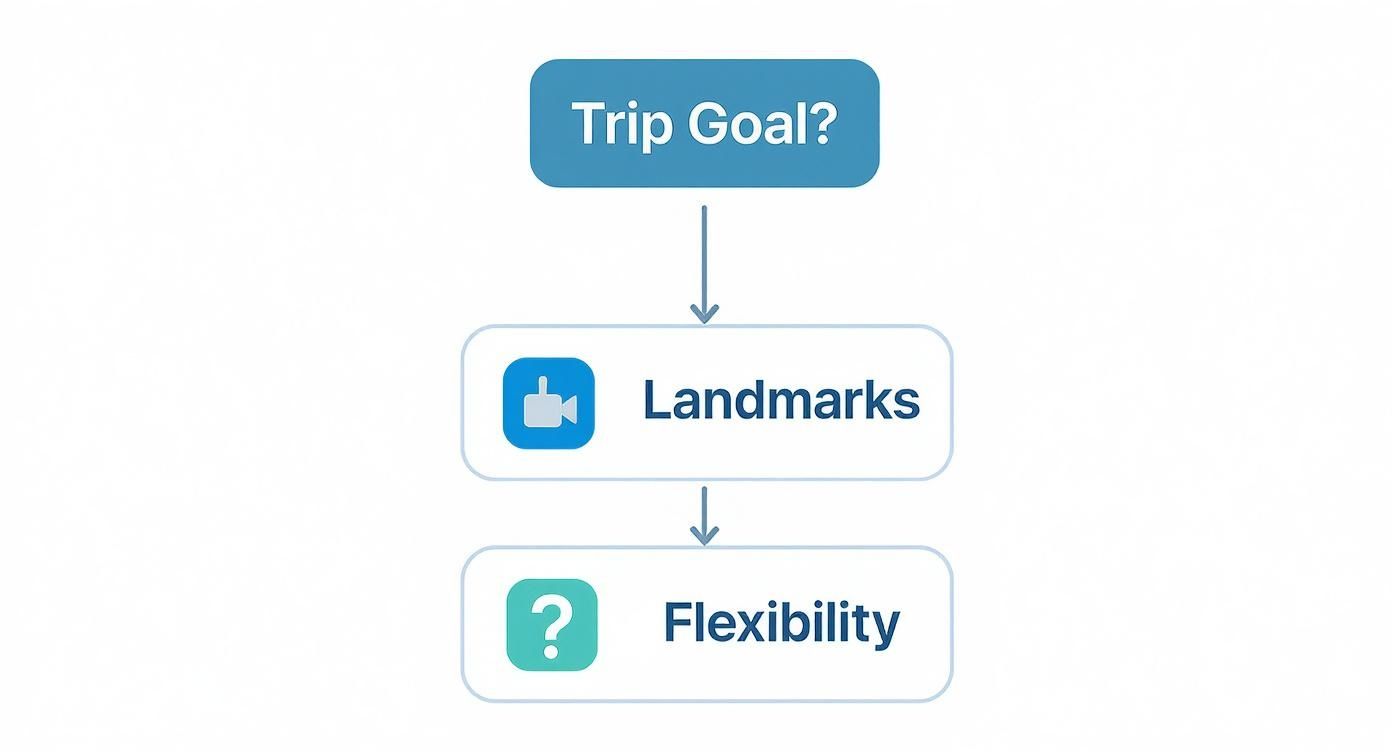
As you can see, if your trip is built around specific landmarks, booking traditional campgrounds in advance is wise. But if you crave flexibility, a whole world of alternative and last-minute options opens up.
To help you weigh your choices, here’s a quick comparison of the most common overnight parking options you'll encounter on the road.
| Accommodation Type |
Average Cost/Night |
Typical Amenities |
Best For |
| Private RV Parks/Resorts |
$40 - $100+ |
Full hookups, Wi-Fi, laundry, pool, store |
Families, long-term stays, comfort seekers |
| State/National Parks |
$20 - $50 |
Electric/water (sometimes), picnic table, fire ring |
Nature lovers, scenic views, budget travelers |
| Membership Hosts |
$0 (with membership) |
Usually none (dry camping) |
Unique experiences, quick overnight stops |
| Public Lands (BLM) |
$0 - $15 |
None (dispersed camping) |
Off-grid adventurers, self-sufficient RVers |
| Store Parking Lots |
$0 |
None |
Quick overnights between destinations |
Each option has its place in a well-planned road trip, and many experienced RVers use a mix of all of them to balance cost, comfort, and adventure.
Sometimes the most memorable nights happen outside of traditional campgrounds. Membership programs have unlocked a new world of unique, often free, overnight stays that are worth looking into.
-
Harvest Hosts: This membership lets you park overnight for free at over 5,000 wineries, breweries, farms, and museums. It’s not truly free, though—the unspoken rule is to support your host by purchasing some of their amazing products.
-
Boondockers Welcome: A sister program to Harvest Hosts, this connects you with a community of RVers who offer up their private property for a night or two. It’s a fantastic way to meet fellow travelers and get local tips.
These programs are incredible, but remember they are not campgrounds. Most locations offer no hookups, and you’re expected to be fully self-contained. It's about the unique experience, not the amenities.
You’ve probably heard stories about staying overnight in the parking lots of places like Walmart, Cracker Barrel, or Cabela's. This practice, often called "Wallydocking," can be a lifesaver on long travel days when you just need a safe place to rest.
It's not a given, though. Not every store allows it. Policies can vary by city ordinance or even by the individual store manager. The only way to know for sure is to call ahead and ask for permission from the manager on duty.
If you get the green light, follow the unspoken rules of the road:
-
Park discreetly. Stay on the outer edges of the lot, well away from the main entrance.
-
Keep it simple. Don't put out your slides, awnings, or camp chairs. You're a guest, not a camper.
-
Leave it better than you found it. Pack out everything you brought in.
-
Show your gratitude. Pop inside and make a purchase to thank them for their hospitality.
When planning your route, don’t forget to consider specialized options like truck and trailer parking in dense urban areas, which can be a secure alternative when other options are scarce. By exploring everything from scenic parks to unique local businesses, you can ensure every night of your RV adventure is a good one. For some inspiration, check out our guide on 10 great RV destinations to visit in an RV.
There’s nothing worse than a trip-ruining surprise that could have been avoided. That's why a well-prepped rig is your best friend on the road. Before you even think about pulling out of the driveway, a thorough pre-trip inspection is non-negotiable.
Think of it as a final conversation with your RV, making sure every single system is ready for what you’re about to throw at it. Skipping this step is a classic rookie mistake, and it often leads to frustrating problems that were completely preventable back home.
You’ll want to make this check a consistent ritual. Start with the obvious: the exterior. Get a quality pressure gauge and check the tire pressure on every tire—don't forget the spares! Underinflated tires are a primary cause of blowouts, so inflate them to the manufacturer's recommended cold psi. Seriously, don't eyeball this one.
Next up, pop the hood and check your fluid levels. That means engine oil, transmission fluid, coolant, and windshield washer fluid. While you’re at it, have someone help you test all the lights—headlights, brake lights, and turn signals—to make sure you’re visible and safe.
Finally, it's time to test the systems that make your RV feel like home:
-
Propane System: Turn on the tanks and fire up the stove for a minute. Do the same with the water heater. You’re just looking for a steady, confident flame.
-
Generator: Start it up and let it run for a few minutes with a small load. Turn on the microwave or an AC unit to make sure it handles the power draw smoothly.
-
Water System: Flip on the water pump and run some water through the faucets. This confirms the pump is working and, more importantly, that you don’t have any surprise leaks.
This whole routine might take you 30 minutes, but believe me, it can save you days of headaches down the road.
Here's a pro tip: Don't forget to sanitize your fresh water tank, especially at the start of the season. A simple bleach-and-water solution, left to sit for a few hours and then flushed, gets rid of any lurking bacteria. It’s a simple step for safe, clean water throughout your trip.
Packing an RV is a delicate dance between comfort and chaos. You need enough gear to be comfortable, but overpacking just leads to a cluttered rig and worse fuel economy. The real goal is to be intentional and organized.
Before you start loading up, it's a good idea to consult a complete RV maintenance guide to ensure your vehicle is truly ready for the journey. Once the rig is good to go, you can focus entirely on what goes inside. The easiest way I’ve found to tackle this is by breaking the packing list into categories.
Instead of staring at one massive, overwhelming list, think about your RV in zones. This approach makes it way harder to forget an entire group of essential items.
Core Gear Categories:
-
Kitchen Essentials: Think pots, pans, utensils, and dishes. To save space and weight, I swear by lightweight melamine plates and nesting cookware. And don't forget the little things: a can opener, basic spices, and whatever you need to make that first cup of coffee in the morning.
-
Tools and Safety: Your toolkit is your lifeline. At a minimum, it should have wrenches, screwdrivers, duct tape, extra fuses, and that trusty tire pressure gauge. You'll also need a first-aid kit, a fire extinguisher, roadside flares, and a weather radio.
-
Bedding and Linens: Pack comfortable bedding and always throw in an extra blanket. You never know when a cold snap will hit. It’s also smart to bring separate towels for the bathroom and for any swimming you plan to do.
-
Outdoor Living: This is what it's all about! Your camp chairs, a good outdoor rug, a small table, and some lighting (like a lantern or string lights) are key to creating that perfect campsite patio.
It can be really helpful to look over an essential RV setup checklistbefore you start packing. It helps you visualize what you’ll actually need when you arrive, which makes packing so much more logical.
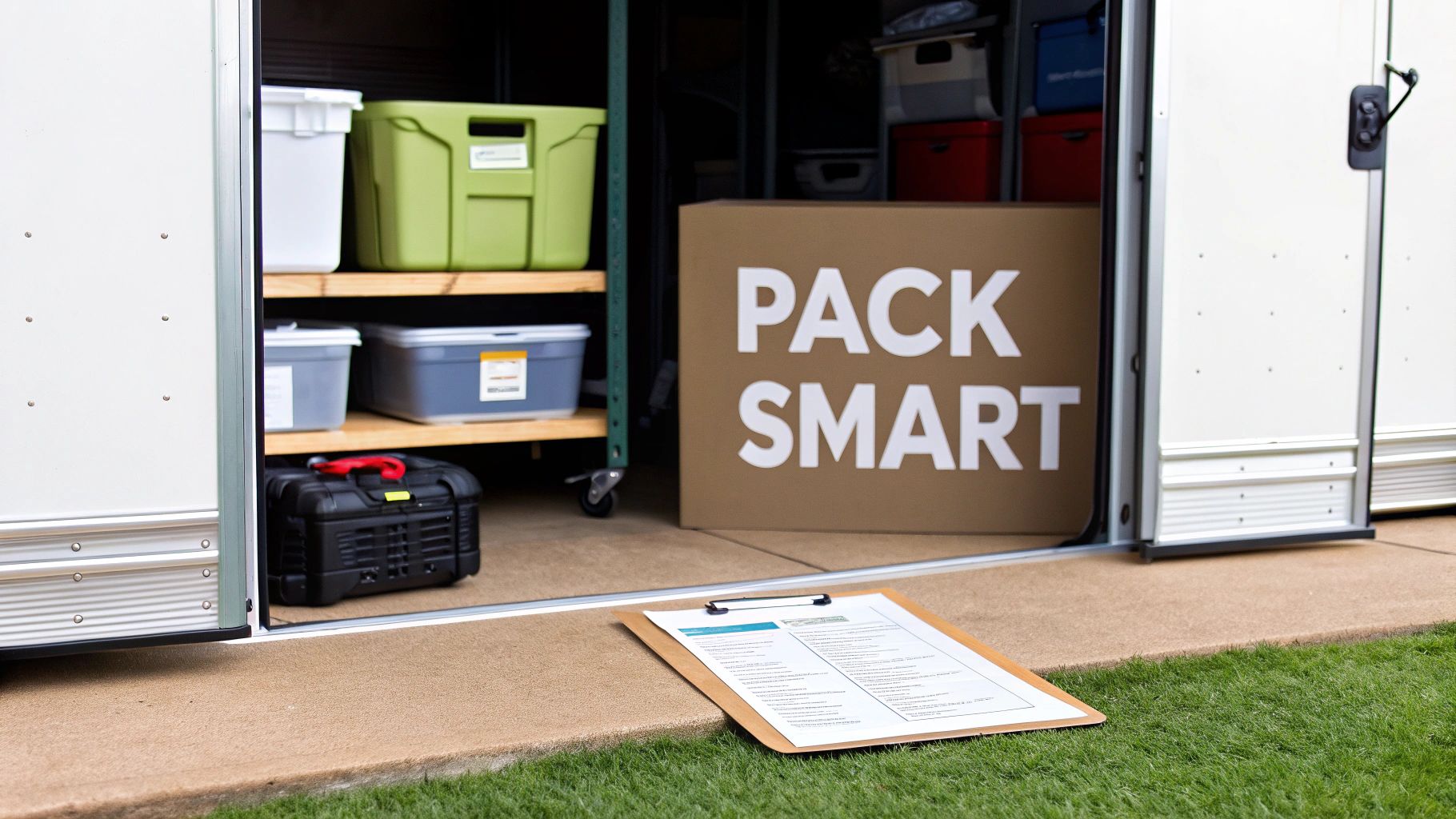
Organization is just as important as what you pack. Use clear, labeled plastic bins in your storage bays so you can see what’s inside without a full-on excavation. Inside, drawer dividers, collapsible containers, and over-the-door organizers are your best friends for maximizing every last inch of space. A little system goes a long way in making your trip smooth and stress-free.
All that detailed planning doesn’t just stop once you pull out of the driveway—it just shifts gears into a daily rhythm. The real magic of a successful road trip happens in how you manage the day-to-day. It’s what turns a good trip into a truly great one.
You have to find a sustainable groove that keeps you energized and comfortable, ready for whatever the road throws your way. It’s a delicate balance between practical chores, like managing your resources, and consciously pacing yourself. Nail this, and you'll sidestep travel burnout and really savor the freedom you worked so hard to create.
Eating well on the road shouldn’t be a nightly struggle between complicated cooking and expensive takeout. Honestly, a little bit of forethought is all it takes. For those long driving days, having pre-made meals ready to go is an absolute game-changer. Think pasta salads, a big batch of chili, or sandwiches that just need a quick assembly.
Stocking your pantry is just as crucial. I always focus on versatile, non-perishable staples—things like rice, pasta, canned beans, and a good set of spices. This gives you a solid base to build on, so you can just pick up fresh, local ingredients along the way. It not only saves money but also takes away the stress of hunting for a grocery store in an unfamiliar town.
Living in an RV means you get to know your life support systems—water, power, and waste—very, very well. When you’re boondocking or staying at a site without full hookups, conservation becomes second nature.
-
Water Conservation: Simple habits have a huge impact. Turn off the tap while brushing your teeth. Take "navy showers"—get wet, turn off the water to lather up, then turn it back on to rinse. You’ll be amazed how much longer your fresh tank lasts.
-
Power Management: Always keep an eye on your battery levels. Switching to LED lights helps a ton, as does unplugging electronics when you're not using them. It’s also important to know which of your appliances are the real power hogs (I'm looking at you, microwave and A/C!) that really need a generator or shore power to run.
-
Holding Tanks: Dealing with your black and gray tanks is just part of the deal. It's not glamorous, but it’s straightforward. Use RV-specific toilet paper and plenty of water with each flush to avoid clogs. Always wear gloves when dumping your tanks, and before you know it, the whole process will be a routine, five-minute task.
A great way to think about it is adopting a "leave no trace" mindset inside your RV. The goal is to use only what you truly need, making sure your resources last as long as possible between fill-ups and trips to the dump station.
These days, reliable internet is a non-negotiable for many of us, whether it's for remote work or just staying in touch with family. Luckily, you’ve got some solid options.
A mobile hotspot from a major carrier like Verizon or T-Mobile is often the easiest starting point, giving you decent coverage in most places. But if you’re a digital nomad who needs a rock-solid connection, investing in a cellular booster or a satellite internet system like Starlink for RVs can be a total game-changer, keeping you online even in the middle of nowhere.
This need for connectivity is a huge part of how RVing is changing. Younger travelers, like Millennials and Gen Z, are now the biggest groups hitting the road. With 76% of Millennials showing interest, they're reshaping the lifestyle to fit remote work and deeper, more experiential journeys. You can discover more insights about these RV and camping trends to see how the landscape is evolving.
I’m going to end with what might be the most important tip I can give you: know when to slow down. It is incredibly easy to fall into the trap of constant motion, turning your dream trip into what feels like a grueling cross-country delivery job.
To avoid this, I absolutely swear by the 3/3/2 rule:
-
Drive no more than 300 miles a day.
-
Plan to arrive at your destination by 3 PM.
-
Stay for at least 2 nights.
This simple guideline is transformative. It puts an end to those exhausting marathon driving days and gives you plenty of daylight to get set up at camp without feeling rushed. More importantly, it guarantees you have a full day to actually rest, explore, and soak in the place you’ve traveled so far to see. It’s the key to making your journey sustainable and, ultimately, so much more enjoyable.
Let's be honest—even with the most detailed plan, a few nagging questions always seem to pop up. You’re not alone in wondering about the "what ifs." This is where we tackle those common concerns head-on, from fuel budget anxieties to the inevitable roadside hiccup.
Think of this as a conversation with a seasoned RVer. We'll get straight to the point and give you the practical advice you need to handle whatever the open road throws your way.
Fuel is the great unknown for many first-time RVers, and it’s almost always your biggest expense after campground fees. While you can't predict the exact cost, you can get surprisingly close with a little prep.
First, you need to know your rig’s average miles per gallon (MPG). It varies wildly. A Class C motorhome might get 8-13 MPG, while a big Class A diesel pusher could be as low as 6-10 MPG. Once you have a rough travel plan, pop the route into Google Maps to get your base mileage. Then, do yourself a favor and add a 15-20% buffer for all those unplanned detours, side trips to cool spots, and the occasional wrong turn.
The math from there is pretty simple:
(Total Miles ÷ Your RV's MPG) x Average Gas Price = Your Estimated Fuel Cost
So, for a 2,000-mile journey in a rig that gets 10 MPG, with gas averaging $4.00 a gallon, you're looking at $800 (2000 ÷ 10 x $4.00). I always recommend rounding that number up. It's much better to have extra cash in your pocket than to run short.
The thought of being stranded on the side of the highway is enough to give anyone pause. But a breakdown doesn't have to

