If you're looking for boats for sale in Florida, you’ve come to the right place. Welcome to America's undisputed boating capital. The sheer volume and variety of boats here is staggering—from laid-back pontoons perfect for cruising the Intracoastal to brawny center consoles built to tackle the open ocean. And with a year-round boating season, the market is always active.
In Florida, owning a boat isn't just a hobby; for many, it's a way of life. The state’s geography is a boater’s paradise, boasting over 1,350 miles of coastline, thousands of lakes, and a seemingly endless network of rivers and canals. It’s this incredible access to water that makes it a magnet for boaters of all stripes.
Think of the state as one giant, natural showroom for every type of watercraft imaginable. Each region offers a totally different experience, which in turn fuels a highly specialized market. The shallow flats of the Keys demand a different kind of boat than the deep offshore waters of Fort Lauderdale, and you’ll find the perfect vessel for either—and everything in between.
This constant demand creates an incredibly vibrant and competitive marketplace. For you, the buyer, that translates into more options, better prices, and a much higher chance of finding the boat that perfectly matches your vision and budget.
The Sunshine State's appeal goes far beyond the warm weather. It’s built on a culture that revolves around the water, and the sales numbers prove it. Industry data from 2021 shows Florida leading the nation with an astonishing 231,030 boats sold and titled in a single year. That figure, which includes both new and used vessels, cements the state's central role in the boating world.
Interestingly, a lot of that growth came from people new to the lifestyle, with first-time buyers accounting for 34 percent of all boat sales nationally in 2021. You can dive deeper into these Florida boat sales trends for more market insights.
For buyers, Florida's status as a boating hub translates directly into opportunity. The high turnover means a constant stream of high-quality, pre-owned boats entering the market, often well-maintained and equipped for local waters.
Trying to navigate this massive market on your own can feel like a tall order. That's where this guide comes in. We’ve designed it to be your roadmap, breaking down everything you need to know to find, inspect, and purchase your next boat with total confidence.
Here’s a sneak peek at what we'll get into:
- Decoding the Florida Market: We’ll explore which types of boats are popular in different regions and why, so you can zero in on the right area for your search.
- Mastering Your Search: You'll get pro tips for hunting down the best listings—both online and off—and learn how to spot potential red flags in an ad.
- Protecting Your Investment: We provide a detailed checklist for your pre-purchase inspection and explain why hiring a professional marine surveyor is non-negotiable.
- Navigating the Paperwork: Get a clear, step-by-step walkthrough of Florida's boat title, registration, and other legal hoops you'll need to jump through.
- Securing Financing: We’ll cover how to find the right loan for your purchase, from understanding the terms to making your application as strong as possible.
By the time you're done with this guide, you’ll have the know-how and the confidence to make a smart buy in the most exciting boat market in the country.
Before you can find the right boat, you have to get a feel for the local market. And in Florida, "local" means a lot of different things. The state isn't one big, uniform market; it's a vibrant tapestry of different regions, each with its own unique waterways, boating culture, and popular boat styles. This variety is what makes shopping for boats for sale in Florida so exciting, but it also means you need a game plan.
Florida's status as a boater's paradise keeps the market incredibly active. Even when things slow down elsewhere, demand here stays strong. By the middle of 2022 alone, Florida had already recorded 119,831 boats sold and titled, a massive number covering both new and used vessels. While that year wasn't a record-breaker, the sales figures were still way above anything seen before 2019, proving just how resilient this market is. You can dig into the numbers yourself with these Florida boat sales figures.
What does this high turnover mean for you? It means there's always a fresh inventory of used boats coming up for sale, giving you a fantastic selection to browse.
The single most important step in your search is matching the boat to the water. The perfect vessel for the glassy, shallow flats of the Gulf Coast would be completely out of its element in the deep, rolling waves of the Atlantic. It really comes down to form following function. To help you get started, here's a look at some of the most common boat types you'll find in Florida and what they're built for.
| Boat Type |
Primary Use |
Ideal Florida Waterways |
Pros |
Average Price Range (Used) |
| Center Console |
Offshore & Inshore Fishing, Cruising |
Atlantic Ocean, Gulf of Mexico, Large Bays |
Versatile, 360° fishability, handles chop well |
$30,000 - $150,000+ |
| Pontoon Boat |
Social Cruising, Family Outings, Light Fishing |
Intracoastal Waterway (ICW), Lakes, Rivers |
Extremely stable, spacious, comfortable seating |
$15,000 - $60,000 |
| Bay Boat |
Inshore & Nearshore Fishing |
Tampa Bay, Charlotte Harbor, Coastal Flats |
Shallow draft, stable casting platform |
$25,000 - $80,000 |
| Flats Boat |
"Skinny Water" Fishing |
Florida Keys, Mosquito Lagoon, Everglades |
Extremely shallow draft, poles easily |
$20,000 - $70,000 |
| Deck Boat |
Family Fun, Watersports, Cruising |
ICW, Larger Lakes, Calm Coastal Waters |
Open layout, combines speed with pontoon space |
$20,000 - $55,000 |
| Cruiser/Yacht |
Overnight Trips, Extended Cruising |
Offshore, ICW, Bahamas Crossings |
Cabin with amenities, handles rough seas |
$50,000 - $1,000,000+ |
This table should give you a solid starting point. Once you know which category fits your dream boating lifestyle, you can really start to narrow down your search and focus on the listings that make sense.
Florida’s different regions are practically custom-built for certain kinds of boating, and that directly shapes the local inventory. If you know where to look, you can save yourself a ton of time.
- South Florida (Miami, Fort Lauderdale): This is the epicenter for go-fast sport boats, luxury yachts, and serious offshore fishing machines. The easy access to the deep Atlantic and the Bahamas drives demand for bigger, more powerful boats.
- The Gulf Coast (Tampa, Naples): Known for its calmer seas and endless shallow flats, this side of the state is a hotbed for bay boats, family-friendly deck boats, and cruisers perfect for island hopping.
- The Florida Keys: Down here, it’s all about getting into the skinny water. Specialized flats boats and smaller center consoles rule the day, designed for chasing bonefish and tarpon where other boats can't go.
- The Panhandle & North Florida: This area has a rich fishing culture that blends Gulf access with countless bays and rivers, so you’ll find a great mix of boats suited for both.
This image gives you a bird's-eye view of the kind of pricing you can expect as you start looking.
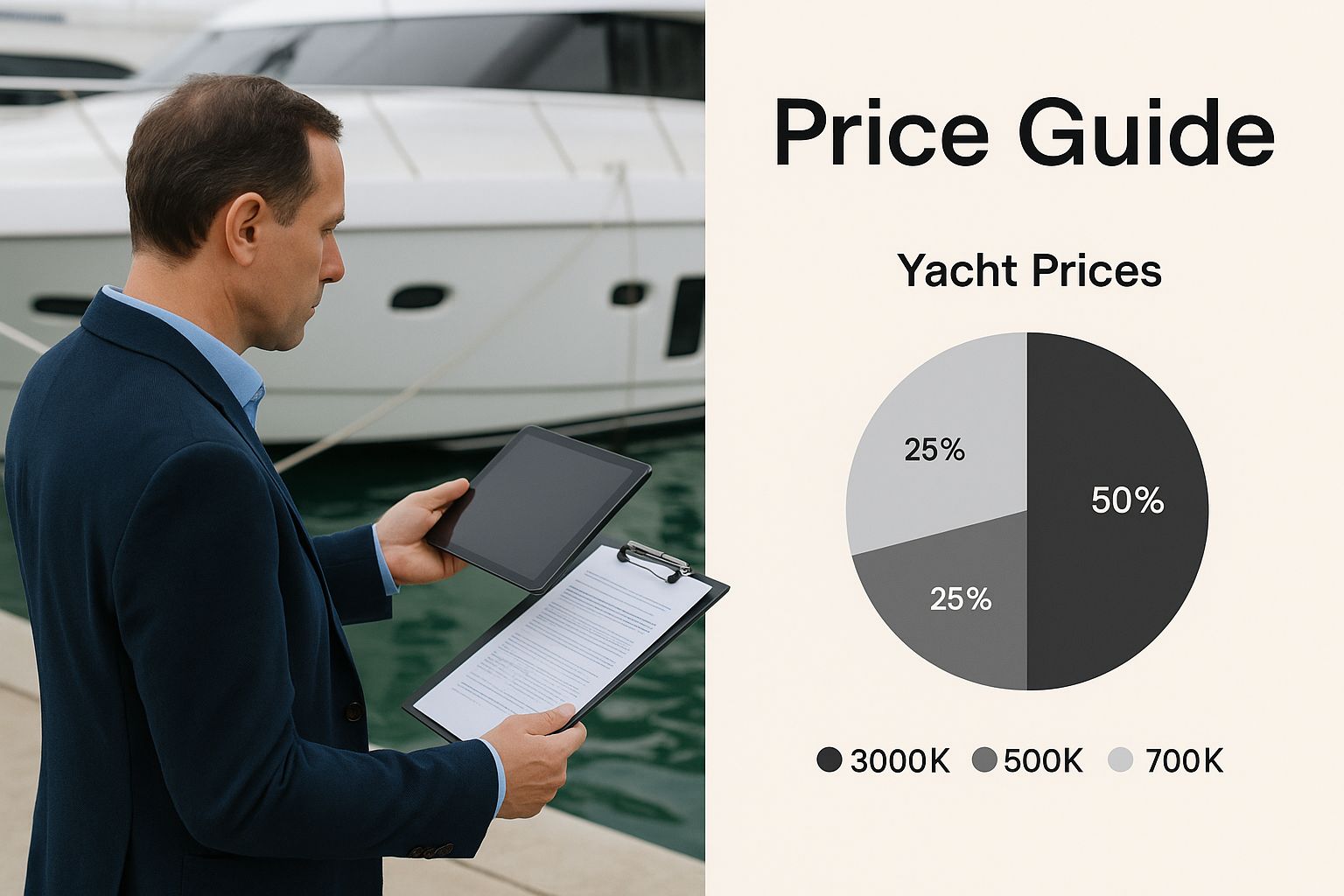
Understanding these regional sweet spots turns your search from a random hunt into a targeted mission. If you have your heart set on a classic high-performance Scarab, for example, you’ll have much better luck browsing listings in the Fort Lauderdale area than you would in the Keys. A little bit of local knowledge goes a long way.
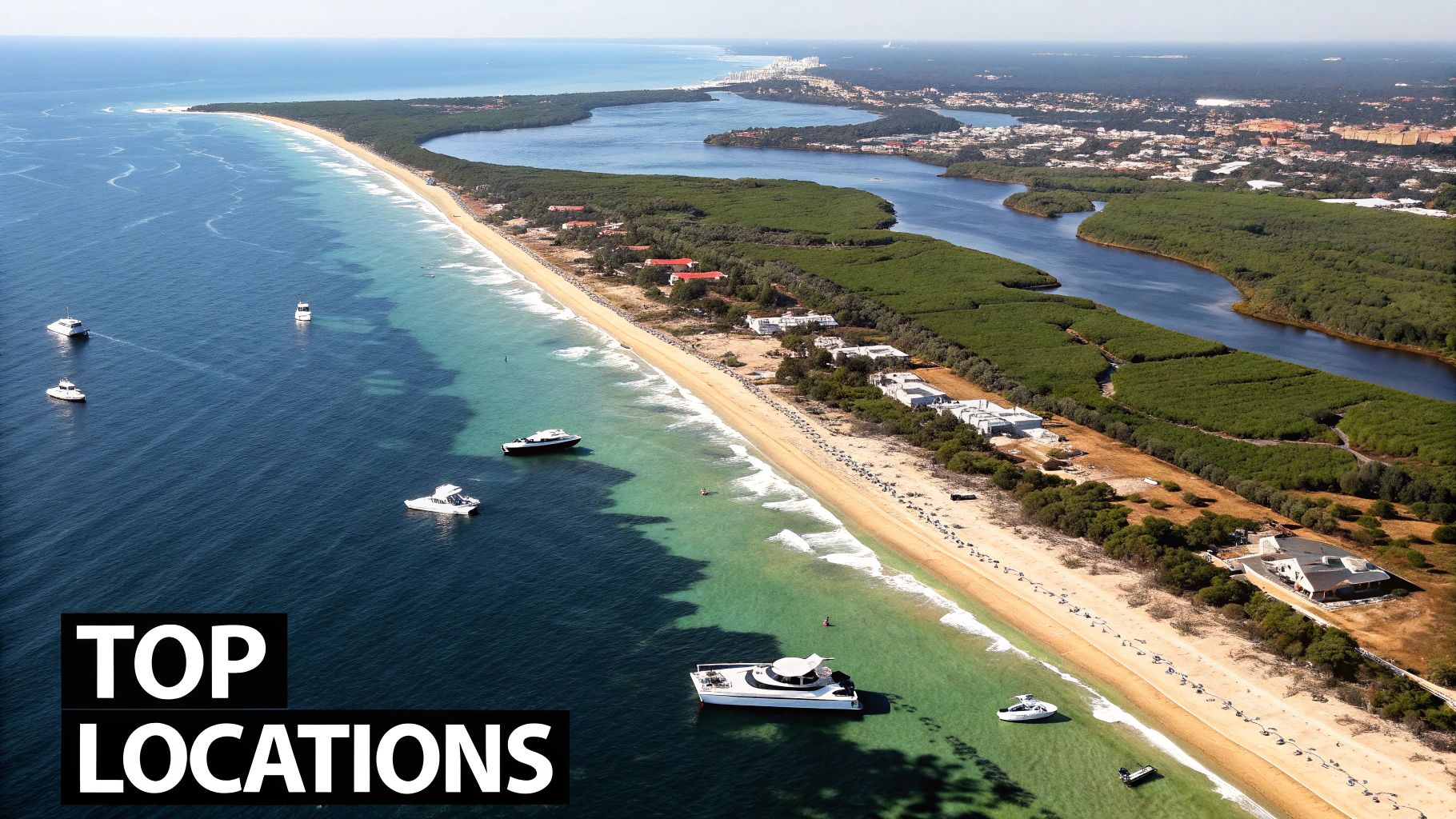
Finding your dream boat in Florida isn't just about browsing—it's about a smart, targeted hunt. The market is huge, and without a solid strategy, you can easily waste weeks sifting through duds. The key is to stop searching like a novice and start thinking like a seasoned buyer.
This means you’ve got to know where to look, what to filter for, and how to read between the lines of a sales pitch. It’s a skill that helps you spot a gem from a mile away and, just as importantly, dodge a potential money pit before you ever step on board.
Your search will almost certainly start online, but it's crucial to understand that not all websites are built the same. Sure, you can find boats on general classified sites, but the real action is on dedicated marine marketplaces. These platforms are built by boat people, for boat people, and their advanced search tools are your best friend.
Take a platform like SearchShop, for example. It lets you go way beyond just length and price. You can really drill down into the details that separate a well-maintained boat from one that's been neglected.
To get the most out of your online search, focus on these filters:
- Engine Hours: This is the boat's equivalent of an odometer. Lower hours are generally better, but you have to be careful. A 15-year-old boat with only 100 hours isn't a find; it's a red flag for a vessel that's been sitting, which can lead to its own set of problems.
- Maintenance History: Sellers who are proud of their boat will shout it from the rooftops. Look for listings that mention recent service, professional upgrades, or a complete set of maintenance logs. That’s a massive green flag.
- Specific Equipment: Have your heart set on a boat with a Seakeeper for stability or the latest Garmin electronics? The best search tools let you filter for these non-negotiables, saving you from even looking at boats that don't make the cut.
- Location: As we covered, Florida's boating scene is regional. Filtering for sportfishing boats in Fort Lauderdale or flats boats in the Keys immediately narrows your search to the most relevant options.
Think of these filters as your secret weapon for cutting through the clutter. Instead of drowning in thousands of irrelevant boats for sale in Florida, you can build a clean, targeted shortlist of vessels that actually fit what you're looking for.
Once you've got a shortlist, it's time to put on your detective hat and analyze each listing. Remember, every ad is a sales pitch. Your job is to see past the glowing adjectives and get to the truth of the boat's condition.
The photos are always your first clue. You want to see tons of high-resolution pictures from every conceivable angle—the engine room, the bilge, close-ups of the hull, inside hatches. If a seller only posts a few grainy, far-away shots of the boat in the water, they're probably hiding something. Keep an eye out for rust streaks, gelcoat cracks, and tired, faded upholstery.
Next, tear into the description. Vague, fluffy language is a warning sign. A great listing is all about specifics.
| What to Look For (Green Flags) |
What to Be Wary Of (Red Flags) |
| Mentions of "all service records available" |
Phrases like "needs a little TLC" or "as-is" |
| Specific upgrades listed with dates (e.g., "new Garmin GPS in 2022") |
Vague descriptions with few specifics on equipment |
| Detailed engine information (hours, recent service) |
No mention of engine hours or maintenance |
| High-quality, recent photos showing all areas |
Old, blurry photos or pictures of the boat only in the water |
While the internet is where the volume is, some of the absolute best deals are found the old-fashioned way. The Florida boating community is a surprisingly small world, and plenty of fantastic boats get sold to a new owner without ever hitting the web.
Don't neglect these channels:
- Marina Bulletin Boards: Seriously, just walk the docks. You'll often find "for sale" signs posted right on the boats or on the marina's community board. This gives you a chance to see the boat and maybe even chat with the owner directly.
- Boat Brokers: A good broker is worth their weight in gold. They know about boats that aren't publicly listed and have an ear to the ground for what's about to hit the market. They work for you, helping you find the right vessel and navigate the deal.
- Local Boating Events: Big shows like the Fort Lauderdale International Boat Show (FLIBS) are a fantastic way to see a massive number of boats in one place. It’s a prime opportunity to connect with dealers, brokers, and other owners from all over the state.
By mixing a sharp online search with some on-the-ground legwork, you give yourself the best possible shot at finding the perfect boat. This balanced approach ensures you're seeing all the boats for sale in Florida, not just the ones that are easiest to find online.
You’ve found it—what looks like the perfect boat online. The photos are gorgeous, the description checks all your boxes, and you’re already picturing yourself on the water.
Hold on. This next step is, without a doubt, the most critical part of the entire buying journey: the inspection. This isn’t just a quick look-around. It’s a deep dive to uncover any ugly, expensive secrets hiding beneath that shiny gelcoat.
Think of it as your ultimate buyer’s shield. A proper inspection, combining your own hands-on walkthrough with a professional’s expert analysis, is the only way to know what you’re really buying. Skipping this is a high-stakes gamble you can’t afford to lose when looking for boats for sale in Florida.
Before you even think about hiring a pro, you need to do your own homework. This first pass lets you spot the obvious deal-breakers and get a real feel for the boat. Grab a good flashlight, get ready to get a little dirty, and leave no hatch unopened.
Here's what you need to zero in on:
- The Hull: Get right up close. Look for a chalky or faded gelcoat, which indicates neglect. Pay special attention to spider cracks, especially around hardware, and any bubbles under the surface, known as blisters. If it's on a trailer, get underneath and inspect every inch.
- Deck and Fittings: Walk the entire deck. Does any part of it feel spongy or soft underfoot? That’s a huge red flag for a rotten core. Tug on the railings and cleats—they should be rock-solid and well-sealed.
- The Engine Room: This is the boat's heart. You don’t have to be a mechanic to spot problems. Look for obvious oil or coolant leaks, heavy rust on engine mounts, and corroded electrical connections. Squeeze the hoses—they should be firm, not mushy—and check the belts for cracks.
- Bilge and Systems: A clean bilge is a happy bilge. It shouldn’t be a swimming pool of oily water. Flip the switches for the bilge pumps, lights, and any other systems you can access to see what works and what doesn't.
- Interior and Upholstery: Use your eyes and your nose. Check cushions for mold, mildew, and UV damage. Open every locker and cabinet and take a deep sniff. A persistent musty smell is a tell-tale sign of a hidden leak.
If this initial check turns up a laundry list of problems, you can walk away without spending a dime on a professional survey. But if it passes your test, it's time to bring in an expert.
No matter how thorough you are, your inspection is just the opening act. The main event, and a non-negotiable one for any serious used boat purchase, is hiring a professional marine surveyor.
A surveyor is your unbiased expert on the ground. They are highly trained professionals who show up with specialized tools and years of experience spotting things the average person would never notice. They can detect hidden moisture in the hull with a moisture meter, sound the hull for delamination with a percussion hammer, and identify the subtle signs of a major repair from a past accident.
A marine survey isn't a cost—it's an investment in peace of mind. The few hundred dollars you spend on a survey can save you tens of thousands in unexpected repairs down the road.
The survey itself is incredibly thorough. It starts with an "out-of-water" inspection of the hull and all its components, followed by an "in-water" sea trial where the engine and systems are tested under a real-world load.
Afterward, you get a detailed report outlining the vessel's condition, a list of necessary and recommended repairs, and its estimated market value. This document is gold. In fact, most insurance companies and lenders won't even talk to you without one.
That final survey report is your single most powerful negotiation tool.
If it comes back with a clean bill of health, fantastic! You can move forward with confidence. But more often than not, it will uncover a list of issues, ranging from small cosmetic fixes to potentially serious mechanical problems.
This is where you get your leverage. You can take that list right back to the seller and renegotiate the price. Ask them to either make the repairs or knock the estimated cost off the sale price. If the report uncovers a deal-breaker, you have all the documented proof you need to walk away from a bad deal and dodge a financial bullet. This turns your boat search into a smart, secure investment.
You’ve found the boat, it passed the inspection, and you’ve shaken hands on a price. The excitement is real, but now comes the part that can feel a bit like homework: the paperwork. Don't let it bog you down. Handling the title and registration correctly is the last step to making that boat legally yours, and it’s not as complicated as it sounds.
Think of it this way: the boat's title is like the deed to a house, and the registration is its license plate. You absolutely need both to own and operate a boat in Florida. Getting this right from the start saves you from future headaches at the tax collector's office and gets you on the water that much faster.
In any private boat sale, two pieces of paper are king: the bill of sale and the Certificate of Title.
The bill of sale is your official receipt. It’s the legal proof of the transaction, and the state has very specific requirements for what needs to be on it. Without a proper bill of sale, you can’t get the boat titled in your name. Simple as that.
Make sure it includes these details before any money changes hands:
- The Boat's Vitals: Hull Identification Number (HIN), year, make, model, and its current Florida registration number.
- The People Involved: Full names, addresses, and signatures from both you and the seller.
- The Deal Itself: The final sale price and the date of the transaction.
- The "As-Is" Clause: Most used boats are sold "as-is," meaning the seller isn't offering a warranty. This should be stated clearly.
Next, you need the original Certificate of Title. The seller has to physically sign it over to you. If they can’t find it, they need to get a duplicate from the state before they can legally sell the boat to you.
I’ve seen this go wrong too many times. A buyer accepts a handwritten bill of sale but walks away without the signed-over title. That’s a huge mistake. The title is the ultimate proof of ownership; without it, the state won’t recognize you as the legal owner.
With the signed title and bill of sale in hand, your next stop is a county tax collector’s office. You have 30 days from the date of purchase to get this done, otherwise, you'll face late fees.
Here’s what you’ll need to bring with you:
- Proof of Ownership: That original title signed by the seller, plus your completed bill of sale.
- Application Form: You'll fill out an "Application for Certificate of Title With/Without Registration," which is just HSMV form 82040.
- Your ID: A valid driver’s license or other government-issued photo ID will do the trick.
- Payment: Be ready to cover the title transfer fee, registration costs, and the sales tax.
Speaking of tax, Florida requires a 6% sales tax on the boat's purchase price. Some counties also add a small local surcharge. You'll pay this all at once when you title and register the boat.
One last thing before you cast off. Florida has a mandatory education requirement for many boaters.
If you were born on or after January 1, 1988, you must have a Florida Boater Education ID Card to operate any boat with 10 horsepower or more. It’s not a license that can be revoked, but rather a lifetime certification that proves you’ve passed a safety course.
You can find approved courses online through the Florida Fish and Wildlife Conservation Commission (FWC). Once you have the card, keep it on you whenever you’re at the helm. It’s the law.
For most of us, turning the dream of owning a boat into reality hinges on one thing: getting the right financing. It’s the final bridge between spotting that perfect vessel online and actually holding the keys in your hand. The great news is, financing a boat or an RV is a well-traveled path, and you've got some fantastic options.
Now, a boat loan isn't quite the same as a car loan. The marine and recreational vehicle world has its own unique set of rules and specialized lenders. Before you start filling out applications, it pays to understand who the players are. Your goal isn't just to get a "yes," but to land a loan that fits so comfortably into your budget that your only worry is what time the tide comes in.
When you start shopping for a loan for one of the many boats for sale in Florida, you’ll quickly find there are three main places to turn. Each has its own rhythm, and the best fit for you will depend on your finances and the kind of boat you’re after.
- Marine & RV Lenders: These are the specialists. They live and breathe recreational vehicles like boats and RVs. Because of this, they get the nuances of the market—like a boat's age or condition—and often offer longer loan terms, sometimes up to 20 years. They’re also typically more flexible.
- Banks: Your everyday local or national bank is another solid choice. If you’ve got a long-standing, positive history with your bank, you might just get a really competitive rate. The only catch is they can sometimes be a bit more cautious, especially with older boats, and might prefer shorter loan periods.
- Credit Unions: As they're member-owned, credit unions are famous for offering great interest rates and a more personal touch. If you're already a member of one, they should definitely be on your shortlist.
Lenders who specialize in marine and RV financing speak your language. They understand what a survey is, why engine hours matter, and aren't scared off by a 10-year-old vessel that’s been impeccably maintained.
Getting a boat loan is a lot like any other major financial step. Lenders are looking for a clear picture of your financial stability so they can feel good about your ability to make payments. Having all your ducks in a row beforehand makes everything go much, much smoother.
Think of it like this: your loan application is telling the story of your financial reliability. A strong application tells a story of a low-risk borrower, which is exactly what lenders want to see.
Here’s what you’ll need to have ready to go:
- A Strong Credit Score: Lenders generally see a credit score of 700 or higher as a sign of a responsible borrower. This is your ticket to getting the best rates and terms available.
- Proof of Income: You'll need to show you have a steady income that can comfortably cover the monthly payments. Be prepared to share recent pay stubs or tax returns.
- A Solid Down Payment: Most marine lenders will ask for a down payment of 10% to 20% of the boat's price. Putting more money down not only lowers your monthly payment but also shows the lender you’re serious, which can help you lock in a better interest rate.
- Boat Details: Naturally, the lender will need to know the boat's year, make, model, and value. For any used boat, they will almost certainly require a professional marine survey to verify its condition and confirm it's worth the asking price.
Putting in a little work to strengthen these areas before you apply will put you in a prime position to get approved with a loan that truly works for you.
Alright, let's wrap things up by tackling some of the questions that pop up time and time again for Florida boat buyers. Think of this as your final pre-flight checklist before you dive into ownership—these are the details you don't want to overlook.
This is a big one. While Florida law doesn't technically mandate boat insurance just to register your vessel, you'll find it’s practically impossible to get by without it. For starters, most marinas won’t even let you tie up at their docks without proof of liability coverage. And if you’re financing your purchase, your lender will absolutely insist on it.
You'll generally be looking at two core types of coverage:
- Liability Coverage: This is your non-negotiable safety net. It protects you financially if you cause an accident that hurts someone else or damages their property. Consider this the absolute bare minimum.
- Hull Insurance: This is what covers physical damage to your boat. Whether it’s from a collision, storm, fire, or theft, this is the policy that helps you repair or replace your investment. For any boat of significant value, it’s a must-have.
Ultimately, your ideal policy depends on your boat’s value, its size, and where you'll be cruising. Your best bet is to get quotes for a comprehensive policy that bundles both, giving you real peace of mind when you're out on the water.
Because you can boat y