So, you’re ready to find your perfect boat in Florida. Good choice. You're jumping into the heart of America's boating capital, a place where owning a boat is less of a hobby and more of a way of life. Just like an RV opens up the highways, a boat opens up Florida's incredible waterways.
From the high-performance fishing machines in the Panhandle to the sleek, luxurious yachts cruising around Miami, the sheer variety can be overwhelming. Before you even start scrolling through listings, taking a moment to understand this massive, dynamic market is the smartest move you can make. It's the key to sifting through thousands of options and zeroing in on the right vessel for you.
Florida’s identity is deeply connected to the water. With over 1,350 miles of coastline, not to mention the countless lakes and the iconic Intracoastal Waterway, it’s a true paradise for boaters. This culture has created a huge and incredibly active marketplace, which can be both a blessing and a bit of a challenge for buyers.
The numbers alone paint a pretty clear picture. In 2021, a staggering 231,030 boats were sold and titled in the state. That's a mix of brand-new and pre-owned vessels, showing just how much demand there is. Even with the usual seasonal ebbs and flows, the market saw a 3.74% increase in new boat titles that year. The interest isn't just steady; it's growing. For a deeper dive, it’s worth checking out these Florida boat sales trends and data to see the market's pulse for yourself.
As you start your search, you’ll immediately see a vibrant mix of new and used boats. A brand-new boat has its perks, of course—the latest gadgets, a full warranty, and that unbeatable new-boat smell. But don't overlook Florida's pre-owned market; it’s where you can find some incredible deals and a massive amount of variety.
The biggest win with a used boat? You skip the steep initial depreciation. A new boat can lose 10-25% of its value in the very first year. For many buyers, letting someone else take that hit makes a pre-owned boat the smarter financial move.
Because the used market here is so strong, you can often find a well-maintained, tricked-out boat for a fraction of what it would cost new. The trick, which we’ll get into later, is knowing exactly what to look for and what to look out for.
Don't make the mistake of thinking all of Florida is one giant boat market. It's really a collection of smaller, distinct regions, each with its own flavor. Knowing this will help you focus your search like a laser.
- South Florida (Miami/Fort Lauderdale): This is the hub for luxury. If you’re dreaming of high-end yachts, powerful center consoles, and sleek European-style cruisers, start here.
- The Panhandle (Pensacola/Destin): Welcome to the "Redneck Riviera." This is hardcore sportfishing country. You’ll find an endless supply of serious offshore center consoles and bay boats built to handle the Gulf.
- The West Coast (Tampa/Sarasota): Things are a bit more relaxed here. This area is perfect for finding family-friendly boats—think pontoons, deck boats, and versatile dual consoles perfect for cruising the calmer Gulf waters.
- Central Florida (Orlando): Head inland, and it's all about freshwater. The "Chain of Lakes" is home to ski boats, wakeboard boats, and bass boats built for a day on the lake.
By understanding these regional specialties, you can stop wasting time and start your search for boats for sale in Florida in the place most likely to have exactly what you want. Getting this lay of the land first will make the entire process smoother and much more successful.
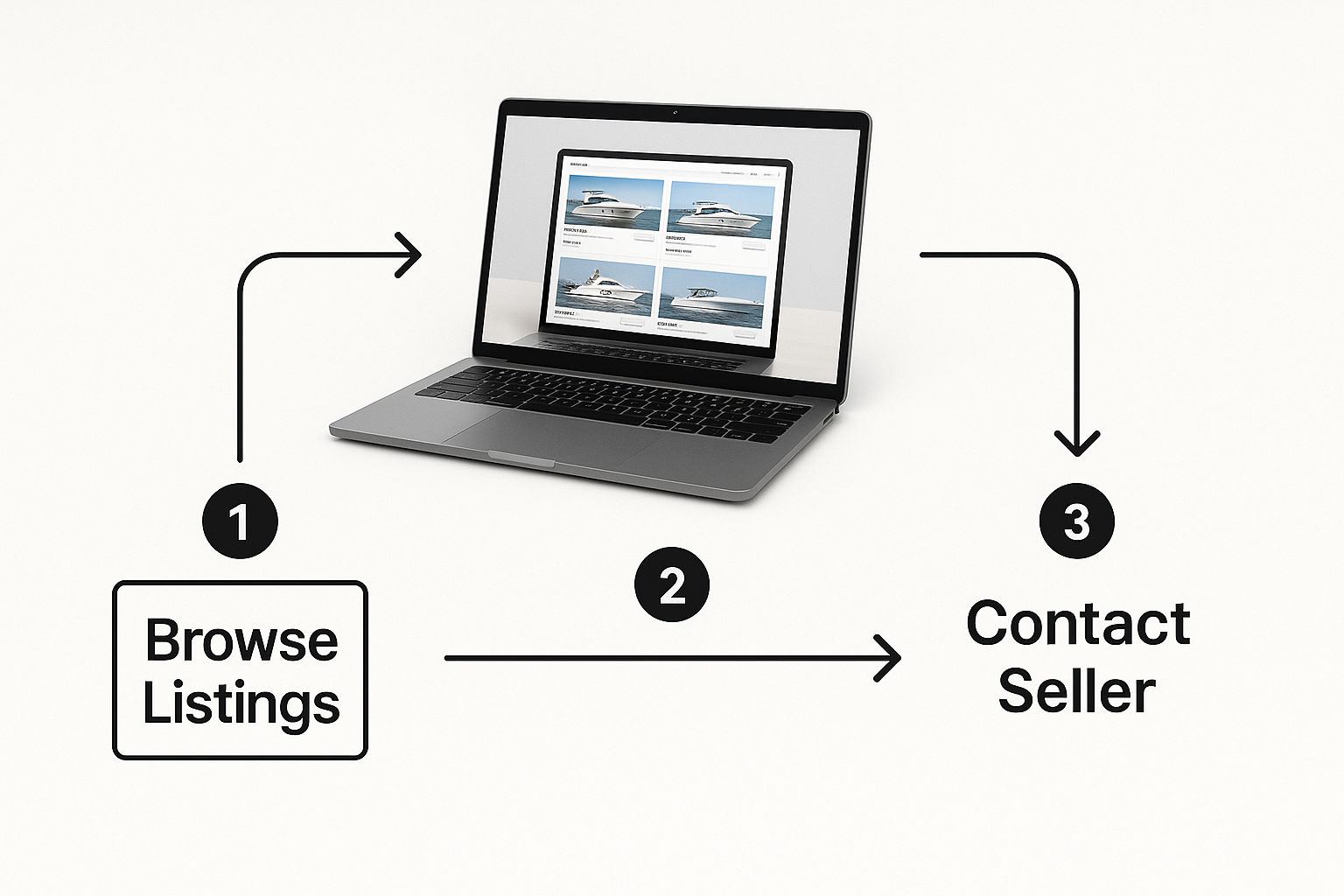
Gone are the days of spending your weekends driving from marina to marina, hoping to spot a "For Sale" sign on the right boat. The search for boats for sale in Florida now starts online. This isn't just about convenience; it's about being smarter, faster, and having the entire state's inventory at your fingertips. You can dial in your search from your couch and find exactly what you're looking for.
The secret is to go way beyond basic filters like price and length. Modern platforms, and I'm particularly a fan of the tools on SearchShop.com, let you get incredibly granular. You’re not just finding a boat; you’re zeroing in on your boat.
Think of advanced search filters as your personal boat-finding concierge. Instead of getting overwhelmed by thousands of listings that don't fit your needs, you can tell the system precisely what you want, cutting right through the noise. This is how you transform a casual browse into a targeted hunt.
A powerful search always starts with your must-haves. Are you loyal to a specific brand known for its legendary hull, like a Grady-White or a Boston Whaler? Filter for it. Know for a fact you need a center console for fishing offshore or a pontoon for lazy Sundays on the lake? Filter by boat type.
Here are a few of the filters I always recommend people use to find the real gems:
- Engine Hours: This is the best indicator of a boat's use, much like mileage on a car or RV. Filtering for low engine hours is a great way to find a vessel that's barely broken in.
- Location, Location, Location: If you're based in Tampa, setting a 50-mile radius saves you from the heartbreak of finding the perfect boat six hours away in Miami. Keep it local to make viewings realistic.
- Brands and Models: If you've done your research and know a Sea-Doo Pontoon or a Scarab jet boat is the one for you, filter by that exact model. Why look at anything else?
- Year of Manufacture: This lets you find that sweet spot—a boat new enough to have modern amenities but old enough to have already taken that big initial depreciation hit.
When you use these filters, you're not just passively scrolling. You're taking control of the hunt, telling the market what you want, and letting the right boats find their way to you.
Let's be honest, Florida's boat market moves fast. A clean, well-priced boat can be listed in the morning and have a deposit on it by the afternoon. If you're not constantly checking new listings, you're going to miss out. This is where setting up search alerts is a game-changer.
Instead of running the same search every single day, you save your perfectly dialed-in criteria. The moment a boat matching your needs hits the market, the platform shoots you an alert. It’s a simple trick, but it puts you ahead of the curve and often gives you the first shot at a great deal.
Picture this: You’re on the hunt for a Grady-White Freedom 235—a fantastic dual console—in the Tampa Bay area. Your criteria are specific: less than five years old with under 200 engine hours. You create a search alert for exactly that. The second a seller lists a boat that ticks all those boxes, you get an email. Now you can be the first to call, the first to schedule a viewing, and the first to make an offer while everyone else is still sipping their morning coffee, completely unaware the boat even exists. That’s how you win in a competitive market.
So, you’ve found a promising listing online. That’s the easy part. Now comes the moment of truth: seeing if that digital dream holds up in the real world. A thorough inspection is your single best defense against buying a floating money pit, especially here in Florida where the sun and saltwater are absolutely brutal on boats.
Don't let the excitement of a potential new toy cloud your judgment. You need to approach this with a critical, even skeptical, eye. This initial walk-through is your chance to spot the big red flags before you sink any real money into a professional survey.
The boating world has seen a huge influx of newcomers recently. A wave of first-time buyers accounted for a staggering 34% of all boat sales in 2021, meaning about 420,000 new owners hit the water. Florida’s boating scene was a huge part of that surge. What does that mean for you? A lot of used boats on the market might be from owners still learning the ropes of proper maintenance. You can get more context on this by reading about the recent influx of first-time boat buyers.
When you first step aboard, put on your detective hat. Your job is to look past the freshly cleaned cushions and shiny gelcoat. The Florida environment accelerates wear and tear, so you need to be laser-focused on the areas most likely to fail.
Trust your senses. Does it smell musty or like mildew? That’s a classic sign of leaks. Can you spot uneven paint or mismatched gelcoat? That could be hiding a shoddy repair. Most importantly, get hands-on.
Here’s where I always start on an initial walk-through:
- The Hull Below the Waterline: Get a good look for any chalking, cracks, or—the big one—blisters in the gelcoat. Those little bubbles can be a sign of osmosis, meaning water has seeped into the fiberglass itself.
- Deck and Transom Integrity: Walk every single inch of the deck. I mean it. Feel for any soft, spongy, or bouncy spots underfoot. Then, head to the back and push hard on the transom where the engine is mounted. Any flex or cracking there is a huge warning sign of a rotted core.
- Engine and Mechanical Systems: Pop open the engine compartment. Look for obvious corrosion, rust, and fluid leaks. Pull the dipstick—if the oil looks milky, like a coffee-and-cream mess, water is getting into the engine. That’s a deal-breaker for me.
- Electrical and Wiring: A quick look at the wiring can tell you a lot about how the boat was cared for. If you see a "rat's nest" of tangled, corroded wires, you're looking at a future filled with frustrating electrical gremlins.
This is where all that time spent browsing online pays off. Starting with a quality search helps you narrow down the field, making your in-person inspection time that much more effective.
Deciding between doing it yourself and hiring a pro can feel tough, but it's one of the most important decisions you'll make. Your personal walk-through is essential for weeding out the obvious duds, but a professional surveyor sees things you simply can't. They bring specialized tools and years of experience spotting hidden problems.
Let's break down the difference in what you can realistically accomplish versus what a certified surveyor will do.
| Inspection Aspect |
Personal Walk-Through |
Professional Marine Survey |
| Goal |
Identify obvious deal-breakers and red flags. |
Provide a comprehensive, in-depth evaluation of the boat's condition. |
| Tools Used |
Your eyes, hands, feet, and a good flashlight. |
Moisture meters, percussion hammers, engine diagnostic tools, thermal cameras. |
| Hull Check |
Visual check for blisters, cracks, and major damage. |
Tapping the entire hull for delamination, moisture meter readings for saturation. |
| Systems Check |
Turn things on/off (pumps, lights, basic electronics). |
Full operational test of all systems under load, including wiring integrity. |
| Engine Check |
Look for leaks, corrosion, and milky oil. |
Compression tests, fluid analysis, check of engine mounts and running gear. |
| Outcome |
A "go/no-go" decision on whether to proceed. |
A detailed written report for you, your lender, and your insurance company. |
Ultimately, a personal inspection saves you from wasting money surveying a boat with clear problems. The professional survey, however, protects you from buying a boat with hidden, expensive ones.
Let me be blunt: even if your personal inspection goes perfectly, it is not a substitute for a professional marine survey. Think of a surveyor as a boat doctor performing a complete physical exam. They have the training and tools—like moisture meters and percussion hammers—to uncover issues you would almost certainly miss.
Besides, most insurance companies and lenders will demand a recent survey for older boats for sale in Florida, so it's often a required step anyway.
A professional survey might cost a few hundred dollars, but it can save you thousands—or even tens of thousands—in unforeseen repairs. It's the best money you'll spend during the entire buying process.
Finally, you should never, ever buy a boat without taking it for a proper sea trial. This is where you find out how the vessel actually performs on the water. Pictures and dockside checks can't tell you how the engine runs under a load or how the hull slices through chop.
During the sea trial, your mission is to test everything:
- Run the Engine Through Its Paces: Don't just idle out of the marina. Push it. Run it at various speeds from a slow cruise all the way to wide-open throttle. Keep an eye on the gauges to make sure temperature and pressure are stable.
- Test the Handling: Make a series of turns, both gentle and sharp. Does the boat feel sluggish? Does it lean uncomfortably? Does the steering feel tight and responsive?
- Check Every System: While you're running, turn on the GPS, the bilge pumps, the livewell—everything. Make sure it all works as it should when the boat is actually underway and vibrating.
This three-pronged approach—your personal look-see, a professional survey, and a thorough sea trial—gives you a complete picture of the boat's health. Following this process ensures you’re making a smart, confident decision, not just inheriting someone else’s problems.
Alright, you've done the hard work. The inspection went well, the sea trial was a success, and you're starting to picture yourself at the helm. Now it’s time to shift gears from being a window shopper to becoming a potential owner. This is where your research really pays off, allowing you to make a strategic offer that truly reflects the boat's value.
Making an offer isn't about pulling a number out of thin air. It’s about building a case. A strong, fact-based offer is one the seller has to take seriously.
Your starting point should always be solid data. I always tell my clients to dive into comparable sales for the exact same model and year, right here in the Florida market. A tool like SearchShop.com is perfect for this, as it can show you pricing history and what similar boats are currently listed for. This gives you a realistic baseline.
Next, use the findings from your inspection and marine survey as leverage. Don’t be afraid to do this! If the surveyor noted that the bilge pumps need replacing or the bottom is due for fresh paint, get a couple of quotes for that work. You can then subtract these costs from your offer and lay it all out for the seller. It's a completely reasonable and logical approach that’s far more effective than just throwing out a lowball number.
Once you've settled on your price, put it in writing. A formal written offer, often called a "Purchase and Sale Agreement," is the only way to go. This document should clearly state your offer price, an expiration date for the offer, and any critical contingencies. The big three are almost always a satisfactory marine survey, a successful sea trial, and your ability to secure financing.
This simple step protects everyone involved and makes the terms of the deal crystal clear. It signals that you’re a serious buyer and sets a professional tone for what comes next. And something will almost always come next—be ready for a counteroffer. It’s a completely normal part of the dance.
The real key to a successful negotiation is keeping emotion out of it. Stick to the facts: the boat's condition, the survey findings, and its current market value. If you and the seller are miles apart on price, don't be afraid to walk away. I promise you, another great boat for sale in Florida will pop up.
It also helps to understand the market you're in. The Florida boat market is always moving. For instance, while mid-2022 saw a slight cooling in sales after the pandemic surge, demand was still much stronger than pre-2019 levels. Knowing these kinds of trends gives you valuable context. You can dig into some of these recent Florida boat sales figures to get a better feel for the current climate.
With an accepted offer in hand, it's time to line up the money. Unless you’re paying cash, you’ll be looking into financing for your recreational vehicle. Generally, you have two paths you can take: a traditional bank or a specialized marine lender. They both have their pros and cons.
You probably already have a relationship with your local bank or credit union, which can sometimes make the application process a bit easier. They can also offer great interest rates, especially if you have excellent credit.
The downside? They aren't boat experts. This can sometimes lead to stricter lending criteria, lower loan-to-value ratios, or shorter loan terms because they don't fully understand the asset they're financing.
These guys live and breathe boats. They get it. They understand marine surveys, how vessels are valued, and the whole boating lifestyle. Because of this specialized knowledge, they often offer much longer loan terms—sometimes up to 20 years—which can make your monthly payments much more manageable. The trade-off might be a slightly higher interest rate, but the flexibility and expertise are often well worth it.
No matter which lender you go with, being prepared will make the entire process faster and smoother. The lender just wants to see a clear financial picture to feel confident you can handle the loan.
Before you even fill out an application, get your paperwork in order. It shows you're an organized and reliable borrower.
- Proof of Income: Get your recent pay stubs, W-2s, and the last two years of tax returns ready.
- Your Financial Snapshot: Put together a simple list of your assets (what you own) and liabilities (what you owe).
- Credit History: Lenders will pull your credit, so it’s smart to check it yourself beforehand to catch any errors. A good credit score is your best friend here.
- The Boat's Dossier: Have the signed Purchase and Sale Agreement, the boat's specs, and the full marine survey report ready to send over.
By approaching your offer with hard data and the financing process with solid preparation, you set yourself up for a smooth closing. This isn't just about buying a boat; it's about making a smart investment in your future on the water.
You’ve navigated the offer, haggled on the price, and secured your financing. The deal is done, the handshake is firm, but there’s one last hurdle before you can legally call that boat yours: the paperwork. This is where you officially become the owner in the eyes of the Sunshine State. It might seem like a maze of forms, but it's pretty straightforward once you know the path.
In Florida, this whole process is managed by the Florida Highway Safety and Motor Vehicles (FLHSMV), but your local county tax collector’s office is where you'll actually get it all done. Getting this part right is non-negotiable—it’s what you need for insurance, financing, and eventually selling the boat down the road.
The single most critical piece of paper in this whole transaction is the boat's title. Think of it just like the title to a car or RV; it's the undisputed proof of ownership. To get it into your name, you and the seller will need to carefully fill out the "Transfer of Title by Seller" section right on the back of the original Florida title.
Slow down and make sure every line is perfect. You'll need:
- Your info: Your full legal name and current address.
- The seller's signature: They must sign it exactly as their name appears on the front. No shortcuts.
- Price and date: This is what the state uses to figure out the sales tax you owe, so be honest and accurate.
What if the seller can't find the title? That's a full stop. They need to apply for a duplicate before they can legally sell you the boat. Never, ever hand over money without a clean, physical title in hand.
A clean title is everything. Before you even think about signing, scan it for any mention of a lien. If you see a bank or lender listed, the seller absolutely must provide a "Lien Satisfaction" form from that institution. This is your proof that the loan is paid off. Without it, the state won't issue a new title in your name, and you'll inherit a massive headache.
With the signed title ready, your next stop is the tax collector's office. You have 30 days from the purchase date to apply for a new title and registration in your name. Bring the signed-over title and a filled-out application form, HSMV 82040. Miss that 30-day window, and you'll be hit with late fees.
This is also when you'll settle up with the state. Florida's sales tax is 6%, but don't be surprised if your county adds a little extra with a discretionary sales surtax. The tax is calculated on the purchase price you wrote on the back of the title.
Registration fees are separate and depend on the length of your boat. For example, a boat between 16 and 26 feet will have a different fee than one over 40 feet. This is an annual fee, and in return, you'll get the registration decal you need to display on your hull.
Not every deal is a simple handover of a Florida title. When you're searching for boats for sale in Florida, you'll run into a few common curveballs.
Buying a boat from out-of-state is a frequent one. The process is almost the same, but the FLHSMV will want to verify the Hull Identification Number (HIN). This usually means you either have to trailer the boat to the tax collector’s office for a quick inspection or have a law enforcement officer come out and sign a verification form for you.
Another situation you might see is a boat that was "Documented" with the U.S. Coast Guard instead of titled by a state. This is common for larger vessels. If that's the case, the seller must give you a "Deletion from U.S. Coast Guard Documentation" form along with the bill of sale. This document proves the boat is no longer under federal oversight and is free to be titled in Florida.
Knowing about these final steps ahead of time makes the closing process smooth instead of stressful. Getting the paperwork right is that last crucial step that takes you from the closing table to the boat ramp, ready to hit the water.
It’s only natural to have a lot of questions when you’re buying a boat, especially in a market as big as Florida’s. Getting clear answers to these common questions ahead of time will give you the confidence to move forward. Let’s tackle some of the most frequent things we hear from soon-to-be boat owners.
Think of this as tying up the loose ends. From figuring out ongoing costs to understanding Florida-specific rules, getting these details straight is the key to a smooth purchase and, more importantly, a great ownership experience.
There’s no single answer here—boat insurance costs in Florida can be all over the map. The biggest factor? Hurricanes. Insurers pay very close attention to where you plan on keeping the boat. Storing your vessel on a trailer in a secure garage is almost always going to be cheaper than leaving it in a wet slip at a marina.
Your personal history matters, too. A clean driving and boating record will definitely help lower your premiums. Of course, the boat itself is a huge part of the equation. A high-performance Scarab jet boat carries a much different risk profile (and price tag to insure) than a family-friendly Sea-Doo Pontoon.
The best way to get a real number is to get quotes from several marine insurance specialists. As a general rule of thumb, you can probably expect to pay somewhere between 1% to 3% of the boat's insured value each year.
Florida is serious about safety on the water. If you were born on or after January 1, 1988, you are required by law to complete a state-approved boater safety course. This applies to operating any boat with an engine of 10 horsepower or more.
Once you pass the course, you’ll get a Boating Safety Education Identification Card. You must carry this card and a photo ID with you anytime you're at the helm. It’s a simple but critical step to make sure everyone out there has a solid foundation of safety knowledge.
Think of the boater education card as your license to operate on Florida's beautiful waterways. It’s an essential piece of documentation that not only keeps you compliant but can also earn you a discount on your boat insurance policy.
This really comes down to how you plan to use and store your boat. A trailer gives you amazing freedom. You can explore different lakes and coastlines all over the state, from the Keys to the Panhandle. It also means you can store the boat at your house, which saves a ton on marina fees and protects your boat from the harsh saltwater environment.
But trailers have their own set of responsibilities. You'll need a truck or SUV that can handle the tow weight, and you'll need to get comfortable with the art of launching and retrieving your boat at a busy ramp.
The alternative is keeping your boat at a marina. This is the peak of convenience—your boat is in the water and ready whenever you are. The trade-off is the recurring cost of slip fees and potentially more maintenance from being in the salt 24/7.
- Trailer: Gives you more flexibility and lower storage costs, but you need a tow vehicle and have to master the boat ramp.
- Marina: Offers maximum convenience, but comes with higher monthly fees and increased maintenance demands.
There’s no right or wrong answer; it just depends on your lifestyle, your budget, and how you really see yourself using your new boat.
Your journey to finding the perfect boat in the Sunshine State should be an exciting one. With the right information and tools, you can dive into the market feeling prepared and confident. Whether you're a seasoned boater or an RVer looking to add a new dimension to your Florida adventures, we're here to help. At SearchShop.com, we give you the listings, data, and resources to find, evaluate, and b