How to Buy a Boat: A Complete Guide for First-Time Buyers
Shopping for a Boat
How to Buy a Boat: A Complete Guide for First-Time Buyers
By Searchshop Editorial Team24 min readOctober 29, 2025Updated January 2, 2026
Some links in this article are affiliate links. If you buy through them, Searchshop may earn a commission at no extra cost to you. Learn how this works.
So, you're ready to buy a boat. It’s a huge decision, and getting it right means breaking the process down into manageable chunks: figuring out what you can realistically afford, picking the right boat for you, giving it a top-to-bottom inspection, and finally, sealing the deal. Nail these steps, and you’ll end up with a vessel that fits your budget and your weekend plans, making the whole journey an exciting adventure instead of a headache. Whether you're a seasoned RV owner looking to expand your recreational lifestyle to the water, or completely new to adventure vehicles, this guide is for you.
Your Journey to Boat Ownership Starts Here
Let's cut to the chase. This is your practical, no-fluff guide to buying a boat. Forget the sales pitches; this is the straightforward advice that seasoned boaters wish they’d had when they started. Think of this as your personal roadmap, taking you from dreaming about the open water to confidently grabbing the helm.
Buying a boat is a major financial move, and it's smart to have a sense of the bigger picture. The global recreational boating market is massive and expected to hit USD 124.6 billion by 2035. But it’s not always smooth sailing. The market has its ups and downs; for example, U.S. retail powerboat sales dipped by 7.3% between mid-2024 and mid-2025 thanks to a shaky economy.
What does that mean for you? Timing your purchase during a market downturn could land you a better deal. But you still have to be ready for the ongoing costs. It’s worth taking a moment to understand these recreational boating market trends and how they might affect your purchase.
Navigating the Core Steps of Buying a Boat
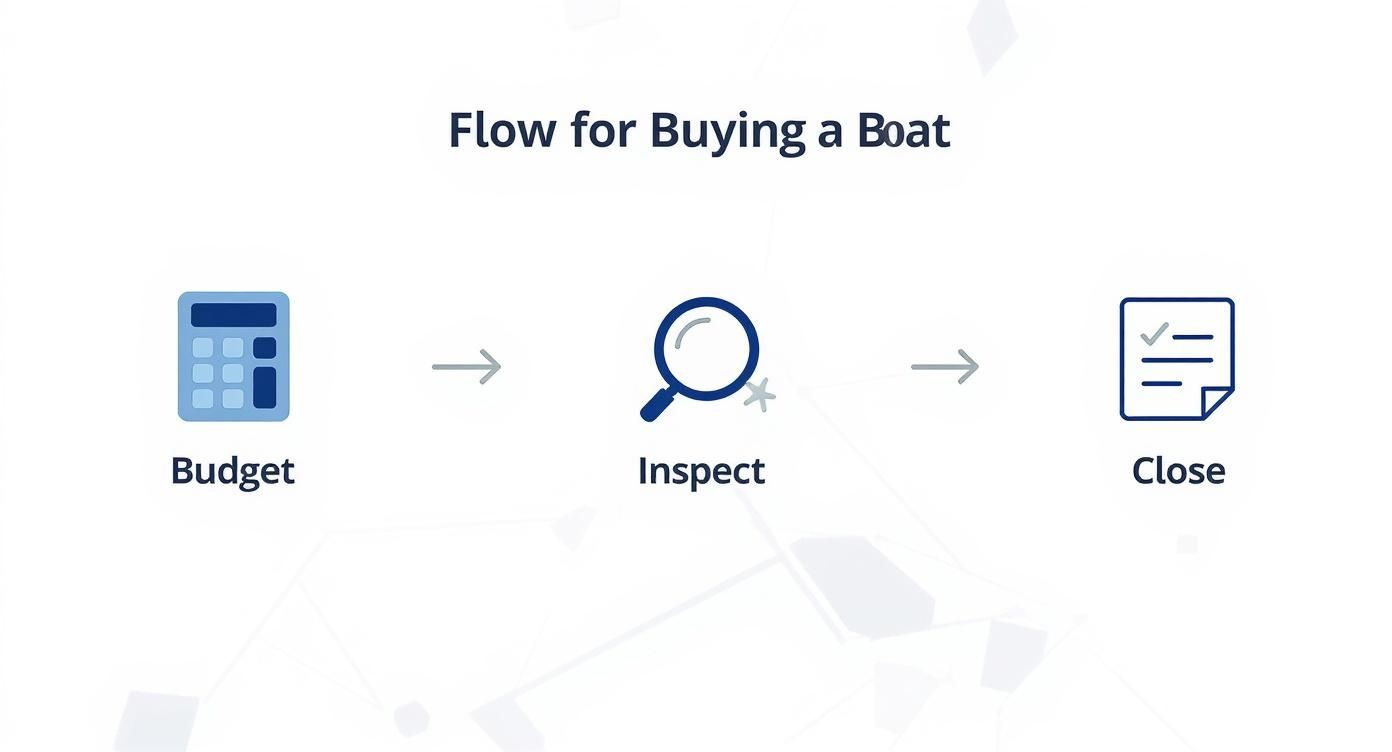
The best way to tackle this is to follow a clear path. Each step logically follows the one before it, so you can make informed decisions without feeling swamped. It all boils down to knowing your numbers, checking the boat out properly, and closing the deal like a pro.
This flowchart lays out the key stages, from the initial number-crunching to the final handshake.
Following a structured approach like this is your best defense against making a costly mistake. It forces you to get your finances and due diligence sorted out before you get too emotionally invested.
My goal here is to give you everything you need to handle each phase with confidence, whether this is your first boat or your fifth.
Here’s what we’re going to cover:
Building a Realistic Budget: We'll go way beyond the sale price and uncover all the hidden costs of ownership that can catch new buyers by surprise.
Navigating the Market: You'll learn the real-world pros and cons of buying a brand-new boat versus a pre-owned one.
Inspecting Like a Pro: I'll walk you through exactly what to look for during a physical inspection and, most importantly, the sea trial.
Closing with Confidence: We’ll talk about getting your financing lined up and how to negotiate a deal you can feel good about.
By the time you're done with this guide, you won't just know how to buy a boat—you'll be equipped to make a smart investment that will bring you years of enjoyment. Let's get you out on the water.
Calculating the True Cost of Your Boat
Before you even start browsing boat listings, we need to talk about a hard truth of boat ownership: the sticker price is just the down payment. The real cost—the one that keeps you on the water year after year—is a long-term commitment. Getting this wrong is the fastest way to turn your dream into a very expensive lawn ornament. Much like owning an RV, the initial purchase is only the beginning of your investment.
There's an old rule of thumb in boating circles called the "10% rule." It's surprisingly accurate. The idea is to budget roughly 10% of the boat's purchase price for annual operating and maintenance costs. So, for a $50,000 boat, you should plan on spending about $5,000 a year just to keep it afloat, insured, and ready to go. It's not a perfect formula, but it's a fantastic reality check.
Breaking Down the Ongoing Expenses
So where does that 10% actually go? It's not just one big bill. The costs are spread across several categories you absolutely can't ignore.
Insurance: Lenders and marinas almost always require it. Your rate will depend on everything from the boat's value and your cruising area to your personal boating history. Don't forget, when you're looking into getting boat insurance, the policy details matter as much as the price.
A Place to Keep It: Unless you have a huge driveway, you're paying for storage. This could be a slip at a marina, which can run into thousands annually, or a more affordable spot in a dry-stack facility.
Routine Maintenance: Boats need love. Think annual engine servicing, oil changes, replacing zincs and impellers, and proper winterization if you live where the water freezes.
Fuel: This one is the wild card. How much you spend depends entirely on your engine's thirst and how much time you spend cruising versus trolling or just relaxing at anchor.
The "Uh-Oh" Fund: Trust me on this: things will break. It’s part of boating. A failed bilge pump or a mysterious electrical issue can pop up at the worst time. Having cash set aside for surprise repairs turns a potential disaster into a manageable inconvenience.
To help you visualize how these costs stack up, here’s a sample budget. This isn't set in stone, but it gives you a realistic picture of what a year of ownership can look like.
Sample Annual Budget for a $50,000 Used Boat
Expense Category
Estimated Annual Cost
Key Considerations
Insurance
$750 - $1,200
Depends on coverage limits, your location, and the boat's age/type.
Storage/Slip Fees
$1,500 - $4,500
Dry storage is cheaper; a prime marina slip costs more.
Routine Maintenance
$800 - $1,500
Includes engine service, winterization, cleaning supplies, etc.
Fuel
$1,000 - $2,000
Highly variable. Based on engine size and hours of use.
Repairs & Upgrades
$500 - $1,000
For unexpected fixes and small improvements.
Total Annual Cost
$4,550 - $10,200
Falling right in that 10-20% range of the purchase price.
This breakdown shows why it’s so important to look beyond the initial purchase. A boat that seems like a bargain might have high storage and maintenance costs that strain your budget over the long haul.
Real-World Cost Comparison
Let's put this into practice with two different boats. The numbers really tell the story.
Scenario 1: The 22-Foot Center Console
You find a great used 22-foot center console for $45,000. It's perfect for chasing fish on the weekends, and you can store it on a trailer.
Insurance: ~$900/year
Trailer Storage: ~$600/year at a local facility
Maintenance: ~$1,200 for engine service and supplies
Fuel: ~$1,500 for a season of moderate use
Repair Fund: ~$500 set aside for the unexpected
Total Annual Cost: Roughly $4,700, or about 10.4% of what you paid. The 10% rule holds up.
Scenario 2: The 30-Foot Family Cruiser
Now, let's say you go bigger with an $80,000 cruiser for overnight trips with the family. It's more boat, which means more of everything else, too.
Insurance: ~$1,800/year (higher value means higher premium)
Marina Slip: ~$4,500/year for a spot in the water
Maintenance: ~$2,500 for more complex systems (twin engines, plumbing, etc.)
Fuel: ~$2,800 to push a heavier boat
Repair Fund: ~$1,000 is a smarter buffer for a bigger vessel
Total Annual Cost: A whopping $12,600, which is nearly 16% of the purchase price.
See the difference? The cruiser's annual cost is almost triple the fishing boat's and blows past the 10% guideline. This is why you have to budget for the total ownership experience, not just the thrill of buying the boat itself.
Choosing Your Vessel: New vs. Used Boats
Alright, you’ve figured out your budget. Now comes the first real fork in the road on your boat-buying journey: do you spring for something brand new, or do you hunt for a gem in the pre-owned market?
This isn't just about the price tag. It’s a decision that really gets to the heart of how you plan to boat, your budget, and frankly, how much you enjoy (or tolerate) tinkering and maintenance. There's no single "right" answer here, but let's break down the real-world pros and cons of each path.
The Allure of a Brand-New Boat
There's nothing quite like buying new. You get that factory-fresh smell, the latest marine technology, and the unmatched peace of mind that comes with a full manufacturer's warranty. Every single hour on that engine is yours and yours alone.
Shop Boats For Sale
Browse current boats from dealers near you — updated daily.
One of the biggest draws is customization. When you order new, you get to play designer. You can often pick your engine, spec out the electronics package, and choose the exact upholstery colors. The boat arrives as your boat, built just for you.
Of course, the major trade-off is depreciation. Just like a new car or RV, a new boat loses a big chunk of its value the second it hits the water. You’re paying a premium for that "first owner" experience.
Why a Used Boat Might Be Your Best Bet
For many boaters, especially if this is your first time at the helm, a used boat offers incredible value. The original owner has already taken the big depreciation hit, which means you can often get a bigger, better-equipped boat for the same money.
Pre-owned boats also have a known history. The engines are broken in, and any of those initial factory quirks have likely been discovered and sorted out. You’re buying something that has already proven itself on the water. The key, though, is to do your homework. A professional survey is absolutely non-negotiable to make sure you aren't inheriting someone else's headache.
As you look at different models, remember to think about how they’ll feel on the water. It’s worth doing some research on what is the best boat for seasickness to ensure every trip is a good one for your crew.
Buying used can stretch your dollar significantly, but it places the responsibility for uncovering potential issues squarely on your shoulders. A meticulous inspection and sea trial are your best tools for making a smart used boat purchase.
Understanding Current Market Dynamics
The market itself plays a huge role in this decision. Right now, we’re seeing some interesting shifts that savvy buyers can take advantage of. Reports from 2025 show a noticeable cooling trend, with U.S. retail powerboat sales dropping by 7.3% compared to the previous year.
This has created a bit of a buyer's market. We're seeing sales for specific categories like pontoons and wake sport boats dip by nearly 20%. For you, this means dealers are often more willing to negotiate on new, leftover inventory, and the used market is filled with great options from owners looking to sell.
A Practical Comparison: New vs. Used
Let's put this into real numbers. Say you have a $60,000 budget for a 24-foot center console.
The New Option: You could probably get a brand-new, base-model boat. It’ll have the full warranty and the latest design, but you might have to skip upgrades like a killer sound system or high-end fish finders to stick to your budget.
The Used Option: That same $60,000 could easily land you a 3-to-5-year-old boat of the same size that’s already fully loaded. We’re talking a top-of-the-line GPS, an upgraded engine, and other bells and whistles that would have cost a fortune on a new model.
Here’s a quick-glance table to help you weigh the options:
Factor
New Boat
Used Boat
Initial Cost
Higher purchase price.
Lower purchase price for a similar model.
Depreciation
Steepest in the first few years.
Slower depreciation; holds value better.
Warranty
Full manufacturer's warranty.
Typically sold "as-is"; a survey is crucial.
Condition
Pristine, with no wear and tear.
Varies greatly; requires thorough inspection.
Technology
Latest engines, electronics, and features.
May have older, but proven, technology.
Customization
Can be built to your exact specs.
What you see is what you get.
Ultimately, it all comes down to your priorities. If a full warranty, the latest tech, and a completely clean slate are what matter most, a new boat is a fantastic choice. But if you want to maximize your investment and get more boat for your buck—and you’re willing to put in the effort on inspections—the used market is where you'll find unbeatable value.
Getting Your Hands Dirty: The Inspection and Sea Trial
Alright, you’ve found a boat that looks great on paper and the excitement is probably starting to build. This is the moment to pump the brakes. The next steps—the inspection and the sea trial—are where smart buyers separate themselves from those who end up with a money pit.
Never, ever let emotion steer the ship here. Think of this phase as your fact-finding mission. It's your one and only chance to uncover the boat's secrets before they become your problems.
Your first walk-through is a bit like a first date. You're just getting a feel for things and looking for any obvious deal-breakers. You don’t need to be a seasoned mechanic to spot the big stuff.
The On-Land Inspection Checklist
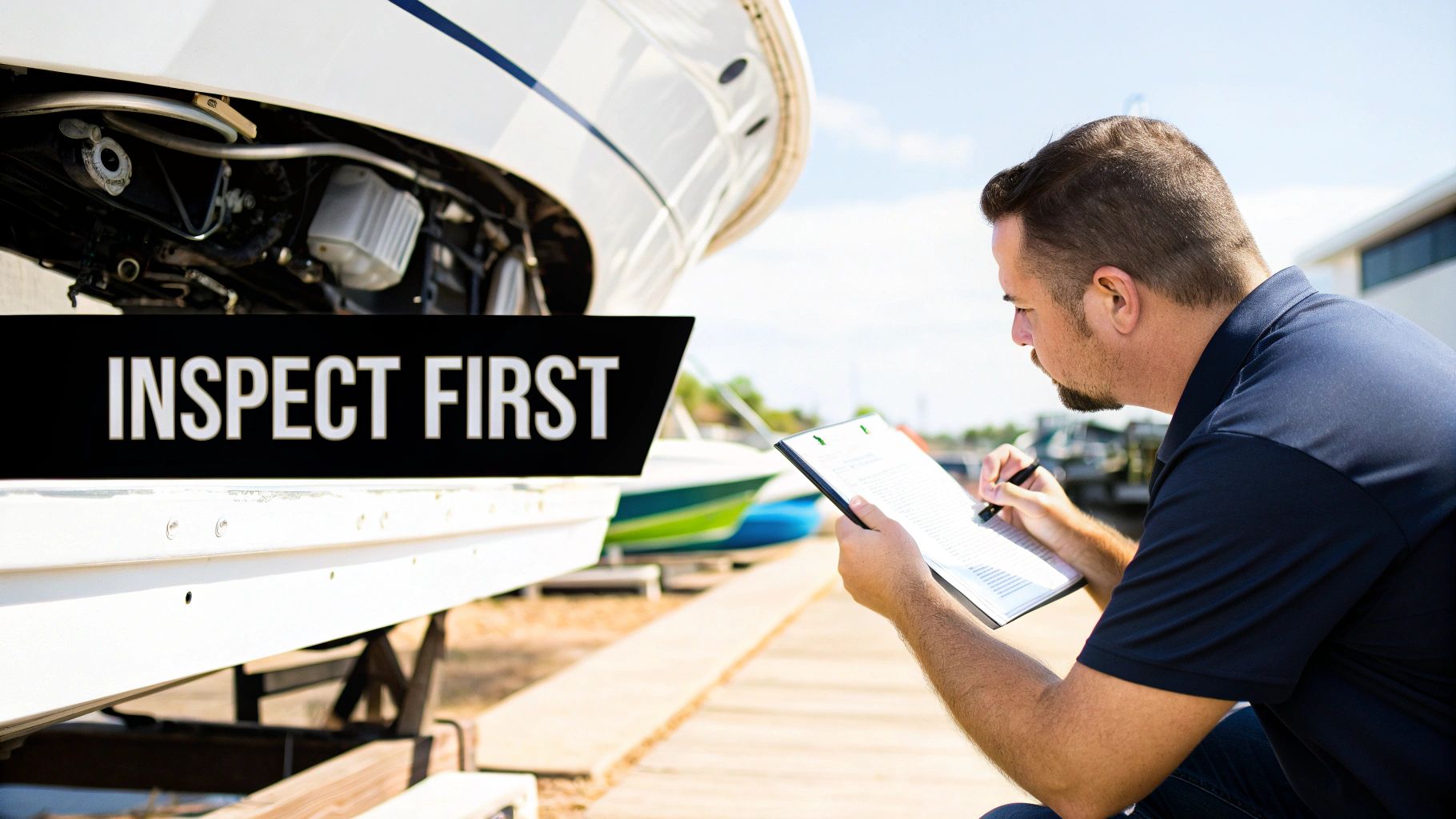
Before that boat even thinks about hitting the water, a thorough on-land inspection can tell you almost everything you need to know about its past life. Take your time. Be methodical.
Start with the hull. Seriously, get down on your hands and knees. Run your hand along the bottom, feeling for any bubbles or blisters in the gelcoat. These are often a sign of moisture getting into the fiberglass, and that's a repair bill you don't want. Crouch down at the bow and stern and sight down the hull lines—are they fair and smooth, or do you see ripples and waves that could signal a past repair?
Next, climb aboard and stomp around the deck. And I mean stomp. Walk every square inch and pay close attention to the feeling under your feet. Soft spots are a massive red flag. They almost always mean the core material is saturated with water and starting to rot. That’s a structural repair, and it’s one of the most expensive headaches you can inherit.
Now, pop the engine cover or head to the stern to look at the outboards. Even if you don't know a piston from a spark plug, you can spot trouble. Look for:
Obvious Corrosion: A little surface rust is one thing, but heavy corrosion eating away at engine mounts, exhaust manifolds, or steering components is a bad sign.
Fluid Leaks: Get a flashlight and look under the engine. Any drips of oil, coolant, or hydraulic fluid? A suspiciously clean spot on an otherwise dirty engine is also a clue—it often means a recent leak was hastily wiped away.
Belts and Hoses: Squeeze them. Are they brittle, cracked, or mushy? These are cheap to replace, but worn-out components can tell a story of deferred maintenance.
The Make-or-Break Sea Trial
An on-land inspection tells you what the boat is. The sea trial tells you what it does. This isn’t just a joyride; it’s a critical systems check under real-world conditions. If a seller is cagey about a sea trial, just walk away. It’s that simple.
Once you’re off the dock, use all your senses. Listen. Is the engine making any odd clicks, whines, or clunks as it warms up? Feel. Are there any strange vibrations coming through the deck or the steering wheel? A well-maintained boat should feel solid and sound smooth.
Make sure the owner runs the boat through its entire RPM range. How does it get on plane? Does it hesitate or labor? At cruising speed, the steering should feel tight and responsive, not sloppy. Keep your eyes glued to the engine gauges—temperature and oil pressure should climb to the normal operating range and stay there.
The sea trial is your chance to test everything. Flip every switch. Turn on the GPS, fire up the fishfinder, run the bilge pumps, turn on the faucets, and check every single light. A system that works just fine at the dock can easily fail once you introduce the vibration and load of being underway.
Calling in the Pros: The Marine Survey
After you've done your own detective work and you're still serious about the boat, it's time to bring in a professional. Hiring a qualified marine surveyor is, without a doubt, the best money you will spend during this entire process.
A surveyor is a trained, unbiased expert whose only job is to find what’s wrong with the boat. They’ll give you a detailed, multi-page report that covers the vessel from stem to stern, from its structural integrity to the condition of its electrical systems.
This report becomes your most powerful negotiating tool. It will either confirm you’ve found a gem, give you a punch list of repairs for the seller to address, or provide the objective proof you need to walk away from a bad deal without a second thought. Don't even consider skipping it.
Securing Financing and Closing the Deal
You’ve put in the hours—you’ve budgeted, inspected, and even taken her for a spin. Now, with the perfect boat in your sights, it’s time to take care of business. This is the moment you transition from a dreamer to an owner, and getting the financing, negotiation, and closing right is what seals the deal.
Finding the Right Boat Loan
Unless you’re paying cash, your first stop is securing a loan. You could go to your local bank, but you'll often get a much better deal by working with a specialized marine lender. These folks live and breathe boats; they understand the value of marine assets and offer financing products designed specifically for them. Just like with an RV, specialized financing can lead to better terms and rates.
Marine lenders are known for offering much longer loan terms—often 10 to 20 years—which can make your monthly payments surprisingly affordable. Just be prepared to put down 10-20% of the purchase price. A solid credit score is your best friend here, as it will directly influence your interest rate and how much you can borrow.
My best advice? Get pre-approved before you even think about making an offer. It’s a game-changer. Pre-approval not only tells you exactly what you can afford but also signals to sellers that you’re a serious, ready-to-go buyer. That alone gives you a huge advantage at the negotiating table.
Crafting a Winning Negotiation Strategy
With your financing lined up and a detailed survey report in hand, you’re in the driver’s seat. It's time to make an offer. Your goal should be to present something that is both fair and firm, based on the boat’s market value and, just as importantly, the issues uncovered during the survey.
Don't just pull a low number out of thin air. You need to justify your offer with cold, hard facts. For instance, if the surveyor flagged that the engine’s exhaust risers are on their last legs (a common and pricey fix), you can present the seller with a repair estimate. This shifts the conversation from haggling to a business-like discussion based on the boat's real-world condition.
Expect a counter-offer; it’s all part of the dance. Very few sellers accept the first price they see. The key is to stay patient, remain professional, and know your absolute walk-away price before you even start. If you can’t get to a number that feels right for the boat's condition and your budget, be prepared to move on. There are always other boats on the water.
Remember, the surveyor's report is your greatest leverage. Use it to build a logical case for your offer, turning a potentially emotional discussion into a business transaction based on the vessel's actual condition and value.
Navigating the Closing Process
Once you and the seller shake hands on a price, you've reached the final stage: closing the deal. This part is all about the paperwork and ensuring a clean, legal transfer of ownership. A little organization here goes a long way and gets you out on the water much faster.
The most important piece of paper is the Bill of Sale. This is the official legal document that makes the boat yours. It absolutely must include:
Full names and addresses for both you and the seller.
A detailed description of the boat, including its Hull Identification Number (HIN), make, model, and year.
The final, agreed-upon purchase price.
Signatures from both parties (getting it notarized is always a smart move).
Next up are the title and registration. Just like a car or an RV, a boat has a title that proves ownership. The seller needs to sign it over to you. You’ll then take that signed title, along with the Bill of Sale, to your state’s DMV or equivalent agency to get the boat registered in your name.
Every state has slightly different rules, so a quick check of your local requirements is essential. To help you keep everything straight, here’s a simple checklist to guide you through the closing process.
This checklist will help you track all the moving parts as you finalize your purchase. It’s your roadmap to ensuring every "i" is dotted and "t" is crossed.
Boat Purchase Closing Checklist
Document or Action Item
Purpose
Status (To Be Checked by Reader)
Finalize Loan Documents
Secure the funds from your lender to pay the seller.
☐
Obtain Bill of Sale
The official legal document transferring ownership of the vessel.
☐
Receive Signed Title
Proof of legal ownership that you'll need for registration.
☐
Verify No Liens
Confirm with the seller and lender that there are no outstanding loans on the boat.
☐
Secure Insurance Policy
You'll need proof of insurance before you can legally operate the boat.
☐
State Registration & Decals
Register the boat in your name with the state and receive your registration numbers.
☐
Once you’ve checked off every item on this list, you’ve officially navigated the final hurdle. By tackling the closing with the same care you used during your search, you can be confident that your new boat is truly and legally yours. Congratulations
Common Questions About Buying a Boat
As you get closer to making one of the most exciting purchases of your life, it's natural for questions to start bubbling up. The world of boating has its own language and unique considerations, and it’s smart to get them sorted out beforehand.
This final section tackles the most common questions I hear from aspiring boat owners. My goal here is to give you clear, straightforward answers to fill in any knowledge gaps so you can move forward with total confidence.
What Is The Best Size Boat For A Beginner?
If you’re just starting, the sweet spot is usually a boat between 18 and 25 feet. I always recommend this range for a few important reasons.
A boat in this class is big enough to feel stable and safe when the wind kicks up a little chop, but it's still small enough to be incredibly manageable. You’ll find that docking, trailering, and maneuvering in a tight marina are far less stressful than with a larger vessel. For those used to driving a large RV, handling a boat of this size will feel intuitive and approachable.
Plus, the ongoing costs for maintenance, insurance, and storage are much friendlier on your wallet, which is a great way to ease into the financial side of boat ownership without feeling overwhelmed.
How Many Engines Should My Boat Have?
Ah, the classic single vs. twin engine debate. The right answer really comes down to where and how you’ll be boating. For most folks sticking to inland lakes, rivers, or coastal bays, a single engine is more than enough. It's simpler, more fuel-efficient, and literally cuts your engine maintenance costs in half.
But, if you have ambitions of heading offshore or making long-distance runs, that second engine offers incredible peace of mind. Knowing you have a backup to get you home is priceless. Twin engines also give you a major advantage in handling, especially for low-speed maneuvering around the dock.
A single engine is the practical choice for simplicity and cost-effectiveness. But if your adventures will take you far from shore, the reliability and safety of a twin-engine setup is the only way to go.
What Should I Look For In A Boat's Helm?
Think of the helm as your command center—a well-designed one makes every trip better. Obviously, you'll have a steering wheel and throttle, but a few other features can make a world of difference.
A modern chartplotter is non-negotiable for navigation; it’s your real-time GPS on the water. Look for a unit that integrates with other systems, like sonar for checking depth and radar for navigating in fog or at night.
A few other game-changers to look for at the helm include:
Autopilot: On long cruises, this is your best friend. It holds a course for you, which seriously cuts down on fatigue and lets you enjoy the ride.
VHF Radio: This isn't just a gadget; it's a critical piece of safety gear for talking to other boats, marinas, and, if needed, the Coast Guard.
Bow and Stern Thrusters: These are pure magic, especially on single-engine boats. Thrusters let you push the boat sideways with a joystick, making docking in tight spots an absolute breeze.
How Old Is Too Old For A Used Boat?
This is a great question. Unlike a car, a boat's age in years is far less important than its maintenance history and overall condition.
SE
Written by
Searchshop Editorial Team
Vehicle research & buying-guide team
The Searchshop editorial team researches and writes buying guides, model reviews, and category roundups across RVs, boats, motorcycles, ATVs, autos, and snowmobiles. We combine hands-on product research, live dealer inventory data, and manufacturer specifications to help buyers make confident decisions.
Reviewed by Searchshop Review Board — credentialed industry professionals.