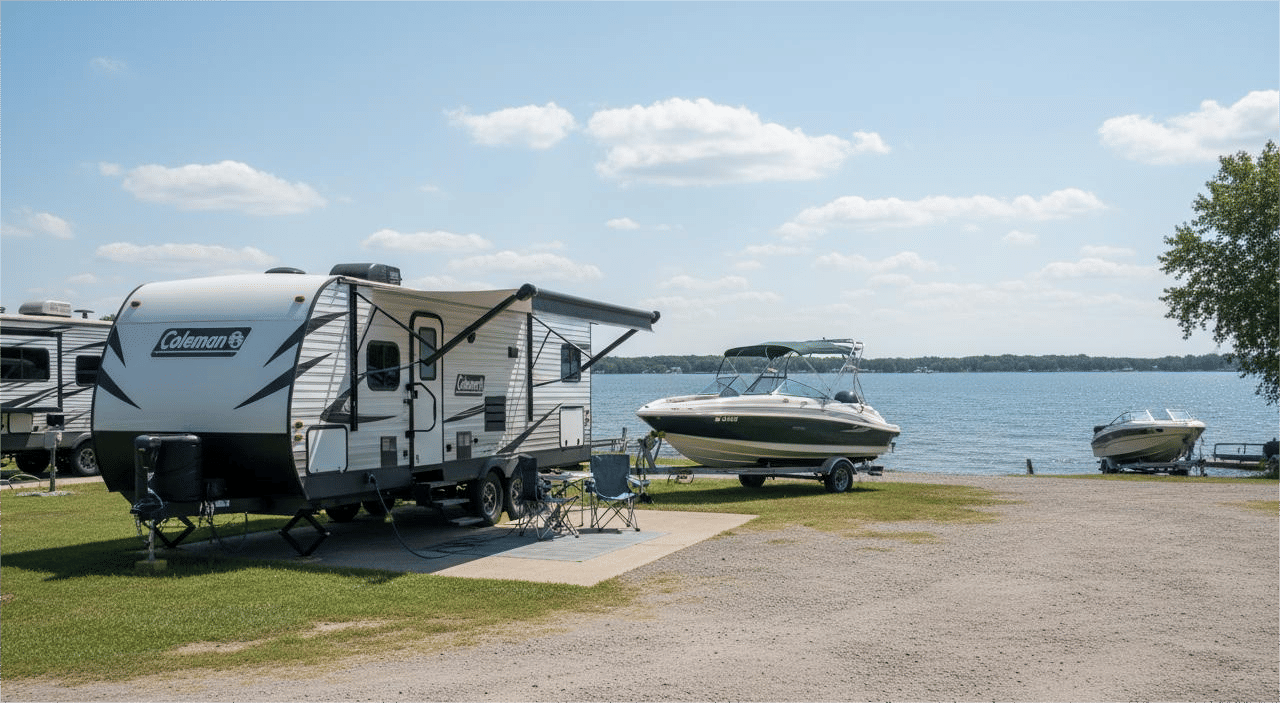
Determining the fair market value for your RV or boat is about finding that sweet spot—the price a knowledgeable buyer and a willing seller can both agree on. It's a blend of hard data from comparable sales, an honest assessment of your vehicle's true condition, and a solid feel for current market trends. Nail these three elements, and you'll be able to price your RV or boat with confidence, ensuring a smooth and successful sale.
Before you put a price tag on your adventure vehicle, you need to understand what "fair market value" (FMV) truly represents. It’s not a number pulled from a generic guide. It's the price that an informed buyer is willing to pay you—a seller who also knows their vehicle's worth—in an open market where neither party is under pressure to make a deal.
This is a critical distinction, as FMV is often confused with other valuations. For example, the "book value" from a source like NADAguides is an excellent starting point, but it's just that—a starting point. It doesn't account for a hot local market, the premium upgrades you’ve installed, or the specific condition of your RV or boat.
Then there's the insurance value, often called "agreed value," which is typically higher than FMV. That figure represents the cost to replace the vehicle and is used for coverage purposes, not for a private sale. Understanding these terms is the first step toward a successful transaction.
A few key factors significantly influence your vehicle’s final price. By evaluating your RV or boat through this lens, you can move from guessing to calculating an informed valuation.
Here's what truly matters:
-
Brand and Model Reputation: Certain names hold their value better. Think of Airstream in the RV world or Boston Whaler for boats—their reputation for quality and owner loyalty means they depreciate more slowly.
-
Current Market Demand: Are you selling in the spring when everyone is planning their next adventure? Or is it late fall when the market cools off? Seasonality and local demand can easily swing prices by 10-15%.
-
Age and Condition: This is the most significant factor. A ten-year-old motorhome that has been meticulously maintained and stored indoors can be worth more than a five-year-old model showing clear signs of neglect.
Fair market value is a dynamic figure, not a static number. It reflects a real-time agreement in a specific market, which is why your own research into comparable sales is so vital.
If you want to dig deeper into the formal appraisal process, you can find great resources on automotive valuation that explore many of the same principles we're talking about here. In the end, your goal is to arrive at a price that you can justify to buyers and that feels fair to you.
No two recreational vehicles are exactly alike, but the factors that determine their value are surprisingly consistent. The table below breaks down the key elements that influence the fair market value for both RVs and boats, highlighting where they overlap and where they differ.
| Valuation Factor |
Impact on RV Value |
Impact on Boat Value |
| Make and Model |
High-demand brands (e.g., Airstream, Winnebago) retain value well. Floorplan is also a major factor. |
Reputation for seaworthiness and build quality (e.g., Boston Whaler, Grady-White) is paramount. |
| Condition |
Interior wear, appliance functionality, and signs of water damage (delamination) are critical. |
Hull integrity, engine hours, and evidence of saltwater corrosion significantly impact value. |
| Mileage/Engine Hours |
Lower mileage is always preferred, but high mileage with excellent maintenance records is acceptable. |
Low engine hours are a huge selling point. The type of engine (inboard/outboard) also matters. |
| Upgrades & Features |
Solar panels, lithium batteries, and modern electronics can add significant value. |
Advanced navigation systems (GPS, fishfinders), trolling motors, and custom towers increase appeal. |
| Maintenance Records |
A complete and documented service history provides buyer confidence and justifies a higher price. |
Verifiable engine service, winterization records, and hull maintenance are crucial for buyers. |
Understanding how these specific elements apply to your vehicle will help you create a much more accurate and defensible asking price when you're ready to sell.

To discover what your RV or boat is really worth, you need to see what similar models have actually sold for recently. While online value calculators provide a decent starting point, they can't account for the unique characteristics of your local market or the specific condition of your vehicle.
This is where you need to become a market detective. We'll use a tried-and-true method professionals rely on called the sales comparison approach. It’s one of the most reliable ways to determine fair market value, and it’s simpler than it sounds.
The core idea is to find recently sold vehicles that are as close as possible to yours in make, model, age, and condition. To get an accurate picture, aim to find at least three solid examples. This gives you a credible baseline for what people are actually paying. If you want to dive deeper, you can learn more about this valuation method from property assessment experts.
So, where do you find these "comps"? You go where the buyers and sellers are. Today, that means online marketplaces are your best source for real-time, real-world data.
Start your research on the major platforms:
-
RV Trader is the go-to marketplace for virtually any type of RV.
-
Boat Trader serves as the equivalent hub for all things marine.
-
Facebook Marketplace can be a goldmine for local, private-party sales data.
Use the search filters to your advantage—they're your most powerful tool. Dial in the make, model, year, and specific trim level or floorplan to ensure an apples-to-apples comparison. A 2018 Winnebago Vista 29VE is a completely different vehicle than a 2018 Vista 31BE, and their market values will reflect that.
Pro Tip: Don’t just focus on the asking price. Savvy sellers look for listings marked "Sold" to see what a vehicle actually went for. Also, pay attention to how long a vehicle has been on the market. A boat listed for three months is likely overpriced. One that disappears in a week? That was probably priced to sell.
This hands-on research provides a realistic, data-backed price range, moving you beyond a vague, automated estimate. It shows you what your vehicle is truly worth in today's market, giving you the confidence to set a price that makes sense.
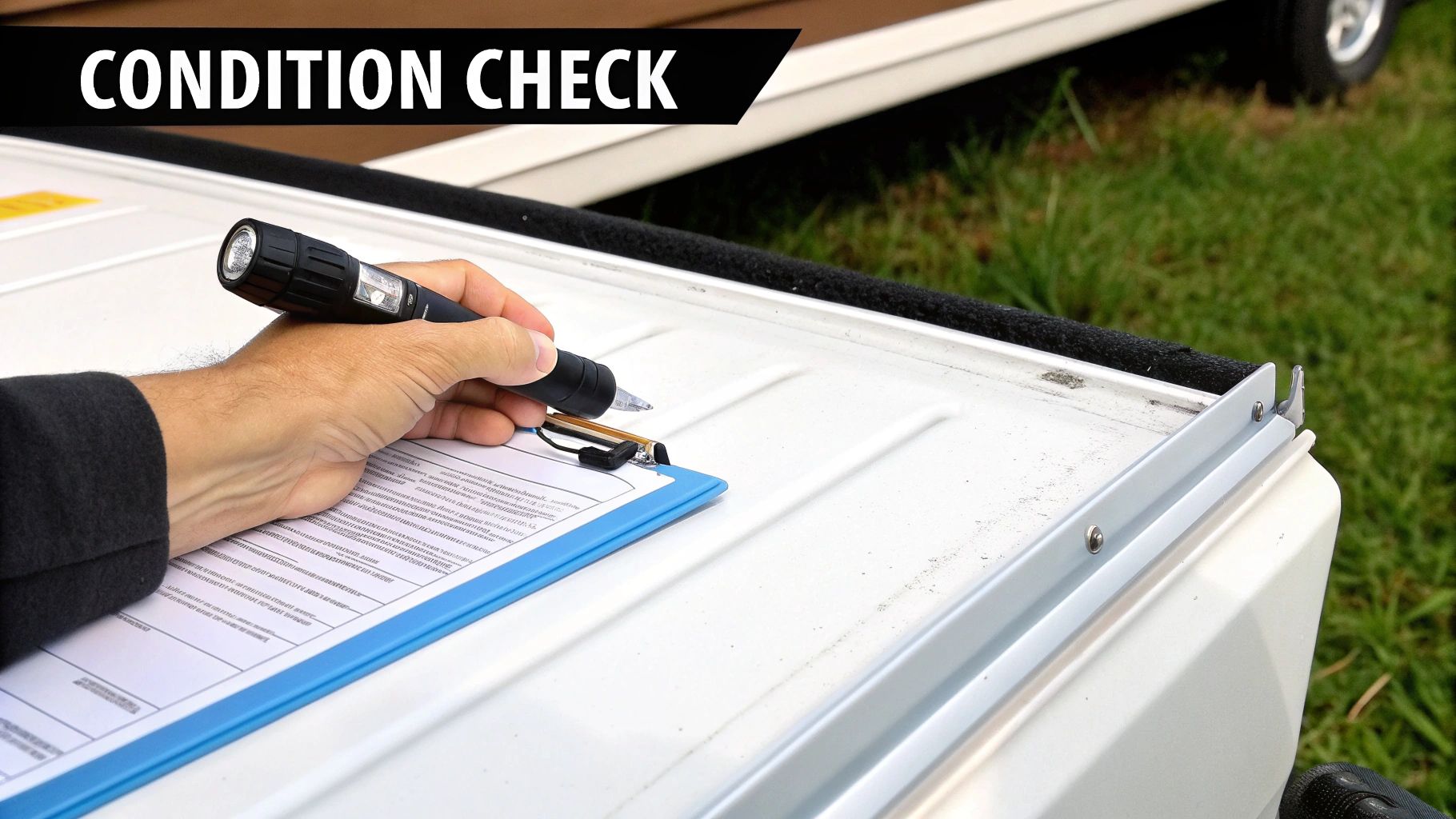
You've researched what similar RVs or boats are selling for. Now comes the most critical step: taking a brutally honest look at your own vehicle.
A generic NADA value is just a starting point. It doesn't know about the pristine upholstery you've maintained for years, but it also can't see the subtle delamination on an RV wall. Your vehicle's real-world condition is what truly drives the final price, and it can easily swing the value by thousands of dollars.
This isn't a quick walk-around. You need to adopt a critical "buyer's mindset" and inspect your vehicle from top to bottom. Every flaw you identify is one a potential buyer will find, and they will use it as a bargaining chip to negotiate a lower price.
For any RV, water is the primary enemy. That's where you need to focus your attention, as hidden water damage can be a silent, expensive problem.
Start from the top down:
-
Roof Seals and Seams: Get on a ladder and inspect the roof closely. Check every inch of sealant around vents, skylights, and the A/C unit. Look for cracks, peeling, or gaps—even a tiny breach can lead to major structural issues.
-
Tires: Find the DOT date code on each tire. RV tires often age out long before their tread wears down. If they're older than five to seven years, a savvy buyer will see them as a major red flag and an immediate, expensive replacement.
-
Appliance Functionality: Don't just flick a switch. Be methodical. Test the refrigerator on both electric and propane. Run the furnace and the AC. Fire up the water pump and test every faucet and light. A non-working appliance is an instant price reduction.
For boats, it’s all about hull integrity and the health of the core systems. What’s happening below the waterline is far more important than a shiny gelcoat.
Be thorough in your inspection:
-
Hull Integrity: Examine the entire hull with a fine-tooth comb. Look for osmotic blisters (small bubbles in the gelcoat) and stress cracks, paying close attention to areas around fittings and other high-impact zones.
-
Transom Strength: The transom supports the engine and takes a beating. Push down firmly on the outboard or outdrive. If you feel any give, softness, or flexing, it's a classic sign of transom rot—a deal-breaker for most buyers.
-
Engine and Bilge: A clean engine compartment is a positive sign. Look for any evidence of oil or fuel leaks. While you're there, ensure the bilge is clean and, most importantly, that the bilge pumps are functional.
The point isn't to get discouraged. It's to arm yourself with facts. When you know your vehicle's true condition—warts and all—you can price it accurately and defend that price with confidence. You can turn a buyer's objection into proof that you've already accounted for it in your fair valuation.
Beyond cosmetic and mechanical condition, the two numbers that significantly influence price are mileage and engine hours. For an RV, the odometer tells the story of its journeys. For a boat, the engine hour meter reveals its time on the water.
For motorhomes, the industry average is around 5,000 to 7,000 miles per year. A ten-year-old Class A with only 30,000 miles is a low-mileage gem that can command a premium price. Conversely, if that same RV has 100,000 miles, you'll need to price it more aggressively unless you have detailed service records to prove its reliability.
For boats, engine hours are the key metric. A boat's engine can run for hours while anchored or trolling, making mileage irrelevant. Low hours are a major selling point because they indicate less wear and tear on the vessel's heart.
Here’s a quick guide to what buyers think:
-
Under 300 Hours: For a boat that's a few years old, this is excellent and signals a lightly used vessel.
-
500-800 Hours: This is a standard range for a well-enjoyed but cared-for boat. The value should hold steady here.
-
Over 1000 Hours: This is considered high. Potential buyers will factor in the cost of future engine maintenance or replacement and will expect a significant discount.
A five-year-old fishing boat with only 150 hours on the clock is far more appealing than the same model with 700 hours. You could realistically price the lower-hour boat thousands of dollars higher.
Remember, these numbers don't tell the whole story. An RV with high mileage but a pristine interior and a recently replaced engine could easily be worth more than a low-mileage unit that has hidden water damage. Always look at the complete picture.
What about all the money you've invested in upgrades? That new solar setup on your RV or the advanced fish finder on your boat absolutely adds value, but you rarely recoup 100% of your investment.
The key is to focus on upgrades with broad appeal. Features like solar power systems, lithium battery banks, or modern navigation equipment can justify a higher asking price because many buyers want them. A custom paint job or a highly personalized interior layout? Not so much. Those are personal touches that may not appeal to the next owner.

You've done the research, crunched the numbers, and assessed your vehicle's condition. Now it's time to pull everything together and land on a final, defensible price. This isn't about picking a number out of thin air; it's about establishing a logical value range based on real-world data.
First, define two critical numbers: your asking price and your walk-away price. Your walk-away price is your non-negotiable floor—the absolute lowest you'll accept. Your asking price should be set slightly higher, typically 5-10% above what you'd be happy to receive. This creates room for negotiation.
Having this range empowers you. It allows you to engage in good-faith negotiations without the fear of being lowballed, because you've already defined your financial boundaries based on solid market data.
This strategic buffer is key. It prevents scaring off serious buyers with an unrealistic price while signaling that you know what your vehicle is worth and aren't desperate to sell.
When potential buyers arrive, be ready to explain your pricing logic. Don't just state a number—tell the story behind it. This builds confidence and shows you're a serious seller.
-
Show Your Work: Have your comparable listings ready on your phone or as printouts. Saying, "Here are three other RVs just like mine that sold in this range," is incredibly persuasive.
-
Be Upfront About Flaws: Point out any dings, scratches, or known issues you found during your inspection. Then, explain how you've already accounted for them in the price. Honesty builds immense trust.
-
Highlight the Positives: Emphasize what makes your vehicle stand out. Do you have low engine hours? Did you just install new tires? Are your maintenance records pristine? These are your value-adds.
This preparation is your best defense against lowball offers. It replaces emotional haggling with a fact-based conversation.
While comparing sales is the primary method for valuing vehicles, other models exist for different assets. For instance, the Income Approach is common for assets that generate cash flow, where value is tied to potential earnings. A well-supported price is also crucial if your buyer needs financing. Lenders want to see a clear justification for the value before approving equipment financing loans. By putting in the effort now, you’re not just setting yourself up for a better negotiation; you're paving the way for a smooth and successful sale.
Figuring out the right price for your RV or boat can be confusing, and it's easy to get lost in the details. Getting clear answers is key to avoiding common pricing mistakes and entering a sale with confidence. Let's tackle some of the most frequent questions from sellers.
For a high-end, heavily customized, or classic RV or boat, a professional appraisal can be a powerful tool. You can expect to pay anywhere from $300 to over $1,000, depending on the vehicle's complexity and your location. While it's an upfront cost, a certified appraisal provides an impartial, expert valuation. This gives both you and your buyer a solid, trusted number to work from during negotiations.
This is a common point of confusion. Think of NADAguides as a solid starting point—a general baseline. However, it's an automated value, which means it can't account for hot local demand, the new solar panels you installed, or sudden market shifts.
That’s why your own research on comparable sales—what people are actually paying for similar vehicles right now—is so much more powerful. It provides a real-time snapshot of the market, which is the essence of fair market value.
A pricing guide gives you a ballpark figure, but your local market data tells you the real story. Always lean on what recent, similar sales are showing you over a generic, automated number.
Absolutely. The market for RVs and boats is highly seasonal. Demand skyrockets in the spring and early summer as everyone prepares for travel and vacations.
Conversely, if you list your vehicle in the late fall or winter, the pool of interested buyers shrinks dramatically, often leading to lower offers. Your best strategy is to list your RV or boat just as the weather starts to warm up, right before peak season. This is your window to get top dollar.
Honesty is the best policy. First, get a detailed, written repair estimate from a trusted mechanic. This removes the guesswork for potential buyers.
With the estimate in hand, you have two smart options:
The first option tends to attract more serious, committed buyers. It shows you've done your due diligence and are being transparent, giving them a clear path to addressing the issue.
Ready to turn all this research into a final price? The powerful search tools at SearchShop.com are perfect for digging into prices, browsing thousands of RV and boat listings, and seeing what vehicles just like yours are actually selling for. Start your search and find your vehicle's true market value today!