So, you’re thinking about buying a used travel trailer. Smart move. It’s a fantastic way to jump into the RV lifestyle without taking the massive depreciation hit that comes with a brand-new rig. But before you get swept away by visions of scenic campsites, let's talk about the essential groundwork. Getting this first part right—figuring out your budget and what you truly need—is the difference between buying your dream on wheels and a money pit on a hitch.
It’s tempting to start scrolling through listings right away, but hold off for just a bit. The most critical first step is to ground your search in financial reality. That means creating a comprehensive budget and a practical wishlist before you even look at your first trailer. This isn't the fun part, I know, but trust me, it prevents a world of headaches later on.
The market right now makes this planning even more important. Recent data shows that new travel trailer sales saw a 13.25% year-over-year decrease in early 2025. This has pushed a ton of buyers into the used market, meaning more competition for the good ones. You can get a deeper dive into these numbers from the state of the RV industry on StatisticalSurveys.com. In a competitive market, having your numbers sorted and your needs defined gives you a serious advantage.
Your budget isn’t just the price you see in the ad. That's a rookie mistake. A true budget accounts for all the expenses that come with owning an RV. The purchase price is just the ticket to entry; the real cost of ownership includes everything it takes to actually hit the road.
Your budget needs to cover a few key areas:
- Purchase Price: This is the big one—the negotiated cost of the trailer itself.
- Taxes and Fees: Depending on your state, sales tax, title transfer, and registration can easily add a few thousand dollars to your total.
- The "Gear-Up" Cost: You'll need a whole suite of essentials right away: a quality sewer hose, a drinking-water-safe fresh hose, wheel chocks, leveling blocks... the list goes on. Plan for at least $500-$1,500 for this initial setup.
- Insurance: RV insurance is non-negotiable. Your rate will depend on the trailer's value, your driving history, and the coverage you choose.
- The "Just-in-Case" Fund: This is crucial. I always recommend setting aside at least 10-15% of the purchase price for immediate repairs. Even a well-inspected used rig can have surprises pop up once you start using it.
By building these costs into your budget from day one, you avoid that gut-wrenching feeling when unexpected expenses pile up. As a rule of thumb, have an extra 20% of the trailer’s price in cash, ready for these initial and unexpected costs.
Okay, now that the money talk is out of the way, you can start thinking about the fun stuff—what you actually want in a trailer. This isn't about daydreaming; it's a practical exercise based on how you'll really use it. The perfect rig for a solo weekend adventurer is going to be totally wrong for a family of four planning a cross-country journey.
To figure this out, you need to be honest with yourself. Ask these questions:
- Who’s coming along? How many people need a dedicated place to sleep? A bunkhouse model is a lifesaver for families with kids, but a couple might rather have that space for a bigger kitchen or living area.
- Where are you headed? If national parks are your goal, you'll want to look at trailers under 30 feet to fit in older, smaller campsites. If you’re planning to boondock off-grid, things like large holding tanks and solar prep suddenly become top priorities.
- What's your tow vehicle? This is non-negotiable. Your truck or SUV has a maximum towing capacity, and your trailer's Gross Vehicle Weight Rating (GVWR) must be safely under that limit. Don't ever fudge these numbers.
- What’s your camping style? Do you love cooking big meals inside, or are you more of a campfire-and-grill person? Your answer will determine how much counter space and storage you need. If you work from the road, a dinette that converts to a comfortable workspace is a must.
Thinking through these points helps you filter out trailers that just won't work. For instance, if your SUV can only pull 5,000 pounds, you can immediately ignore every trailer with a GVWR over that. It saves you from falling in love with something you can't safely tow and makes your search infinitely more efficient.
The table below is a great tool to help you organize your thoughts. Use it to define your absolute must-haves and nice-to-haves before you start shopping.
Use this table to define your must-haves and set a realistic budget before you start your search, ensuring you focus on the right options from the beginning.
| Factor |
Key Questions to Answer |
Why This Is Critical |
| Budget |
What is my absolute maximum for the trailer, taxes, fees, and initial gear? |
Prevents overspending and ensures you can afford the total cost of ownership, not just the sticker price. |
| Tow Vehicle |
What is my vehicle’s max towing capacity? What is its payload capacity? |
Safety first. Exceeding your tow capacity is dangerous and puts extreme stress on your vehicle. |
| Sleeping Capacity |
How many people need a permanent, comfortable bed (not a converted dinette)? |
Ensures everyone has a comfortable place to sleep, which is key for enjoyable long trips. |
| Layout/Floor Plan |
Do we need a bunkhouse? A rear living area? A front bedroom? A dedicated workspace? |
The right layout makes daily life on the road much more comfortable and functional for your specific needs. |
| Camping Style |
Will we be at full-hookup campgrounds or boondocking off-grid? |
Determines the importance of holding tank size, battery capacity, and solar readiness. |
| Size & Length |
What's the maximum length that fits in our storage spot or desired campsites? |
A trailer that's too long can limit your camping options and be a pain to store. |
Taking the time to fill this out will give you a powerful filter. You'll be able to walk away from a "great deal" that doesn't actually meet your core needs, which is one of the smartest things a buyer can do.
This is it. This is the moment that separates a fantastic deal from a rolling money pit. A thorough, hands-on inspection is the single most important thing you’ll do when buying a used travel trailer. We're not just talking about kicking the tires here. You need to become a detective, hunting for clues that reveal the true story of the trailer's past life and current condition.
Sure, you can hire a professional inspector—and that's often a great idea that can save you thousands. But even if you do, you need to know what they're looking for. It helps you ask better questions and really understand their final report. Let's walk through how to approach any trailer with the confidence of a seasoned pro.
This infographic gives you a solid game plan for tackling the outside, focusing on the big-ticket items like the trailer's core structure and safety gear.
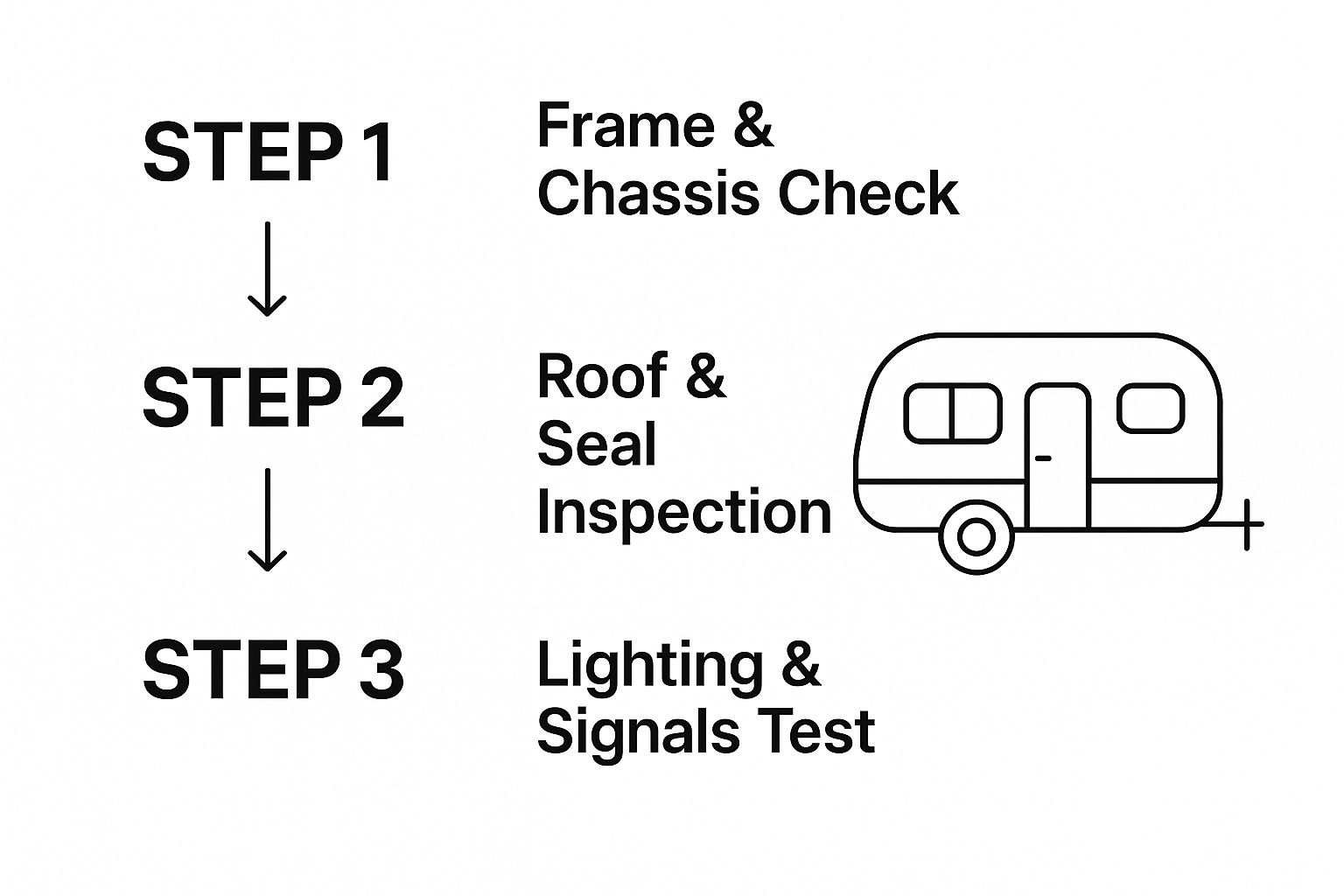
Starting with the frame and roof gives you a baseline for the trailer's structural health before you even think about stepping inside.
Water is the arch-nemesis of every RV. It silently rots wood, causes the walls to bubble up (delamination), and fosters mold growth that can be a serious health risk. Uncovering any sign of a leak, past or present, is your number one priority. The repairs can be brutally expensive, often running into the thousands to fix properly.
Begin your search on the exterior. Look for any tell-tale signs of delamination, which looks like bubbles or waves in the outer fiberglass skin. Go ahead and press firmly on the walls; they should feel solid. Any soft spots are a massive red flag.
Once inside, trust your nose first. Does it have a musty, damp odor? Don't just write that off as the "old camper smell." After the sniff test, it's time for your eyes and hands to take over.
- Ceilings and Corners: Scan every single inch of the ceiling. Pay extra close attention to the areas around vents, skylights, and the air conditioner. You're looking for stains, any discoloration, or wallpaper that looks rippled.
- Inside Cabinets and Closets: This is critical. Open every cabinet and closet door. Get a flashlight in there and inspect the back corners where the walls and ceiling meet. These spots are notorious hiding places for slow leaks.
- Floors: Carefully walk over every square foot of the floor. Focus on the areas directly under windows, in front of the entry door, and all around the kitchen and bathroom. Any sponginess, softness, or unusual give underfoot is a very bad sign.
A common mistake is just checking the easy-to-see spots. The most serious damage loves to hide. I always make a point to pull back the corners of the mattress to check the bed platform and look inside the storage areas under the dinette seats. Be thorough. Be suspicious.
Think of a travel trailer as a house on wheels—and all of its systems need to work for it to be more than just an expensive lawn ornament. Never just take the seller's word that "everything works." You have to see it for yourself. Insist that the seller has the trailer connected to power and water for your inspection.
If they're hesitant or say they can't, consider that a major warning. Testing these systems is absolutely non-negotiable.
Electrical: The 12V and 120V Sides
Your trailer actually has two separate electrical systems. The 12V DC system is powered by the battery and runs things like the interior lights, the water pump, and the fan for the furnace. The 120V AC system kicks in when you're plugged into an outlet (shore power) and runs the big stuff: the air conditioner, microwave, and regular wall outlets.
- Plugged In: With the trailer on shore power, crank up the A/C and let it run for a bit. Test every single wall outlet with a cheap circuit tester from any hardware store. Fire up the microwave.
- On Battery: Now, unplug the shore power cord. Do the ceiling lights still work? Can you hear the water pump kick on? If the trailer has slide-outs, test them on battery power.
A dead battery is a simple fix, but a bad power converter or inverter can be a surprisingly expensive repair. You need to know that both systems are good to go.
Plumbing and Propane
The plumbing system is another area where expensive problems can lurk. First, test the water pump. With a bit of water in the freshwater tank (ask the seller to have this ready), flip the pump switch. You should hear it whir to life, pressurize the lines, and then shut off. If it keeps cycling on and off, you've got a leak somewhere in the system.
Next, turn on every faucet—both hot and cold—and test the shower and the toilet. As the water is running, look under the sinks and around the base of the toilet for any drips. And don't forget the water heater! Make sure it works on both its electric and propane settings if it's a dual-source model.
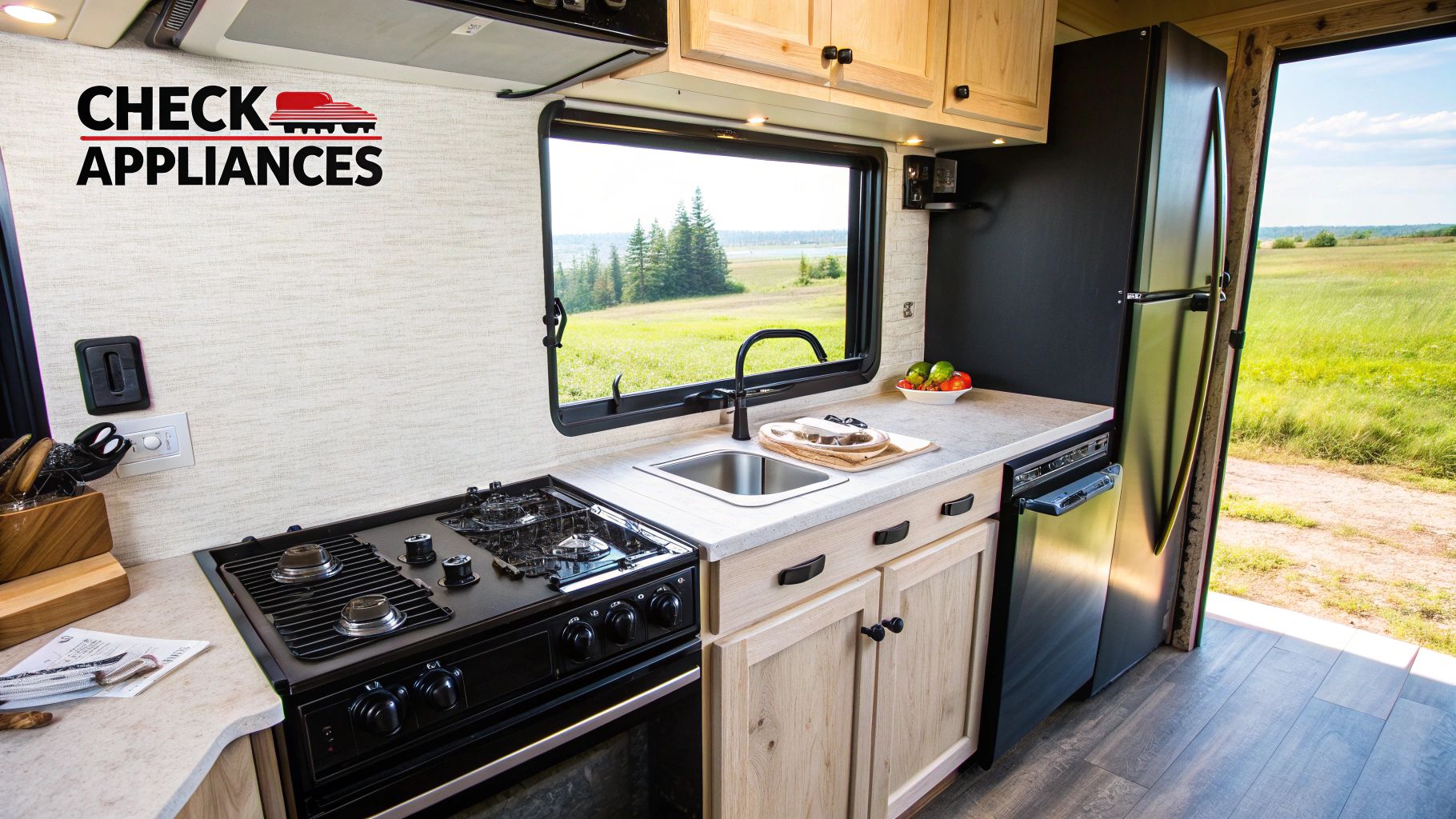
For the propane system, have the seller light all the stove burners, the oven, the furnace, and—most importantly—the refrigerator on gas mode. A fridge that won't get cold on propane can easily be a $1,500+ replacement.
What's holding it all together is just as important as what's on the inside. Your exterior check is all about structural integrity and whether it's safe to tow down the highway.
First, get down on the ground and look at the frame. You're searching for excessive rust, any cracks in the steel, or welds that look like a sloppy backyard repair job. A bent or cracked frame is an absolute deal-breaker. Period.
Next up, the tires. Find the DOT code stamped on the sidewall to check their age. Trailer tires should be replaced every five to seven years, no matter how much tread is left. Old, cracked tires are just blowouts waiting to ruin your trip.
Finally, you have to inspect the roof—one of the most commonly neglected parts of an RV.
- Roof Material: Check the rubber or fiberglass membrane for any cracks or tears.
- Sealants: The gooey sealant (called lap sealant) around every vent, skylight, and seam should be soft and pliable. If it's dried out and cracked, it's a guaranteed leak point.
- Soft Spots: If the manufacturer says it’s a walkable roof, carefully get up there. Tread lightly and feel for any soft spots underfoot. That means water has gotten in and the underlying wood is rotting.
This deep-dive inspection might feel like a lot, but trust me, an hour of being meticulous now can save you from years of headaches and thousands of dollars in repairs later. It gives you the power to either walk away from a lemon or confidently negotiate a fair price based on what the trailer is really worth.
Alright, you’ve got your budget figured out and a solid idea of what you need. Now for the fun part: the hunt. Knowing where to look and, more importantly, how to figure out what a travel trailer is actually worth is what separates a smart buyer from someone who gets taken for a ride.
The market right now is fascinating. While new RV sales have cooled off a bit, the private market for used trailers has absolutely exploded. We're talking a staggering 111% jump in private used RV sales year-over-year through April 2025. This tells us a couple of things: people are hungry for affordable adventures, and the good deals get snatched up fast. You can dig deeper into these RV market trends on Bishs.com.
To find that perfect rig, you’ll want to cast a wide net. Each place you look has its own set of pros and cons, so don't put all your eggs in one basket.
-
Private Sellers: This is where you'll often find the best prices. I'm talking about places like Facebook Marketplace, RV Trader, and even Craigslist. You get to talk directly to the owner, hear the trailer's life story, and avoid dealer fees. The trade-off? It's all on you. There's no warranty, and you're 100% responsible for a thorough inspection.
-
Dealerships: Going to a dealer offers a safety net. Their used trailers are usually inspected, cleaned up, and sometimes even come with a short-term warranty. That peace of mind costs more, though. Expect higher prices and a more formal, less flexible sales process.
-
Consignment Lots: Think of these as the middle ground. The owner is still a private individual, but they're paying a lot to display and sell the RV for them. This can give you some of the security of a dealership setting but with prices that are often closer to a private sale.
This is where your homework really pays off. Never, ever take the asking price at face value. Your goal is to make an offer grounded in reality, based on the trailer's age, its condition, and what the market is doing right now.
Pro Tip: Try not to fall in love with the first trailer you see. Emotion is the enemy of a good negotiation. I always tell people to have a couple of backup options in mind. It keeps you objective and gives you the confidence to walk away if the deal isn't right.
So, how do you pin down a fair price?
-
Find the "Comps": Before you even go see a trailer, find at least three to five other listings for the exact same year, make, and model. Use the same sites you're searching on. Pay attention to their asking price, condition described, and how long they've been for sale. This gives you a real-time snapshot of the market.
-
Consult NADAguides: The NADAguides for RVs is the bible for valuation. It's what banks and insurance companies use, so you know it's legit. Look up the "low retail" and "average retail" values. A trailer needing work might be closer to low retail, while a pristine one from a dealer will be at average retail. A fair private-party price should fall somewhere in between.
-
Consider Timing and Location: The RV market is seasonal. You'll almost always find better deals in the late fall and winter than you will in the spring rush. Where you live matters, too—prices can swing quite a bit from one region to another, so keep your "comp" search local.
When you bring all this together, you're not just kicking tires—you're building a case. Walking into a negotiation able to say, "I've seen three similar models listed for an average of X, and NADA puts the value right around Y," gives you incredible leverage. This prep work is what turns a decent find into a fantastic deal.
Alright, you've done the hard part. You’ve crawled underneath, poked around in every cabinet, tested the systems, and decided this is the travel trailer for you. Now we get to the part that makes most people sweat: talking money.
But here's the secret: a little prep work here can literally save you thousands of dollars. Approaching this stage with confidence starts long before you ever mention a number to the seller.
The single most powerful move you can make is getting pre-approved for financing before you negotiate. Seriously. Walking into a dealership or a private seller’s driveway with your own loan already lined up completely changes the dynamic. It puts you in the driver's seat.
Getting pre-approved proves you're a serious, qualified buyer. At a dealership, this is especially crucial because their business model often involves making money on the financing they arrange for you. By securing your own, you sidestep that whole game and lock in a rate and term that works for you, not for their bottom line.
Here are the best places to look for an RV loan:
- Credit Unions: I always tell people to start here. Because they're member-owned, credit unions consistently offer some of the best interest rates and most favorable terms you’ll find for recreational vehicle loans.
- Specialized RV Lenders: Don't overlook companies that only do RV financing. They live and breathe this stuff and can sometimes be more flexible than a traditional bank, especially if you're looking at an older or more unique trailer.
- Online Lenders: The big advantage here is speed. Many online platforms have a streamlined application and can give you a decision in minutes, which is great when you find a trailer you want to move on quickly.
When you have that pre-approval letter, you're no longer just a window shopper. You’re a buyer, ready to sign. That's a powerful position to be in when the price talk begins.
Negotiating isn't about being aggressive or trying to win a fight. It’s about building a clear, logical case for the price you’re offering. And that detailed inspection you just did? That's your ammunition. Every single issue you noted, from the worn-out tires to that cracked vent cover, is a legitimate talking point.
Your first offer should always be less than what you’re ultimately willing to pay, but it has to be grounded in reality. Don't just throw out a low number; you'll lose credibility. Instead, you calmly and respectfully walk them through what you found.
I’ve had a lot of success opening the conversation with something like this: "I really like the trailer, and I think your asking price is a fair place to start. While I was looking it over, I did spot a few things that will need some money and time, like the four-year-old tires and the cracking sealant on the roof. I've had to factor those upcoming costs into my offer."
See how that works? It’s not confrontational. You're not attacking their price; you're just explaining the real-world math behind your own number. It’s a lot harder for a seller to argue with a repair estimate than a number that seems pulled out of thin air.
Here’s a simple framework for the conversation:
- Reference Your Research: Start by mentioning the market. "I've been watching the market, and similar trailers in this condition are listed between $X and $Y, so that's the ballpark I'm working in."
- Itemize the Issues: Get specific about the repair costs. "The water heater is only firing up on electric, and a new gas valve assembly runs about $150. The tires will also have to be replaced right away for safety, and that's going to be around $600."
- Make Your Offer: Present your number as the logical conclusion. Be polite, be firm, and be ready for a counteroffer.
This strategy is the same whether you're talking to a private seller who loves their trailer or a dealership salesperson who does this ten times a day. Your documentation, your research, and your calm demeanor are your best tools.
And remember, you always have to be willing to walk away if you can't agree on a price that truly reflects the trailer’s value and condition. Sometimes the best deal you’ll ever make is the one you don’t.
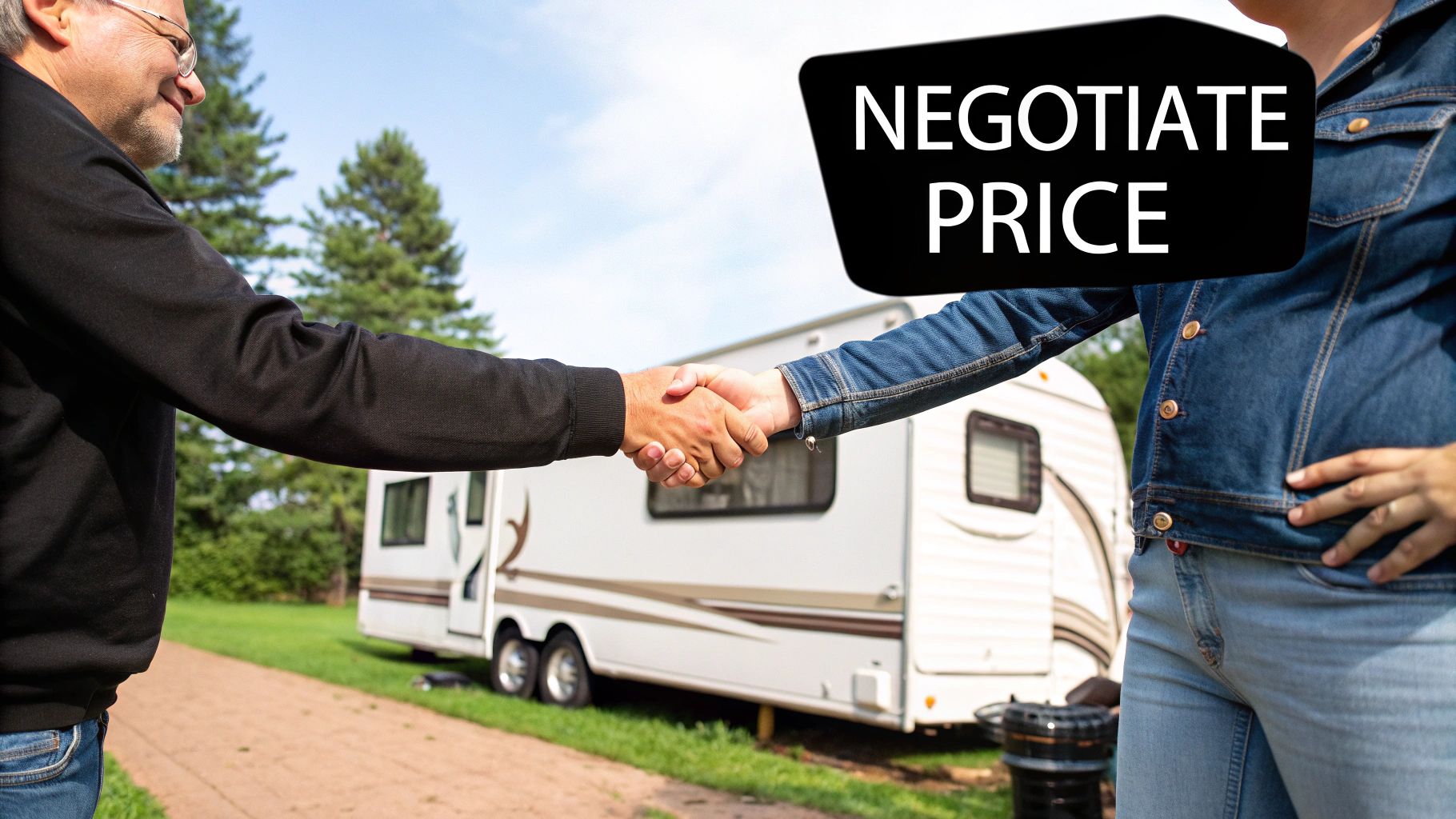
You’ve navigated the inspections, hammered out a great price, and shaken hands on the deal—congratulations! The temptation to just hitch up and head for the nearest campground is real, but hold on. This final stage is all about protecting yourself and making sure the ownership transfer is clean and legal. A little bit of diligence now can save you from a world of hurt later.
This last step isn't just a formality; it's about locking in the value of your new-to-you rig. Believe it or not, the used travel trailer market is holding strong. Even with more new RVs out there, the average selling price for used towables has actually gone up by about 6.2% year-over-year, sitting around $18,770. This just goes to show how much demand there is. With that much money on the line, you need to be sure your purchase is buttoned up and properly documented. You can actually dig into some of the current used RV market dynamics and what they mean for buyers to see why this is so important.
Getting the paperwork right is, without a doubt, the most critical part of this entire process. Do not let a single dollar leave your hand until you have the title and a bill of sale sorted out. These two documents are absolutely non-negotiable.
-
The Vehicle Title: This is the golden ticket—the legal proof of ownership. You need to scrutinize this document. The Vehicle Identification Number (VIN) on the title must be an exact match to the VIN stamped on the travel trailer’s frame. Double-check that the seller's name is the one listed as the owner. Critically, look for any mention of a lien. If there's a lienholder listed, the seller has to give you an official lien release letter from their bank. Without it, you can't legally take ownership.
-
A Bill of Sale: Think of this as your official receipt and contract. It should clearly lay out the date, the final purchase price, the VIN, and the trailer's year, make, and model. It also needs the full legal names and signatures of both you and the seller. A well-written bill of sale will also include a clause stating the trailer is being sold "as-is," which protects everyone from potential disputes down the road.
A classic mistake I see people make is getting sloppy with the title transfer. Never, ever accept a title that isn't properly signed over by the person whose name is on the front. An "open title," where the seller's signature line is left blank, is a massive red flag. It can create a bureaucratic nightmare for you at the DMV.
A "clean" title is exactly what it sounds like—it means the trailer has never been declared a total loss by an insurance company and branded as "salvage" or "rebuilt." A branded title can absolutely tank the trailer's value and can make getting it insured a serious challenge.
Thankfully, checking this is pretty easy. Most state DMVs offer online VIN check services. For a small fee, you can pull a full vehicle history report that will call out any title brands, past insurance claims, or even odometer issues. It’s a tiny investment for some serious peace of mind.
Before you even think about backing your truck up to that trailer, you need to have it insured. It's as simple as calling your insurance agent with the VIN and getting a policy activated before you drive off. Towing an uninsured trailer is a huge legal and financial gamble you just don't want to take.
Finally, when you show up to hand over the cash and pick up your new rig, do one last walkthrough with the seller. This is your chance to confirm that everything is in the exact same condition as it was when you agreed on the price. Flick on the lights, test the water pump, check the fridge. This simple final check prevents any last-minute surprises and makes sure your new life on the road starts off on the right foot.
So, you've done the research, crunched the numbers, and inspected a few potential travel trailers. It's totally normal to still have some nagging questions bouncing around in your head. Getting these last few details sorted out is what separates a confident purchase from a regretful one.
Think of this as the final check-in before you make an offer. We’ll cover the most common uncertainties that buyers face, from the real cost of ownership to knowing if a professional inspection is truly worth it.
The sticker price is never the final price. I’ve seen countless first-time buyers get blindsided by the immediate expenses that come after the handshake. Don’t let that be you.
Right off the bat, you'll have taxes and registration. But the real surprise is the "startup kit" you'll need to buy. Most sellers take their essential gear with them to their next rig, so you'll be starting from scratch.
- Hookup Essentials: You can't go anywhere without the basics. A quality drinking water hose, a full sewer kit, a water pressure regulator, and a set of leveling blocks are non-negotiable. Budget $200-$300 just for this stuff.
- Safety First: Don't even think about skipping this. Plan on a new fire extinguisher and fresh smoke/CO detectors. A good tire pressure monitoring system (TPMS) is another must-have that can litera