Right now, in September 2025, you’ll find most boat and RV loan interest rates sitting somewhere between 7% and 10% APR.
That’s a pretty wide range, though. If your credit is rock-solid, you could snag a rate as low as 6.95%. On the other hand, if your financial picture is a bit more complicated, you might see rates that climb higher.
Trying to pin down a single "average" loan rate for a recreational vehicle is a bit like trying to name the "average" price of a house—it just doesn't work that way. The real number depends entirely on the specifics.
Think of it as a spectrum. Your personal credit history, the length of the loan you want, and whether you're buying a shiny new model or a tried-and-true used one all push your rate one way or the other. Getting a handle on these moving parts is the first step to making a smart financing decision.
The interest rate is simply the cost of borrowing money. A lower rate means a lower monthly payment and, more importantly, a lower total cost over the life of your loan. We're talking about saving hundreds, or even thousands, of dollars.
To give you a real-world example, let's look at the numbers from a major lender. As of September 2025, a lender like Navy Federal Credit Union offers rates for new boats and RVs starting as low as 6.95% APR for short-term loans (up to 36 months). For longer terms, that rate might go up to around 8.95% APR.
If you're looking at a used model, expect slightly higher rates. They start around 7.45% APR and can go up to 9.90% APR for loan terms stretching out to 180 months. You can dive deeper into these current boat loan rates to see how the terms affect the final number.
Out of all the factors, your credit score carries the most weight. Lenders see it as a snapshot of your reliability as a borrower. A great score tells them you're a low-risk customer, and they'll reward you with their best rates.
To help you get a sense of where you might land, here's a breakdown of estimated rates for a new boat or RV loan based on different credit score tiers.
Estimated Average Boat Loan Interest Rates by Credit Score
| Credit Score Tier |
Score Range |
Estimated APR Range (New Vehicle) |
| Excellent |
781-850 |
7.00% - 8.50% |
| Good |
661-780 |
8.00% - 10.00% |
| Fair |
601-660 |
9.50% - 13.00% |
| Poor |
Below 600 |
12.00% - 18.00%+ |
Keep in mind, these are just estimates. But they give you a realistic starting point and show just how much your credit score can impact what you'll pay.
Think of a boat or RV loan interest rate as the price tag for borrowing money. Lenders don't just pull this number out of a hat; it’s a carefully calculated figure based on how risky they think you are as a borrower. The less risk they see, the better the rate you're going to get. Simple as that.
It's a formula with a few key ingredients. Once you understand what they are, you can start to see where you have control and how to position yourself as the kind of low-risk applicant every lender wants to see.
Let's be clear: your credit score is the single most important factor. Lenders view it as a direct report card on your financial reliability. A high score—anything above 780 is fantastic—tells them you have a solid history of paying your bills on time, making you an ideal candidate.
On the flip side, a lower score signals a higher risk that you might not pay the loan back. To protect themselves, lenders will charge you a higher interest rate to compensate for that extra risk. Over the life of a loan, that difference can add up to thousands of dollars.
The infographic below really puts the key factors into perspective, with your credit score sitting right at the top of the list that lenders look at.
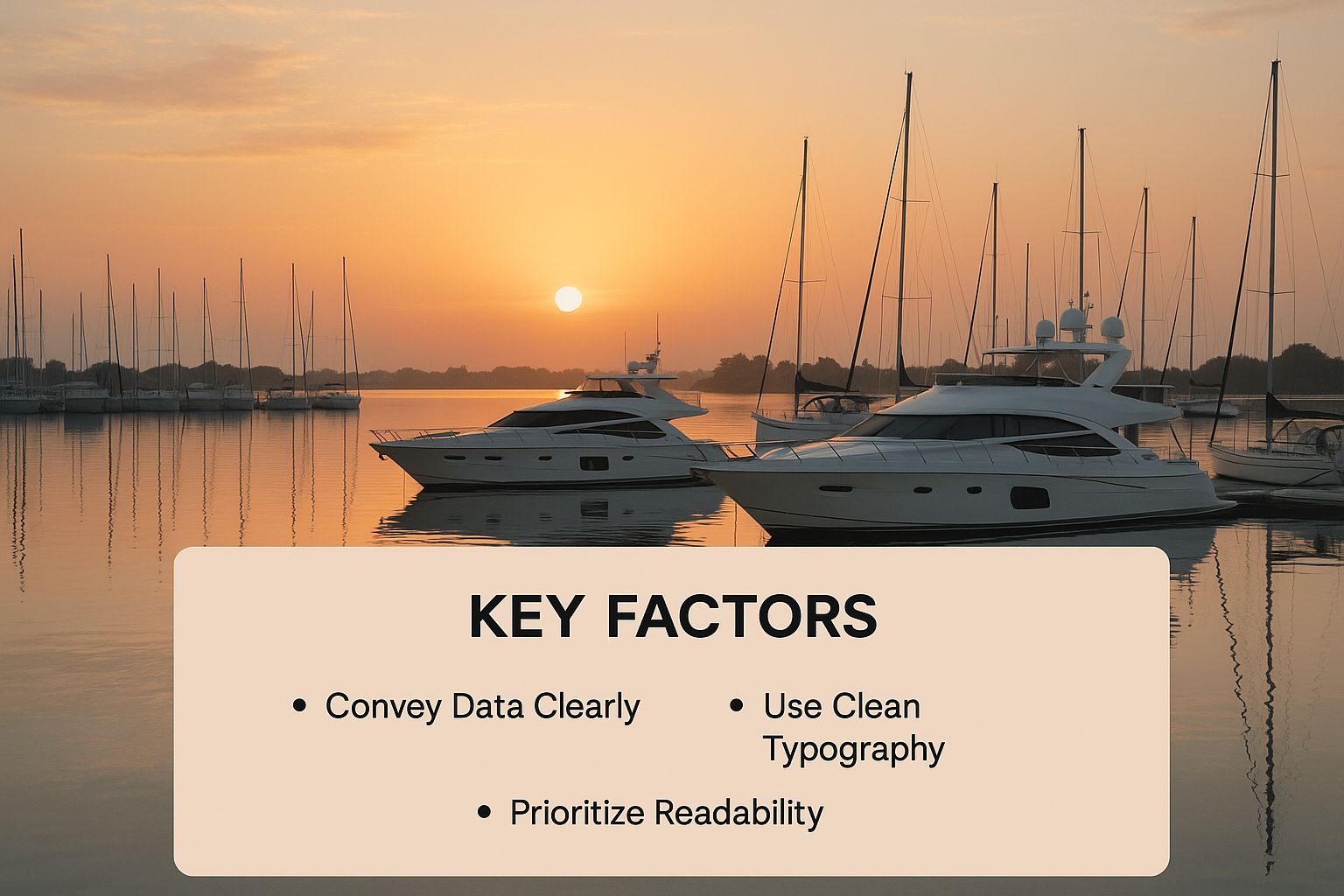
As you can see, while your credit score is the foundation, it doesn't work alone. It's part of a bigger picture that includes your down payment and loan term, all of which come together to shape your final offer.
Your down payment is your upfront investment in the vehicle, and believe me, lenders love to see it. A healthy down payment—the sweet spot is typically 10% to 20% of the purchase price—does two very important things for your application.
First, it shrinks the amount of money you need to borrow. A smaller loan means less potential loss for the lender if things go south, which immediately makes you a safer bet in their eyes.
Second, putting a good chunk of cash down shows you're financially stable and serious about the purchase. It proves you’ve got savings and you're committed, which builds a ton of trust and often unlocks a better interest rate.
Think of it this way: The more of your own money you put into the deal, the less risk the bank has to take on. When you share the risk, they'll almost always reward you with a better rate.
How long you take to pay back the loan and how much you borrow also have a big impact on the average boat loan interest rates you'll be offered.
- Loan Term: This is simply the length of your loan. Shorter terms, like 3-5 years, mean higher monthly payments, but you'll often snag a lower interest rate. Why? The lender gets their money back faster, reducing their long-term risk. Longer terms of 15-20 years give you a more manageable monthly payment but usually come with slightly higher rates to account for that extended risk.
- Loan Amount: The size of the loan matters, too. Financing a massive yacht or a luxury Class A motorhome is different from financing a small personal watercraft or a pop-up camper. Some lenders actually give better rates for larger loans because they're more profitable, while others might see them as a bigger liability.
Finally, the boat or RV itself is a huge piece of the puzzle. It’s the collateral for the loan, which means if you stop making payments, the lender can take it back and sell it to recoup their money. Because of this, they care a lot about its value.
A brand-new vehicle from a well-known builder holds its value better and is seen as a low-risk asset. This is precisely why loans for new boats and RVs almost always have lower interest rates.
An older, used model, on the other hand, comes with more unknowns. It could have hidden mechanical problems or lose its value more quickly, making it riskier collateral for the lender. To balance that risk, you can expect to see higher interest rates on financing for used vehicles.
When you’re shopping for a boat or RV loan, it’s easy to get drawn in by the promise of a low monthly payment stretched out over 15 or even 20 years. Lenders love to advertise these long terms because they make even a pricey vehicle seem incredibly affordable.
But here’s a little secret that seasoned owners understand: almost nobody keeps a recreational vehicle loan for its full term. Grasping this single fact can completely change how you approach financing and save you a small fortune in the process.
The marine and RV lending world has a unique quirk known as loan turnover. While the paperwork might show a loan term that spans a decade or two, the reality on the ground is completely different.
Industry data reveals something fascinating. The average boat loan is written for a term of about 15 years and 3 months. But how long do people actually keep them? The typical turnover—the time until the loan is actually paid off—is just 34 to 54 months. Most owners either sell the vehicle, refinance, or simply pay off the balance within a few short years. You can explore more about these marine lending trends to see the numbers for yourself.
This is a game-changer. It means you shouldn't just be looking at the monthly payment. Instead, the real focus should be on the total interest you'll pay during the actual time you plan to have the loan.
Let's put this into practice and see how an early payoff strategy can dramatically slash your costs.
Imagine you're financing a $50,000 boat. You get a loan with an 8% APR and a 15-year (180-month) term, which gives you a comfortable monthly payment of $477.83.
Now, let's look at how this plays out over two different timelines:
- Path A: The Full Term: If you stick with the loan for all 15 years, you'll end up paying a whopping $36,009.40 in total interest. That $50,000 boat ultimately costs you $86,009.40.
- Path B: The Early Payoff: What happens if you pay it off in just four years instead? You'd only pay $8,832.74 in interest.
By clearing the loan 11 years ahead of schedule, you save an incredible $27,176.66 in interest alone. That's the power of focusing on a faster payoff.
This simple comparison makes it crystal clear: a long loan term is really just a tool to keep your monthly payments manageable. Your real goal should be to pay it down as aggressively as your budget allows. Doing so will cut the true cost of your boat or RV and free up your cash for what really matters—fuel, gear, and enjoying your next adventure.
Your personal finances are the captain of your loan application, but they don't navigate the waters alone. The broader economy creates powerful currents that cause average boat loan interest rates to rise and fall for everyone, and it helps to understand these larger forces.
Think of the U.S. Federal Reserve as setting the main tide level. When the Fed adjusts its key interest rate, it's like adjusting the sea level for all lending. If they raise rates to cool down the economy, it becomes more expensive for banks to borrow money. They don't just absorb that cost—they pass it along to you through higher interest rates on everything, from mortgages to boat and RV loans.
Once banks have that baseline rate, which often tracks benchmarks like U.S. Treasury Notes, they start building the actual rate you'll be offered. They're not just handing over cash; they're running a business, and they have to cover their own costs.
Your final APR is the result of them layering a few key things on top of that base rate:
- Factoring in Risk: This is an extra buffer they add to cover the chance that a borrower might not be able to pay the loan back.
- Covering the Bills: They have administrative costs for managing your loan, from processing payments to staffing their call centers.
- Marketing & Outreach: It costs money to find new customers, and those expenses get baked into their lending model.
- Staying in Business: At the end of the day, a lender needs to make a profit to continue operating and offering loans.
This isn't just financial theory; you can see it in action. Over the last couple of decades, average boat loan interest rates in the U.S. have generally floated between 6% and 11%, moving up and down with these economic tides.
Take 2008, for example. Even with the Fed's main rate being low, boat loans were more closely linked to the 5-Year Treasury Note. This resulted in rates hovering around 8.5% APR. That figure is a perfect example of how the base rate gets combined with a lender's own costs and profit margin to arrive at the number you see on your loan offer. If you're interested in the history, you can discover more insights about the Fed's influence on boat loans.
This is exactly why timing your purchase can make a real difference. When you're shopping for a boat or RV during a period of low national interest rates, you're stepping into a more competitive lending market, which can give you a much better shot at locking in a great deal.
Knowing what shapes average boat loan interest rates is half the battle. The other half—the part that saves you real money—is putting that knowledge into action. It’s time to move from theory to practice. With the right strategy, you can walk into any negotiation feeling confident and prepared to get the best financing deal possible.
This isn’t about just hoping for a good rate; it’s about actively creating one. By taking a few key steps before you even start looking at boats or RVs, you put yourself in control. Think of this as your game plan for polishing your application, shoring up your finances, and approaching lenders from a position of strength.
Long before you start dreaming about which vehicle to buy, the most important work begins with your finances. Your goal here is simple: make yourself look like the most reliable, low-risk borrower a lender has ever seen.
Start with your credit score. Pull your credit reports and comb through them for any errors. If you have high-balance credit cards, work on paying them down to lower your credit utilization ratio. Most importantly, make sure every single bill is paid on time in the months leading up to your application. Even a small jump in your credit score can mean a lower interest rate, which can add up to thousands in savings over the years.
Next up is your down payment. Lenders love to see that you have some skin in the game.
A down payment of 10% to 20% is the industry standard for a reason. It signals to lenders that you're financially stable and serious about the purchase, which reduces their risk and often gets you a better APR and more favorable terms.
Once your finances are in shipshape, it's time to see what lenders are offering. One of the biggest mistakes you can make is accepting the first loan offer you get. The lending world is competitive, so use that to your advantage by checking out a few different places.
- Banks and Credit Unions: Your own bank or a local credit union is a great first stop. They already know your financial history and often reward loyal customers with great rates, especially if you have a solid credit profile.
- Marine & RV Lenders: Don't forget about companies that specialize in financing recreational vehicles. They live and breathe this stuff, so they often have more flexible terms that are built specifically for assets like boats and RVs.
- Online Lenders: Digital lenders can be a fantastic resource for getting quick quotes. You can easily compare multiple offers from your couch, giving you a clear picture of the best rates available to you.
If you take only one piece of advice from this guide, let it be this: get pre-approved. A pre-approval letter is more than just a rate quote; it's a lender’s commitment to give you a certain amount of money at a specific rate, pending a final review.
Getting pre-approved fundamentally changes your position at the dealership. You're no longer just someone asking for a loan—you're a cash buyer ready to close a deal. It sets a firm budget so you don't get tempted to overspend, and it gives you immense negotiating power. With financing already locked in, you can focus all your energy on getting the best possible price for the vehicle itself.
As you get closer to pulling the trigger, a few last-minute questions are bound to surface. Let's be honest, the world of recreational vehicle financing has its own unique currents, and knowing how to navigate them is the key to a smooth journey. We've rounded up some of the most common questions we hear to give you clear, no-nonsense answers.
Think of this as your final pre-launch checklist. These insights tackle the typical hang-ups and will help you approach the financing process like a seasoned pro, making sure there are no surprises once you're underway.
The short answer is yes, it's definitely possible to get a boat or RV loan even if your credit has seen better days. But you should expect a few trade-offs. Lenders will view you as a higher-risk borrower, which almost always translates into a significantly higher interest rate than what's offered to someone with excellent credit.
To offset their risk, they'll likely ask for a larger down payment—think 20% or more—and might stick to shorter loan terms. Your best move is to seek out specialized lenders who are comfortable working with these profiles. You can also make your application much stronger by showing proof of a stable income or by bringing in a co-signer who has a solid credit history.
This isn't a one-size-fits-all answer; each path has its own perks. Going through the dealer is undeniably convenient. They handle all the paperwork and often have relationships with a network of marine and RV lenders, which can sometimes unlock special promotional rates you wouldn't find on your own.
On the other hand, walking into the dealership with a pre-approval from your own bank or credit union is a major power move. It gives you a concrete interest rate to work with and essentially turns you into a "cash buyer" in their eyes, giving you more negotiating leverage.
Here's the smartest strategy: Do both. Get a pre-approval from your bank first. Then, let the dealer see if they can beat that offer. This approach forces you to compare real, concrete numbers, ensuring you're making a decision that's truly best for your wallet.
Absolutely. Remember, the boat or RV itself is the collateral for the loan, so lenders look very closely at its value, age, and overall condition. A brand-new vehicle from a reputable manufacturer is considered a lower risk because its future resale value is much easier to predict. Because of this, new boats and RVs almost always secure lower average boat loan interest rates.
An older, used model brings more unknowns into the equation for a lender. Its mechanical condition is less certain and its value might drop more quickly, making it riskier collateral. That increased risk is passed directly on to you in the form of higher interest rates.
In some cases, yes! If your boat or RV has a galley (a kitchen), a head (a bathroom), and sleeping quarters, the IRS might let you classify it as a second home. This is a huge potential benefit, as it means you could deduct the interest you pay on your loan, just like you would with a home mortgage.
Be warned, though—the rules are very specific, and there are often limitations on the loan amount that qualifies. It is absolutely essential to talk to a tax professional. They can look at your personal financial situation and confirm if your boat, RV, and loan meet all the requirements for this valuable deduction.
Ready to find your next adventure on the water or the open road? At SearchShop.com, we simplify the buying process. Use our powerful tools to research pricing, compare thousands of listings, and find the perfect boat or RV with total transparency. Start your search today on SearchShop.com and make your dream a reality.