Picking out an RV trailer can feel like navigating a maze. You’ve got everything from tiny teardrops that barely fit a bed to colossal fifth wheels that look like small apartments on wheels. It’s easy to get lost in the options, but one rule stands above all others: your trailer has to be the right dance partner for your tow vehicle. A trailer that’s too heavy or too long for your truck or SUV isn't just a hassle—it's a serious safety hazard on the road.
Kicking off the hunt for your ideal camper really starts with understanding the world of RV trailer sizes. This single decision ripples through your entire experience, affecting everything from how comfortable you are inside to where you can park for the night. Think of it as the foundation upon which all your future adventures will be built, whether on land or leading you to the water's edge.
Don't worry, we're here to cut through the jargon. This guide will give you a clear roadmap for decoding critical terms like GVWR (Gross Vehicle Weight Rating) and tongue weight. We’ll also walk through the main trailer categories, giving you the confidence to pick the one that truly fits your travel style.
Before you even think about falling in love with a shiny new trailer’s floor plan, you absolutely have to know your tow vehicle's limits. This is true whether you're shopping for an RV or a boat trailer. Trying to pull too much weight isn't just tough on your engine and transmission; it’s a recipe for disaster. It can lead to brake failure, dangerous swaying, and a complete loss of control.
The golden rule of shopping for any towable is simple: your tow vehicle dictates the maximum size and weight of the trailer you can safely consider. Never try to make a trailer fit your vehicle; always choose a trailer that fits within your vehicle's capabilities.
Getting this right from the beginning ensures your search starts with a realistic set of options.
The sheer variety of RV trailers on the market today is incredible, and it’s a far cry from what was available just a few decades ago. Back in the mid-20th century, most trailers were compact little units, usually under 20 feet, designed to be pulled by the family station wagon.
Fast forward to today, and the spectrum is huge. Lengths can stretch from a nimble 12 feet to an impressive 40 feet or more. The sweet spot for a modern travel trailer usually falls somewhere in the 25- to 30-foot range. This evolution really shows how campers' expectations have grown, with a bigger demand for creature comforts like slide-outs and residential-style kitchens. You can dive deeper into these market trends and the history of travel trailers to see how far we've come.
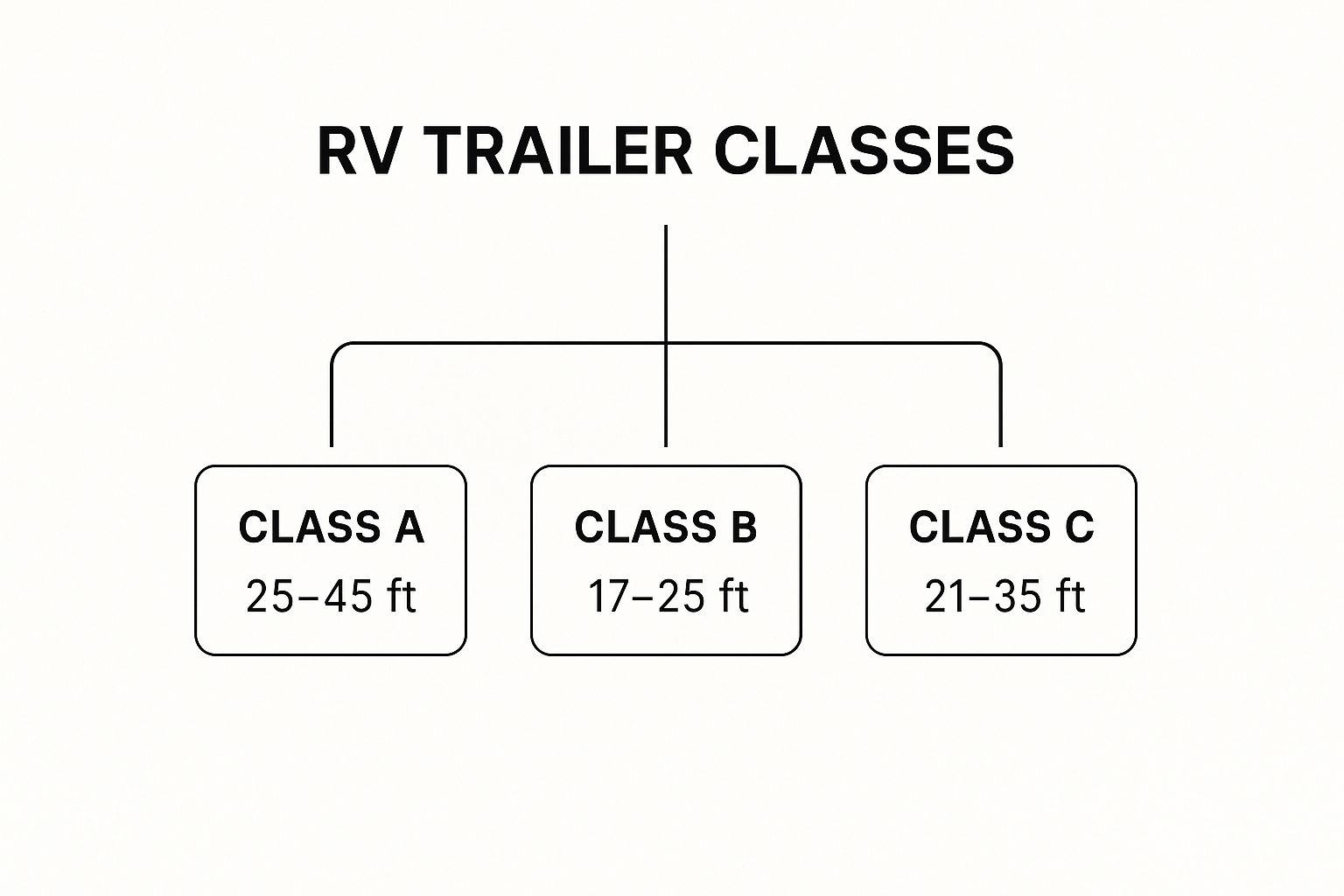
The Main Types of RV Trailers Explained
Before you can pick the right size trailer, you need to get a feel for the main categories out there. It helps to think of it like shopping for a vehicle. A camping trailer is like a minimalist tiny home, a travel trailer is your classic suburban ranch, and a fifth wheel is more like a spacious two-story. Each type offers a totally different experience when it comes to size, features, and what you need to pull it.
Let's break down the big three. Understanding these categories will help you quickly zero in on what makes the most sense for your truck, your wallet, and the kinds of trips you're dreaming of.
These are your entry-level, get-out-there-now options. You'll often hear them called pop-up campers or teardrop trailers. They’re the smallest and lightest of the bunch, usually running between 12 to 18 feet long. Their compact size makes them a breeze to tow—many SUVs and even some minivans can handle them without breaking a sweat. Once you get to the campsite, pop-ups expand upward or outward, giving you a surprising amount of room to stretch out.
The real draw here is simplicity. Their low profile means better gas mileage on the road and they’re much easier to tuck away in a garage or driveway. They're an awesome fit for solo travelers, couples, or small families who love weekend getaways and want something a step up from a tent. Just keep in mind that amenities are usually pretty basic, and they don't offer much insulation from hot or cold weather.
Travel Trailers: The Versatile Mainstay
This is, without a doubt, the most popular and varied category of towable RV on the market. Travel trailers are the bread and butter of the RV world for a reason—they come in just about every shape and size imaginable. You can find tiny 12-foot models perfect for a couple, or massive 40-foot bunkhouses that can sleep the whole crew.
This incredible versatility is why they dominate the industry. In fact, towable RVs, with travel trailers leading the charge, accounted for nearly 72.7% of the entire recreational vehicle market back in 2023. They just hit that perfect sweet spot between affordability and variety. Plus, they connect to a standard bumper hitch, making them compatible with a wide range of pickup trucks and larger SUVs. You can dig deeper into the numbers behind this dominant RV market share.
Sitting at the top of the towable food chain are fifth wheels. These are the biggest, most luxurious rigs you can pull. You can spot them instantly by the raised front section that hangs over the bed of a pickup truck. That unique gooseneck hitch provides a much more stable and secure towing experience than a bumper-pull trailer, which is a good thing considering how massive these RVs are.
Fifth wheels generally start around 30 feet and can stretch to well over 40 feet long. They are built for serious comfort on the road, often decked out with residential-sized appliances, multiple slide-outs that create huge living spaces, and tall ceilings. This makes them a top choice for full-time RVers and families taking long-haul vacations. Of course, all that luxury comes with a big requirement: you'll need a heavy-duty truck with a special hitch installed in the bed to pull one safely.
To make it easier to see how these types stack up, here’s a quick-glance table.
This table breaks down the key differences between the main trailer categories to help you quickly figure out which one might be the best starting point for your search.
| Trailer Type |
Typical Length Range |
Average Dry Weight Range |
Best For |
| Camping Trailer |
12 - 18 feet |
1,000 - 3,500 lbs |
Solo travelers, couples, and weekend campers seeking simplicity. |
| Travel Trailer |
12 - 40 feet |
3,000 - 12,000 lbs |
Almost everyone, from beginners to families, due to its huge variety. |
| Fifth Wheel |
30 - 45+ feet |
10,000 - 20,000+ lbs |
Full-time RVers and families needing maximum space and luxury. |
Seeing them side-by-side really highlights how each category serves a different kind of camper, from the minimalist adventurer to the long-term traveler.
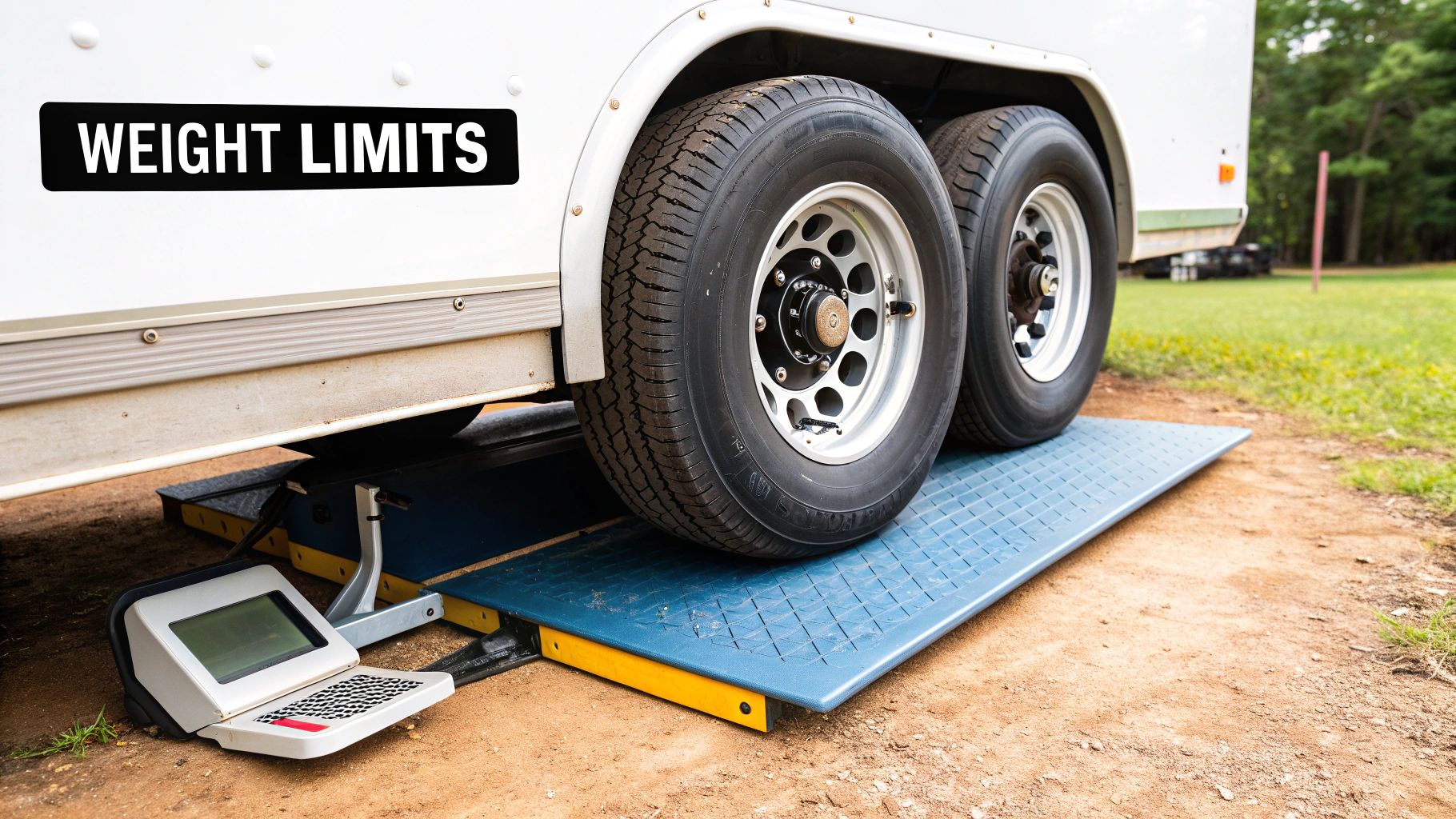
While the length of an RV trailer usually gets all the attention, it's the weight that's truly the most important factor for safe towing. Getting this wrong isn't just a minor mistake—it's a serious safety risk that can strain your tow vehicle and create dangerous situations on the road.
The good news is that understanding the key weight ratings is simpler than you might think. It's a lot like packing for a flight: the empty suitcase has a weight, the airline sets a limit for how much you can pack, and the handle puts downward pressure on your hand. RVs and boats work the same way, and getting a handle on three key terms will have you reading spec sheets like a seasoned pro.
The first number you'll almost always see is the Unloaded Vehicle Weight (UVW), which most people just call Dry Weight. This is simply the weight of the trailer as it rolled off the factory floor. It includes all the standard equipment but doesn't account for a single drop of water, any propane, or any of the gear you'll eventually load into it.
Think of this number as your starting point—the absolute minimum your trailer will ever weigh. It’s useful for making a quick comparison between different models, but it is not the number you should use to decide if your vehicle can tow it safely.
Dry weight is like knowing how much an empty moving box weighs. It's good information, but it doesn't tell you how heavy it will be once you've packed it full of books. The real-world weight will always be higher.
Realizing this is the first and most important step toward towing safely. The next number is the one that really tells you if you're within your vehicle's limits.
The Gross Vehicle Weight Rating (GVWR) is, without a doubt, the most critical number for your safety. This figure represents the absolute maximum weight the trailer is designed to handle when it's fully loaded. This includes the trailer itself, plus all your cargo—water in the tanks, propane, food, clothes, and every last piece of gear you bring along for the ride.
Your tow vehicle has its own maximum towing capacity, and you must ensure your trailer's GVWR does not exceed it. In fact, you should aim for a trailer with a GVWR that is at least 15-20% below your vehicle's max tow rating. This buffer is crucial, giving you a margin of safety for things like steep mountain grades or the reduced engine performance that happens at high altitudes.
Finally, we have Tongue Weight, sometimes called Hitch Weight. This is the downward force that the front of the trailer—the tongue—exerts on your tow vehicle's hitch. Getting the tongue weight right is absolutely essential for stable, predictable towing and preventing the terrifying experience of trailer sway.
As a solid rule of thumb, your tongue weight should be between 10% and 15% of your trailer's total loaded weight (its GVWR). For a trailer that weighs 6,000 pounds fully loaded, you'd want a tongue weight somewhere between 600 and 900 pounds.
Always check your tow vehicle's owner's manual to find its maximum tongue weight capacity. Exceeding it can overload your truck's rear suspension, lift the front wheels slightly, and make steering dangerously light. Matching all these numbers is what creates a secure, stable, and safe connection between your vehicle and your trailer.
Now that we’ve sorted through the different types of trailers and deciphered all that weight rating jargon, it’s time for the fun part: matching a trailer to your actual travel plans. Picking the right RV size isn’t just about getting the biggest rig you can afford. It’s about finding the one that genuinely fits your lifestyle, and that starts with asking some honest questions about how you see yourself hitting the road.
Think of it like buying a boat. You wouldn't buy a giant cabin cruiser for quiet afternoons on a small lake, and you wouldn't take a little fishing boat out on the open ocean. Your trailer is the same—it has to be the right tool for the adventure you have in mind.
This is the big one, the first question you have to answer, and it's a hard-and-fast rule: What can my vehicle safely tow? We talked about GVWR and Tongue Weight before, and this is where that knowledge gets put to the test. Your truck or SUV draws the line in the sand, setting the absolute maximum weight and size you can even consider.
And please, always leave yourself a safety margin. A good rule of thumb is to keep your trailer's fully loaded weight (its GVWR) at least 15% below your vehicle's max tow rating. That buffer is what gives you the confidence and control to handle steep mountain passes, unexpected crosswinds, or a sudden stop. It’s the difference between a white-knuckle drive and a relaxed, enjoyable trip.
Next up, who’s coming with you? Is it just you, you and a partner, or are you loading up the whole family for a cross-country tour? The number of people in your crew directly dictates how much living and sleeping space you’re going to need to stay sane.
- Solo or Couple: A smaller trailer under 20 feet is often the sweet spot, giving you plenty of room without feeling cavernous.
- Small Family (3-4 people): Look into mid-size trailers, somewhere in the 21 to 25-foot range. Many of these have smart layouts with bunks or a dinette that converts into a bed.
- Large Family or Group (5+ people): This is where you'll want to explore the larger travel trailers or fifth wheels over 26 feet. These often come with dedicated bunkhouse rooms and multiple sleeping areas.
Finally, where do you dream of taking this thing? The answer plays a massive role in figuring out the ideal RV trailer sizes. Trust me, not all campsites are built the same, and size restrictions are more common than you might think.
Many beautiful national and state parks, for example, have length limits that often top out around 25 to 30 feet. If your goal is to camp deep inside these natural wonders, that massive 40-foot fifth wheel might have to sit on the sidelines.
The destination dictates the dimensions. If you love those rustic, old-school campgrounds, a smaller, more nimble trailer will get you into the best spots. But if you're all about sprawling RV resorts with concrete pads and full hookups, you can easily go for a much larger rig.
It's all about finding that perfect balance between the interior space you crave and the access you need. Answering these questions before you ever step onto a dealer's lot will help you zero in on a trailer that doesn't just look good, but truly works for the adventures you have planned.
For a lot of folks just dipping their toes into the RV lifestyle, starting small is the way to go. These nimble campers, like teardrops, pop-ups, and travel trailers under 20 feet, are the perfect gateway. They offer a much less intimidating way to hit the road and their smaller size opens up a world of possibilities that the big rigs just can't touch.
The main appeal is simple: convenience. A lightweight, compact trailer often means you can use the vehicle you already own. Many can be towed by a family SUV or a mid-sized pickup, which immediately translates into better fuel economy and a far less stressful driving experience. Trust me, pulling one of these into a tight gas station is worlds apart from trying to navigate a 35-foot behemoth.
Beyond the easy towing, the real magic of smaller rv trailer sizes shines through once you’ve arrived. These trailers can wiggle into campsites that are completely off-limits to larger RVs. This is especially true in older national and state parks where the spots were designed long before modern RVs became so massive.
That access to more secluded, beautiful sites is a huge draw for anyone looking for a real adventure. The benefits don't stop there:
- Easier Navigation: Those winding mountain roads or narrow park entrances? Not nearly as nerve-wracking.
- Simpler Storage: When the trip's over, a compact trailer can often tuck away in a driveway or even a garage, saving you hundreds of dollars a year in storage fees.
- Lower Overall Costs: From the sticker price to insurance and maintenance, just about every part of owning a smaller trailer is easier on the wallet.
The whole idea behind a compact trailer is to spend more time adventuring and less time dealing with hassle. It’s a minimalist philosophy that’s all about getting out and exploring, rather than trying to bring every single comfort of home along for the ride.
Of course, going small means making some compromises. The living space is, well, compact. Storage is at a premium, so you have to be clever about what you pack. Many smaller trailers also come with a wet bath—where the shower and toilet share one small space—which can be a deal-breaker for some people.
Even with the trade-offs, the market for these smaller campers is booming. There’s a growing demand for high-tech models that mix easy mobility with a touch of luxury. All over the world, camping trailers in the 8 to 20-foot range are incredibly popular, especially with younger travelers and anyone wanting to get closer to nature without roughing it completely. You can get more details on these global trends in the camping trailer market.
In the end, choosing a compact trailer is about embracing a more agile, back-to-basics style of travel.
Diving into the world of RVs always brings up a ton of questions, especially when it comes to trailer sizes. It’s easy to get bogged down in the specs, but getting straight answers is the key to picking the right rig and avoiding costly mistakes. I've heard these questions come up time and time again, so let's tackle them head-on.
Think of this as the final check-in before you start seriously shopping. Getting these details sorted out now will make you feel a lot more confident when you're reading spec sheets, talking to dealers, and finally making a choice.
This is probably the most common mix-up I see. When you see a travel trailer advertised at a certain length, that number is almost always the total bumper-to-hitch measurement. That’s the full, end-to-end length you need to worry about for booking campsites, squeezing into a storage spot, or navigating a tight gas station.
But here’s the catch: you should always ask. Every once in a while, a listing might refer to the “box length”—just the living space—which doesn’t include the A-frame hitch or the rear bumper. For fifth wheels, the measurement is a little different; it’s usually from the rearmost point to the very front of the nose cap that hangs over your truck bed.
Always confirm if the listed length is bumper-to-hitch. This one detail can make or break your trip, since many campgrounds have strict overall length limits. A trailer listed as 25 feet might not fit in a 25-foot site if that number only reflected the living area.
This question is crucial, but the answer isn't one-size-fits-all. It comes down to your specific SUV and what the manufacturer says it can safely tow. You can find this magic number in your owner's manual or on a sticker inside the driver's side door jamb.
To give you a general idea, most SUVs fall into a couple of camps:
- Mid-size SUVs: Most of these can pull somewhere between 3,500 and 5,000 pounds. This puts you in the territory of pop-up campers and smaller, lightweight travel trailers, typically under 22 feet.
- Full-size, truck-based SUVs: These are the real workhorses, with some models rated to tow 9,000 pounds or even more. This opens up a much wider world of mid-size travel trailers.
The golden rule is to never exceed your vehicle's Gross Combined Weight Rating (GCWR). That’s the absolute maximum weight of your fully loaded SUV and your fully loaded trailer, combined. Pushing that limit isn't just a bad idea—it's a serious safety hazard.
For the overwhelming majority of RVers, the answer is a simple no. In nearly every state, your standard driver's license is all you need to tow your own RV, no matter how big it is. The rules are generally set up to make RVing accessible.
That said, there are a few exceptions. Some states might require a non-commercial special license or an endorsement if the total combined weight of your truck and trailer tips the scales over 26,000 pounds. We're talking about the biggest, heaviest fifth-wheels pulled by heavy-duty trucks here. Because regulations can vary and sometimes change, it's always a good move to check with your local DMV just to be sure.
Slide-outs are a game-changer for interior space. They can make a small trailer feel absolutely huge inside once you're parked. While they don't change how long the trailer is on the road, they do impact two other very important things: weight and width.
Even a single slide-out can tack on several hundred pounds to a trailer's dry weight. You have to account for that extra weight to make sure you're still well within your tow vehicle's limits. And, of course, when the slides are extended, they add several feet to the trailer's width, which is something you'll need to remember when you're sizing up a campsite.
Ready to find the perfect RV or boat for your next adventure? At SearchShop.com, we offer a huge selection of new and used vehicles with the tools you need to make a great choice. Use our powerful search to compare prices, read reviews, and find your match today at SearchShop.com.