If there's one golden rule in the world of motorhome towing, it's this: never, ever exceed your vehicle's weight limits. This isn't just a friendly suggestion from the manufacturer; it's a hard-and-fast law of physics that governs how your entire rig behaves on the road. Getting these numbers right is the first, and most critical, step before you even think about hitting the highway.
Before you hitch up, you have to get intimate with your vehicle's specific limitations. This goes way beyond a quick Google search for its "towing capacity." It means getting your hands dirty, finding the actual ratings on your specific truck or SUV, and truly understanding how every single piece of gear, gallon of water, and passenger impacts the total weight.
Trust me, ignoring these ratings is the most common mistake I see new towers make. It's a shortcut to terrifying situations like uncontrollable trailer sway, brake failure, or even a complete hitch separation. A safe and enjoyable trip starts with knowing your numbers, not just hoping for the best.
When you open your driver's side door, you'll see a sticker with a bunch of acronyms and weights. It might look like a foreign language at first, but this little label is the key to towing safely. Each number tells a crucial part of the story about what your setup can truly handle.
Here’s a quick rundown of the terms you absolutely need to know.
| Term |
What It Means for You |
Why It's Critical for Safety |
| GCWR (Gross Combined Weight Rating) |
The absolute maximum weight of your fully loaded tow vehicle and your fully loaded motorhome, combined. Think of it as the total weight of everything rolling down the road. |
Exceeding this puts immense stress on your engine, transmission, and brakes. It’s a recipe for overheating and catastrophic failure, especially on long grades. |
| GVWR (Gross Vehicle Weight Rating) |
The maximum your tow vehicle can weigh all by itself, including you, your passengers, fuel, and all your cargo. |
Overloading your truck or SUV compromises its suspension and braking. It becomes unstable and unsafe before you even attach the motorhome. |
| Towing Capacity |
The maximum trailer weight your vehicle's manufacturer says it can pull. |
This is a good starting point, but it's often a "best-case scenario" number that doesn't account for passengers or cargo in your tow vehicle. It's not the whole story. |
| Tongue Weight |
The downward force the motorhome's tongue pushes onto your vehicle's hitch. |
Getting this right (typically 10-15% of the total trailer weight) is the single most important factor in preventing dangerous trailer sway. |
Think of these numbers as the safety foundation for your entire journey.
Let's walk through a real-world scenario. A family is getting their Class C motorhome ready for a big trip. Their truck's spec sheet says it has a towing capacity of 12,000 pounds, and the motorhome's "dry weight" (empty) is 9,500 pounds. Seems like they have plenty of wiggle room, right?
Not so fast. After they load up with camping gear, food for a week, a full tank of fresh water, and get four people into the truck, the situation changes dramatically. A quick trip to a CAT scale reveals the truth: their motorhome now weighs 11,200 pounds, and their truck is carrying an extra 800 pounds of people and supplies. Their combined weight is now pushing the absolute limit of the truck's GCWR, leaving zero margin for safety.
By actually weighing their setup, they made an informed decision to leave some heavier, non-essential items behind. This simple act of verifying their real weight, rather than just trusting the brochure numbers, is what separates a safe, relaxing journey from a stressful and dangerous one.
This kind of proactive safety check is more important than ever. The appeal of life on the road is exploding; the global motorhome market, valued at USD 36.75 billion, is projected to more than double. You can learn more about the factors driving motorhome sales and what it means for the industry. This boom means our highways are getting more crowded, making it essential for every RVer to master these foundational safety principles.
The physical connection between your tow vehicle and motorhome is, without a doubt, the most critical hardware decision you'll make. This isn't just about grabbing a hitch that fits. It's about creating a single, unified system that moves as one on the road. Believe me, skimping on your towing setup or picking the wrong gear is a recipe for disaster.
Your first decision point is the hitch itself. For a small travel trailer, you might get by with a standard receiver hitch and a simple ball mount. But when you’re talking about the serious weight of a Class A or Class C motorhome, you need to think bigger. You need a more robust solution that gives you rock-solid stability and control.
This visual shows a common setup—an SUV towing a motorhome—and it really drives home the point about having a properly matched tow vehicle.
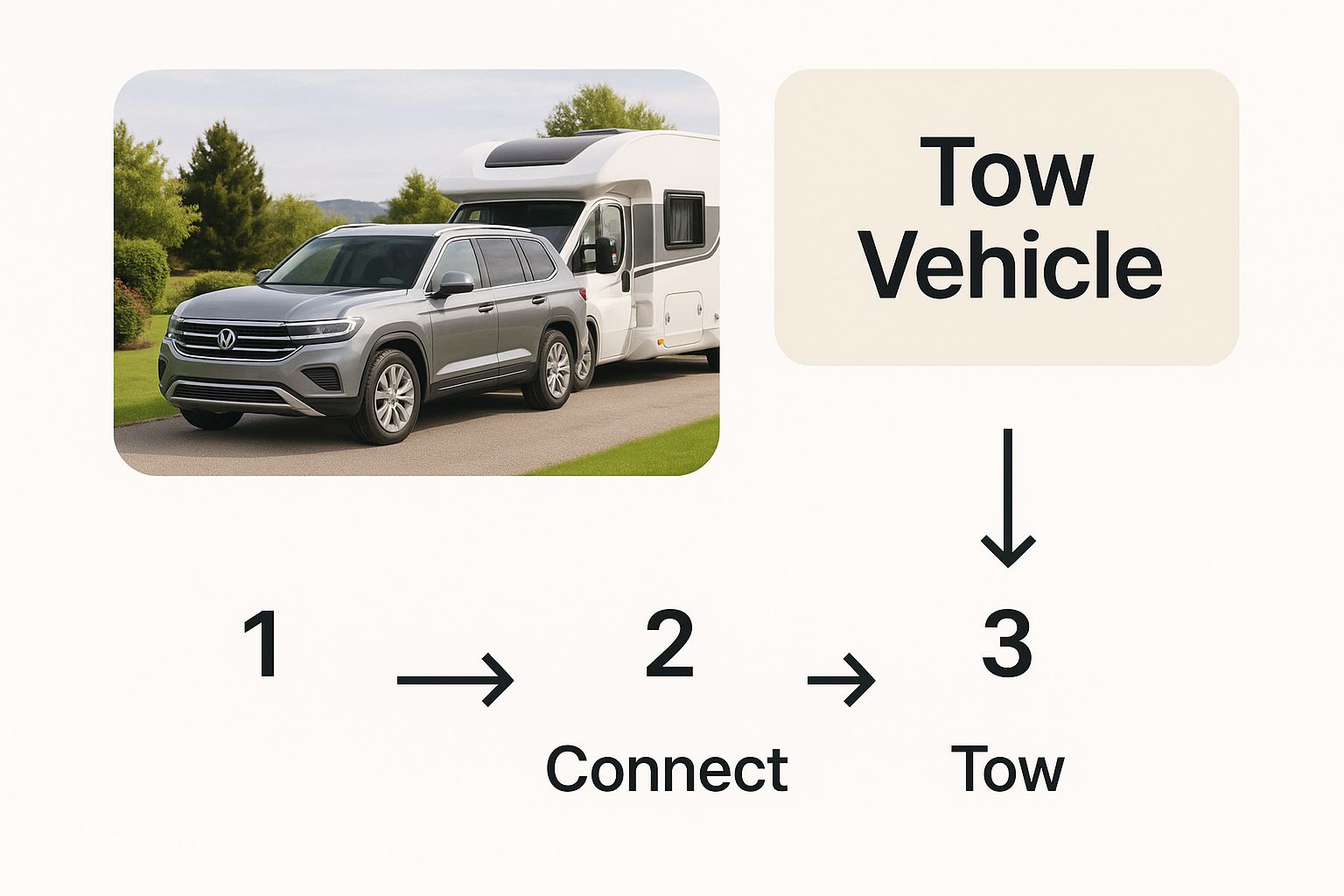
As the image illustrates, everything starts with the capabilities of your tow vehicle. Every other choice you make, from the hitch to the brake controller, flows from there.
A basic hitch dumps all of the motorhome's tongue weight straight onto your vehicle's rear axle. This pushes the back end down and lifts the front, which is a huge problem. You lose steering traction, your braking performance suffers, and the whole ride becomes an unsettling, bouncy mess. This is exactly why a weight distribution system is so essential.
This is far more than just a heavy-duty hitch; it’s an active system. It uses a set of spring bars to create leverage at the connection point. This clever engineering effectively shifts a significant portion of that tongue weight off your vehicle's rear axle and redistributes it to the front axle and the motorhome's own axles.
The difference is night and day. You get a level, planted, and stable ride.
- Without it: Your truck acts like a seesaw. The rear axle is the pivot point, getting slammed down by all that weight.
- With it: The entire rig—truck and motorhome—becomes a rigid, level platform, sharing the load evenly across every tire.
This system is your best defense against the dreaded trailer sway, that terrifying side-to-side movement that can quickly lead to losing control. If you're serious about towing a motorhome safely, a weight distribution hitch isn't an option; it's a must-have.
A properly set up weight distribution system does more than just make the ride comfortable. It restores the critical steering and braking power to your front wheels, giving you the control you need when things get hairy.
Just think about it: trying to stop thousands of extra pounds using only your truck's brakes is a losing battle. They'd overheat and fade in no time. That's precisely why virtually every state and province legally requires a supplemental braking system for towed loads over a certain weight—a threshold any motorhome will easily blow past.
This system works by applying the motorhome's own brakes right in sync with your tow vehicle. You’ve got two main types to pick from:
-
Proportional Brake Controllers: These are the gold standard, and for good reason. They use an internal sensor to detect how hard your tow vehicle is braking and apply the motorhome's brakes with proportional force. A light tap on the pedal for traffic results in gentle braking, while a panic stop triggers full braking power. The experience is smooth, intuitive, and worlds safer.
Time-Delayed Brake Controllers: These are a more basic, budget-friendly option. When you brake, they send a pre-set amount of power to the trailer brakes after a short delay. They get the job done, but the braking can feel jerky and disconnected from what your foot is doing.
For the vastly superior performance and safety it provides, a proportional brake controller is the obvious choice. It gives you the seamless, confident braking needed to handle anything from tight city streets to long mountain descents. Whether you're just starting out or a seasoned pro, checking out the properly equipped vehicles at a resource like Searchshop RV can help you find a rig that’s truly road-ready from the start.
Before you even think about putting the truck in drive, you need to walk around your rig. A safe trip starts right there in your driveway, not when you merge onto the highway. Making a pre-trip inspection part of your routine is probably the single most important habit you can develop. It’s what separates the pros from the people you see on the side of the road.
Think of it like a pilot's pre-flight check—it's not optional. This isn't just a quick look-over. It's a hands-on, methodical check of every single connection. Taking a few extra minutes here gives you the peace of mind to actually enjoy the drive.
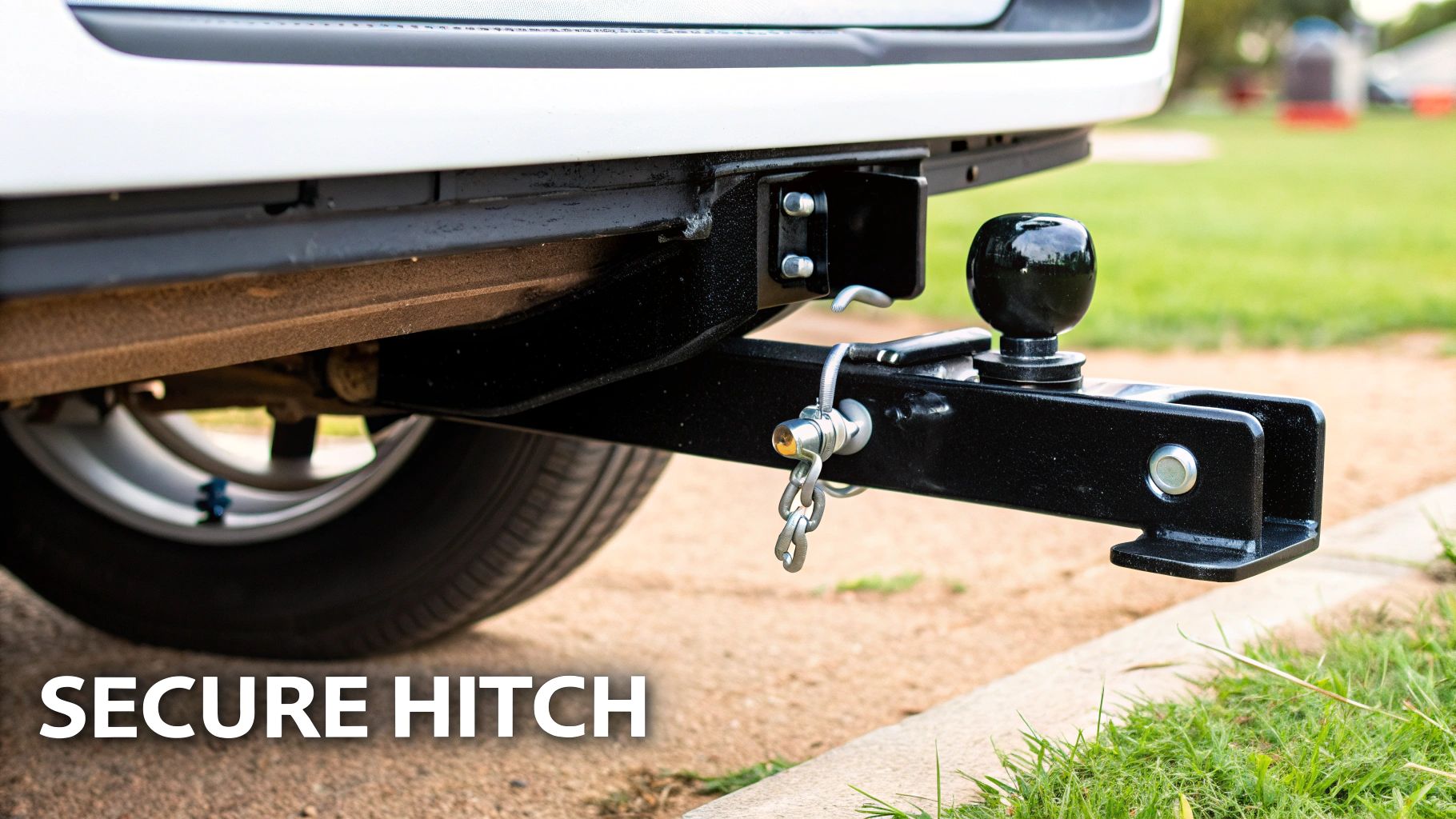
Always start your check at the hitch. This is where your truck and motorhome become one, and that connection has to be rock-solid.
- Secure the Coupler: Make sure the trailer coupler is sitting all the way down on the hitch ball. Once it's seated, lock the latching mechanism down. Then, give the tongue a good, solid yank upwards to be absolutely sure it’s not going anywhere.
- Insert the Safety Pin: Never forget this part. That little safety pin or clip is your insurance policy. It slides through the latch and physically stops it from popping open if you hit a nasty pothole.
- Cross the Safety Chains: Here's how you do it right: cross the chains underneath the hitch. The right chain goes to the left side of your truck's receiver, and the left chain goes to the right. This creates a little "X" pattern that acts like a cradle. If the worst happens and the hitch fails, that cradle will catch the tongue instead of letting it dig into the asphalt.
- Check the Breakaway Cable: This is your last line of defense. Clip the breakaway cable to your tow vehicle, but never to the hitch assembly itself. You want it attached to the frame or a dedicated loop. If the motorhome completely separates, this cable pulls a pin and slams on the trailer's brakes.
Your pre-trip check isn't just about finding problems; it's about building muscle memory. The more you do it, the faster you'll spot something that looks or feels out of place, turning a potential disaster into a simple fix.
This kind of detail-oriented approach is more important than ever. The global market for motorhomes and towable RVs is on track to hit nearly $21.88 billion, which means a lot more people are out there discovering the freedom of the road. If you're curious, you can explore more about this growing trend and what it means for the RV community.
Okay, the physical connection is solid. Now it’s time to make sure you can communicate with other drivers and that your rolling gear is ready to go.
Grab a partner for this next part—it’s much easier. With someone sitting in the driver's seat, run through all the lights.
- Running Lights: Flip them on. Do a quick walk-around to make sure you’re visible from every angle.
- Brake Lights: Have them press the brake pedal. Check that the brake lights on both your truck and the motorhome light up bright.
- Turn Signals: Test the left blinker, then the right one. Make sure they’re both working on the rig.
Last but not least, do one final walk-around and pay close attention to the tires. Get a good quality tire pressure gauge and check the pressure on every single tire—don’t forget the ones on your tow vehicle. Do this while the tires are cold for an accurate reading. Underinflated tires are one of the biggest causes of blowouts and can make handling a nightmare when you're towing a motorhome.
The moment you pull out of the driveway with a motorhome hitched up, you’ll realize it's a whole new ball game. Your vehicle is suddenly longer, much heavier, and a lot less agile. Learning to handle a rig of this size isn’t just about avoiding rookie mistakes; it's about fundamentally changing how you drive.
You have to start thinking three or four moves ahead of everyone else on the road. Forget about quick, jerky movements. Every turn, every lane change, and every stop needs to be smooth and deliberate. Gentle acceleration and gradual braking are your new best friends—they'll save your transmission, protect your brakes, and keep the whole rig stable and comfortable.
The first thing that catches most new towers by surprise is the turning radius. It’s huge. You simply can't cut corners or hug the curb on a right-hand turn anymore. You need to learn how to make wide turns, and it takes practice.
- Go deep into the intersection. Pull forward, further than you normally would, before you even begin to turn the wheel. This gives your motorhome the room it needs to swing around without hopping the curb or clipping a sign.
- Live in your mirrors. Your side mirrors are your eyes in the back of your head. As you’re turning, constantly check them to see where your motorhome's tires are tracking.
Hills are another challenge entirely. Going uphill, your engine and transmission are under a lot of strain. Don't be shy about shifting down a gear. This will bring your RPMs up, keeping the engine in its power band and preventing it from overheating.
Coming down a long, steep grade is where things get serious. If you just ride your brakes the whole way down, you risk overheating them to the point of "brake fade," where they basically stop working. Trust me, you don't want to experience that. Before you even start heading downhill, shift into a lower gear. This uses the engine's compression to slow you down, a technique called engine braking. Then, you only need to use your brakes in short, firm bursts to keep your speed under control.
Driving on the open highway brings its own set of challenges, namely wind. A strong crosswind hitting the broad side of your motorhome can feel like it's trying to push you right into the next lane. The trick is to anticipate it, slow down a bit, and keep a firm two-handed grip on the steering wheel.
Passing semi-trucks create a similar effect. As a big rig gets close, it pushes a wall of air that shoves your motorhome away. Then, as it passes, a vacuum effect sucks you back towards it. It can be a little unnerving at first.
My Go-To Tip: When I see a semi coming up behind me in my mirror, I subtly drift toward the outside line of my lane. This little bit of extra space gives me a buffer to absorb that push-pull effect without getting knocked around.
Motorhome travel is booming, and it's easy to see why. The motorhomes segment already holds an estimated 61.3% market share in the industry and is only expected to grow. For a closer look at these trends, check out this caravan and motorhome market report.
Alright, let's talk about the maneuver every new tower dreads: backing up. I have one non-negotiable rule here: always use a spotter. Before you put the vehicle in reverse, agree on a simple set of hand signals.
Position your spotter so you can see them clearly in your driver's-side mirror. They are your eyes for the blind spots you can't see. Take it slow—painfully slow. If you lose sight of your spotter for even a second, stop immediately. Clear communication and patience are what separate a stressful parking nightmare from a controlled, no-sweat maneuver.
Even the most seasoned RVer knows that things don't always go according to plan. The road can be unpredictable, and knowing how to handle a high-stress situation calmly is what separates a minor hiccup from a major disaster. It’s all about being ready for the "what-ifs."
Let's talk about trailer sway. If you've never experienced it, imagine the motorhome starting to fishtail behind you, swinging side to side. It can be terrifying, often set off by a strong gust of wind or a sudden swerve. Every instinct in your body will tell you to slam on the brakes, but that's the absolute worst thing you can do.
The right move feels completely wrong: take your foot off the gas and manually apply only the trailer brakes using the slider or button on your brake controller. This creates drag on the trailer, helping it pull itself straight again.
Resist the urge to fight the steering wheel. Just hold it as steady as possible and let the trailer brakes work their magic to bring everything back in line.
The sudden bang and lurch of a tire blowout will get your heart pounding. The most important thing is to stay calm and maintain control. Whether it’s a tire on your truck or the motorhome, grab the steering wheel with both hands and keep your rig pointed straight down your lane.
Again, don't slam on the brakes. Let the vehicle slow down on its own by easing off the accelerator. Once your speed has dropped considerably, you can start braking gently and look for a safe spot to pull over, getting as far off the road as you can.
A little preparation goes a long way. The flimsy jack that came with your truck isn't going to lift a loaded motorhome. Having the right gear on board can mean the difference between a quick fix and a trip-ending wait for a tow.
Make sure your emergency kit is up to the task.
- A high-capacity bottle jack powerful enough to handle your motorhome's weight.
- A properly sized lug wrench or a breaker bar with the right socket for both your tow vehicle and trailer wheels.
- A torque wrench is a must-have for tightening lug nuts to the correct spec.
- Roadside triangles or flares to make sure other drivers see you clearly.
- Work gloves and a small tarp or mat will make a tough job a little more comfortable.
Thinking ahead also means planning your route wisely. Before you even start the engine, use an RV-specific GPS or an app like RV LIFE Trip Wizard to scout for hazards. You can screen for low-clearance bridges, roads with weight limits, or dangerously steep grades. A few minutes of planning can save you from a very bad day.
Alright, let's wrap this up by tackling some of the questions I hear all the time from RVers. These are the real-world concerns that come up once you’re actually getting ready to hit the road, and having solid answers can save you a world of trouble.
Hands down, the most dangerous mistake I see is getting the weight distribution wrong. People overload their motorhome or, just as bad, they don't balance the cargo properly. This throws the tongue weight completely out of whack.
When that happens, you get trailer sway, and that’s the number one cause of losing control. The other huge error is just driving too fast. Remember, you’re hauling a massive amount of weight, and it takes a lot longer to stop than you think. Speed just makes every little problem, from a gust of wind to a bump in the road, ten times worse.
The secret to safe towing isn't having the biggest truck on the block. It’s respecting the physics of weight and speed. Nail your weight distribution before you even pull out of the driveway and keep your speed in check. Those two things will do more for your safety than anything else.
In pretty much every case, yes. This isn't just a "nice to have" item; it's a legal requirement in most states once your towed load hits a certain weight, sometimes as low as 1,500 pounds. Your motorhome will blow past that limit easily.
Think of a supplemental braking system as a non-negotiable piece of safety gear. It makes your motorhome's brakes work in sync with your tow vehicle's, which dramatically cuts down your stopping distance. It also stops the motorhome from shoving your vehicle forward in a hard stop—a classic cause of jackknifing. Don't even think about skipping this.
Towing is tough on your vehicle, there's no way around it. You'll see a big hit to your fuel economy first. Be prepared for your gas mileage to drop by 30-50%. That’s a real number, so you need to factor that into your travel budget and plan your fuel stops.
Beyond the pump, the added strain on your engine, transmission, and brakes means everything wears out faster. This just means you have to be extra vigilant with maintenance. You'll need more frequent oil changes, you should check your transmission fluid regularly, and get your brakes inspected often. Staying on top of maintenance is key to keeping your tow vehicle safe and reliable for the long haul.
Ready to find a motorhome that perfectly matches your towing setup? At Searchshop, we provide the tools and listings to help you make a confident choice. Start your search and find the ideal RV for your next adventure. Find your perfect RV on Searchshop