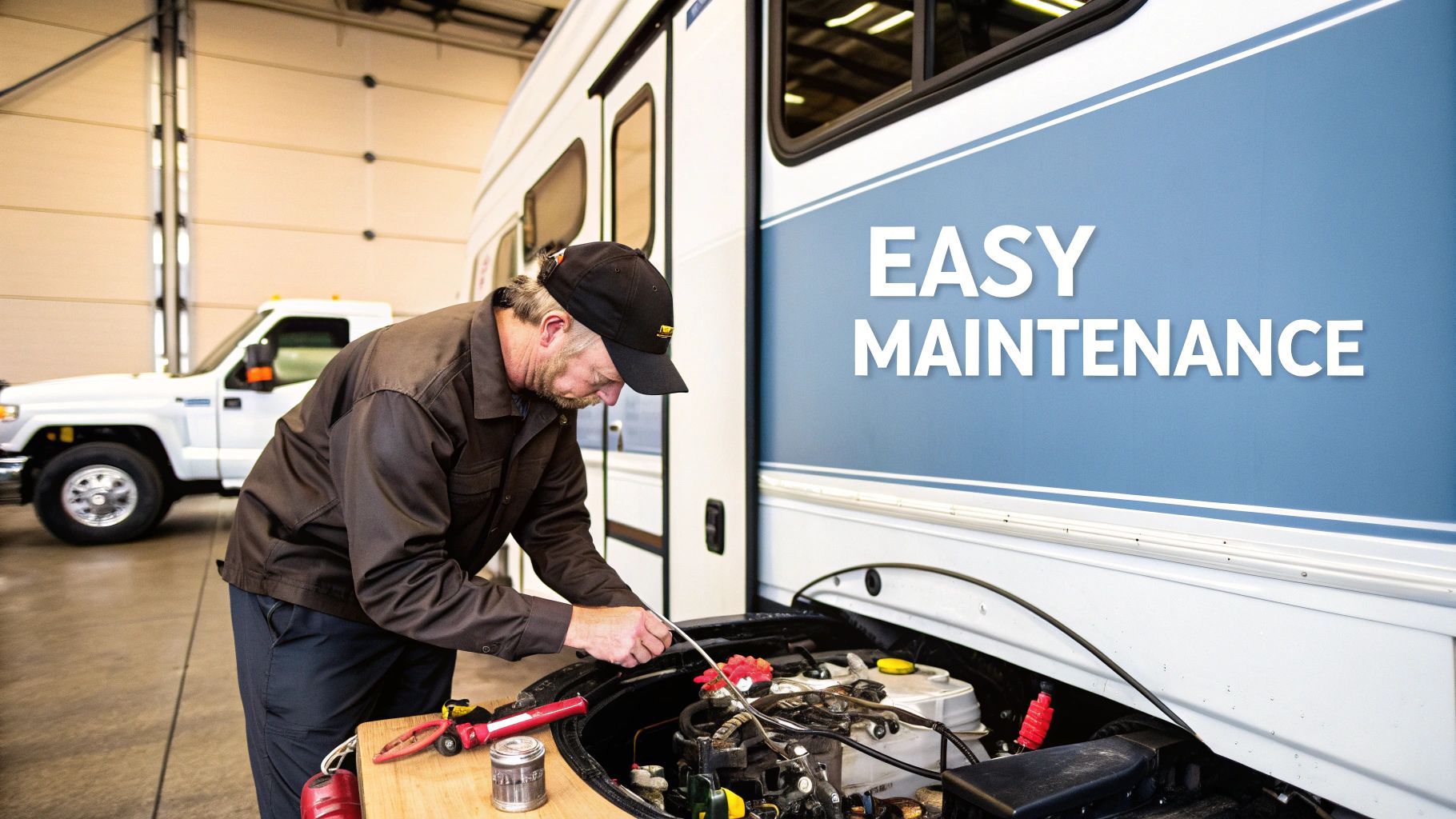
Used Motor Homes for Sale in Florida Your Buyer Guide
Buying a Used RV
Used Motor Homes for Sale in Florida Your Buyer Guide
By Searchshop Editorial Team19 min readSeptember 30, 2025Updated January 2, 2026
Some links in this article are affiliate links. If you buy through them, Searchshop may earn a commission at no extra cost to you. Learn how this works.
If you're looking for a used motor home for sale in Florida, you've come to the right place. The Sunshine State isn't just a destination; it's the epicenter of the RV and boating world, and that creates a fantastic buyer's market. Thanks to a steady stream of snowbirds, full-time RVers, and a massive travel culture, the inventory here is huge, diverse, and constantly changing. That means more choices and better deals for you.
Why Florida Is a Hotspot for Used Motor Homes
What makes Florida so special for shopping for recreational vehicles? It's all about the lifecycle of ownership. The constant flow of seasonal travelers and retirees means there's always a fresh supply of well-maintained, pre-owned motor homes and boats hitting the market. This isn't just a place to find a vehicle; it's a complete ecosystem built around the mobile lifestyle, both on land and water.
The sheer volume of options is your biggest advantage. You can find everything from a massive Class A diesel pusher for cross-country adventures to a compact Class B camper van perfect for weekend escapes. This variety lets you really compare different layouts, brands, and conditions—often in the same area.
A Thriving and Active Market
The state’s entire infrastructure is built to support the RV and boating community. Florida is home to a massive Recreational Vehicle (RV) dealership industry, which is a direct reflection of the high demand. As of the mid-2020s, there are roughly 448 businesses in this space, and that number keeps climbing. You can dig into more RV industry trends with data from Statistical Surveys.
This competitive scene is a huge win for buyers:
Better Selection: With a bigger pool of RVs, you're far more likely to find the exact model and floor plan you've been dreaming of.
Negotiating Power: More sellers, both private and dealerships, means prices are more competitive and often more flexible.
Strong Support Network: You'll have no trouble finding specialized RV mechanics, parts suppliers, and storage facilities.
The constant cycle of snowbirds upgrading, downsizing, or simply ending their travel plans creates a uniquely fluid inventory. This dynamic is what makes finding a great deal on a used motor home in Florida more than just a possibility—it's a probability.
To help you get started, here's a quick checklist to guide you through the process in this bustling market.
Florida Used Motor Home Buyer Checklist
Phase
Key Action
Pro Tip
Research
Define your must-haves (class, layout, budget). Use online tools to see what's available in your target area.
Don't just look at price. Check the NADA guides for baseline values before you start negotiating.
Inspection
Hire a certified RV inspector. Check for water damage, tire age (date codes, not just tread), and appliance functionality.
Always test everything yourself, even after an inspection. Run the generator, AC, water heater, and slides.
Negotiation
Start your offer based on inspection findings and market comps. Don't be afraid to walk away.
A private seller might be more flexible on price, while a dealer might offer a limited warranty or other perks.
Closing
Verify the title is clean and free of liens. Complete all transfer paperwork meticulously.
Florida requires a title transfer and registration. Ensure the seller properly signs over the title to avoid DMV headaches.
Think of this as your roadmap. Understanding these market dynamics is the first step to moving past casual browsing and confidently finding, inspecting, and securing your perfect home on wheels in the country's biggest RV hub.
Start Your Search for the Perfect Motor Home Online
Your journey to finding the right used motor home in Florida almost always starts with a screen and a keyboard. With thousands of listings for both RVs and boats out there, the real trick is knowing how to cut through the clutter and build a solid shortlist without wasting a ton of time.
The best way to start is by figuring out what you absolutely can't live without. Are you dreaming of a big, bus-like Class A for maximum space, or do you prefer a nimble Class B van that can park almost anywhere? Or maybe a Class C, the classic over-the-cab model, offers the perfect middle ground for your family.
Once you’ve settled on a class, it's time to get a little more specific. Think about the layout you want, how many slide-outs you need to feel comfortable, and any must-have features. Maybe an outdoor kitchen is a deal-breaker, or you need a bunkhouse for the kids. This is where using the advanced filters on a site like SearchShop.com becomes your best friend, letting you zero in on the listings that actually match what you’re looking for.
Reading Between the Lines of an Online Ad
Every online ad is telling a story, and you need to become an expert at interpreting it. A listing with just a few blurry photos and a vague description? That’s your first sign to be cautious.
A good seller is proud of their rig and will show it off. When you're scrolling through photos, put on your detective hat.
Mismatched paint? That could be a sign of a past accident or a shoddy repair job.
Zoom in on the ceilings and corners. Any weird discoloration or bubbling wallpaper is a classic giveaway for water damage, the biggest enemy of any RV.
Check the seals. Look closely at the caulking around the windows, vents, and along the roof edges. Cracks and gaps here mean leaks are either happening now or are just waiting for the next big rainstorm.
Here’s a pro tip: A great ad from a serious seller will be packed with high-res photos, a detailed maintenance history, and an honest description of its condition. If you see anything less, it's time to ask more questions.
It also pays to know what's happening in the market right now. The used motor home scene in Florida has been busy. From 2022 to early 2025, we saw dealers clearing out a lot of their older used inventory. This created a huge influx of nearly-new 2024 and 2025 models hitting the market, completely changing the game.
Knowing this helps you understand why prices are what they are and what kind of availability to expect. If you want to dive deeper, you can learn more about recent Florida RV inventory trends and walk into a dealership armed with real-world knowledge.
The Critical On-Site RV Inspection
So, you’ve done your homework online and narrowed down the list. Now for the most important part of the entire process. Don't be fooled by pretty pictures—listings for used motor homes for sale in Florida can hide a world of problems. A detailed, hands-on inspection is non-negotiable. This is where you find out what you’re really buying.
Shop RVs For Sale
Browse current rvs from dealers near you — updated daily.
I always start with the exterior, focusing on the RV’s bones. Keep a sharp eye out for delamination, which looks like bubbles or waves in the fiberglass siding. It’s a classic sign that water has seeped in and started to separate the layers of the wall.
Next, get a good look at the roof. Check every single inch of sealant around the vents, AC units, and along all the seams. The brutal Florida sun is notorious for baking this sealant until it cracks, creating an open invitation for leaks that can cause thousands in damage.
Florida-Specific Exterior Checks
Don’t just kick the tires—get up close and personal with them. Every tire has a four-digit date code stamped on the sidewall. For example, "3221" means it was made in the 32nd week of 2021. Even if the tread looks great, any tire over five to seven years old is a blowout waiting to happen and a hefty replacement cost you’ll have to cover.
With Florida's salty, humid air, rust is your number one enemy. You have to be a detective here.
Chassis and Frame: Get on the ground with a good flashlight and slide underneath. Look for serious rust on the frame, suspension parts, and around the leveling jacks.
Storage Bays: Open every single outside compartment. Check the metal framing and floors for any signs of corrosion from that coastal air.
A bit of surface rust is pretty normal, but if you see deep, flaky corrosion that’s eating away at the metal, that’s a huge red flag. Fixing significant frame rust is a nightmare, both financially and structurally.
Testing Every System Inside
Once you step inside, your mission is to test everything like you’re about to head out on a cross-country trip. Flip every switch, test every outlet, and run both the air conditioner and the furnace. It’s best to have the seller hook the rig up to power and water so you can give it a real-world test.
The first thing to do is trust your nose. Any musty or mildewy smell is a dead giveaway of hidden water damage, a common issue thanks to Florida’s humidity.
From there, run water in the kitchen sink, the bathroom sink, and the shower, checking underneath for any drips. Flush the toilet. Turn on the fridge, fire up the microwave, and light the stove burners—make sure they work on both electric and propane, if that’s an option. An appliance that’s on the fritz isn't just a hassle; it’s a bargaining chip or, in some cases, a clear sign to walk away. This methodical approach is your best defense against buying a dream that quickly turns into a money pit.
Talking Numbers: How to Negotiate a Fair Price on Your Motor Home
Alright, you’ve found a rig that checks most of your boxes and you’ve given it a thorough once-over. Now comes the part that makes most people sweat: talking numbers. Negotiating the price for used motor homes for sale in florida isn't about some high-pressure showdown. It’s a conversation, and the key is to walk into it armed with facts, real-world market data, and a solid understanding of what that RV is actually worth.
That inspection report you have? It’s pure gold. Every single issue you found is a valid talking point. For example, did you notice the tires are five years old? That's not a small thing; it's a $2,000-$4,000 expense staring you in the face in the near future. A generator that’s hard to start or a faint water stain under the bathroom sink aren’t just quirks—they are legitimate reasons to adjust the asking price.
Base Your Offer on Reality, Not Hope
A good offer is never a number you pull out of thin air. It has to be grounded in what similar RVs are actually selling for right here in Florida. This is where you put in a little homework. Using a tool like SearchShop is perfect for this. You can quickly pull up comparable listings and see what a 2018 Class C with similar mileage is going for, or how a specific Class A model holds its value.
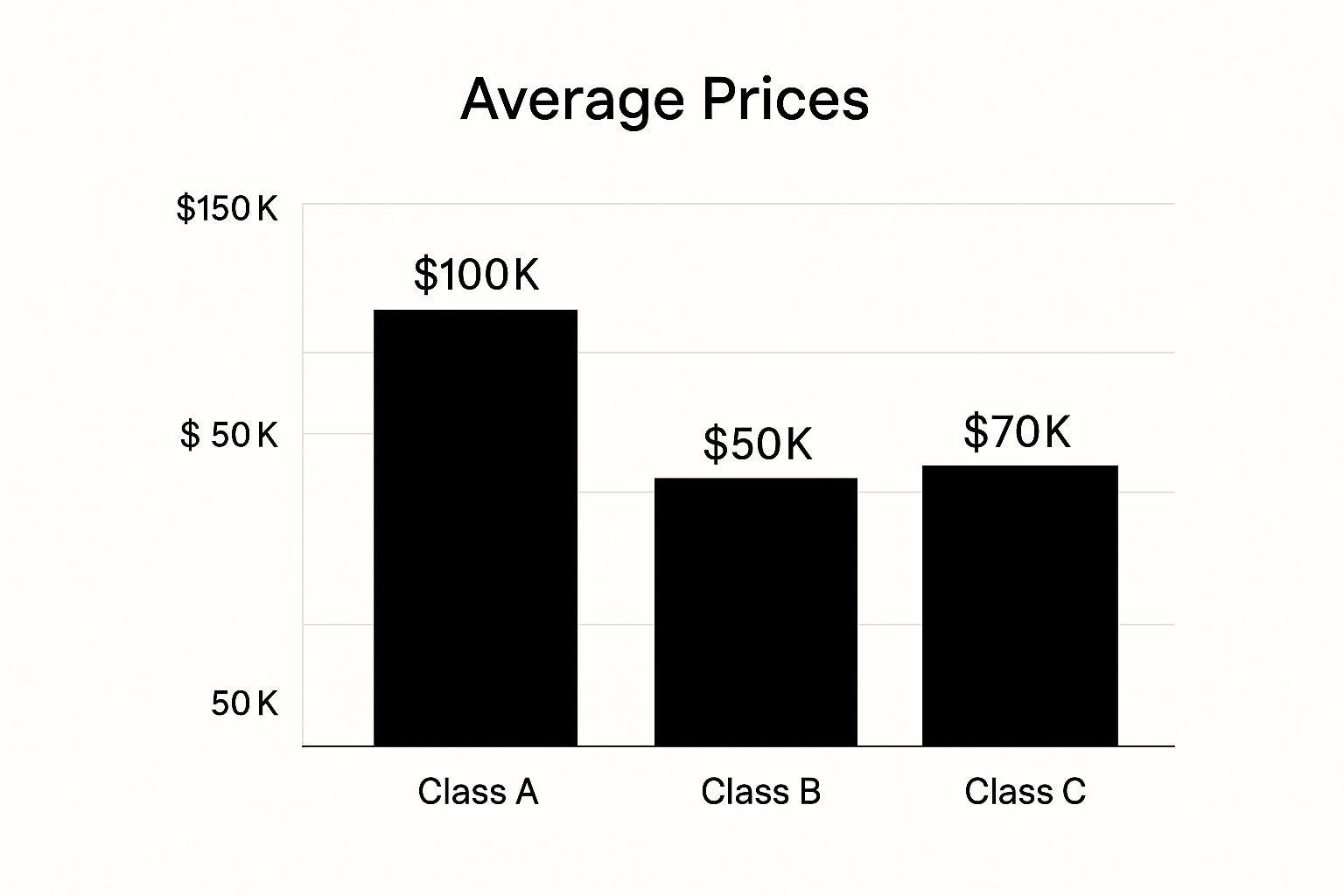
Doing this research does two things: it stops you from lowballing so much that the seller doesn't take you seriously, but it also prevents you from overpaying and leaving cash on the table. Knowing the going rate for different RV classes gives you a realistic starting point for the whole conversation. For instance, data from across Florida shows that the average purchase price for a used Class A motor home is around $140,250, while a Class C averages $75,500, and a Class B comes in near $95,750. This massive difference shows why you have to compare apples to apples.
Any issues you uncovered during your inspection can become powerful leverage. Here’s a quick look at how common findings can strengthen your negotiating position.
Common Florida Motor Home Issues and Negotiation Impact
Potential Issue
What to Look For
Negotiation Angle
Old Tires (5+ years)
Check the DOT date code on the sidewall. Look for cracks.
"These tires will need replacement soon for safety, which costs around $3,000. I'll need to factor that into my offer."
Water Damage/Leaks
Soft spots on the floor/ceiling, delamination on walls, musty smells.
"Repairing water damage is extensive and expensive. We'd need to reduce the price significantly to cover potential structural repairs."
Appliance Malfunctions
Test the fridge on both gas/electric. Run the A/C, furnace, and water heater.
"A new RV refrigerator can be $1,500+. Since this one isn't working on propane, the price needs to reflect that replacement cost."
Roof Sealant Condition
Cracked, peeling, or missing sealant around vents, seams, and A/C units.
"The roof needs to be resealed immediately to prevent leaks. That's a day's worth of labor and materials I have to account for."
Generator Issues
Struggles to start, runs rough, or won't power the coach.
"A generator repair or replacement is a major expense. Let's adjust the price to cover the cost of a professional service or potential replacement."
Remember, these aren't just nitpicks; they are real costs you will inherit the moment you sign the papers. Using them to guide the negotiation is just smart business.
How to Approach the Conversation
Private sellers and dealerships play the game differently, but your best strategy is always the same: stay calm, be logical, and let your research do the talking. The single most powerful tool you have, though, is your willingness to walk away. It's true. If the seller won't budge on a price that just doesn't make sense with the RV’s condition, you have to be ready to say, "Thank you for your time," and mean it.
Pro Tip: After you make a reasonable, well-supported offer, just get quiet. Don't feel the need to fill the silence. Let the seller be the next one to talk. You'd be amazed how often this simple pause encourages them to come back with a better number.
Also, don't get fixated only on the final price tag. If a dealer is firm on their number, start negotiating on value-adds. You might be surprised what they'll agree to.
Consider asking for things like:
A brand-new set of house batteries ($400-$800 value).
A full tank of fuel and propane.
Throwing in key accessories like a quality sewer hose, leveling blocks, or a surge protector.
Committing in writing to fix specific items you found during the inspection before you take delivery.
These items add real, tangible value and can make a deal feel much better, even if the price itself didn't move as much as you'd hoped. A successful negotiation is all about finding that win-win spot where both you and the seller feel good about the outcome.
Finalizing the Purchase and Taking the Keys
Getting the seller to agree on your price feels like the finish line, but hold on—the deal isn't truly done until the ink is dry and that title is legally in your name. This is the part where you officially make the motor home yours, and believe me, sweating the small stuff now can save you from gigantic headaches down the road.
The two pieces of paper you'll live and breathe during this process are the Bill of Sale and the Certificate of Title. Think of the Bill of Sale as your official receipt. It needs to have the final sale price, the date, the RV’s Vehicle Identification Number (VIN), and, of course, signatures from both you and the seller.
But the title? That's the holy grail. It’s the official, legal proof of ownership. Don't just give it a quick look; you need to inspect it like a detective. Make absolutely sure the VIN on the title is an exact match for the VIN on the RV itself. Even a single digit being off can stop you dead in your tracks at the DMV.
Securing a Clean Title and Proper Insurance
Before a single dollar leaves your pocket, you have to confirm the title is "clean." This is a crucial step. A clean title means there are no liens on it, which are basically legal claims from a lender because the seller still owes money. If there’s an outstanding loan, you can't become the new owner until that debt is settled and the lien is officially released. You can usually check for liens through the Florida Highway Safety and Motor Vehicles (FLHSMV) portal.
Never, ever accept just a Bill of Sale as proof of ownership for a motor home. Without a properly signed-over and lien-free title, you're not just buying an RV—you're buying a potentially massive legal problem.
Once you’re 100% sure the title is clear, it's time to line up your insurance. You can't legally drive that rig off the lot or out of the seller's driveway without it. Florida law is strict: you need proof of insurance to register any vehicle. A good tip is to get quotes while you're negotiating, and then you can activate the policy the moment you have a firm purchase date.
Here’s a quick checklist for the final handover:
Florida Title Transfer: Watch the seller sign the "Transfer of Title by Seller" section on the physical title.
Application for Title: You'll need to fill out an Application for Certificate of Title With/Without Registration, which is HSMV form 82040.
Final Walkthrough: Before you sign that last document, do one more quick walkthrough. Check that any repairs you agreed upon have been done and that everything is in the same condition as when you did your big inspection.
Following these last steps is what ensures your search for used motor homes for sale in florida ends successfully. You'll drive away with the keys in hand and, more importantly, a clear, legal title to your new home on wheels.
Got Questions About Buying a Used RV in Florida? You're Not Alone.
Jumping into the world of used RVs and boats can feel a little overwhelming, even when you've done your homework. A few common questions always seem to pop up, so let's tackle them head-on. Getting these answers sorted out will help you feel much more confident as you start looking at used motor homes for sale in Florida.
One of the first things people ask is, "Do I need a special license for this thing?" Good news—in Florida, you probably don't. For any motor home weighing less than 26,001 pounds, your standard Class E driver's license is all you need. That covers almost all the Class A, B, and C motor homes you'll come across.
Financing is another big one. Getting a loan for a used RV is absolutely possible, and it’s quite common. You'll find plenty of banks and credit unions that specialize in loans for recreational vehicles, including boats. Depending on the RV's age and value, they often offer terms for 10 or even 15 years, making the monthly payments more manageable.
Don't Get Tripped Up by the Paperwork
Let's talk about two critical pieces of the puzzle that can cause major headaches if you'm not careful: titles and insurance.
Getting this right from the start is non-negotiable.
Florida Insurance Basics: The state requires every registered motor home to have Personal Injury Protection (PIP) and Property Damage Liability (PDL) coverage. That's the legal minimum. Frankly, most owners get much more comprehensive coverage to protect their investment.
Confirming a Clean Title: Before a single dollar changes hands, you have to be sure the title is "clean," meaning it has no liens. A lien means a lender still has a claim on the RV. You can check the title's status yourself on the Florida Department of Highway Safety and Motor Vehicles (FLHSMV) portal.
I can't stress this enough: Do not buy an RV without getting a clean title, signed over to you by the seller, at the moment of sale. That piece of paper is your only proof of ownership.
Once you have the signed title and proof of insurance in hand, the final step is registering it in your name. You'll just need to take your paperwork to a local county tax collector's office. Once that's done, it's officially yours and you’re ready to hit the road.
Feeling ready to start the hunt? Head over to SearchShop.com, where our tools make it easy to sort through thousands of listings for both RVs and boats. You can filter by price, class, and location to find the perfect vehicle for your Florida adventures. Start your search today at https://www.searchshop.com.
SE
Written by
Searchshop Editorial Team
Vehicle research & buying-guide team
The Searchshop editorial team researches and writes buying guides, model reviews, and category roundups across RVs, boats, motorcycles, ATVs, autos, and snowmobiles. We combine hands-on product research, live dealer inventory data, and manufacturer specifications to help buyers make confident decisions.
Reviewed by Searchshop Review Board — credentialed industry professionals.